If, as in Troisi and Benigni’s film Nothing Left to Do but Cry (Non ci resta che piangere), you could travel back to Florence between the 15th and 16th centuries, you might meet Brunelleschi and Masaccio, Donatello and Michelangelo, Lorenzo the Magnificent and Savonarola in the streets of the Tuscan city.
Each of them played his part — architect, painter, sculptor, prince, preacher — helping to transform, without fully intending or realising it, this small city on the banks of the Arno into a masterpiece: the “Cradle of the Renaissance”. Florence, which until then had been a wealthy but relatively quiet city, became a new model for the “New Man” emerging from the Middle Ages.
Within just a few kilometres, thanks to enlightened rulers and brilliant artists, churches, palaces, museums and bridges began to rise.
In Florence’s workshops, works were painted that today enrich museums all over the world and would change the history of art forever.
There are so many things to visit in Florence that 10 were not enough, so we have added another 10 things to see in Florence.
All these masterpieces — in stone, canvas and marble — are perfectly preserved and there for everyone to see. Provided, of course, that you can make your way through the crowds of tourists.
Naturally, to truly enjoy them, it would be better not to do what the mass of visitors does and try to see Florence in just two or three days.
It can be done, but you need to plan in advance what to see and what to leave out.
Our advice is to choose in advance from the main places of interest listed on this page.
If you are looking for a hotel in Florence, we recommend choosing from the options available on Booking.com.
There are around 700 hotels in Florence, with prices, photos and reviews from previous guests. Go to Booking.com
Florence Cathedral, Giotto’s Bell Tower, the Baptistery and Brunelleschi’s Dome
1
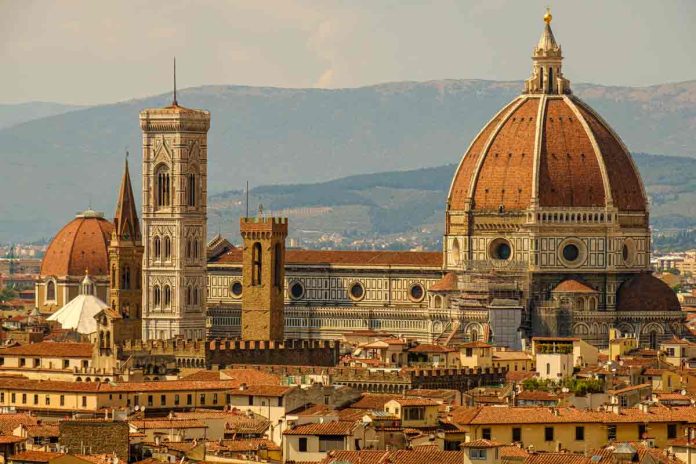
The first thing to see in Florence is undoubtedly Piazza del Duomo, one of the most beautiful architectural complexes in the world.
Here, Brunelleschi’s Dome dominates Florence, and even today there is no building in the city that rises higher.
The Bell Tower was designed by Giotto, although he did not live to see it completed.
The Baptistery is one of the oldest buildings in Florence and has stood here since the 4th century; with its magnificent doors, it is a true Bible in images.
The Cathedral, with its white and green marble façade, immediately captures the eye.
Nowhere else in the world is there a complex of buildings quite so extraordinary. We are in the heart of Florence, before Santa Maria del Fiore, known to everyone simply as the Duomo.

A cathedral 153 metres long, built over almost 170 years to rival the churches of Pisa and Siena.
The most important Florentine artists took part in the creation of this complex: from Giotto to Brunelleschi, from Vasari to Talenti, from Arnolfo di Cambio to Lorenzo Ghiberti.
Every visit to Florence begins here: heads tilted upwards, eyes full of wonder, asking how human beings could have created such a marvel.
Opening times and ticket prices for the Cathedral, Bell Tower, Dome and Baptistery
Cathedral: Monday to Saturday, 10.15 am-5.00 pm. Closed on Sundays and public holidays.
Brunelleschi’s Dome: Mon-Fri: 8.15 am-7.30 pm. Saturday 8.15 am-5.15 pm. Last admission 4.30 pm. Sundays and public holidays: 12.45 pm-5.15 pm. Last admission 4.30 pm.
Baptistery of San Giovanni: daily 9.00 am-7.30 pm. Closed for restoration from 17 October to 18 December 2022.
Giotto’s Bell Tower: daily 8.15 am-7.45 pm.
Ticket price:
Cathedral: free
Brunelleschi Pass (Dome, Bell Tower, Museum, Baptistery, Santa Reparata): full price €30, reduced €12 for ages 7 to 14, free for ages 0-7.
Ghiberti Pass (Museum, Baptistery, Santa Reparata): full price €15, reduced €5 for ages 7 to 14, free for ages 0-7.
How to get there: the complex is located in the historic centre of Florence. View on Google Maps.
Find out more about Cathedral Bell Tower Dome Baptistery
Ponte Vecchio in Florence
2
The most beautiful bridge in Florence, and one of the most photographed in the world, has not always been such a chic place.
Although today it is the goldsmiths’ shops that attract streams of visitors, until 1565 the bridge was dominated by greengrocers’ and butchers’ shops.
When the Vasari Corridor of the Uffizi, which passes above Ponte Vecchio, was built, the butchers and greengrocers were moved out in favour of goldsmiths and artisans, considered more suited to the beauty of the place.
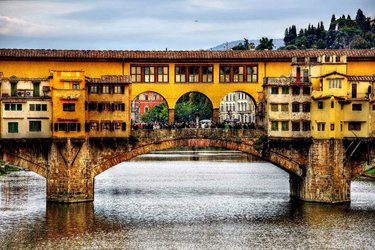
Since then, gold has become the defining feature of Ponte Vecchio, as the statue of Benvenuto Cellini, Florence’s greatest goldsmith, reminds us.
The Vasari Corridor
In 1565, Giorgio Vasari built the Vasari Corridor for Cosimo I de’ Medici, linking Palazzo Vecchio with Palazzo Pitti, then the private residence of the Medici family.
The corridor, around one kilometre long, starts from Palazzo Vecchio, passes through the Uffizi Gallery, then above the shops of Ponte Vecchio, before continuing on to Palazzo Pitti.
Along this route, there is certainly no shortage of things to do, see and buy. It is said that Hitler ordered Ponte Vecchio to be spared during the bombings of the Second World War. Sometimes beauty can illuminate even tyrants.
How to get there: view on Google Maps.
Find out more about Ponte Vecchio.Palazzo Vecchio in Florence
3
The first thing that strikes you about Palazzo Vecchio is how impossible it is to photograph it in its entirety.
Even if you move to the farthest side of Piazza della Signoria, at the corner with Via dei Calzaiuoli, you still will not manage to fit it all in.
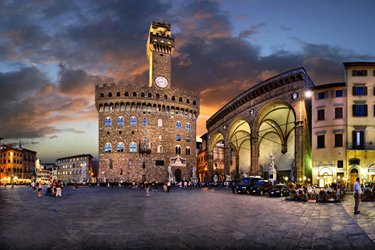
It is too large and too tall to fit into a single photograph. The point is that you cannot resist photographing it, since it is considered the finest example of 14th-century civic architecture in the world.
Arnolfo’s Tower
What prevents it from fitting fully into one shot is the “Torre di Arnolfo”, 94 metres high and built around 1310, with the great flag bearing the Florentine lily flying at its summit.
At the entrance to Palazzo Vecchio stands, in full view — and much appreciated by the pigeons — a copy of Michelangelo’s David.
This magnificent palace stands in Piazza della Signoria, a place that for a long time was considered “cursed”, as it was the battleground between Guelphs and Ghibellines.
Once the traces of a bloody past had been erased, Piazza della Signoria became the centre of social, civic and political life for all Florentines.
Opening times and ticket prices for Palazzo Vecchio
Opening times: Monday-Sunday: 9.00 am-7.00 pm; Thursday 9.00 am-2.00 pm. The tower closes at 5.00 pm and at 2.00 pm on Thursdays. Last admission: one hour before museum closing time.
Ticket price: admission must be booked at info@musefirenze.it or by calling +39 055 2768224.
Palazzo Vecchio Museums: full price €12.50, €10 for 18-25-year-olds and university students, free for ages 0-18.
Arnolfo’s Tower: full price €12.50, €10 for 18-25-year-olds and university students, free for ages 0-18.
How to get there: the palace is located in the historic centre of Florence.
The Uffizi Gallery
4
A Caravaggio comes in, a Raphael goes out. A Titian leaves for an exhibition abroad, while the famous angels by Rosso Fiorentino return. This is the Uffizi: a kind of art supermarket, a treasure chest of masterpieces from every century and a dream destination for art lovers from all over the world.

Indeed, it is striking to see the long queue of foreign visitors patiently waiting their turn to enter, while many Italians, despite having the chance, have never been to the Uffizi.
There is certainly plenty to see: think of the first famous painting that comes to mind, and it is probably here.
The journey begins with the 14th-century room and the three altarpieces by Cimabue, Duccio di Buoninsegna and Giotto, all depicting the “Madonna Enthroned with Child”.
Then comes a crescendo of beauty: Botticelli, Leonardo, Signorelli, Perugino, Dürer, Caravaggio and then more, and more, and more…
Set aside a full day for the visit, wear a comfortable pair of shoes, and then simply enjoy the spectacle.
The Uffizi are very crowded and the queue outside can be exhausting.
Opening times and tickets for the Uffizi in Florence
Opening times: Tuesday to Sunday, 8.15 am-6.30 pm. Last admission 5.30 pm. Closed on Mondays.
Ticket price: full price €20. Reduced €2 for ages 18-25. Free up to age 18 with identity document. The ticket also includes free admission to the National Archaeological Museum and the Opificio delle Pietre Dure Museum.
How to get there: the museum is located in the historic centre of Florence. View on Google Maps.
Brancacci Chapel in Florence
5
Although it does not always appear on lists of attractions to visit in Florence, the Brancacci Chapel is in fact an unmissable place.
An angel with a sword chases Adam and Eve out of Paradise.
Adam covers his face with his hand, weeping and hiding in shame.
Eve’s expression is disfigured by grief, fully visible because her arms are busy covering her breast.

It is a heartbreaking scene, one of the highest points in the history of art, and it can be found in the Brancacci Chapel in Florence, inside the Church of Santa Maria del Carmine.
Masolino and Masaccio, old and young, master and pupil, frescoed this chapel together at the request of Felice Brancacci.
It is not easy to distinguish the frescoes of one from those of the other.
The patron Brancacci obliged them to work on the same walls, to prevent the differences in style from becoming too obvious.
The result is an extraordinary pictorial journey, recounting the story of sin and other episodes from the Bible and the Gospel, leaving believers and non-believers alike astonished.
Opening times and ticket prices for the Brancacci Chapel
Opening times: Monday, Friday and Saturday 10.00 am-5.00 pm. Sunday 1.00 pm-5.00 pm. Closed Tuesday, Wednesday and Thursday. The ticket office closes 45 minutes earlier. Maximum admission: 30 people every 20 minutes.
Ticket price: full price €10, €7 for ages 18-25 and university students, free up to age 18. Booking is compulsory at http://bigliettimusei.comune.fi.it/4_cappella-brancacci/
How to get there: the chapel is located in Piazza del Carmine 14, in central Florence.
The Basilica of Santa Croce in Florence
6
Michelangelo’s tomb, “protected” by three sculptures representing Painting, Sculpture and Architecture, shares the opening section of the Basilica of Santa Croce with the tomb of Galileo Galilei, placed directly opposite.

Immediately after Michelangelo is the cenotaph of Dante, though not his remains, which were left in Ravenna, where he died in exile.
Then come Vittorio Alfieri, Antonio Canova, Niccolò Machiavelli, Gioachino Rossini and Ugo Foscolo, who in his lifetime described Santa Croce as the place that preserved the “Urne dei Forti” — the tombs of Italy’s great figures.
But Santa Croce is not merely a “collection” of the remains of Italians who shaped history. At the far end of the basilica are the chapels frescoed by Giotto with scenes from the Life of Saint Francis.
In the Pazzi Chapel, where Giuliano de’ Medici was killed and Lorenzo the Magnificent wounded during the famous conspiracy, the Crucifix by Cimabue is preserved.
Opening times and ticket prices for the Basilica of Santa Croce
Opening times: Monday to Saturday, 9.30 am-5.30 pm. Sundays and public holidays from 12.30 pm to 5.45 pm. Last admission at 5.00 pm.
Ticket price: full price €8, €6 for ages 12-17 and university students, free for ages 0-11. Family ticket €8: free for underage children, paid admission for accompanying parents.
How to get there: the basilica is located in Piazza Santa Croce 16, in central Florence.
Church of Santa Maria Novella
7
It was simply unthinkable that the churches of Santo Spirito and Santa Croce, belonging respectively to the Augustinian and Franciscan friars, should be the most beautiful and majestic churches in Florence.
So, in 1278, the Dominican friars began construction of the Church of Santa Maria Novella, which became a magnificent example of “Tuscan Romanesque”, thanks to its use of white, black and green marble.

The interior of Santa Maria Novella contains some of the most important works in Italian art. First of all, the Crucifix by Giotto, which hangs from the central vault.
It is a work by the young Giotto, yet it already reveals the extraordinary artist he was to become.
In the Strozzi and Tornabuoni chapels are two fresco cycles: one by Filippino Lippi and the other by Ghirlandaio, in which the patrons of the work are also portrayed.
Brunelleschi’s Crucifix and Masaccio’s Trinity
In the Gondi Chapel, meanwhile, is the Crucifix by Brunelleschi, the artist’s only work in wood.
The masterpiece of Santa Maria Novella is Masaccio’s revolutionary Trinity. The vault creates an extraordinary effect, placing Jesus, the Virgin Mary and Saint John in a three-dimensional space. Mary does not look at the dying Christ, as she does in most works on this subject, but points towards the viewer.
Opening times and ticket prices for the Church of Santa Maria Novella
Opening times: Monday to Thursday and Saturday, 9.30 am-5.30 pm; Friday 11.00 am-5.30 pm; Sunday 12.00 noon-5.30 pm.
Ticket price: full price €7.50, €5 for ages 11-18. Free for ages 0-11.
How to get there: the church is located in Piazza Santa Maria Novella, just a short walk from the station.
Official website of the Opera di Santa Maria Novella7
It was simply unthinkable that the churches of Santo Spirito and Santa Croce, belonging respectively to the Augustinian and Franciscan friars, should be the most beautiful and majestic churches in Florence.
So, in 1278, the Dominican friars began construction of the Church of Santa Maria Novella, which became a magnificent example of “Tuscan Romanesque”, thanks to its use of white, black and green marble.
The interior of Santa Maria Novella contains some of the most important works in Italian art. First of all, the Crucifix by Giotto, which hangs from the central vault.
It is a work by the young Giotto, yet it already reveals the extraordinary artist he was to become.
In the Strozzi and Tornabuoni chapels are two fresco cycles: one by Filippino Lippi and the other by Ghirlandaio, in which the patrons of the work are also portrayed.
Brunelleschi’s Crucifix and Masaccio’s Trinity
In the Gondi Chapel, meanwhile, is the Crucifix by Brunelleschi, the artist’s only work in wood.
The masterpiece of Santa Maria Novella is Masaccio’s revolutionary Trinity. The vault creates an extraordinary effect, placing Jesus, the Virgin Mary and Saint John in a three-dimensional space. Mary does not look at the dying Christ, as she does in most works on this subject, but points towards the viewer.
Opening times and ticket prices for the Church of Santa Maria Novella
Opening times: Monday to Thursday and Saturday, 9.30 am-5.30 pm; Friday 11.00 am-5.30 pm; Sunday 12.00 noon-5.30 pm.
Ticket price: full price €7.50, €5 for ages 11-18. Free for ages 0-11.
How to get there: the church is located in Piazza Santa Maria Novella, just a short walk from the station.
Galleria dell’Accademia in Florence
8
In 1784, the Galleria dell’Accademia was created at the request of Grand Duke Pietro Leopoldo, to introduce students of the nearby Academy of Fine Arts to the great examples of Florentine art.
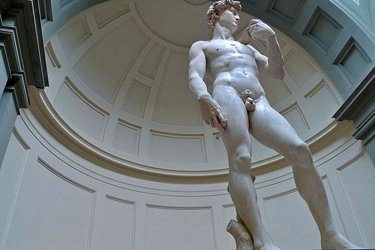
Also known as the Museum of Michelangelo, thanks to the abundance of works by the Florentine genius, the Galleria dell’Accademia today also houses sculptures by other artists and paintings dating from the 14th to the 16th century.
Michelangelo’s David
The most important work in the gallery, and an absolute must-see, is without doubt Michelangelo’s David, which once stood exposed to wind and cold in Piazza della Signoria, where it has now been replaced by a copy.
David is sculpted at the very moment when he is about to begin his fight with Goliath.
This statue, which Michelangelo carved from a very fragile block of marble, has symbolised since the 1500s the victory of intelligence and courage over the brute strength of the giant Goliath.
Opening times and tickets for the Galleria dell’Accademia in Florence
Opening times: Tuesday to Sunday, from 8.15 am to 6.50 pm. Last admission 6.20 pm. Closed on Mondays.
Ticket price: full price €12, €2 for ages 18-25. Free up to age 18.
How to get there: the gallery is located in Via Ricasoli, in the centre of Florence.
Palazzo Pitti in Florence
9
An illustrious building, once the residence of the Grand Dukes of Tuscany and the Kings of Italy, Palazzo Pitti is today an important complex of galleries and museums.
It magnificently preserves important collections of paintings and sculptures, art objects and porcelain.
The complex includes the Palatine Gallery and the Gallery of Modern Art.
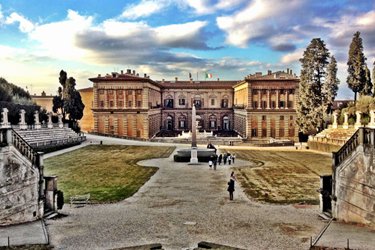
Connected to Palazzo Pitti are the Boboli Gardens, where Florentines love to spend their free time, finding a little peace and escaping the summer heat while surrounded by the glory and grandeur of the Medici family.
The Boboli Gardens
Boboli, in fact, preserves works and structures that bear witness to the taste and magnificence of this family, which was the sole owner of this wonderful green space.
In the mid-18th century, the Habsburg-Lorraine family took over, also great lovers of art.
Opening times and ticket prices for Palazzo Pitti
Opening times: Tuesday to Sunday, from 8.15 am to 6.30 pm. Last admission 5.30 pm. Closed on Mondays.
The Treasury of the Grand Dukes is open on Tuesdays and Fridays from 4.00 pm to 5.00 pm for a maximum of 10 people at a time, accompanied by museum staff.
Ticket price: full price €16, combined Pitti + Boboli ticket €22. €2 for ages 18-25. Free up to age 18. The ticket includes the Palatine Gallery, Gallery of Modern Art and Treasury of the Grand Dukes.
How to get there: the palace is located in Piazza Pitti. On foot through the historic centre, after Ponte Vecchio.
Find out more about Palazzo Pitti.Palatine Gallery in Florence
10
On the first floor of Palazzo Pitti, where some of the most beautiful and fascinating rooms are found, is the Palatine Gallery.
Some rooms are dedicated to sculpture and take their names from the magnificent frescoes that decorate their vaults.
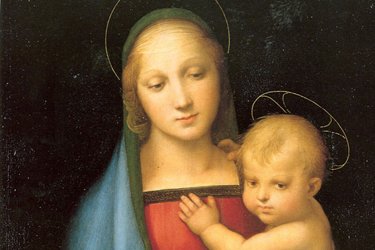
The fresco cycle is inspired by Greco-Roman mythology and the Medici dynasty.
The evocative frescoes in the first five rooms were painted by the most renowned artist of the time, Pietro da Cortona, while the others were created by various neoclassical artists of the first half of the 19th century.
The picture gallery brings together masterpieces by Raphael, Titian, Caravaggio, Rubens, Signorelli, Lippi, Van Dyck, Veronese and many others.
Opening times and ticket prices for the Palatine Gallery
Opening times: Tuesday to Sunday, from 8.15 am to 6.30 pm. Last admission 5.30 pm. Closed on Mondays.
Ticket price: full price €16, combined Pitti + Boboli ticket €22. €2 for ages 18-25. Free up to age 18. The ticket includes the Palatine Gallery, Gallery of Modern Art and Treasury of the Grand Dukes.
How to get there: the palace is located in Piazza Pitti. On foot through the historic centre, after Ponte Vecchio.
Find out more about the Palatine GalleryGallery of Modern Art in Florence
11
Go up just one floor and enter the Gallery of Modern Art: here, in 30 rooms, works are gathered that range from the late 18th century to the early 20th century.

The works are largely by Italian artists, with a rich collection of paintings by the Macchiaioli from the Diego Martelli collection.
There are paintings by Giovanni Fattori, Silvestro Lega and Telemaco Signorini. There is also a significant presence of artists linked to Futurism, such as De Pisis, Morandi, Donghi, Balla and Marinetti.
Among the sculptures not to be missed are Calliope by Canova and Psyche by Pietro Tenerani.
Opening times and ticket prices for the Gallery of Modern Art
Opening times: Tuesday to Sunday, from 8.15 am to 6.30 pm. Last admission 5.30 pm. Closed on Mondays.
Ticket price: full price €16, combined Pitti + Boboli ticket €22. €2 for ages 18-25. Free up to age 18. The ticket includes the Palatine Gallery, Gallery of Modern Art and Treasury of the Grand Dukes.
How to get there: the palace is located in Piazza Pitti. On foot through the historic centre, after Ponte Vecchio.
Church of San Lorenzo and the Medici Chapels
12
Overshadowed in fame and beauty by the Cathedral of Santa Maria del Fiore, the Church of San Lorenzo has nevertheless earned a special place in the hearts of millions of visitors. It is one of the oldest churches in Florence and served as the city’s cathedral for 300 years.

Favoured by the Medici, who used it as their family parish church, it was enlarged from 1419 onwards, when the task was entrusted to Filippo Brunelleschi, who transformed it into a true masterpiece.
The Old Sacristy
To his genius we owe the Old Sacristy, where Brunelleschi’s brilliance was joined by that of Donatello.
Still within the Basilica of San Lorenzo, but accessed from outside, is the New Sacristy with the Medici Chapels, which contain the tombs of 50 members of the noble Florentine family.
The New Sacristy
The New Sacristy is the result of Michelangelo’s genius. He began work on it in 1520 and continued for around 14 years, with repeated interruptions, until his departure for Rome, where he was called to work on the dome of St Peter’s.
Here are the tombs of Lorenzo the Magnificent and Giuliano de’ Medici, adorned with the Madonna and Child, an autograph work by Michelangelo.
The nearby tombs of Lorenzo, Duke of Urbino, and Giuliano, Duke of Nemours, are enriched by Michelangelo’s allegories of Day and Night.
Opening times and ticket prices for the Medici Chapels
Opening times:
Saturday, second and fourth Sunday of the month, Monday: 8.15 am-1.50 pm
Wednesday to Friday: 1.15 pm-6.50 pm. Closed on Tuesdays and on the other Sundays of the month.
Ticket price: full price €9, €2 for ages 18-25. Free up to age 18.
How to get there: the church with the Medici Chapels is located in Piazza di Madonna degli Aldobrandini 6, in central Florence.
Find out more about the Basilica of San Lorenzo Find out more about the Medici ChapelsChurch of San Lorenzo and the Medici Chapels
13
The Church of Santo Spirito is one of the most important religious monuments in Florence, although it is less well known than the city’s other churches.
Its fame is due above all to the Sacristy, a small and precious jewel of the Renaissance, where Michelangelo lived for a short period of time.

It seems, in fact, that the Florentine genius, with the help of the Medici, lived at Santo Spirito after the death of his father and that, as a sign of gratitude, he gave the church a crucifix he had made when he was only 17 years old.
The attribution of the work is periodically questioned, although by now almost everyone accepts the idea that it is by the Florentine genius.
The Sacristy, preceded by a vestibule built by Sansovino and inspired by the Roman Pantheon, was begun by Giuliano da Sangallo and completed by Antonio del Pollaiolo.
On the altar of the transept is one of the basilica’s most important works: the Madonna and Child with the Young Saint John, Saint Martin and Saint Catherine the Martyr by Filippino Lippi.
In the small square in front of the church is the Cenacolo di Santo Spirito, decorated with a grand fresco by Andrea Orcagna depicting the Crucifixion and the Last Supper of Christ.
Opening times and ticket prices for the Church of Santo Spirito
Opening times: Monday to Saturday 10.00 am-1.00 pm and 3.00 pm-6.00 pm. Sundays and public holidays 11.30 am-1.30 pm and 3.00 pm-6.00 pm. Closed on Wednesdays.
Ticket price: entrance to the basilica is free; €2 single ticket for the museum route.
How to get there: the basilica is located in Piazza di Santo Spirito 30, on the left bank of the Arno.
Find out more about the Church of Santo SpiritoThe Church of Dante and Beatrice in Florence
14
It cannot have been easy to remain apart. Dante lived barely 20 metres away; his house is still there and can be visited every day.
Beatrice, meanwhile, attended Mass in the small church where members of her family, the Portinari, were buried, as were members of the family of Gemma Donati, Dante’s wife.

They would cross paths along the narrow street, or inside this tiny church, and that is all their love was ever granted.
The church is actually called Santa Margherita dei Cerchi, but to everyone it is the church of Dante and Beatrice.
A rather unattractive painting hanging on one of the walls recalls their first fleeting meeting of eyes, the moment when Dante fell in love with Beatrice.
But it is the little notes left on her tomb — Please, make him come back to me; Help me, I don’t want to lose him — that make this place a symbol for all lovers, especially those who spend their lives never quite reaching one another.
One of the curiosities to see in Florence, as well as one of Italy’s unmissable attractions for literature lovers and incurable romantics.
Opening times and ticket price for the Church of Dante and Beatrice
Opening times: every day.
Ticket price: free.
How to get there: from Via dei Calzaiuoli, follow the signs for Dante’s House.
Bargello National Museum
15
Palazzo del Bargello is one of the oldest public buildings in Florence and was built to provide a worthy seat for the Captain of the People.
This structure has been the scene of numerous conflicts: popular uprisings, fires and natural disasters, which caused serious damage to the palace, as well as clashes between Papacy and Empire and between Guelphs and Ghibellines.
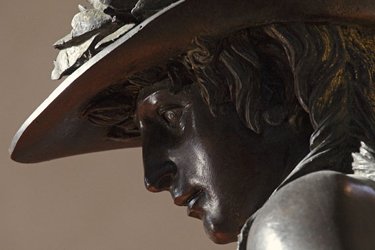
In short, we certainly cannot say that this was a particularly peaceful place: from 1574, Palazzo del Bargello became the city prison and took its name from the Bargello, the chief of the guards, who, with the help of his officers, questioned and arrested criminals.
The most famous work in this museum is Donatello’s David: the statue, open to several interpretations, may represent either the biblical hero or Mercury, the Roman god.
Donatello’s David
Take your time with his expression: it is a mixture of pride and mischief, typically adolescent.
David has the eyes of someone who knows he has accomplished great deeds and is proud of them.
Opening times and ticket prices for the Bargello National Museum
Opening times: every day from 8.15 am to 1.50 pm. Closed on Tuesdays and on the second and fourth Sunday of the month. Last admission at 1.00 pm.
Ticket price: full price €9, €2 for ages 18-25, free for ages 0-18.
How to get there: the museum is located in Via del Proconsolo 4, between the Duomo and Santa Croce.
Archaeological Museum of Florence
16
We recommend the Archaeological Museum of Florence because it houses one of the most important collections of Etruscan art in the world, though there is much more besides.
This museum brings together the finest finds from excavations throughout Tuscany, with Etruscan and Roman artefacts, as well as objects from all the Mediterranean peoples who passed through this region.

In the Gallery of Bronzes, three splendid Etruscan bronzes are displayed: the famous Chimera wounded by Bellerophon, the statue of Minerva and the Arringatore, a funerary monument from the 3rd century.
A journey into the past that fascinates and inspires the imagination, thanks also to the remarkable Egyptian collections, the richest in Italy after those of Turin.
Opening times and ticket prices for the Archaeological Museum
Opening times:
Monday to Wednesday, Saturday and Sunday 8.30 am-2.00 pm
Thursday and Friday 1.30 pm-7.00 pm
Ticket price: full price €8, €2 for ages 18-25, free for ages 0-18.
How to get there: the museum is located in Piazza della Santissima Annunziata, in central Florence.
Piazzale Michelangelo in Florence
17
If you have ever seen a panoramic view of Florence, the photo was probably taken from Piazzale Michelangelo.
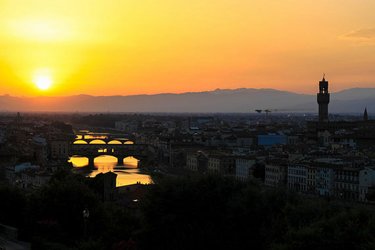
The problem is that you are not the only one to have seen it: quite a few other people will also be trying, just like you, to secure a spot from which to enjoy the whole of Florence in a single glance.
You will therefore have to contend with Japanese, German, American and Korean visitors, vendors of every possible kind — but it is honestly worth it.
Only at night can you enjoy the view in real peace, although the best moment is still sunset.
Dawn is spectacular too, and there are far fewer people. Provided you can find the strength…
Opening times and ticket price for Piazzale Michelangelo
Opening times: always open.
Ticket price: free.
How to get there: the square is about 4 km from the centre of Florence and can be reached by buses no. 12 and 13.
San Miniato al Monte in Florence
18If you have not managed to secure a panoramic spot at Piazzale Michelangelo, do not lose heart.

Continue on foot for another 400 metres, because nearby you will find San Miniato al Monte, which, besides being a beautiful church, offers an equally magnificent view, but with far fewer crowds.
San Miniato was the first martyr of Florence and, according to tradition, after being beheaded for being Christian, he picked up his head under his arm and walked to the place where the church now stands.
The façade of San Miniato is a masterpiece of Tuscan Romanesque, and the interior, with its mosaics, is just as precious.
Opening times and ticket price for San Miniato al Monte
Opening times: Monday to Saturday 9.30 am-1.00 pm and 3.00 pm-7.00 pm. Sunday 8.15 am-1.00 pm and 3.00 pm-7.00 pm.
Ticket price: free.
How to get there: from Santa Maria Novella Station, take bus number 12 to Piazzale Michelangelo.
The Boboli Gardens and Le Cascine
19
The Boboli Gardens are one of the most important examples of an Italian garden. A centuries-old place, embellished by all the rulers of Tuscany, Boboli is much loved by Florentines, who come here to run, stroll, enjoy a little greenery and attend events that make the garden one of Florence’s main open-air venues.
The garden is part of the Palazzo Pitti complex. For more information, visit the page dedicated to the Boboli Gardens.
The same cannot be said of the Cascine, another historic green space in Florence which, in recent years, has unfortunately become a park best avoided, especially in the evening.
What to Eat in Florence
20
Famous for its steak, Florence’s traditional cuisine has much more to offer: simple, authentic dishes born from the ingenuity of ordinary people, who turned humble, essential ingredients such as bread, olive oil and vegetables into extraordinary recipes.
A meal usually begins with a selection of cured meats, accompanied by crostini topped with chicken liver pâté or a fettunta (grilled bread with olive oil and salt).
Among the first courses, two true local classics are pappa al pomodoro and ribollita.
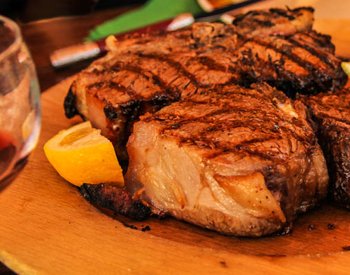
The undisputed queen of main courses is the famous bistecca alla fiorentina, even if not everyone fully appreciates it at first sight.
Florentines are keen to point out that it should weigh no less than 1.2 kg and must be served rare — very rare indeed!
Other standout main dishes include trippa and lampredotto, while beans are a classic side dish.
And of course, steak calls for red wine, and Tuscany certainly knows a thing or two about that: Chianti, Brunello and Montepulciano are the great stars of the table.
As for where to eat in Florence, our advice is to steer clear of the tourist traps concentrated in the historic centre.
Just move a little away from the busiest areas and you will find trattorias and restaurants serving excellent Florentine cuisine, without making your credit card cry.
Where to Stay in Florence
H
Subject to a constant influx of foreign tourists and Italian school groups, Florence is a city organised almost entirely around tourism.
This means that the choice of hotels, B&Bs, guesthouses and rooms is truly exceptional, but also that you will need to make a little effort, be flexible and book in advance to find somewhere to stay with a good balance between price and room quality.

We recommend first planning your itinerary carefully, deciding what you want to see, and only then choosing the area where to book your hotel.
In the historic centre there is no shortage of rooms in B&Bs and small 3-star hotels, with an average nightly price of around €100.
By moving just outside the centre, still easily reachable on foot, you can save a little or find better hospitality.
If you are looking for a hotel in Florence, we recommend choosing from the options available on Booking.com. There are around 700 hotels in Florence, with prices, photos and reviews from previous guests. Go to Booking.com