The Learned, the Red, the Fat: this is how Bologna, capital of wealthy Emilia-Romagna, is often described.
The Learned because it is home to one of the oldest universities in Italy, which still attracts Italian and international students today and continues to play its role as a lively cultural centre.
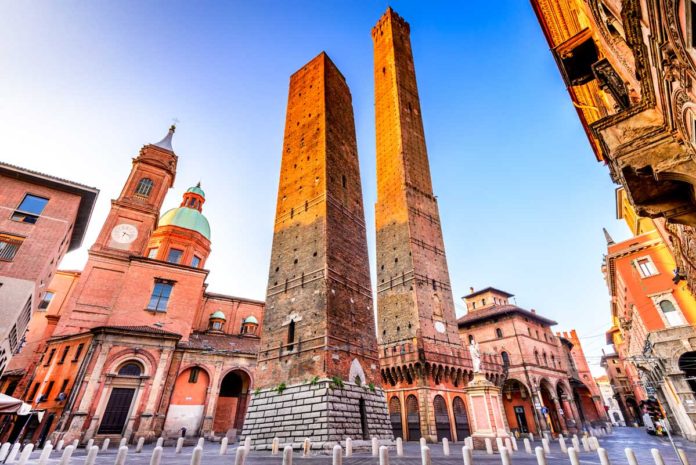
Bologna the Red because of the colour that its roofs and houses give to the city, keeping alive the typical shades of the medieval period.
Bologna the Fat because of its delicious and sublime food: Bolognese cuisine is known all over the world and has won over even the most demanding palates.
Of course, Bologna is much more than this. It also has extraordinary spiritual places, such as the church of San Luca, reached by walking through 6 km of porticoes, or the scenic and beautiful Complex of the Seven Churches, and the church of Santa Maria with its extraordinary “Lamentation“.
Most of the places of interest are located in Bologna’s city centre, so there is no need to get around by car or public transport.
In short, it is one of Italy’s most beautiful cities and it is easy to visit. If you are travelling as a family with children, this guide suggests 9 attractions to spark their curiosity by combining culture and fun.
On this page we recommend what to do and see in Bologna on a 1, 2 or 3-day itinerary.
If, on the other hand, you are looking for a hotel in Bologna, we recommend choosing from those offered by Booking.com. There are about 120 hotels with prices, photos and reviews from guests who have stayed there before you. Go to Booking.com
Piazza Maggiore in Bologna
1
The beating heart of the city, Piazza Maggiore (or Piazza Grande, as the people of Bologna call it and as Lucio Dalla sang) is the centre of Bologna’s civic and religious life.
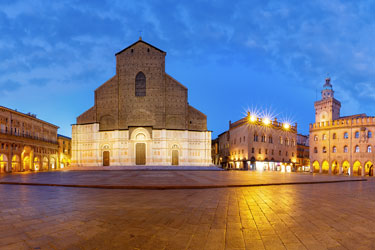
It is famous for the Fountain of Neptune, overlooked by the most important buildings of the medieval city:
to the west, the 14th-century Palazzo Comunale with the Clock Tower and the Sala Borsa; to the east, the 16th-century Palazzo dei Banchi;
to the south, the imposing Basilica of San Petronio, opposite the elegant Palazzo del Podestà.
All these buildings bear witness to the history of the city, a history that began in the 13th century, when the people felt the need to equip Bologna with a space to be used as a market.
All the buildings that stood there were purchased by the Municipality and then demolished, and it was only in the 15th century that Piazza Maggiore took on the austere appearance it still has today.
Despite its historical importance, it seems that the square brings “bad luck” to students attending the famous University of Bologna.
According to legend, you should never cross the square through the middle, but always walk around the edge, otherwise you can say “goodbye” to that much-coveted degree.
Palazzo D'Accursio, the Clock Tower and Sala Borsa
2
The Clock Tower immediately identifies Palazzo D’Accursio, the seat of Bologna City Council.
Since 1336, Bologna’s political power has been exercised in the frescoed halls of this beautiful palace. It takes its name from the jurist Accursius, whose birthplace stood here and which, century after century, became the building we see today.
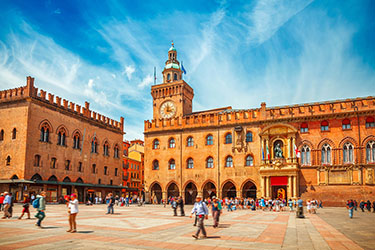
After climbing the grand staircase designed by Bramante, which allowed rulers to enter on horseback, you should visit the Sala d’Ercole, the City Council Hall, the Sala Farnese, the Farnese Chapel, the Sala Rossa and the Sala Urbana.
Finally open to the public is the Torre Accursi, or Clock Tower: you can climb to the top, discover the mechanism that regulates the clock and, with the same ticket, also visit the Municipal Art Collections on the top floor.
On your way out, do not miss the Madonna di Piazza with Child, a terracotta work by Nicolò dell’Arca — the artist behind the Lamentation in Santa Maria — created around 1478.
To the right of the Palazzo Comunale, where the Orto dei Semplici once stood, today you will find the Sala Borsa Library, or “Covered Square”, dedicated to Umberto Eco.
Here, where the Bologna Stock Exchange stood from 1880 to 1990, there is now a wonderful multimedia library where students from Bologna’s universities meet — and not only to study.
Opening times and ticket price for Palazzo D’Accursio
Palace opening times: variable opening times, ask the attendants.
Sala Borsa opening times:
Monday 2.30 pm – 8 pm
Tuesday to Friday 10 am – 8 pm
Saturday 10 am – 7 pm
Ticket price: Palace free of charge.
Tower + Municipal Collections: €8
How to get there: on foot in Piazza Maggiore.
Basilica of San Petronio in Bologna
3
The Basilica of San Petronio is Bologna’s most important and imposing church, as well as the fifth largest church in the world.
Construction work on the Basilica began in 1390 but continued for centuries.
To make room for this temple, a symbol of the city’s civic pride, towers, private homes and no fewer than eight churches had to be demolished.

It is the last great Gothic work built in Italy, with a Latin cross plan, three naves and chapels.
Do not miss the Bolognini Chapel, frescoed with the Stories of the Magi, the Last Judgement, Paradise and, below, Hell, with an extraordinary and gigantic figure of Lucifer and the representation of the Prophet Muhammad in Hell.
For a long time, the Basilica of San Petronio belonged to the Municipality, which used it for the most varied purposes: a place for ceremonies, a courthouse and a public meeting place; only in 1929, following the Lateran Pacts, did it become the property of the Diocese.
If you visit the Basilica of San Petronio, you cannot fail to notice the Meridian Line built by Cassini to demonstrate that the Earth revolved around the Sun, and not vice versa as was believed at the time.
Do not miss the climb up to the new panoramic terrace, from which you can admire Bologna’s rooftops and monuments from a height of 54 metres.
Luckily, there is a lift! The Basilica also includes a small museum with just a few rooms, telling the story of the construction of San Petronio and displaying sacred objects from the basilica.
Opening times and ticket price for the Basilica of San Petronio in Bologna
Basilica opening times: every day from 8.30 am to 1.00 pm and from 3.00 pm to 6.00 pm.
The terrace can be visited only on Saturday and Sunday, 10 am-1 pm and 3 pm-6 pm. The Chapel of the Magi can be visited every day, 10 am-1 pm and 3 pm-6 pm. Museum open Tuesday to Saturday from 10.00 am to 12.30 pm and from 2.30 pm to 5.30 pm. Sunday: from 2.30 pm to 5.30 pm
Ticket price: entrance to the church and museum is free. Terrace entrance €5. Visit to the Chapel of the Magi €3.
How to get there: on foot in the historic centre.
The Asinelli Tower in Bologna
4
The towers of Bologna are one of the city’s most distinctive features.
Of the many towers built between the 12th and 13th centuries, fewer than twenty remain today. These structures had both a military and aristocratic function: they brought prestige to the family that commissioned them.
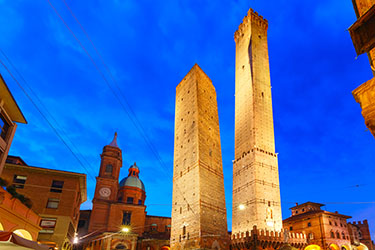
The two most important towers are the Asinelli and the Garisenda.
The Asinelli Tower was built between 1109 and 1119 by the family of the same name, who not only gained social prestige from it but also used it for military defence and lookout purposes.
In 1448, in fact, the tower was fitted with a small fortress to house the guards.
Today, the arches of the small fortress portico house a number of craft shops, recalling the commercial role played by the city in the Middle Ages.
Visitors, after climbing the 498 steps of the internal staircase, can reach the top of the Asinelli Tower which, at 97.20 metres high, places the red city at their feet.
On clear days, the view can stretch as far as the sea and the Venetian Prealps. The Garisenda Tower is lower at 47 metres and cannot be visited.
Opening times and ticket price for the Asinelli Tower
Opening times: every day, with four admissions per hour: at 00, 15, 30 and 45 minutes past the hour.
First admission at 10 am, last at 6.15 pm.
Ticket price: full price €5, reduced €3.
How to get there: on foot in the historic centre.
The Basilica of Santo Stefano in Bologna
5
The Basilica of Santo Stefano is a group of sacred buildings forming the famous complex known as the Seven Churches.
The triangular Piazza Santo Stefano, recently restored to its original appearance, is home to the Church of the Crucifix, the Basilica of the Sepulchre, the Church of Saints Vitale and Agricola, Pilate’s Courtyard, the Church of the Martyrium, the Medieval Cloister and the Museum of Santo Stefano.

These are all very ancient buildings which, although they date from different periods, retain a certain stylistic harmony, making the complex Bologna’s most interesting and best-preserved Romanesque monument.
It is likely that the original design of the complex dates back to the 5th century, when Bishop Petronius, after a journey to the Holy Land, wanted to reproduce the holy places of Jerusalem in the Emilian capital.
Over the years, alterations and restorations changed the complex’s ancient appearance, eventually reducing the original seven churches to four.
Opening times and ticket price for the Basilica of Santo Stefano
Monument opening times: from 9.30 am to 12.30 pm and from 2.30 pm to 7.00 pm
Basilica opening times: from 7.30 am to 12.30 pm and from 2.30 pm to 7.30 pm.
Ticket price: voluntary donation
How to get there: on foot in the historic centre.
BOLOGNA WITH CHILDREN
The Archiginnasio
6
The Archiginnasio is Bologna’s most beautiful palace and certainly one of the finest in Italy.
Tourists in a hurry usually pass in front of the entrance doorway, casting only a distracted glance at the central portico.
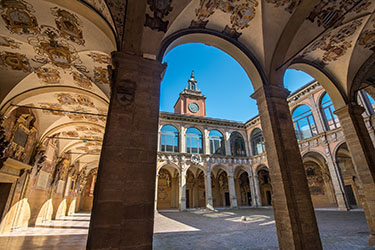
And yet it takes only a few steps to be amazed by a long portico with 30 arches decorated with hundreds of coats of arms and two loggias on the upper floors.
The Archiginnasio was commissioned in 1563 by Cardinal Carlo Borromeo.
The aim was to give the University of Bologna, the oldest in the world, a single and beautiful headquarters. This building served as a place of teaching until 1838, when it became home to the library.
After climbing the staircases, you come across 10 classrooms, which cannot be visited, and the Library, which may be accessed for study but not for tourist visits.
The two great halls that once hosted the Artists and the Jurists — including the Stabat Mater hall — are splendidly decorated.
The vaults, the walls of the rooms, the staircases and the loggias are covered with coats of arms, inscriptions and monuments celebrating the teachers and students who passed through the classrooms of the Archiginnasio.
Do not miss a visit to the Anatomical Theatre, destroyed by bombing in 1954 but entirely and perfectly rebuilt using the original materials.
A curiosity: during the Allied bombing of Bologna, the palace was badly damaged.
For propaganda purposes, the Fascists wrote “Opera dei liberatori” — “work of the liberators” — at the entrance, to suggest that the destruction was the fault of those who wanted to free Bologna from the Nazi-Fascists. The inscription is still visible.
Opening times and ticket price for the Archiginnasio
Opening times: Monday-Friday 10 am-6 pm. Saturday: 10 am-7 pm. Sunday and public holidays: 10 am-2 pm
Ticket price: €3. Access to the Anatomical Theatre and the Stabat Mater Hall when not being used for cultural events. Tourist visits to the Library are not allowed.
The Church of San Domenico
7
Right opposite that temple to luxury, the Galleria Cavour, stands the Church of San Domenico, which a distracted tourist may pass by without much interest.
Yet this church is worth a visit for several reasons: first, because it holds the remains of Saint Dominic, founder of the Dominican Order, who died in 1221 in a cell of the nearby convent.
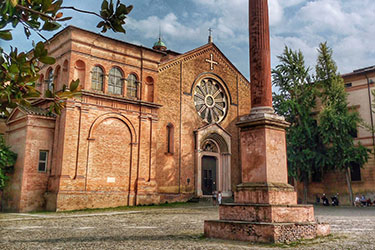
Secondly, the marble tomb that houses the remains, known as the “Arca di San Domenico“, involved the work of great artists over many centuries.
Although the name is linked to Niccolò dell’Arca — the same artist behind the Lamentation over the Dead Christ in Santa Maria — the work was actually commissioned from Nicola Pisano and his pupils.
Only two centuries later were the parts by Niccolò di Bari, the stele with the life of the saint by Alfonso Lombardi and the three statues by Michelangelo added.
Very few people know these works by the great artist, representing Saint Petronius, Saint Proculus and the angel holding a candlestick.
But that is not all: works by Guercino, Filippino Lippi, Guido Reni and Ludovico Carracci are displayed on the walls.
Do not miss an in-depth visit to the wooden choir, a masterpiece of Renaissance inlay work described by contemporaries as “the eighth wonder of the world” and admired even by Charles V.
The San Domenico complex is completed by a Gothic bell tower from 1313, the Convent of San Domenico with a Library of 90,000 volumes, and the cloister.
Opening times and ticket price for the Church of San Domenico
Opening times:
Monday-Saturday: 8.30 am-12.00 noon; 3.30 pm-6.00 pm.
Sunday: 3.30 pm – 5.30 pm.
Ticket price: free.
The Canals of Bologna
8
Perhaps few people know it, but Bologna has always been a city of water, a little Venice that is now largely hidden.
The most charming glimpse of this unusual Bologna is discovered by opening a small window in Via Piella.
Here, as if in a vision, the view opens onto the Canale delle Moline, used for centuries to power the watermills that processed grain.
This little window is probably the most unusual curiosity to see in Bologna.
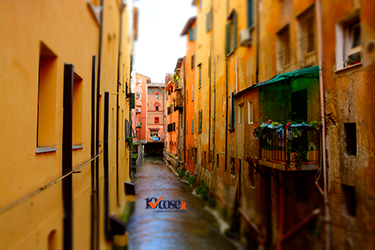
Forgotten for decades — so much so that most of the canals were covered over in the 1950s — Bologna’s “watery” nature has recently been rediscovered by the city’s own inhabitants, who are trying to enhance it once again.
In addition to the little window in Via Piella, other “views” over the Canale delle Moline have been opened from the bridges in Via Oberdan and Via Malcontenti.
Here and there, around the historic centre, you can glimpse locks and half-hidden streams; you can hear the sound of water, even if you cannot see it.
As in the Jewish Ghetto, beneath which the Aposa flows, or at the crossroads between Via delle Moline and Via Capo di Lucca, where you can hear the roar of the Salto del Reno.
The National Art Gallery of Bologna
9
The National Art Gallery of Bologna houses one of Italy’s most important museum collections.
The works displayed here trace the entire artistic development of Emilia and Italy from the 13th to the early 19th century. There are works by Raphael, the Carracci, Reni, Perugino, Parmigianino, Tintoretto, Vasari, Guercino and many others.

The initial core of the collection came from a substantial donation by Monsignor Francesco Zambeccari. Over the years, the collection was enriched by private donations, bequests and state acquisitions, making the Pinacoteca one of Italy’s most respected and best-known national galleries, both at home and abroad.
It has thirty exhibition rooms, plus a space entirely dedicated to temporary exhibitions and educational activities.
In addition to its purely exhibition role, the Bologna Art Gallery is responsible for the protection, conservation and study of the city’s and the region’s artistic heritage.
Opening times and ticket price for the Pinacoteca
Opening times: Tuesday, Wednesday, Thursday, Saturday, Sunday and public holidays from 9 am to 2 pm (ticket office closes at 1.30 pm). Friday from 9 am to 7 pm (ticket office closes at 6.30 pm)
Ticket price: €6. Reduced tickets available
How to get there: Via delle Belle Arti 56. In the university district, 800 metres from the Asinelli Tower.
The Porticoes of San Luca in Bologna
10
What would Bologna be without its porticoes? The city is crossed by 40 kilometres of arcades which are not merely an architectural feature but represent the very essence and mood of the city.
In fine weather, they offer excellent protection from the sun; in the colder months, they provide perfect shelter from the rain.
They are Bologna’s open-air underground: covered routes that allow you to reach every part of the city.
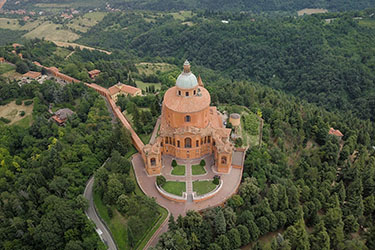
The most famous portico is the almost 4 km-long one that leads from the centre of Bologna to the Church of San Luca, a symbol of the city standing on Colle della Guardia.
Linked to the cult of the image of the Blessed Virgin of Saint Luke — believed to be the first image of the Madonna painted directly by the Evangelist — the current church was built between 1723 and 1757 to replace a previous 15th-century church.
The church has an elliptical plan with a Greek-cross interior embellished with works by Guido Reni and Guercino.
The covered portico, with 666 arches, connects the sanctuary to Porta Saragozza in the city. The number 666, the symbol of the devil, is said not to be accidental but full of symbolic references: the porticoes form the shape of a serpent — the devil — crushed by the foot of the Madonna, represented by the church with its miraculous image.
The climb therefore represents a journey of liberation and purification from sin.
Every year, the procession carrying the Madonna and Child to the cathedral during Ascension week starts from the church.
The people of Bologna go running along the porticoes of San Luca, especially on Sundays: if you want to tackle them, wear comfortable shoes and bring plenty of patience, because it is a demanding walk!
If you still have some energy left, visit the recently reopened Crypt or climb onto the roof of the dome to enjoy an extraordinary view over Bologna and the hills.
Opening times and ticket price for the Church of San Luca
Opening times
Church: from 7.00 am to 7.00 pm
Square: from 6.30 am to 7.30 pm
Crypt and dome: from 10.00 am to 1.30 pm and from 2.30 pm to 6.00 pm
Ticket price: basilica free of charge. Crypt €3, Terrace €5.
How to get there: on foot — see above! — or by car.
Church of Santa Maria della Vita in Bologna
11
This small church, reached from a side street off Piazza Maggiore, is worth visiting for the beautiful “Lamentation over the Dead Christ“, modelled in the second half of the 15th century by Niccolò dell’Arca.
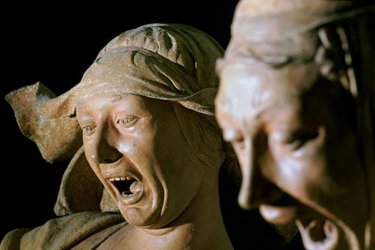
This sculptural group is considered one of the masterpieces of Italian sculpture, unjustly unknown to many.
The pain expressed by the faces of the statues led Gabriele D’Annunzio to describe the work as a “scream in stone“.
The Church of Santa Maria della Vita was founded in the second half of the 13th century by the Confraternity of the Battuti, or Flagellants, and is considered the most important example of Bolognese Baroque.
Do not miss the nearby oratory and the Museum of Health, which preserves the memory of the hospital founded by the Flagellants.
Opening times and ticket price for the Church of Santa Maria della Vita
Opening times: Tuesday to Sunday from 10.00 am to 7.00 pm
Lamentation from 10.00 am to 6.30 pm. Last admission 1 hour before closing.
Ticket price: basilica free of charge. Lamentation €5.
How to get there: on foot to Via Clavature 10.
Santa Maria dei Servi and the Portico
12
From the Asinelli Tower, take Strada Maggiore and, after a beautiful walk of about 900 metres under the porticoes, you arrive at the church of Santa Maria dei Servi, one of Bologna’s most fascinating places.
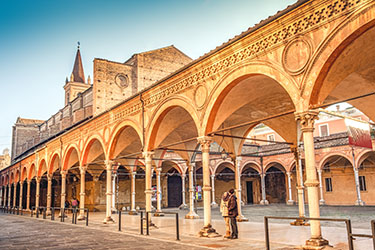
You will be welcomed by the quadriportico, a magical place beautifully captured by Pasolini in the final scene of Oedipus Rex and mentioned by Guccini in the song Eskimo.
The church was built in 1343 and originally had only one porticoed side, the one facing Strada Maggiore.
Other arches were added in 1492, in 1515-1521 and in the 17th century, until it reached its present quadriportico form only in 1864.
It is one of the longest-running constructions in the history of architecture!
The simple façade gives access to the three-nave church, with cross vaults supported by an alternation of round columns and octagonal pillars.
Santa Maria dei Servi is famous above all for the Maestà by Cimabue, but you should also not miss the works by Guido Reni — San Carlo Borromeo and Angels — a Madonna and Child by Giovanni da Modena, an Eternal Father by Guercino and many others.
It is worth remembering that Santa Maria dei Servi is historically one of Bologna’s “musical” places, with a wonderful 50-voice choir performing concerts throughout the year.
The traditional Santa Lucia Fair with Christmas markets is held under the portico.
Opening times and ticket price for the Church of Santa Maria dei Servi
Opening times: every day 7.15 am-12.15 pm and 4.00 pm-6.45 pm
Ticket price: free.
How to get there: on foot from Strada Maggiore
Lucio Dalla House Museum
13
During a walk through the centre of Bologna, it is a must to pass by number 15 Via d’Azeglio to visit the Lucio Dalla Foundation.
The Dalla Foundation is located just a few steps from Piazza Maggiore — 150 metres — and the Basilica of San Petronio, and is an essential stop for admirers of Dalla, but also for anyone wishing to explore the world of a cornerstone of Bolognese musical culture.

When you reach the building, you will recognise it immediately: on the façade next to the balcony there is an image of the singer-songwriter playing the saxophone.
The tour lasts one hour and takes place with a guide.
Calling it a house museum is an understatement, because it is not simply a visit through the various rooms: it is the emotion of entering the place where Dalla lived, where he composed, and of seeing memories connected to both his professional and private life.
The guide illustrates his biography and tells the story of the objects and works of art with which Lucio enriched his home over the years. Many are as eclectic as his personality.
There are works ranging from the 16th century to contemporary art, as well as small objects of sentimental value.
The house is located on the first floor of a 15th-century palace.
The Caruso Room was the professional space used as a meeting room and also as a dining room;
the Column Room is an elegant sitting room with a typically Bolognese feel, wooden floors and frescoes.
You then pass through Lucio’s Studio, the most intimate room, filled with objects dear to the singer.
Booking is required and it is advisable to plan ahead, as the attraction is open only two days a week at set times.
Opening times and ticket price for Lucio Dalla’s House
Opening times:
Friday: 3.00 pm – 4.00 pm – 5.00 pm – 6.00 pm
Saturday: 10.00 am – 11.00 am – 12.00 noon – 2.00 pm – 3.00 pm – 4.00 pm – 5.00 pm
Ticket prices: Full ticket: €15; Reduced: €10 (ages 6 to 12 and over 65s); Free for children under 6.
Giardini Margherita in Bologna
14
The Giardini Margherita are Bologna’s largest and most popular public park.
They were created in honour of Queen Margherita of Savoy and opened in 1879.
They are located 15-20 minutes on foot from the Two Towers and can be entered through several access points: Porta Castiglione, Piazza di Porta Santo Stefano and Viale Gozzadini.
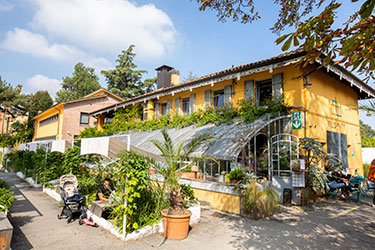
From an architectural point of view, the park has not changed much since its origins and has preserved a typically Romantic character.
It is the ideal place for a break during your stay in Bologna: you will probably pass by, so set aside some time for a walk among tree-lined avenues, lawns, fountains and an artificial lake.
In spring it is perfect for walking, doing sport or taking children to play in the equipped area. In summer, it is where many Bolognese people find relief in the shade of the trees.
Inside the park there are various refreshment areas: the Chalet dei Giardini Margherita is located on a small island on the banks of the lake and is connected to the rest of the park by a bridge.
It is the place where Bolognese people meet for breakfast and aperitifs, and where young people often go dancing at the weekend.
Near Porta Castiglione there is also an artisan ice cream shop where musical evenings are organised in summer.
For another excellent food stop, there are the Serre dei Giardini Margherita, which also host events, markets and other activities.
On Sundays and summer evenings, a busy calendar of concerts enriches the park’s entertainment offer.
Opening times and ticket price for Giardini Margherita
Opening times: Giardini Margherita are open to the public 24 hours a day.
How to get there: by bus from the Central Station: lines 30, 32 and 33, Porta Castiglione stop.
On foot from the historic centre: from the towers, take Via Castiglione and after 1 km you arrive at the gardens.
Ticket price: free.
Conserva Valverde - Bagni di Mario
15
The Valverde Cistern, known as the Bagni di Mario, is a historic hydraulic work in Bologna.
It is called this because at first it was mistakenly thought to be Roman baths, and only later was it understood to be a complex system for collecting and settling water.

The cistern was built in the Renaissance by the Palermo-born architect Tommaso Laureti, as part of the renewal promoted by Pope Pius IV in the mid-16th century.
The site is not very well known among tourists, but it certainly has its own value.
Essentially, it collected water from the hills of Bologna and channelled it towards the city centre, supplying the famous Fountain of Neptune.
It is therefore interesting to understand this attraction from a historical and architectural point of view.
The focus of the visit is the ingenuity and complexity of hydraulic knowledge already present during the Renaissance.
Through an excursus into the history of the underground city, you discover the mysteries and curiosities linked to this site.
For those returning to Bologna who already know the main attractions, it could be an opportunity to explore a piece of history away from the classic tourist routes.
Now for some practical information. The visit to the Bagni di Mario lasts about an hour and takes place among the arches and tunnels of the ancient structure, accompanied by a tourist guide.
Independent visits are not allowed.
As the temperature inside the cistern is lower than outside, even in summer it is advisable to bring a sweatshirt or jacket.
Booking is compulsory by contacting the association “Succede solo a Bologna”.
Opening times and ticket price for the Bagni di Mario
Opening times and days: the visit calendar is updated periodically by the association and can be consulted on their official website.
Ticket price: entrance through “Succede solo a Bologna” involves an optional voluntary donation at the end of the guided tour.
How to get there: the Valverde Cistern is a ten-minute walk from Porta San Mamolo. Access is from number 10, through a staircase among the buildings leading underground.
By bus: Line 29
What to eat in Bologna
16
Bologna’s gastronomic fame dates back to the Middle Ages, when the influx of students and professors from all over the world made it necessary to enrich the city’s food culture.
Bolognese cuisine, like Emilian cuisine in general, is varied and generous.
In addition to the famous tortelli, still handmade by expert pasta makers and served strictly in broth, egg pasta and pork are the stars of the table, and some typical dishes are born from different combinations of these two ingredients.
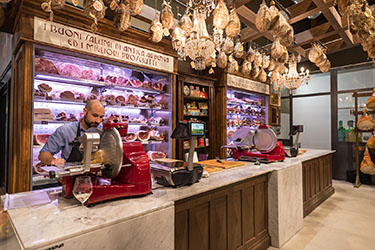
These include ragù, prepared with mixed pork, veal and beef;
tagliatelle, made with flour and eggs;
lasagne, layered with ragù, béchamel and Parmesan;
cotoletta alla bolognese, topped with cheese and a slice of cured ham.
Pork also gives us mortadella, a typical cured meat used not only to make the filling for tortelli, but also to prepare a mousse served with tartines and crostini.
Among the desserts, the famous certosino is worth mentioning: it is a Christmas cake made with honey, almonds, candied fruit, pine nuts, butter, sultanas, cinnamon and dark chocolate.
You can eat well almost everywhere, but if you love young crowds and evening life, your destination is the “Quadrilatero” around Piazza Maggiore.
Also not to be missed is a visit to FICO, the shopping centre dedicated to excellent Italian food, which can be reached by bus from Bologna station. Bear in mind that you will need at least half a day to see it all.
Saving money in Bologna with the Welcome Card
The Bologna Welcome Card is the tourist pass that allows you to see the best of Bologna — attractions, museums and experiences — while reducing costs. The saving is clear, up to €78, compared with buying individual tickets for each attraction. Find out more on the Bologna Welcome Card page.
Where to stay in Bologna
HA constant presence of students, professors, business travellers and tourists makes it difficult to find a low-cost place to stay, especially in high season.
But do not despair, because Bologna has excellent accommodation capacity, with hotels, B&Bs and apartments.
Hotels in the historic centre are the most expensive, but avoid them if you are arriving by car: Bologna has a very large limited traffic zone and fines for unauthorised access are common.
Just outside the centre or near the station, there are small hotels and B&Bs where you will still find the warmth, hospitality and friendliness typical of the Bolognese. Prices for hotels start from €50 per night in a 3-star hotel.
If you are looking for a hotel in Bologna, we recommend choosing from those offered by Booking.com. There are about 120 hotels with prices, photos and reviews from guests who have stayed there before you. Go to Booking.com