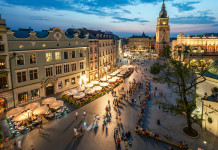
Milan is commonly known as Italy’s economic capital — a label that can make it sound as though there is plenty of money here, but not much worth seeing. Nothing could be further from the truth. There are so many things to do and see in Milan: you might begin with postcard Milan, the city of Piazza Duomo, the Galleria Vittorio Emanuele II and the Castello Sforzesco, all symbols of Milan’s historic wealth and power.
Then there is the Milan of Leonardo da Vinci, who put his architectural genius to work on making the Navigli canals navigable — today beautifully revived and among the city’s most fashionable areas. Leonardo also left Milan one of his greatest masterpieces: The Last Supper, painted in the refectory of Santa Maria delle Grazie.
Then there is international Milan, the city that attracts the wealthy from across the globe: the Milan of San Babila with its attractive neo-Romanesque church, but above all with its fashion streets, designer shop windows, models on the move and supercars parked outside.
In short, there is certainly no shortage of things to do and see in this city — to which you should add the appeal of a major European metropolis and a cuisine that is unfairly overlooked when compared with Rome, Naples or Florence.
Here, then, are 10 things to see in Milan to begin discovering this great and beautiful city, even over just a weekend.
If you are looking for a hotel, we recommend choosing from the options available on Booking.com. There are around 2,000 hotels in Milan, with prices, photos and reviews from previous guests. Go to Booking.com
Milan Cathedral
1
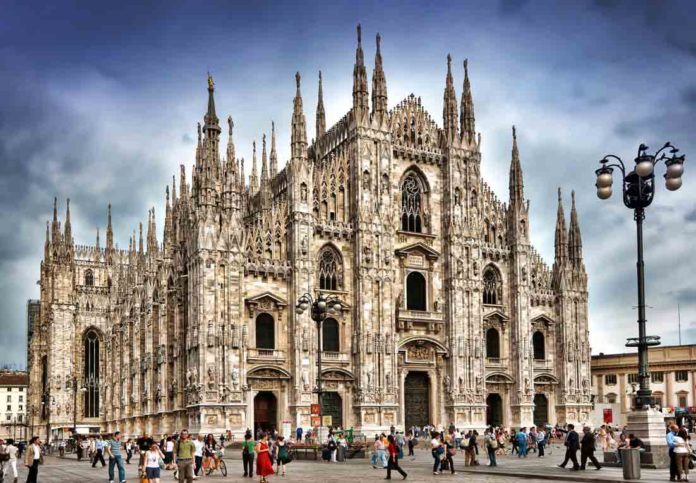
What could be more representative of Milan than its Cathedral?
The church dedicated to Santa Maria Nascente, built at the behest of Gian Galeazzo Visconti, is the symbol of the city and one of the first things to see as soon as you set foot in Milan.
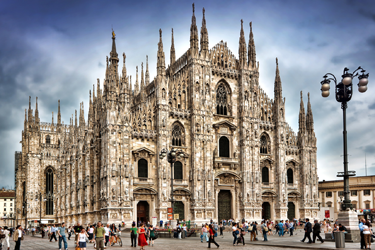
Work on Milan Cathedral began in 1386, leading to the creation of an extraordinary monument, with magnificent stained-glass windows and beautifully carved decoration.
This majestic building is one of the most significant examples of Gothic architecture, and there is no mistaking its uniqueness: it is the only one in which northern European features blend with Lombard elements.
Milan’s famous Madonnina
The beauty of the Cathedral is crowned by the main spire, where the celebrated Madonnina stands: a gilded copper statue no less than 4 metres high.
Visit the church on a clear, sunny day and from the terraces you can enjoy a wonderful view over the city and the Alps.
Inside, do not miss the presbytery, renovated in the second half of the 16th century. At the top of the apsidal vault is the relic of the Holy Nail of the Cross.
To give you a few figures: the Cathedral contains 3,500 statues, including the 96 giant gargoyles; the building is 157 metres long and 92 metres wide, while the spire rises to 108.5 metres.
Opening times and ticket prices for Milan Cathedral
Opening times: daily from 9.00 am to 7.00 pm. Last admission at 6.00 pm. On Sundays and public holidays, advance booking is compulsory.
Ticket price: from €9 without access to the terraces, to €15 with stair access, or €20 with the lift. All tickets include: access to the Cathedral, Archaeological Area, Cathedral Museum and the Church of San Gottardo.
Every Thursday evening from 10 June 2021, the terraces remain open until 10.00 pm, with last lift ascent at 9.10 pm.
How to get there: it is right in the centre of Milan — you can hardly miss it. Metro M1 and M3, Duomo stop.
Official website: http://www.duomomilano.it/
Museo del Novecento
2
Just a few steps from the Cathedral is the Palazzo dell’Arengario, home to the excellent Museo del Novecento.

The museum houses a collection of more than 400 works of Italian art, arranged in chronological order. The visit begins with Giuseppe Pellizza da Volpedo’s The Fourth Estate, to which an entire room is dedicated.
Among the artists from the early 20th century, you will encounter works by Picasso, Braque, Klee, Kandinsky and Modigliani. The route then moves on to Futurism, with Balla, Boccioni, Carrà, Depero, Severini and Soffici.
The 1920s and 1930s are represented by de Chirico, Morandi and an entire space dedicated to Marino Marini. On the third floor are works by Informal artists — Burri, Vedova, Licini and others — as well as the 1950s and 1960s, with Piero Manzoni and artists from Azimuth.
The fourth floor is devoted entirely to Lucio Fontana, with the large 1956 Spatial Ceiling from the Hotel del Golfo on the island of Elba, the Neon and the Spatial Concepts of the 1950s. The great room dedicated to Fontana has large windows offering a spectacular view of the Cathedral.
The suspended walkway leads to Palazzo Reale, where the section dedicated to works from the 1960s to the 1980s includes Kinetic and Programmed Art, Pop Art, Analytical Painting and Conceptual Art, with works by Kounellis, Paladino and others.
Opening times and ticket prices for the Museo del Novecento
Opening times: daily from 10.00 am to 7.30 pm. Thursdays until 10.30 pm.
Ticket price: full price €10. Reduced adult ticket €8; reduced ticket for young people and children €5.
How to get there: next to the Cathedral. Metro M1 and M3, Duomo stop.
Official website: http://museodelnovecento.org/it/
Leonardo da Vinci’s Last Supper in Milan
3
Leonardo da Vinci’s Last Supper is carefully preserved inside the refectory of the Dominican convent of Santa Maria delle Grazie in Milan. Leonardo created this work of astonishing beauty on the north wall of the great hall between 1494 and 1498, during the rule of Ludovico il Moro.
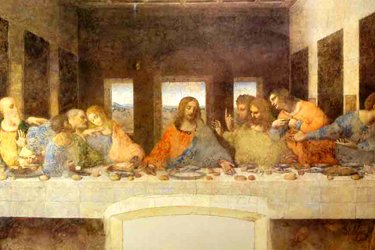
The brilliant Leonardo executed this masterpiece a secco, rather than using the fresco technique normally employed for wall paintings.
Sadly, over time, due to environmental conditions and historical events, the work has suffered serious deterioration and can now be seen only in part.
The Last Supper has undergone numerous restoration campaigns; in particular, the 1999 restoration returned the painting to its original colours and removed earlier repainting.
To prevent any further damage, the work is kept in special environmental conditions, with carefully controlled air treatment, and can be visited only by groups of a maximum of 25 visitors at a time, every 15 minutes.
Opening times and ticket prices for Leonardo’s Last Supper
Opening times: Tuesday to Saturday, from 9.45 am to 7.00 pm, with last admission at 6.45 pm. Sunday from 2.00 pm to 7.00 pm, with last admission at 6.45 pm.
Only 15 people may enter the Refectory every 15 minutes.
Ticket price: €15, with compulsory booking on the Vivaticket website.
How to get there: Piazza Santa Maria delle Grazie. Metro Line 1: Cadorna or Conciliazione Metro Line 2: Cadorna or Sant’Ambrogio
The Pinacoteca di Brera in Milan
4
The Pinacoteca di Brera was founded in 1776 as a collection of significant works intended for the education of students at the Academy of Fine Arts.
When Milan was proclaimed capital of the Kingdom of Italy by Napoleon, paintings confiscated from churches and aristocratic families — those not taken to Paris — arrived at Brera.
The Pinacoteca di Brera therefore differs from many other prestigious Italian museums because it did not originate from the private collecting of aristocrats and princes, but from state and political collecting.
The collection is exceptionally rich and includes some of the most famous works in the world: from Caravaggio’s Supper at Emmaus to Mantegna’s Dead Christ, from Piero della Francesca’s Brera Altarpiece to Raphael’s Marriage of the Virgin.
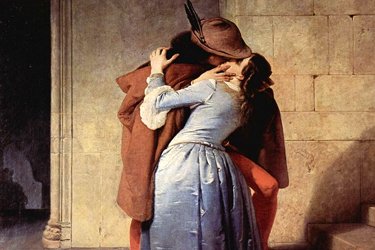
Alongside these celebrated works are many others, equally exceptional though less well known. One of Brera’s symbols is the quintessential painting of Italian Romanticism: Hayez’s The Kiss. The collection reaches into the 20th century with works by Braque, Modigliani, Picasso, Morandi, De Chirico and many more.
Opening times and ticket prices for the Pinacoteca di Brera
Opening times: valid from 1 June to 4 July inclusive:
• Tuesday: 9.30 am-2.30 pm, last admission at 1.30 pm
• Wednesday: 12.30 pm-5.30 pm, last admission at 4.30 pm
• Thursday: 12.30 pm-5.30 pm, last admission at 4.30 pm
• Friday: 9.30 am-5.30 pm, last admission at 4.30 pm
• Saturday: 9.30 am-5.30 pm, last admission at 4.30 pm
• Sunday: 9.30 am-5.30 pm, last admission at 4.30 pm
Closed: every Monday, 1 January, 1 May and 25 December. Ticket price: full price €15, reduced €10. How to get there: Via Brera, 28. M2 Lanza stop, M3 Montenapoleone stop. Tram: 1-4-8-12-14-27. Bus: 61, 97 Official website: [http://pinacotecabrera.org/](http://pinacotecabrera.org/)
Milan’s Navigli canals
5
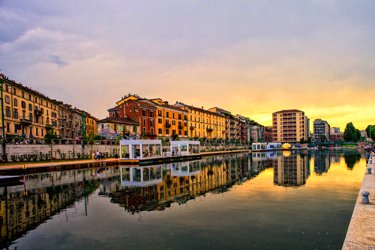
Milan is rarely thought of as a city of water, yet that is precisely what it is. The Navigli canal system was born from the ambitious project of linking Milan with Lake Como, the Adda, Lake Maggiore and the Po, reaching northern Europe and ultimately the sea. The history of the Navigli began in the second half of the 12th century, with the construction of the first navigable stretch.
The first canal, the Ticinello, was inaugurated in 1179 and, with its impressive 50 kilometres in length, paved the way for the construction of the Naviglio Grande. In 1457 Francesco Sforza entrusted Bertola da Novate with the construction of the Naviglio della Martesana, but it was under Ludovico il Moro that the real turning point came.
And who but Leonardo da Vinci could complete such a complex hydraulic undertaking? With an ingenious system of locks, Leonardo succeeded in linking Milan with Lake Como.
Only the connection to the sea via the Po was missing: Napoleon completed this in 1805 with the construction of the Naviglio Pavese.
The Navigli have lived through changing fortunes: they brought wealth, but later suffered neglect and pollution, and a large part of the network was covered over.
Despite everything, the Milanese have always loved them, strolling along the canals or gathering in the taverns and bars that grew up around them.
Today they are enjoying a revival and are at the centre of numerous regeneration projects. The first to be completed was the new Darsena, on the Naviglio Grande, redeveloped for Expo 2015. Cycle lanes, boats and relaxation areas now sit alongside traditional osterias, boutiques and artists’ shops. Not to be missed, even if you are in Milan for only a few hours.
Milan’s Castello Sforzesco
6
The Castello Sforzesco has accompanied the history of Milan for 750 years and has played a decisive role on many occasions.
The first structure was commissioned by Galeazzo II, but it was Francesco Sforza — from whom the castle takes its name — who gave it its present form.
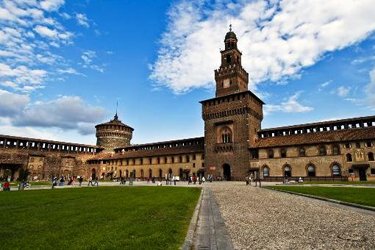
The castle has almost always served as a military citadel and remains one of the largest castles in Europe.
Long associated with war, foreign rule and mourning — and therefore both loved and hated by the Milanese — in the 20th century the castle changed its character, becoming a reassuring place of culture, used to safeguard the artistic heritage of Lombardy.
The museums of Milan’s Castello Sforzesco
Today the Castello Sforzesco is home to a wealth of museums: on the ground floor of the Corte Ducale is the Museum of Ancient Art; on the first floor, the furniture collection and the Picture Gallery; on the first and second floors of the Rocchetta are the Applied Arts collections and the Museum of Musical Instruments; while beneath the Corte Ducale are the Museum of Prehistory and Protohistory and the Egyptian Museum.
The castle contains some masterpieces of Italian art: Michelangelo’s Rondanini Pietà, Leonardo’s frescoes in Room VIII of the Museum of Ancient Art, Mantegna’s Madonna in Glory with Saints John the Baptist, Gregory the Great, Benedict and Jerome in the Picture Gallery, and the extraordinary cycle of tapestries depicting the twelve months by Bramantino, in the Sala della Balla.
Behind the Castello Sforzesco lies Parco Sempione, Milan’s green lung: a vast green space where Milanese people escape smog and city stress to run, stroll or have a picnic.
Opening times and ticket prices for the Castello Sforzesco
Opening times: courtyards from 7.00 am to 7.30 pm. Castle Museums: Tuesday to Sunday, 10.00 am-5.30 pm, with last admission at 5.00 pm.
Admission: free entry to the courtyards. Museums €5. Reduced ticket €3. How to get there: Piazza Castello. Red line (M1): Cairoli and Cadorna FN stops Green line (M2): Lanza and Cadorna FN stops
Tram
Lines 1, 2, 4, 12, 14, 27
Bus
Lines 50, 57, 58, 61, 94 Official website: [https://milanocastello.it/](https://milanocastello.it/)
Milan’s Galleria Vittorio Emanuele II
7
The Galleria Vittorio Emanuele II, Milan’s so-called drawing room, was built because in the first half of the 19th century the city looked with envy at the urban transformations taking place in the great European capitals and wanted to be their equal.
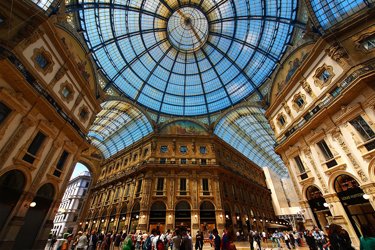
In 1859 the idea of a covered passageway linking Piazza Duomo with Piazza della Scala became increasingly concrete, and an international competition was launched to assess proposals from various architects. As many as 176 architects submitted their ideas, but the proposal by Giuseppe Mengoni stood out: a long gallery crossed by a second arm, with a large octagonal hall at the point of intersection.
Work began in 1865, with the first stone laid by King Vittorio Emanuele II of Savoy himself, and two years later the Galleria was inaugurated, even though it was still incomplete and the king was not present.
The construction of the Galleria Vittorio Emanuele II, however, had a tragic ending: its designer, Giuseppe Mengoni, died during an inspection of his own “creation”.
Many did not believe it was an accident, but rather a suicide caused by the many criticisms levelled at his work and by his disappointment at the king’s absence from the inauguration. No one could have known that the king was in poor health and would die only a few days later.
The Galleria is Milan’s grand drawing room: a place to meet, to be seen, to shop — often at high prices — or simply to have a coffee.
Church of San Maurizio al Monastero Maggiore
8
After 30 years of restoration, the magnificent Renaissance church of San Maurizio has returned to its former splendour.
Built in the early 16th century on the remains of an ancient place of worship, the church was attached to the Monastero Maggiore of the Benedictine order, demolished in 1799. Today, its entrance cloister survives and forms an integral part of the Archaeological Museum.
The division of the interior into two parts — one open to the faithful and the rear section reserved for the nuns of the monastery, who attended Mass from behind a grille — bears witness to the building’s original function.
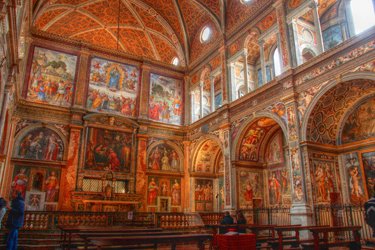
The simple, linear façade on Corso Magenta gives no hint of the astonishing interior, richly decorated with frescoes that cover the entire architectural structure, from walls to vault. For this reason, the church has been called the Sistine Chapel of Milan.
The brightly coloured fresco decoration extends over an impressive 4,000 square metres and is the work of some of the greatest masters of 16th-century Lombard painting:
Bernardino Luini, responsible among other works for the Stories of Saint Catherine in the Besozzi Chapel and the Stories from the Life of Christ in the nuns’ choir and on the partition wall; Simone Peterzano, Caravaggio’s teacher, who painted The Return of the Prodigal Son and Christ Driving the Money Changers from the Temple on the inner façade of the church; Antonio Campi, responsible for the Adoration of the Magi on the high altar; Bergognone in the choir; Lomazzo; and Boltraffio, a pupil of Leonardo.
The organ
Of particular value in the cloistered choir is the organ made by Gian Giacomo Antegnani in 1557, originally intended for liturgical concerts and now used for concert events held in the city. A must-see.
Opening times and ticket prices for San Maurizio al Monastero Maggiore
Opening times: every Friday, Saturday and Sunday, with entry from 10.00 am to 4.00 pm. Booking is compulsory via Eventbrite
Ticket price: free
How to get there: Corso Magenta 15. M2 green line, Cadorna stop; M1 red line, Cordusio stop.
Trams 19, 20, 24; buses 19, 50, 59
Basilica of Sant’Ambrogio in Milan
9
The church dedicated to the city’s patron saint is considered the second most important church in Milan, after the Cathedral.
Founded in the 4th century at the wish of Ambrose, Bishop of Milan — who was buried here in 397 — on the site of a cemetery for martyred Christians, the church was originally called the Basilica Martyrum. It was rebuilt according to the principles of Romanesque architecture between 1088 and 1099.
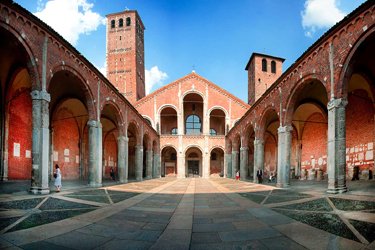
Although regarded as the most important example of Lombard Romanesque architecture, the basilica also owes its appearance to building work and adaptations carried out over subsequent centuries.
Preceded by a four-sided porticoed atrium, the basilica has a gabled façade characterised by two superimposed loggias and is framed by two bell towers: the Monks’ Tower on the right, dating from the 9th century, and the Canons’ Tower on the left, built in the 12th century, apart from the upper two floors added in 1889.
The interior of Sant’Ambrogio
The interior is divided into three naves, each ending in an apse and divided into four square bays covered by cross vaults. In the presbytery, note the 9th-century ciborium, a Lombard-Byzantine stucco baldachin resting on four red porphyry columns, beneath which stands the Golden Altar, a masterpiece of Carolingian goldsmithing by Vuolvino.
Also of great interest is the early Christian sarcophagus known as the Sarcophagus of Stilicho, dating from the 4th century. Another curiosity is the Roman column supporting a singular bronze sculpture, the so-called serpent of Moses: according to legend, the end of the world will be heralded by the creature descending from the column.
The crypt with the remains of the saints
The underground crypt preserves the remains of Saints Ambrose, Gervasius and Protasius. Inside the Ambrosian basilica, you can also admire the small chapel, or sacellum, of San Vittore in Ciel d’Oro, built in the 4th century to house the remains of the martyr Victor. It is famous for its early Christian mosaics on the walls and dome, depicting several saints, including Saint Ambrose.
The Devil’s Column and its legend
Near the Basilica of Sant’Ambrogio stands a Roman-era column with two holes which, according to legend, were made by Satan. The story goes that the devil, having failed to seduce Ambrose, tried to pierce him but struck the column instead, getting stuck there with his long horns.
Furious, the Evil One then took the form of sulphurous fumes and used those same holes to return to hell. So there is no need to be alarmed if you smell a faint odour of sulphur from the holes, or if, when placing your ear near them, you hear strange noises coming from within…
Opening times and ticket prices for the Basilica of Sant’Ambrogio
Opening times: Monday to Saturday: 10.00 am-12.00 noon; 2.30 pm-6.00 pm. Sunday: 3.00 pm-5.00 pm.
Ticket price: free
How to get there: Piazza Sant’Ambrogio. M2 green line, S. Ambrogio stop
Bus 50, 58, 94
Official website: http://www.basilicasantambrogio.it/
San Bernardino alle Ossa in Milan
10
About 500 metres from Piazza del Duomo, in Piazza Santo Stefano, you will find one of Milan’s most unusual, fascinating and macabre places. This is the Sanctuary of San Bernardino alle Ossa, and the name already says a great deal.
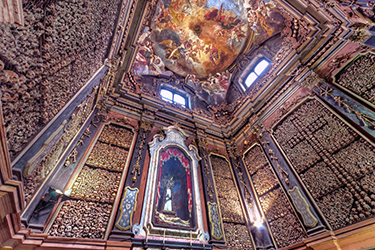
This small chapel, later transformed into a church, served for centuries as an ossuary, and its interior walls are entirely decorated with human bones.
The story begins in 1145, when a hospital and cemetery were built in the area to bury patients who had died there.
After only a few years, the available space proved insufficient, making it necessary to build a chamber to house the bones of the dead exhumed from older graves.
After the collapse of the old ossuary, a new one was built at the end of the 17th century. The friars decorated it with the bones of the dead and had it frescoed in 1693-94 by the Venetian painter Sebastiano Ricci.
The walls are completely covered with bones, blending the macabre with the delicacy of Rococo decoration. Although legend says these are the bones of Christian martyrs, in reality they are the remains of hospital patients, friars who lived in the church, Milanese prisoners and some members of noble Milanese families. An absolute must-see.
Opening times and ticket prices for San Bernardino alle Ossa
Opening times:
Monday-Friday: 8.00 am-6.00 pm
Saturday: 9.30 am-6.00 pm
Sunday: church open from 9.30 am to 12.00 noon. Ossuary CLOSED.
Ticket price: free, with voluntary donation.
How to get there: in Piazza Santo Stefano. Around 5 minutes on foot from Piazza del Duomo.
Parco Sempione in Milan
11
In a hectic city such as Milan, Parco Sempione is a green lung where you can enjoy a breath of fresh air away from traffic. The park is large and well maintained, stretching from the Castello Sforzesco to the Arco della Pace, and skirting the Arena Civica, the Aquarium and the Triennale.
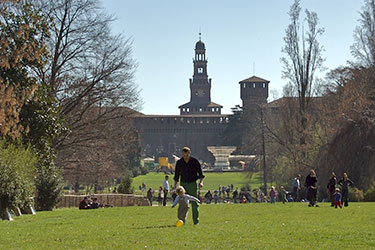
For the Milanese, this is the place to go jogging, take a walk, relax on the grass, walk the dog or let children play outdoors on sunny days.
The park includes several dog areas, a playground with small rides for families, basketball and volleyball courts, a library and various equipped fitness trails.
Especially dear to the Milanese — and particularly to couples — is the Ponte delle Sirenette, which crosses an artificial lake and is undoubtedly one of the park’s most picturesque corners. It is said that crossing the little bridge brings good luck: a good enough reason to go.
Parco Sempione is periodically used by the municipality for events, fairs and public gatherings. A walk here is pleasant all year round, with each season offering its own colours.
Autumn is certainly one of the most atmospheric times, with a carpet of leaves and chestnuts falling naturally from the trees. Spring days, meanwhile, are ideal for grabbing something from one of the kiosks scattered through the park, having a drink or reading a book on the grass.
Parco Sempione is one of the symbols of Milan, as well as an essential stop for a pause between museum visits. It is best visited outside the weekend, when it is less crowded. It is worth setting aside half an hour to stroll among its rich flora and fauna. Lovers of educational walks can join guided tours led by volunteers to discover tree species and monumental trees.
How to get there
Parco Sempione is very central. The nearest metro stops are Cairoli on the red M1 line, Lanza on the green M2 line and Cadorna on both the red M1 and green M2 lines.
Milan’s Monumental Cemetery
12
While visiting a cemetery may not always sound appealing, we can assure you that a visit to Milan’s Monumental Cemetery is an experience not to be missed.
Distinguished architects and artists have left their mark here: funerary chapels, shrines, temples and sculptures have immense artistic as well as symbolic value. The sculptural movements represented are extremely varied, from Art Nouveau to Symbolism, via the Scapigliatura movement.

We recommend even a simple walk through this open-air museum, which conveys the grandeur of the illustrious figures of Italian and Milanese history buried here: Wanda Osiris, Giorgio Gaber, Alda Merini, Dario Fo, Franca Rame and Enzo Jannacci, to name only a few.
Milan’s Monumental Cemetery can be visited free of charge. You can explore it independently, choosing from a series of recommended itineraries that lead through its various areas. Alternatively — and this is an option we warmly recommend — you can join an interesting guided tour led by Civil Service volunteers, subject to booking.
Route A includes 24 monuments and takes about an hour, while those with less time can choose Route B, which includes 12 monuments and takes around half an hour.
The Famedio and the tombs of famous Milanese figures
Do not miss a visit to the Famedio, or “Temple of Fame”, located in the main part of the Monumental Cemetery. It is worth going inside for the beauty and richness of the decoration, as well as for the illustrious tombs of Manzoni, Carlo Cattaneo, Luca Beltrami, Salvatore Quasimodo, Carlo Forlanini, Bruno Munari and Leo Valiani. You can also descend into the crypt of the Famedio.
Other points of interest in the cemetery include the Monument to those who died in Nazi extermination camps, the Crematorium Temple, the Bocconi Chapel, the Bistoletti Monument, the Toscanini Chapel and the central ossuary.
How to get to Milan’s Monumental Cemetery
By metro:
Monumentale stop, Line M5
Garibaldi stop, Line M2. From here, continue on foot for 7-8 minutes.
By bus:
94, P.ta Volta stop
70, Ceresio stop
By tram:
2, 4, 33, Farini stop
10, Monumentale stop
12 and 14, Bramante stop
Milan’s Albergo Diurno Venezia
13
In Milan there is a place where you can travel back to the Belle Époque: the Albergo Diurno Venezia. It is located beneath Piazza Guglielmo Oberdan, near the entrance to Porta Venezia metro station on Line M1.
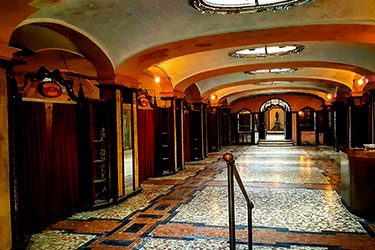
To enter, you need to book a guided visit organised by FAI volunteers through Milanoguida, lasting around one hour.
FAI members can access it free of charge. It is a curious experience, well off the usual tourist routes, and a way to discover a piece of modern Milanese history.
This day hotel, designed by Piero Portaluppi, was used in the 1920s as a “refreshment stop” by Milanese people who, returning from work or from a journey, wanted to relax and take care of themselves for a few hours.
At the time, treating oneself to such a place was a luxury, given that not everyone had a private bathroom at home. The Albergo Diurno included a barber’s area, a manicure area, baths — the so-called “Bagni” — and more. Today, we might compare it to our spas and wellness centres.
The atmosphere has the charm of another age, and will particularly appeal to admirers of Art Nouveau and Art Deco style. Unfortunately, the Albergo Diurno is currently unfit for use due to long disuse and requires restoration and safety work.
At present it is not open to the public and cannot be visited. A reopening is planned, although no definite date has yet been announced; it will probably take place in a few years, possibly to coincide with the inauguration of the new Museum of Digital Art.
The Maggiolina district in Milan
14
Maggiolina is a historic Milanese district on the edge of the Quartiere dei Giornalisti. It takes its name from an old farmhouse that once stood on the banks of the Seveso river, but has now disappeared.
Maggiolina is not part of the classic tourist circuit, yet it deserves attention for its wonderfully unconventional atmosphere. Do not expect monuments, churches, famous sights or skyscrapers. The district lies away from the centre, in the north-eastern outskirts of the city.

Milan never stops surprising, and Maggiolina is proof of that. Having undergone several transformations over the years, it is now known for its curious igloo- and mushroom-shaped houses, known to the Milanese as “gnome houses” or “Smurf houses”.
Many of the mushroom houses were demolished in the 1960s, and only a few remain today in Via Lepanto.
The Maggiolina “igloos” are built over two levels and are still inhabited. A walk through the streets of the district will introduce you to an unusual, experimental and far quieter Milan than the more chaotic city centre.
Villa Figini
Another noteworthy building is Villa Figini in Via Perrone, known as the “Palafitta”, designed by its owner, the architect Luigi Figini.
During the FAI Days, a visit to nearby Villa Mirabello should also not be missed. Dating from the second half of the 15th century, it has a private chapel and a courtyard with a loggia.
It is a typical example of suburban farmhouse architecture, transformed over time from a country residence into a private villa.
To appreciate Maggiolina fully, we recommend joining an organised tour. Only in this way can you delve into the history, architecture and many curiosities connected with the district. Did you know that the Seveso river flows beneath its streets?
How to get to Maggiolina
By metro: Line M3, Zara or Sondrio stop; from there it is a short walk
By bus: numbers 81, 42, 43
Villa Invernizzi and Milan’s pink flamingos
15
Right in the centre of Milan there is a garden inhabited by pink flamingos, an attraction that is certainly unusual. It is the garden of Villa Invernizzi, named after the owners of the factory that made the famous little cheese triangles. If you have a little time left, it deserves a place on your list of things to see in Milan.
The building’s Art Nouveau façade overlooks Corso Venezia at number 32 and is already interesting in itself, but the real draw is the group of flamingos that have lived in the rear garden for decades. To see them, simply turn the corner into Via Serbelloni and continue to Via Cappuccini.
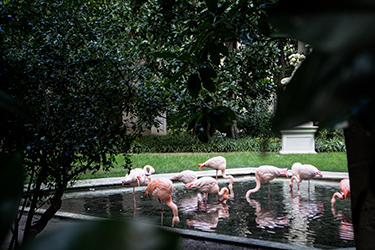
Brought to Milan from Africa and South America, it is said that the first flamingo arrived from Chile around the mid-20th century, when importation was still permitted. From that moment, the colony grew thanks to the villa’s owner, the entrepreneur Cavaliere Invernizzi, who recreated the ideal habitat for them.
A lover of the countryside, he decided to create this green corner in the heart of Milan because his wife preferred city life.
Today the villa belongs to the Fondazione Romeo ed Enrica Invernizzi, which protects the birds. It is closed to the public, but it is worth making a short detour from the fashion and shopping streets to pass by this place, which fascinates both Milanese residents and visitors.
The flamingos generally do not come close to the gate, but they can be observed through the hedges and photographed as they wander between the garden and the fountain.
The area itself is worth a stroll. It is known as the Quadrilatero del Silenzio, the “Quadrilateral of Silence”, because, as the name suggests, it is remarkably peaceful. Walk among Art Nouveau buildings and elegant residences, then make your way to the neighbourhood’s most unexpected sight. Also worth noting are the arch in Via Tommaso Salvini, Palazzo Rocca Saporiti, Casa Berri Meregalli and Villa Necchi Campiglio.
How to get to Villa Invernizzi:
Palestro metro station, red M1 line, then 200 metres on foot.
What to eat in Milan
16
Like every Italian city, Milan has its own important culinary tradition. The true king of Milanese cooking is butter, used in most dishes, from risotto to cotoletta alla milanese, and even panettone.

To begin with the traditional dishes, the best known is certainly risotto alla milanese, made with saffron. The traditional recipe includes beef marrow, although not many cooks prepare it this way today.
Another typical Milanese first course is busecca — from which the Milanese nickname busecconi derives — made with tripe cooked in a stew.
Among the main courses, the best known and most appreciated is cotoletta alla milanese. According to tradition, it is made with veal, at least a finger thick, and fried in butter, although today healthier and lighter olive oil or seed oil is often preferred. Nor should we forget ossobuco, or òsbus a la milanesa: a stewed slice of veal or beef shank.
Cassoeula, meanwhile, is a very rich dish made with cabbage and the so-called “poor” parts of the pig, such as rind, head, ribs and trotters. As for desserts, both panettone and colomba originated in the Milanese capital. Dairy products are also typical of the area: stracchino, mascarpone, Grana di Lodi and, of course, gorgonzola.
Where to stay in Milan
No longer only a destination for managers and business travellers, Milan was already becoming a major cultural tourism destination before Expo 2015. The revival of the Navigli, the growing number of exhibitions and the opening of new museums have attracted many new visitors to the city.
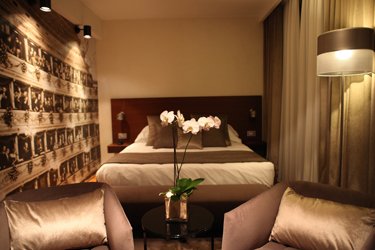
Given the large influx of people, Milan has had to expand its accommodation offer and today, more than ever, it is ready to welcome visitors with numerous hotels, bed & breakfasts, apartments and hostels spread throughout the city.
Alongside the large luxury hotel chains, you will also find more modest and welcoming hotels, comfortable guest houses, family-run bed & breakfasts and even quirky Art Nouveau houses from the early 20th century. Finding a reasonably priced room is not always easy, especially in the centre and during international events.
Prices start from around €80 per night for a three-star hotel and rise from there. The best advice is to book in advance. All accommodation is well connected to central Milan thanks to the city’s efficient and practical public transport system, so if you want to save a little, you can choose to stay further out without worrying about getting around.
If you are looking for a hotel, we recommend choosing from the options available on Booking.com. There are around 2,000 hotels in Milan, with prices, photos and reviews from previous guests. Go to Booking.com