


Ravenna can certainly be described as a treasure unknown to most Italians. Overshadowed by Italy’s more famous art cities (Florence, Rome, Venice, Naples), it is actually an extraordinary town with several masterpieces to see at least once in a lifetime, attracting tourists and art lovers from all over the world.
Few people know, for example, that Ravenna was three times the capital of three empires: the Western Roman Empire, the kingdom of Theodoric King of the Goths, and the Byzantine Empire in Europe.
This past is witnessed by Ravenna’s basilicas and baptisteries, where the richest mosaic heritage of humanity dating back to the 5th and 6th centuries is preserved. Few people also know that Ravenna has eight monuments listed as UNESCO World Heritage Sites and that Dante’s remains are kept here, not in Florence.
The food is extraordinarily good — we are still in Romagna — and in summer there are 35 kilometres of coastline to choose from for a swim. If you are travelling with young children, the Mirabilandia amusement park can be a good stop to take a break from basilicas, mausoleums and mosaics.
For nature lovers, just a few kilometres away are the Po Delta and the valleys of Comacchio, as well as the pine forests of Classe and San Vitale and the Punte Alberete oasis.
In short, if you too were among those who did not know Ravenna, now you have no more excuses. Discover with us what you absolutely must see and do in Ravenna.
If you are looking for a hotel in Ravenna, we recommend choosing from those offered by Booking.com. There are about 30 hotels with prices, photos and reviews from guests who stayed before you. Go to Booking.com.
Piazza del Popolo
1
Every visit to Ravenna inevitably passes through Piazza del Popolo, the heart of the Romagna city. Let’s start with the name: it has been called this since 1946, when, in the referendum between Republic and Monarchy, Ravenna was the Italian city that voted most strongly for the Republic (88%). The square is small and harmonious, almost perfect, we might say.
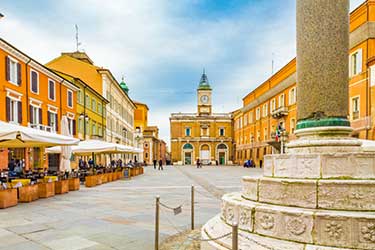
The atmosphere is relaxed: people stroll around, exchange a few words, have something at the café tables or browse the markets when they take place.
The most beautiful building in the square is the “Merlato” palace, today the Town Hall, which occupies the space once taken up by the Padenna river, filled in by the Venetians when they arrived in the city. Speaking of the Venetians: it was they who, around 1480, erected the two columns with the Lion of Saint Mark and the patron saint Sant’Apollinare.
The opposite side of the square was closed off by the churches of San Marco and San Sebastiano, now disappeared. The square was meant to show the rule of Venice over Ravenna, and so it did. In fact, immediately after the papal “reconquest”, the lion was dismantled and replaced with Sant’Apollinare, joined by San Vitale. Two curiosities about this column: on its surface you can still see a sundial that was used to indicate Ravenna’s solar noon.
On the bas-relief, the zodiac signs are not 12 but 13, including Ophiuchus, the only constellation that did not become a zodiac sign. Even lower down is the miniature of a Hercules Horarius, a large statue of Ravenna later destroyed by an earthquake.
The two Venetian churches on the other side of the square were demolished and replaced by the current Clock Tower. The other representative buildings in the square are the Apostolic Palace, now the seat of the Prefecture, the former headquarters of the Banca Nazionale del Lavoro and the Palazzo dei Rasponi del Sale, now the seat of a banking institution.
The Mausoleum of Galla Placidia in Ravenna
2
Approaching the Mausoleum of Galla Placidia, you would never imagine that the simplicity of the exterior hides, in just a few square metres, such splendid mosaics, the oldest in Ravenna. We are not exaggerating when we say that the atmosphere of the Mausoleum is magical.
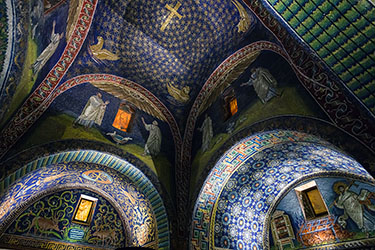
It was Emperor Honorius — who in 402 transferred the capital of the Western Empire from Milan to Ravenna — who wanted this mausoleum and dedicated it to his sister Galla Placidia.
The theme of the mosaics is in fact the victory of life over death, in keeping with the funerary purpose of the building. But it is the starry sky reproduced on the vault that most captures visitors’ imagination and remains forever impressed in their eyes.
It seems that the same thing happened to Cole Porter, who went to Ravenna on his honeymoon at the end of the 1920s. The story goes that it was precisely the starry sky of the mausoleum that inspired his very famous Night and Day.
Opening hours and ticket price for the Mausoleum of Galla Placidia
Opening hours: every day 9.00-19.00. On Saturdays, Sundays and holidays, booking is mandatory and must be made at least one day in advance, exclusively online
Closed: Christmas and New Year’s Day.
Ticket price: €10.50 (combined ticket including: Sant’Apollinare Nuovo, Neoniano Baptistery, San Vitale, Mausoleum of Galla Placidia, Museum and Archbishop’s Chapel). For the Mausoleum of Galla Placidia there is an additional charge of €2.
How to get there: Via Giuliano Argentario. On foot in Ravenna’s historic centre.
View on Google Maps.
The Basilica of San Vitale in Ravenna
3This octagonal temple — eight was a symbol of Resurrection because it was seven, time, plus one, God — is among the most important monuments of early Christian art in Italy.

Not only because of the splendour of its mosaics, but also because of its complete adherence to the canons of Eastern art: there are no naves, only a central octagonal core topped by a frescoed dome.
If you manage to take your eyes off the mosaics, especially from Theodora’s face, you will notice on the floor a series of concentric circles with arrows: it is a labyrinth, like those found in many Christian churches.
It symbolises the path out of sin towards purification. If you want to try to get out of the labyrinth, we’ll give you a little help: start from the centre, and discover the rest for yourself. Next to the basilica is the National Museum of Ravenna, which collects masterpieces donated or found in the city’s main excavation and restoration sites.
Opening hours and ticket price for the Basilica of San Vitale in Ravenna
Opening hours
From June to October every day 9.00-19.00
From November to May every day 10.00-17.00
Closed: Christmas and New Year’s Day.
Ticket price: €10.50 (combined ticket including: Sant’Apollinare Nuovo, Neoniano Baptistery, San Vitale, Mausoleum of Galla Placidia, Museum and Archbishop’s Chapel).
How to get there: Via San Vitale. On foot in Ravenna’s historic centre.
View on Google Maps.
Basilica of Sant’Apollinare Nuovo in Ravenna
4
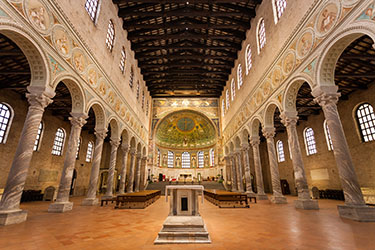
Not to be confused with Sant’Apollinare in Classe, which is outside the historic centre, 8 km from Ravenna, the Basilica of Sant’Apollinare Nuovo bears this name to distinguish it from another city church that had the same name: it houses the largest cycle of mosaics in the world.

The walls of the central nave are divided into three clearly distinct bands of mosaics: the highest band recounts the life of Christ, the central one depicts Saints and Prophets, while the lower one portrays the famous Palace of Theodoric.
The erasure of the Emperor’s figure and of other characters, covered with white drapery, took place when the basilica passed from the Arian cult, for which it had been built, to the Catholic cult.
On the opposite wall is the port of Classe, one of the most important in the Mediterranean at the time of the Roman Empire.
Opening hours and ticket price for the Basilica of Sant’Apollinare Nuovo
Opening hours
From June to October every day 9.00-19.00
From November to May every day 10.00-17.00
Closed: Christmas and New Year’s Day.
Ticket price: €10.50 (combined ticket including: Sant’Apollinare Nuovo, Neoniano Baptistery, San Vitale, Mausoleum of Galla Placidia, Museum and Archbishop’s Chapel).
How to get there: Via di Roma. On foot in Ravenna’s historic centre. View on Google Maps.
The Mausoleum of Theodoric
5
According to legend, the red porphyry basin on the upper floor of the Mausoleum is the very one in which the barbarian Emperor met his death. Since he was afraid of lightning, on a stormy day he took refuge in his mausoleum, but a lightning bolt struck him just as he was taking a bath.
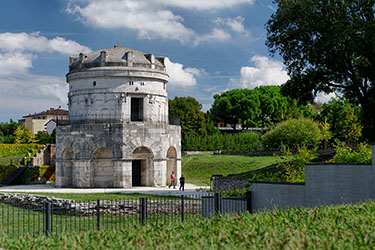
Through the cross-shaped opening in the roof of the Mausoleum, a black horse is said to have arrived and thrown him into Mount Etna!
There are many legends about the death of this barbarian king who ruled Italy for 33 years, bringing tolerance, peace and prosperity, and who had this mausoleum built in Istrian stone so that he might find peace in Ravenna, where he had lived. Its two-storey structure, decagonal in shape and topped by a massive roof made from a single block of stone, makes it a unique monument, completely different from Ravenna’s brick buildings.
Opening hours and ticket price for the Mausoleum of Theodoric
Opening hours:
Monday to Thursday: 8.30 – 13.30
Friday and Saturday: 8.30 – 19.00
Sunday: 8.30 – 13.30
Last admission: 30 minutes before closing time.
Closed: Christmas and New Year’s Day.
Ticket price: €4. Reduced: €2 for young people aged 18 to 25.
Tickets can be booked online.
How to get there: Via delle Industrie. Just outside the walls, in the Rocca Brancaleone area. Bus lines no. 2-5. View on Google Maps.
Basilica of Sant’Apollinare in Classe in Ravenna
6
Among Ravenna’s basilicas, this is the most imposing and majestic. Its mosaics rival those of the city’s other churches in beauty and portray Christ surrounded by the four Evangelists, while the sheep symbolise the Apostles.
The face of Jesus appears at the centre of the Cross, in a roundel decorated with 99 stars. The entire scene unfolds between the sky and the enchantment of a green paradisiacal landscape rich in rocks, trees, flowers and colourful birds.
Today the Basilica of Sant’Apollinare in Classe is located 8 km from the centre of Ravenna and a few kilometres from the sea, whereas when it was built it stood on the seashore.
Next to the basilica, in fact, are the excavations of the large archaeological area of the ancient city of Classe, headquarters of the Roman fleet in the Adriatic. Also not to be missed is the new Classis Museum, a journey into Byzantine Ravenna reconstructed in an old 19th-century sugar refinery.
The route goes from Prehistory to medieval Ravenna, but the museum is worth a visit even just for the staircase decorated with a 33-metre-long mosaic wave.
Opening hours and ticket price for Sant’Apollinare in Classe
Opening hours:
From Monday to Wednesday from 13.30 to 19.30 (last admission 19.00)
From Thursday to Saturday from 8.30 to 19.30 (last admission 19.00)
Sunday from 13.30 to 19.30 (last admission 19.00)
Closed: Christmas and New Year’s Day.
Ticket price: €4. A combined ticket for the Ancient Port of Classe + Classis Museum can be purchased for €12.
How to get there: 6 km from the centre, Via Romea Sud, 224. By car or bus no. 4 from Ravenna Central Station, or by train towards Classe. By bicycle: the museum is connected to the city by a cycle path. View on Google Maps.
Dante’s Tomb and San Francesco
7
For many, it is a surprise to discover that Dante’s Tomb is in Ravenna and not in Florence. Dante died in Ravenna during his exile and, despite repeated attempts to bring him back to his native city, he is still here.
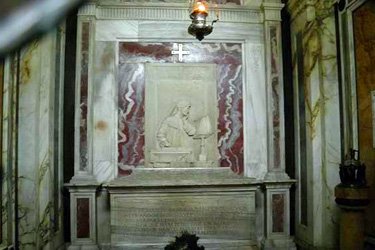
The Franciscans of the nearby convent stole and jealously preserved Dante’s bones for several centuries, opposing the wishes of rulers and popes who wanted to return his remains to Florence.
They were also the ones who saved them from the bombings of the Second World War, burying them under the mound of earth you can see next to the Tomb.
Today, Florence and Tuscany are remembered by the 18th-century votive lamp, fuelled with olive oil from the Tuscan Apennines, which is donated every year — on the second Sunday of September — by the city of Florence.
The so-called “zucarira”, the sugar bowl in the local dialect, as the people of Ravenna jokingly call Dante’s Tomb, is located in the “Zone of Silence”, a place of peace and tranquillity where Dante can rest.
Also part of this area is the Quadrarco di Braccioforte, where we find not only the mound that protected Dante’s bones during the Second World War, but also the great oak wanted by Carducci and the wall where, for about two centuries, the Franciscans hid Dante’s bones to prevent them from being taken away from Ravenna.
Do not miss, therefore, a visit to the nearby Church of San Francesco with its beautiful cloister. In particular, it is worth spending one euro to switch on the lights of the crypt, now underwater.
On the first floor of the convent is the Dante Museum, with the fir-wood box that housed Dante’s remains from 1677 to 1865.
Opening hours and ticket price for Dante’s Tomb
Opening hours:
From November to March: 10.00 – 18.00
From April to October: 10.00 – 19.00
1 January 2022: 13.00 – 18.00
Closed: 25 December
Ticket price: free
How to get there: on foot in Ravenna’s historic centre. View on Google Maps.
The Arian Baptistery in Ravenna
8
The Arian Baptistery of Ravenna was built during the reign of Theodoric, when Ravenna was the capital of the Empire and Arianism was the official religion of the court.
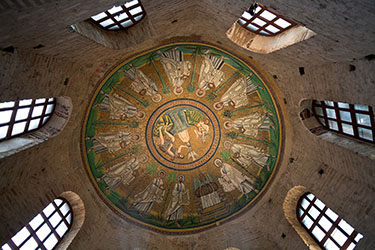
Arianism has always been considered a heresy of Christianity because according to Arian doctrine, Christ was the Son of God but retained his human nature: only through the rite of baptism was the divine nature communicated to Christ.
The mosaics on the vault of the baptistery celebrate precisely the baptism of Christ. Unlike in the nearby Orthodox Baptistery, here the young Christ is not represented as coming from the East (“light from light, true God from true God”), but moves towards the East, becoming divine only at the moment of baptism.
He is a man, therefore there is no “censorship” of his nudity, while he is immersed in the waters of the Jordan and John the Baptist administers Baptism to him. From above descends the divine dove, pouring a breath of light, symbol of the Spirit, over Christ’s head.
Opening hours and ticket price for the Arian Baptistery
Opening hours: Monday to Saturday: 9.00 – 12.00
Closed: Sunday
Ticket price: €2
How to get there: the baptistery is right in the historic centre, near the Basilica of the Holy Spirit.
The Neoniano or Orthodox Baptistery in Ravenna
9
The Neoniano Baptistery was the Catholic response, by Bishop Neone, to the Arian heresy, which had reached its greatest splendour in Ravenna under the reign of Theodoric.
This opposition is also found in the Christ depicted in the mosaic beneath the dome: unlike the one in the nearby Arian Baptistery, he comes from the East (“light from light, true God from true God”) and is divine even before the baptism given to him by John the Baptist and the divine dove — the Arians claimed the opposite.

It is said that Carl Gustav Jung, the famous psychologist, during a trip to Ravenna in the 1930s, saw in the Neoniano Baptistery a mosaic representing Christ reaching out to Saint Peter, who was about to drown.
He discussed this image at length with his travelling companion and interpreted it as a sign of death and rebirth.
Only much later, when he looked for a photo of the Neoniano Baptistery, did he realise that the image did not exist and had been the product of his imagination.
Jung used that episode to write beautiful pages on the relationship between the unconscious and consciousness, and on how imagination also changes the way we see reality.
Opening hours and ticket price for the Neoniano Baptistery
Opening hours: every day 9.00-19.00. On Saturdays, Sundays and holidays, booking is mandatory and must be made at least one day in advance, exclusively online
Closed: Christmas and New Year’s Day.
Ticket price: €10.50 (combined ticket including: Sant’Apollinare Nuovo, Neoniano Baptistery, San Vitale, Mausoleum of Galla Placidia, Museum and Archbishop’s Chapel). For the Neoniano Baptistery there is an additional charge of €2.
How to get there: Via Gioacchino Rasponi. On foot in Ravenna’s historic centre. View on Google Maps.
The Domus dei Tappeti di Pietra in Ravenna
10Italy is a country full of wonders that never stops revealing its extraordinary past: this is what happened with the Domus dei Tappeti di Pietra, discovered in the early 2000s, 3 metres below the level of the church of Sant’Eufemia.
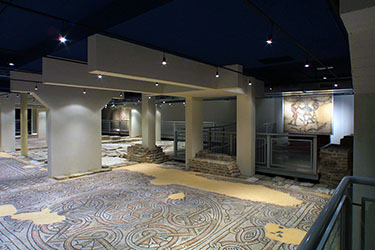
A wonderful Byzantine house from the 5th-6th centuries, with 14 rooms all decorated with polychrome mosaic floors and marble. The mosaics are absolutely extraordinary and allow you to imagine the wealth of the owner of the house and his taste for beauty.
Geometric, floral and figurative elements abound: the “Dance of the Geniuses of the Four Seasons” is a very rare representation showing the Geniuses dancing in a circle. Also unique is the mosaic with the figure of the “Good Shepherd”, portrayed in a version different from traditional Christian representations.
Opening hours and ticket price for the Domus dei Tappeti
Opening hours: every day from 10 to 18.
Ticket price: Full price: €4. Reduced: €3
How to get there: the Domus is located right in the historic centre, in a Limited Traffic Zone. By bus: line 70, stop in Piazza Baracca. View on Google Maps.
Ravenna Covered Market
11
During a visit to Ravenna, a gastronomic stop at the Covered Market, located in Piazza Andrea Costa, 100 metres from Piazza del Popolo, is a must.

Its origins are ancient, as it already existed in the 9th century, and over time several city markets followed one another here.
The market as we see it today is the result of an important renovation of the old interiors, which in 2008 allowed it to win a historic recognition awarded by the Directorate for Cultural and Landscape Heritage of Emilia-Romagna.
Walking among the stalls, you will find shops of every kind, from gastronomy to butchery, through the piadineria and the fishmonger. You can sit down at the restaurant or opt for a quick take away.
What should you taste at Ravenna Covered Market? The Romagna piadina with squacquerone is essential, to be paired with other ingredients — you will see that the choice is wide. Try the handmade fresh pasta, prepared according to Romagna tradition: green cappellacci, tagliatelle, passatelli and other formats to take away or eat on site.
Order a seasonal menu of fresh fish, a platter of local cheeses and cured meats, and as a main course mora romagnola meat accompanied by fresh side dishes and a glass of wine.
At the market shops it is also possible to choose typical products to take home when you return. Those who love immersive experiences in local culture can take part in food and wine workshops and labs.
Opening hours of Ravenna Covered Market
Opening hours:
Covered Market: MON-SUN 09:00 / 21:00;
Shops: MON-SUN 09:00 / 21:00;
Restaurant (Delivery 09:00 / 22:00 – Takeaway 09:00 / 21:00)
Official website: https://www.turismo.ra.it/
Mirabilandia in Ravenna
12It is not the first thing we recommend seeing in Ravenna, but it is undeniable that for many Italians going to this Romagna city mainly means Mirabilandia, one of Italy’s most famous amusement parks.

Divided into 6 themed areas, it is a park for the whole family because it includes both thrilling attractions and quieter routes.
It starts with Adventurland, the area for those who are not afraid and do not fear adventure, with roller coasters over a kilometre long and speeds exceeding 100 km/h.
No less adrenaline-filled is the Route 66 area dedicated to the USA, with a ride skimming the water in a vehicle inspired by the world of offshore racing, stunt shows, naval battles with water cannons and even a laser game set in New York.
Also inspired by the USA is the Far West area. For younger children there are Bimbopoli and Dinoland, while motorcycle enthusiasts have an entire area dedicated to Ducati. Of course, there are also dozens of restaurants and shops. The entire visit requires at least one day, two if you also enter Mirabeach, Mirabilandia’s water park with pools and attractions.
Opening hours and ticket price for Mirabilandia
Opening hours: summer 10 – 20. October weekends only 10-18. Closed in winter.
Adult ticket price: Mirabilandia only online €19.90, at the ticket office €34.90.
Mirabilandia + Mirabeach €50, valid for two days.
Child ticket price up to 140 cm: Mirabilandia only online €19.90, at the ticket office €29.90.
Free for children up to 100 cm. Mirabilandia + Mirabeach €45, valid for two days.
How to get there: by car towards Cesena Nord.
By bus from Ravenna: line 176 or line 4 + line 176 + Ravenna FS shuttle line. View on Google Maps.
The Pialassa della Baiona in Ravenna
13
The Pialassa della Baiona is a lagoon nature area in the province of Ravenna. It is part of the Po Delta Regional Park, an area of great landscape interest. The distinctive feature of this zone is the presence of the so-called “barene”, sandbanks that emerge from the lagoon waters depending on the tides.
The place is ideal for observing many species of birds and typical plants of brackish waters, such as glasswort and tamarisk. Cormorants, pink flamingos, swans and herons find their ideal habitat here. In the lagoon you will also come across the “padelloni”, typical Romagna stilt huts used for fishing with large nets lowered into the water.

Arriving by car, after parking you continue on foot for a short stretch through the San Vitale Pine Forest. Wooden walkways lead to the sandy shore of the lagoon.
Alternatively, to admire the area from an exclusive perspective, you can reach the Pialassa by boat from Porto Corsini or Marina Romea.
The excursion takes place in the company of fishermen who explain the beauty of the area. The tour continues to the nearby Isola degli Spinaroni, and at times the engines are switched off to make it easier to spot the local wildlife. The luckiest visitors may even see the flight of pink flamingos.
Perhaps the most beautiful moment of the day is sunset: as the sun goes down, a special magic is created — a camera is essential! The Pialassa can be visited independently, or you can book a tour with an environmental guide, which we recommend in order to deepen your knowledge, discover curiosities and explore unusual lagoon corners.
The Pialassa della Baiona is located two kilometres from Marina Romea, a seaside resort on the Adriatic Riviera ideal for a peaceful family-friendly holiday.
How to get to the Pialassa della Baiona
By car from Ravenna: a quarter of an hour, about 17 km.
By bus: Line 90 from Ravenna railway station, get off at the Delle Valli stop in Marina Romea. From there, 9 minutes on foot.
What and where to eat in Ravenna
14
Let’s say it straight away: Ravenna is not a place for anyone trying to get back in shape, unless they have an iron will to resist the abundant, rich, succulent and very calorific Romagna cuisine.

You usually start with mixed cold cuts and squacquerone, continue with cappelletti and tagliatelle with ragù, then move on to meat, fish and seafood, or to the inhabitants of the abundant local canals, such as eels and frogs. You finish with a mascarpone dessert, and everything is accompanied by Albana, Sangiovese, Trebbiano or Pagadebit. Two good places to taste typical local cuisine are Cà De Vèn and Locanda del Melarancio in the heart of the historic centre. For a quick piadina, there is Piadina del Melarancio , also in the centre, and many other more or less pleasant places.
The surroundings of Ravenna
15Ravenna can be visited in 2-3 days if you want to take things very calmly. Some people manage to see everything in one day, but we do not believe that is the right way to visit this jewel. If you have a little time left, however, the surroundings of Ravenna mainly offer sea and villages. Let’s start with the beaches of Ravenna, a long strip of fine sand, 40 km, with clean Blue Flag water, and nine very well-equipped seaside resorts, especially ideal for families and for those who do not like very wild beaches.

For nature lovers, around Ravenna there is one of the most beautiful places in the world: the Po Delta, with extraordinary landscapes where oases, valleys, lagoons and canals follow one another. Speaking of canals, the first village to visit is Comacchio, a little Venice built entirely on water. Without water but equally beautiful and colourful is the village of Brisighella, with its famous Via degli Asini and pastel-coloured palace façades. Not far away is also San Leo, a perfect village, and leaving Romagna you reach Gradara, the famous Dantean fortress of Paolo and Francesca and
How to get to Ravenna, how to get around and where to park
+
Ravenna is easy to explore on foot and convenient to visit because everything worth seeing is concentrated within a few square kilometres. Except for Sant’Apollinare in Classe, all the monuments and churches are in the historic centre, much of which is pedestrianised. The risk of entering an active restricted-traffic gate and receiving a fine is very high, so once you arrive near the historic centre, it is better to choose one of the many paid or free car parks and then continue on foot. To organise your visit to the various monuments, we recommend downloading the historic centre map from the official Ravenna Tourism website.
We are in Emilia-Romagna, so seeing people speeding by on bikes is the norm, also because there is a very dense network of cycle paths. Ravenna can therefore be visited by bicycle, which can be rented at the Velostazione in Piazza Farini or at Casa del Ciclo in Via San Mama 152.
If you want to reach the seaside resorts or the Po Delta, there is a day and night bus service run by Start Romagna, useful for those who arrive in Ravenna without a car.
Ravenna station is located in Piazza Farini, a 3-minute walk from the historic centre.
Ravenna can be reached by car via the A14 motorway, Ravenna exit, while the nearest airports are Forlì, Rimini and Bologna, at 30, 60 and 90 km respectively.
Where to stay in Ravenna
Taken over by school groups in spring, university students all year round and tourists in the warm months, Ravenna has an excellent tourist accommodation offer organised around hotels, B&Bs, guesthouses and apartments.

There are many hotels in the historic centre and they are not expensive, although you need to book a little in advance, especially in spring and autumn. Many more options are available in hotels just outside the centre and further out in the suburbs. In addition, the Romagna Riviera is not far away, with its extraordinary accommodation offer. The average price of a 3-star hotel for one night starts from €50.
If you are looking for a hotel in Ravenna, we recommend choosing from those offered by Booking.com. There are about 30 hotels with prices, photos and reviews from guests who stayed before you. Go to Booking.com