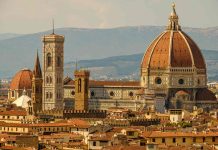

More than 100,000 students from the ancient university of Krakow look for an escape from the boredom of lectures by roaming through clubs, pubs, beer halls and discos, especially in winter, when the thermometer drops below zero and stays there for weeks.
This constant presence of students — and their professors — has made Krakow, for several centuries now, the true cultural capital of Poland. But even if students are not really your thing, and you are not the kind of traveller who visits a city just to find out what its nightclubs are like, Krakow will not disappoint you.
The Old Town is intact and unfolds around the largest medieval square in Europe. From the top of Wawel Hill, the Castle watches over the city, as it has done at least since Polish rulers were crowned here.
In the city centre there is also a small but fascinating museum housing Leonardo da Vinci’s enigmatic and beautiful Lady with an Ermine, while outside the centre the salt mines and the district of Nowa Huta are well worth a visit: the “ideal city” of the socialist regime, though in truth there was little ideal about it.
To stay with that theme, Karol Wojtyla lived in Krakow, carrying out his dual role as bishop and dissident before becoming Pope and moving to Rome. A tour of the places connected with his life is one of the most popular itineraries. On this page we recommend the 10 things you absolutely must do and see during your visit to Krakow.
If you are looking for useful information about local laws, the most dangerous areas, hospitals and emergency numbers in Krakow, read our page with useful tips for visiting Krakow.
If, instead, you are looking for a hotel, we recommend Booking.com. Around 400 hotels with photos, facilities, prices and reviews from guests who have already stayed there. Go to Booking.com.
Krakow Castle
1
If you love legends, Krakow Castle — Wawel — is exactly the place for you: once upon a time, a dragon lived here and terrorised the city. The king promised half his kingdom and his daughter’s hand in marriage to whoever managed to kill it:

a shoemaker succeeded by feeding the dragon a sheep stuffed with sulphur, forcing it to drink the entire river of Krakow — the Vistula — until it burst. The dragon, fortunately now in the form of a fire-breathing but harmless monument, awaits you at the entrance to Wawel. Beyond the legends, Krakow Castle is a symbolic place for all of Poland: this is where the rulers of the Kingdom lived and were crowned before the capital became Warsaw. Many rooms can be visited, together with the Royal Chapel, the Royal Treasury and the medieval armoury.
Find out more about Krakow Castle.
Opening hours and ticket price for Krakow Castle
Opening hours: in general, open every day except from 9:30 am to 5:00 pm; each area has different opening hours.
Ticket price:
Royal Apartments: full price 25 PLN, reduced 15 PLN for school pupils, university students and over 65s. Free for children aged 0-7.
Armoury: full price 15 PLN, reduced 10 PLN for school pupils, university students and over 65s. Free for children aged 0-7.
State Rooms: full price 30 PLN, reduced 20 PLN for school pupils, university students and over 65s. Free for children aged 0-7.
Crown Treasury: full price 25 PLN, reduced 15 PLN for school pupils, university students and over 65s. Free for children aged 0-7.
Church of St Gereon: full price 10 PLN, reduced 5 PLN for school pupils, university students and over 65s. Free for children aged 0-7.
Lost Wawel: full price 15 PLN, reduced 10 PLN for school pupils, university students and over 65s. Free for children aged 0-7.
Wawel Recovered: full price 10 PLN, reduced 5 PLN for school pupils, university students and over 65s. Free for children aged 0-7.
How to get there: the Castle is located on the hill of the Old Town. It can be reached from the centre on foot in 10 minutes. By tram: Wawel stop; by bus: Jubilat stop.
Krakow Cathedral
2Krakow Cathedral stands on Wawel Hill and is one of the most important religious sites in Poland. When Krakow was the capital of the kingdom, before Warsaw took on that role, Polish rulers were crowned in Krakow Cathedral, their funerals were held here, and royal dynasties and illustrious figures were buried here, including the great poets Mickiewicz and Slowacki and national heroes such as Kosciuszko.
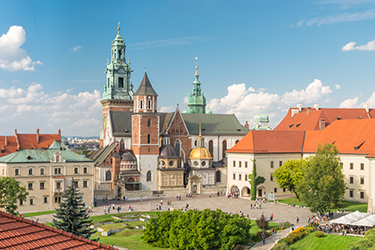
The church was built in Gothic style between 1320 and 1364, and over time no fewer than 19 chapels were added, in Gothic, Renaissance and Baroque styles. The Cathedral is dedicated to Saints Stanislaus and Wenceslaus.
The interior of Krakow Cathedral is rich in works of art: royal sarcophagi, particularly the beautiful one of King Casimir Jagiellon by Veit Stoss in the medieval Chapel of the Holy Cross; fine altars, including the famous one dedicated to St Stanislaus, patron saint of Poland, which houses his relics; and the highly distinctive dark wooden Gothic Christ wrapped in black tulle belonging to Saint Hedwig.
But above all stands the funerary Chapel of Sigismund, built to a design by the Italian architect Berrecci, which, with its magnificent gilded dome, is considered the masterpiece of Polish Renaissance architecture.
The Cathedral is topped by three towers, one of which contains the imposing Sigismund Bell — zygmunt — from 1520, cast from metal taken from cannon barrels and weighing a full 11 tonnes. It is rung only on special occasions; it takes 10 people to set it in motion, and its sound can be heard up to 12 km from Krakow.
From the top, there is a beautiful view over the city. A small curiosity: if you are looking for your soulmate, you are in the right place. It is said that anyone who touches the bell’s clapper will soon find them. Since you are already up there, why not try?
Opening hours and ticket prices for Krakow Cathedral
Address: Wawel is located in the upper part of Krakow and is visible from across the city.
How to get there: on foot from the Old Town. Tram: 9, 10, 13, 19, 22, 24, Wawel stop.
From April to September: every day from 9:00 am to 5:00 pm; Sunday: from 12:30 pm to 5:00 pm
From October to March: every day from 9:00 am to 4:00 pm; Sunday: from 12:30 pm to 4:00 pm
Ticket price: 12 zloty — €3.
Krakow Old Town
3
Perfectly preserved, with very few cars and many bars and restaurants, Krakow Old Town — Stare Miasto — is a UNESCO World Heritage Site.
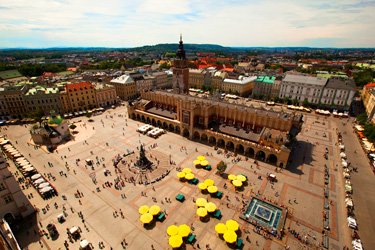
The heart of the Old Town is the Rynek, the Market Square, which Poles say is the largest in Europe. At the centre of the Rynek stands the Cloth Hall — Sukiennice — where you can indulge in souvenir shopping, while on one side of the square rises St Mary’s Church, with its two towers of different heights.
The Old Town borders another historic district of Krakow, Kazimierz, named after its founder, King Casimir the Great. For around 600 years it was home to Krakow’s large Jewish community, until it was exterminated by the Nazis.
After decades of neglect, it came back to life above all thanks to the attention brought by the filming of Schindler’s List — the factory itself is really located 20 minutes outside the centre. Do not miss the synagogues and the old shops with their original signs.
Find out more about Krakow Old Town.
Krakow’s Rynek
4
The beating heart of medieval Krakow is the immense Market Square — Rynek Glowny — a square measuring 200 metres on each side, a symbol of Krakow and one of the largest squares in Europe. Today, as in the past, the square is the nerve centre of Krakow’s public, cultural and commercial life. It will enchant you with its cafés, galleries, flower stalls, horse-drawn carriages and improvised performances by musicians and street artists.
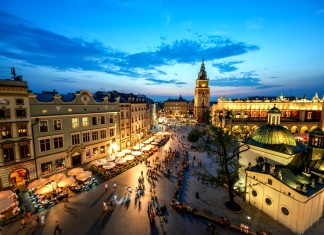
In one corner of the square stands the Town Hall Tower — Wieza Ratuszowa — or rather what remains of the town hall built at the end of the thirteenth century and destroyed by the Austrians in 1818.
The tower leans by more than 50 centimetres, and from its 70-metre height there is a fine view over the city. In the underground level, where the old dungeons once stood, you will now find the Ludowy Theatre, where you can attend a fine classical music concert. Visit: May-October 10:30 am – 2:00 pm and 2:30 pm – 6:00 pm. Cost: 5 Zl.
In the square stands the statue dedicated to Adam Mickiewicz, one of Poland’s best-known and best-loved writers, seen as the embodiment of the dreams and ideals of the Polish people.
Dismantled by the Nazis in 1940, it reappeared in 1955. At the sides of the monument there are four statues symbolising the Homeland, Science, Courage and Poetry. The monument has become the favourite meeting point for the people of Krakow, especially the young, who arrange to meet here both by day and by night.
At the centre of the square rises the imposing ancient Cloth Hall — Sukiennice. Built in the thirteenth century as a centre for the textile trade, it was destroyed by fire in 1555 and rebuilt in Renaissance style.
In the nineteenth century it took on its present form, with neo-Gothic portals and decorative mascarons. It was a business centre for around 700 years: merchants arriving in Poland met here to barter and buy goods. On the ground floor, beneath characteristic vaults, there is a succession of small souvenir and local craft shops — lace, embroidery, wooden and marble chessboards, silver and amber jewellery; the first floor, meanwhile, houses the Gallery of Nineteenth-Century Polish Painting and Sculpture.
St Mary’s Basilica
5
To the north-east of the Rynek, the main square of Krakow, rises the unmistakable outline of St Mary’s Basilica — Bazylica Mariacka — a fourteenth-century Gothic church with two towers of different heights, one 69 metres and the other 81 metres.
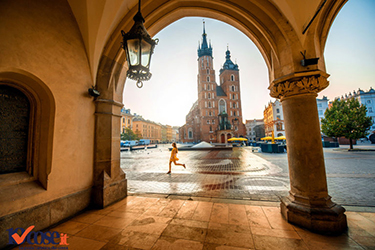
It is said that the construction of the two towers was entrusted to two architect brothers. The fierce competition between them led the elder brother to stab the younger one, whose tower remained unfinished after his death.
There are two versions of what happened to the fratricide: according to the first, he was overcome by guilt and took his own life with that same knife; according to the second, the murderer was executed. This explains the sad story behind the large rusty knife hanging from the wall of one of the arches of the Sukiennice, placed there as a reminder that crime does not pay.
Opening hours and ticket price for St Mary’s Basilica
Opening hours:
Every day from 11:30 am to 6:00 pm.
Sunday: from 2:00 pm to 6:00 pm
Ticket price: Adults: 10 zl.; reduced: children, seniors and students 5 zl.
How to get there: on foot in the historic centre.
Find out more about St Mary’s Basilica
The Kazimierz District in Krakow
6The Kazimierz district was, above all, the centre of the religious and social life of Jewish Krakow until the Semitic community that lived there — around 65,000 people — was deported to the various extermination camps during the Nazi occupation.
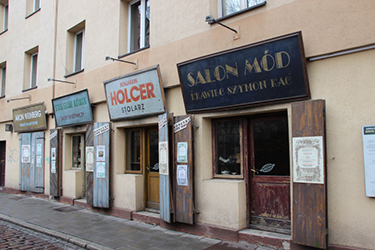
Walking through the old stone streets, you can sense the spirit of Jewish culture everywhere: the synagogues, the façades of the houses on Jozefa Street with Yiddish inscriptions and, in some cases, the Star of David, as well as the busy daily market of Plac Nowy, the district’s main square.
Neglected and abandoned until about a decade ago, the district regained prestige and fame also thanks to the scenes from Schindler’s List that were filmed here. Today it is a lively neighbourhood where artists’ workshops, alternative venues and fashion shops continue to open.
Find out more about the Kazimierz District
Lady with an Ermine in Krakow
7
How a masterpiece by Leonardo da Vinci ended up in the Czartoryski Museum in Krakow is a long story, and one that perhaps does not interest everyone. Far more fascinating is the story of the “Lady” portrayed: she is believed to be Cecilia Gallerani, whom Leonardo met in
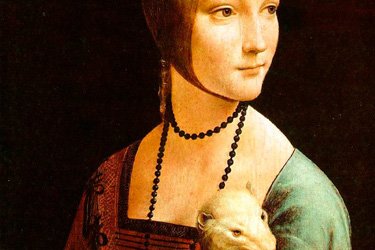
Milan in 1494, while he was staying at the Sforza Castle as a guest of the ruler of Milan, Ludovico “Il Moro” Sforza. Leonardo was commissioned to paint Cecilia, who at the time was only 15 but already famous for her sensitive spirit. The ermine was the symbol of Ludovico il Moro, but in Leonardo’s intention it was also meant to recall the root of Cecilia’s surname — ermine in Greek is “gale”. After wandering across Europe between Poland, Italy and France, Lady with an Ermine came to rest in Krakow’s Czartoryski Museum, alongside a Rembrandt, a Mantegna and a few other important works.
Find out more about the Czartoryski Museum.
Opening hours and ticket price for Lady with an Ermine
Opening hours: the painting is housed in the Princes Czartoryski Museum, open Tuesday, Friday and Saturday 10:00 am-7:00 pm, and Wednesday, Thursday and Sunday 10:00 am-6:00 pm. Closed on Monday.
Ticket price: full price 38 PLN, reduced 28 PLN for school pupils, university students and over 65s. Free for children aged 0-7 and every Tuesday.
How to get there: on foot in the Old Town. Bus: 124, 152, 424 — tram: 4, 14, 18, 20, 52, Stary Kleparz stop.
Krakow’s Museums
8
Home to countless museums and art galleries, and the setting for major artistic events — the Graphic Arts Biennial, the Short Film Festival, the Jewish Culture Festival — Krakow, with its passion for music, poetry and theatre, has everything it needs to be considered the cultural capital of Poland.
It has several museums, although most visits tend to focus on the Czartoryski Museum, where you can find Lady with an Ermine, one of Leonardo da Vinci’s most famous and mysterious female portraits, and Rembrandt’s Landscape with the Good Samaritan.
For art lovers, the tour can continue with a visit to the Jean Matejko House Museum, where numerous sketches, drawings and preparatory works by the great artist who painted the key episodes of Polish history are displayed. The most significant works, however, are kept in the Gallery of the National Museum, on the first floor of the Sukiennice. Also interesting is the Stanislaw Wyspianski Museum, dedicated to the leading figure of Polish Art Nouveau, with personal objects and works by this eclectic artist.
In the Natural History Museum you can see the best-preserved mammoth in the world, practically intact, while a visit to the Pharmacy Museum will show you how far medicine has come over the centuries.
But in Krakow there really is something for everyone. Today the city also boasts a Museum of Contemporary Art, MOCAK, built on the site of the former Schindler factory. The museum, which deliberately preserves an industrial character, gives space to international art collections, with particular attention to the most recent artistic phenomena, as if sealing the bond between memory and the future.
The Pope John Paul II Tour in Krakow
9
Even if you are not religious and do not care much about the Pope, you will somehow feel the spirit of Pope Wojtyla hovering over Krakow. Before becoming Pope, Karol Wojtyla was bishop of the city for about 15 years.
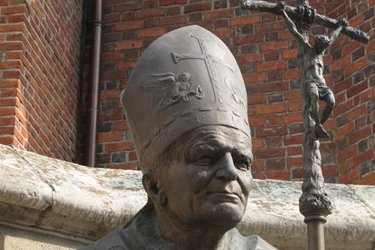
The visit winds through the Debniki district, where he lived when he first arrived in Krakow, the ancient Jagiellonian University, where he studied and taught philosophy, the Rynek, and the Bishops’ Palace near the Rynek, where he lived as Bishop of Krakow. In all the city’s churches, the future Pope prayed and celebrated Mass, while a church of strong symbolic value stands in the suburban district of Nowa Huta, just outside Krakow. Wojtyla laid the first stone of the church — the Lord’s Ark — in 1967, but only after 20 years of struggle with the communist government did the workers of the socialist industrial district obtain permission to complete it.
Find out more about the places of Pope Wojtyla in Krakow.
Nowa Huta in Krakow
10
You can certainly continue to live perfectly well without ever visiting Nowa Huta in Krakow, but it is worth taking a look around this district, especially if you are interested in architecture or history. This is where the 40,000 workers of Krakow’s steelworks lived with their families. According to the socialist regime, it was supposed to be the ideal city, with broad avenues, green spaces and a very intense collective life.
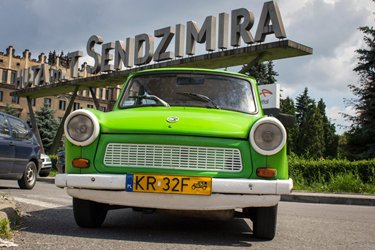
In practice, Nowa Huta was a grim place, poisoned by the fumes of the steelworks, where people lived in deprivation and were forced into identical apartment blocks. Today the district can be visited on a tourist tour in an old Trabant, the quintessential car of the Eastern Bloc regimes. In Nowa Huta you will find the Lord’s Ark, a rather unattractive church but one with strong symbolic value: it was Karol Wojtyla, then bishop of Krakow, who laid the first stone. Only after 20 years of struggle did the workers obtain permission to build it.
Find out more about the district of Nowa Huta in Krakow.
Collegium Maius of the University of Krakow
11Every day, at all hours, around 150,000 students fill the streets, bars, squares and every corner of Krakow.
The city’s academic tradition boasts centuries of history, so knowledge and culture are truly at home here. It was 1364 when King Casimir the Great founded the Jagiellonian University, one of the oldest in Europe, second only to the University of Prague.

Renewed in 1400 by King Wladyslaw Jagiello, it became a centre for the spread of new ideas in science and philosophy.
Illustrious names have brought prestige to the Polish university: Copernicus, Karol Wojtyla and the poet Szymborska, winner of the Nobel Prize for Literature, all studied here.
Collegium Maius is the oldest building of the University of Krakow. Do not miss the inner courtyard, with its beautiful late-Gothic arcades — free entry — where at 1:00 pm the clock above the Golden Gate comes alive with small figures representing the rector and professors, who perform a brief musical procession to the notes of an old student song.
Guided visits allow you to discover the library — Libraria — where the original manuscript of Copernicus’s De Revolutionibus Orbium Coelestium from 1543 is preserved; the professors’ room — Stuba Commins — with its Moorish-style stove and a fine carved wooden staircase; and finally the university ceremony hall — Aula — with the Latin motto inscribed on the wall: plus ratio quam vis, meaning “reason is worth more than force”.
Opening hours and ticket price for Collegium Maius
Opening hours: every day from 10:00 am to 2:20 pm. Saturday: from 10:00 am to 1:20 pm.
From 1 April to 31 October: from 10:00 am to 5:20 pm
Ticket price:
Adults: 12 zl.; reduced: children, seniors and students 6 zl.
How to get there: via Jagiellońska 15. On foot in the historic centre.
Krakow’s Churches
12
Krakow, the city of a hundred churches, is Poland’s spiritual capital, often described as “the Mecca of the Poles”, since many places of worship have become pilgrimage destinations thanks to the miraculous icons or relics of saints they preserve.
The two main churches are St Mary’s Basilica, in the city’s main square, and the Cathedral, on Wawel Hill. But there are many other churches worth visiting: here are a few.
One of the oldest is the Church of St Adalbert, patron saint of Poland, built at the southern corner of the Market Square, on the spot where, according to legend, the saint preached.
A small wooden church from the end of the first millennium — its construction predates the square itself — it was rebuilt first in the eleventh century in Romanesque style and then again in the seventeenth century in Baroque style.
In the underground level, where the remains of the original structure are preserved, there is a permanent exhibition on the history of the Market Square.
The Romanesque Church of St Andrew dates back to the end of the eleventh century. The church has three naves and two towers topped by Baroque domes. Inside it, the inhabitants took refuge during the Tatar raids of the thirteenth century. It was therefore both a place of prayer and of defence, as shown by the arrow slits and thick walls.
The austere appearance of the stone and brick façade contrasts with the rich Baroque interior, with gilding, black marble and stucco cherubs.
Particularly beautiful is the rococo pulpit, shaped like a ship.
The Church of Saints Peter and Paul is the first example in Poland of a church built in Baroque style. It was constructed between 1597 and 1635 for the Jesuits, to a design by Italian architects, who took as models the Church of the Gesù by Vignola and the Church of Sant’Andrea della Valle in Rome.
The Latin-cross church is topped by a large elliptical dome from which a Foucault pendulum swings — Thursday 10, 1, 12 — demonstrating the Earth’s rotation. Outside, a row of life-size statues of the 12 Apostles — copies of the 1723 originals damaged by pollution — protects the church.
Visit: Mon-Sat 9:00 am-5:00 pm and Sun 1:00 pm-5:00 pm; June-September until 5:45 pm. Admission to the crypt and transept for a fee: 2.5 Zl.
Also Baroque is the seventeenth-century Church of St Anne, dedicated to St Anne Metterza, whose image decorates the main altar. In the side altar is the sarcophagus containing the relics of St John of Kety. The stuccoes by Baldassarre Fontana are beautiful, and the organ is precious.
Krakow’s Salt Mines
13
Just 13 km outside the centre of Krakow there is an extraordinary sight not to be missed: the Wieliczka Salt Mines, which for centuries supplied Poland with salt and wealth.
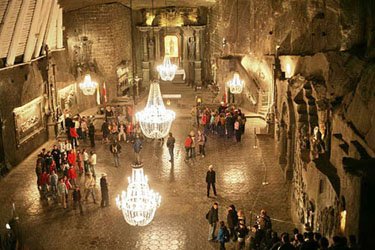
After production ended, fortunately, the mines were not abandoned but restored and transformed into an exceptional tourist attraction. Most astonishing of all is the “Salt Cathedral”, a real church measuring 54 by 12 metres, dedicated to Blessed Kinga, patron saint of Polish miners. But there is much more to discover: almost 300 km of tunnels with bas-reliefs, decorations and underground lakes, as well as an area for salt inhalation therapy. The mines are, in fact, genuinely beneficial for allergy sufferers, thanks to their stable microclimate and pure air.
Find out more about Krakow’s Salt Mines.
Opening hours and ticket price for Krakow’s Salt Mines
Opening hours: every day 8:30 am-5:30 pm; guided tours in Italian at 1:14 pm and 4:15 pm.
Ticket price:
Adults: 119 PLN
School pupils, with ID: 99 PLN
University students and over 65s: 109 PLN
Children aged 0-4: free
How to get there: the tourist route is located at ul. Daniłowicza 10 in Wieliczka. From Krakow, you can arrive by train, Wieliczka Rynek Kopalnia stop, or by bus 304, Dworzec Główny Zachód stop.
Auschwitz near Krakow
14
The place of tragedy par excellence, not everyone knows that Auschwitz is a Polish town just a few kilometres from Krakow. It is certainly not a place for those looking for a relaxing, carefree holiday,
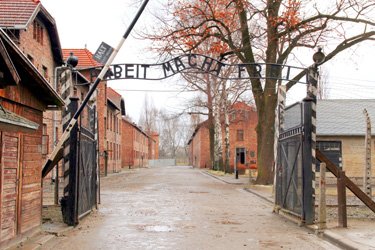
but if travel is essentially the pleasure of discovering new cultures and learning something, then Auschwitz is an essential stop. More than 1.5 million people, including Jews, homosexuals, political opponents, Roma people and people with disabilities, were exterminated in this place designed to turn murder into an unstoppable industrial process. Cross the gate with the famous and mocking inscription Arbeit Macht Frei — “Work sets you free” — and you will be thrown into absolute horror, testified by gas chambers, personal belongings, photographs and documentaries on the extermination. The tour includes transfer from the centre of Krakow and a visit to the camp lasting about half a day.
Find out more about Auschwitz near Krakow.
Opening hours and ticket price for Auschwitz
Opening hours: every day from 7:30 am.
Ticket price: free admission for visits without a guide, with identity document and reservation on visit.auschwitz.org. The visit is not recommended for children under 14.
How to get there: the museum is located on the outskirts of the town of Oświęcim, on national road 933. The tour begins at the former Auschwitz I camp. It can be reached by car or by train from Krakow station.
Going Out at Night in Krakow
15
Krakow is a university city: that alone is enough to imagine the buzz that fills the city during the months when the university is open, and therefore the number of venues of every kind in the historic centre.
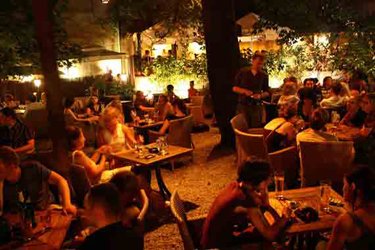
Every evening, almost 100,000 students seek refuge in beer halls, pubs, discos and live-music venues where every kind of music is played. Nights out in Krakow, then, are unlikely to be boring and, importantly, do not require a large wallet, because prices are very affordable.
What to Eat in Krakow
16
The best way to enjoy Krakow’s cuisine is to dive into a jadłodajnia, a kind of trattoria serving generous traditional food at very low prices, or into a Mleczny Bar,
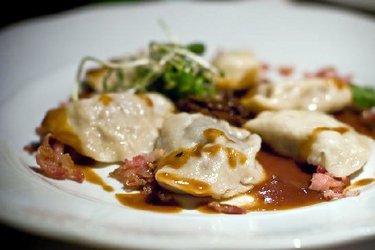
a reminder of the old communist regime, where you eat self-service and rarely spend more than €5. They are scattered throughout the city.
It must be said that Poland is not world-famous for its gastronomy, but fortunately Krakow is an exception: the variety of dishes is certainly fairly limited, and after a few days you may not want to see meat and potatoes again for a few months.
In any case, try the pierogi — dumplings filled with cheese, meat or other ingredients — barszcz — beetroot soup with dumplings — chlodnik — a cold soup made with curdled milk — and bigos, a hearty meat stew. Do not forget to take a walk through the Jewish Ghetto, where very cheap street food still survives. All of it, of course, accompanied by excellent Polish beer, which flows freely here.
Where to Stay in Krakow
H
Krakow has an excellent range of hotels, hostels and apartments at relatively affordable prices.
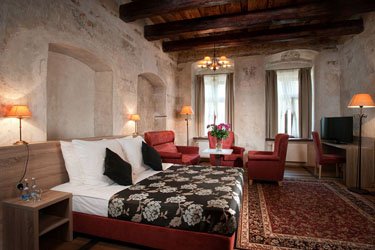
The large presence of university students and professors does not affect the availability of mid-range hotels, but only that of apartments and low-cost rooms. For tourists, therefore, there is plenty of choice, but if you decide to visit the city in spring, you need to book well in advance to find a good balance between price and quality. With the city’s growing tourist success, prices are rising a little, but they are still affordable. For a double room in the historic centre in a 3-star hotel, prices range from €40 to €80 per night.
The full range of hotels in Krakow is available on Booking.com. Around 400 hotels with photos, facilities, prices and reviews from guests who have already stayed there. Go to Booking.com