

Do not be misled by the silhouette of the Palace of Culture and Science, a legacy of socialist architecture. Although it is the first thing you will see when arriving in Warsaw, it does not represent the true beauty of the Polish capital.
Not surprisingly, locals call it “the Monster”. Quite a contrast with the nickname “Paris of the North”, by which the Polish capital was known before the Second World War destroyed it.
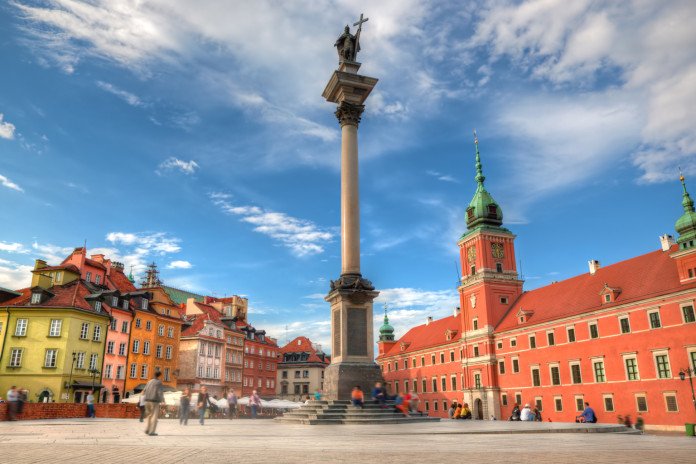
The historic centre, perfectly reconstructed, is a small jewel of colourful façades, narrow lanes, gas lamps and hidden little squares.
There are two essential places in the centre: the Market Square, with the Mermaid, symbol of the city, and Castle Square, the place where Warsaw began.
Just outside the centre, following the ancient “Royal Route”, you reach two palace-parks: Wilanów and Łazienki, the legacy of kings, nobles and wealthy merchants.
But these are only some of Warsaw’s highlights: discover with us the 10 things you absolutely must see and do during a visit to Warsaw.
The full range of Warsaw hotels is available on Booking.com. Around 550 hotels with photos, facilities, prices and reviews from guests who have already stayed there. Go to Booking.com
Warsaw Old Town
1
Completely destroyed during the bombings of the Second World War, Warsaw Old Town (Stare Miasto) was entirely and meticulously rebuilt.
The work was carried out so well that, in essence, the “copies” are almost indistinguishable from the originals, and UNESCO therefore granted this area protection as a World Heritage Site.
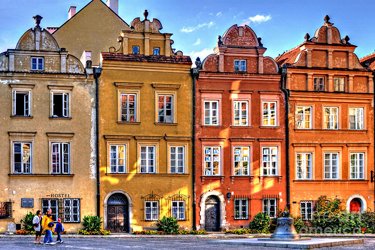
This intricate maze of lanes, little squares and noble palaces with colourful façades is striking on the few sunny days the city enjoys, and reveals its most romantic side as evening falls.
The main sights in the Old Town are Market Square (see point 2), Castle Square (see point 4), the Barbican, and the churches of St John and St Martin.
Market Square in Warsaw
2
An essential stop on any visit to Warsaw, Market Square (Rynek Starego Miasta) was for centuries the centre of city life: markets, fairs, public ceremonies, executions and everyday urban affairs all took place in this great square.
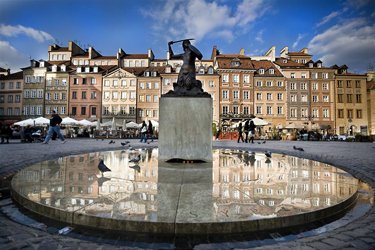
Today it is simply a gathering place for travellers, drawn by the outdoor tables of cafés and restaurants and by the souvenir shops tucked into the surrounding lanes. On the four sides of the square stand the colourful houses, entirely rebuilt after the bombings of the Second World War, following drawings by the Italian painter Bellotto.
In the finest Eastern European tradition, the houses have curious names: the Basilisk House, the Lion House, the Golden House. At the centre of the square stands the statue of a Mermaid, considered the sister of the more famous one in Copenhagen.
According to legend, this little mermaid lived in the Vistula, Warsaw’s river, and used to disturb the fishermen. She was captured and then freed; from that moment on, she has watched over the Polish capital.
Castle Square in Warsaw
3
Warsaw was born in what is now Castle Square, the meeting point between the Old Town and the New Town.
The first castle was built by the Dukes of Masovia and, over the centuries, was enlarged, looted and set on fire, until its complete destruction at the hands of the Nazis.
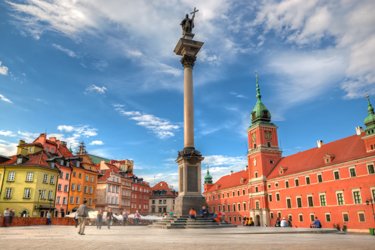
The stones from the ruins were left in the square until 1971, when reconstruction began; it was completed in 1984. Do not miss the painting collection, which includes two works by Rembrandt.
At the centre of the square stands Sigismund’s Column, erected in 1644 in honour of the king who moved the capital from Kraków to Warsaw.
The Royal Route starts from the square: a 4 km route that once led to the old summer residence of Wilanów (see point 4).
The Royal Route is actually made up of three stretches of road with different names, lined with Baroque and Renaissance palaces, churches, bourgeois townhouses, monuments, cafés, luxury restaurants and souvenir shops.
Opening hours and ticket prices for the Castle
Opening hours: every day except Tuesday, from 10 am to 6 pm. Closed on Monday. The Royal Gardens are open from 10 am to 8 pm.
Ticket price:
Royal Route: full price 40 PLN, reduced 30 PLN for school pupils, university students and over-65s. 1 PLN for ages 7–16. Free for ages 0–7.
The Gallery of Masterpieces: full price 45 PLN, reduced 35 PLN for school pupils, university students and over-65s. 1 PLN for ages 7–16. Free for ages 0–7.
The Palace Under the Tin Roof: full price 20 PLN, reduced 15 PLN for school pupils, university students and over-65s. Free for ages 0–7.
Most attractions are free every Wednesday.
How to get there: the Castle is located in the Old Town. Buses 116, 178, 180, 503 and 518.
Wilanów Palace in Warsaw
4
At the end of the “Royal Route”, just outside the historic centre, stands the Wilanów Residence, or Villa Nova, a splendid Baroque palace known as the “Polish Versailles”.
Together with the park that surrounds it, it forms one of the most beautiful architectural complexes in Poland, not least because it miraculously escaped Nazi destruction.
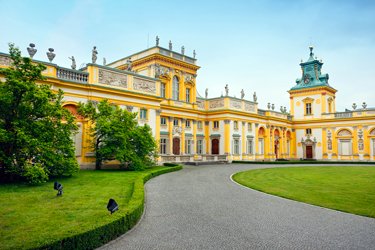
It was built for the Polish king Jan III Sobieski at the end of the 17th century and, over the centuries, changed hands several times, becoming the home of kings, nobles and wealthy Polish magnates.
The splendour with which these owners surrounded themselves is still evident today, with frescoes, period furnishings and a fine gallery of paintings, including a Pietà by Cima da Conegliano.
The surrounding park is magnificent, with small lakes, Italian and English gardens, fountains, statues and walking paths. It is certainly the ideal stop between one monument and the next.
Opening hours and ticket prices for the Wilanów Residence
Opening hours: every day from 10 am to 4 pm, last admission at 3 pm.
Ticket price: full price 35 PLN, reduced 28 PLN for school pupils, university students and over-65s. 1 PLN for ages 7–16. Free for ages 0–7 and every Thursday.
How to get there: the residence is located in Wilanów, about 10 km from the centre of Warsaw. It can be reached by car or by buses 116, 180 and 519 from central Warsaw.
The Warsaw Jewish Ghetto
5
Before the Nazi occupation, 400,000 Jews lived in Warsaw, the second-largest Jewish community in the world after New York. From 1940, the area in which Jews were concentrated was divided into the “small” and the “large” ghetto.

Between starvation, disease and deportations, an undefined number of Jews died. Almost everything of Jewish Warsaw was razed to the ground. Along the former line of the wall built by the Germans, cast-iron inscriptions have been set into the pavement.
To remember Jewish Warsaw and ensure that what happened is never forgotten, a Route of Remembrance was created, marked by 16 granite blocks and by the Monument to the Ghetto Heroes, which depicts men, women and children fighting amid the flames, and a line of Jews being led towards the concentration camp.
Only a few buildings on Próżna Street remain from the old ghetto: left in ruins, just as the Germans reduced them, their façades display huge photographs of Jews who lived in the ghetto and were killed by the Nazis.
Łazienki Park in Warsaw
6
Łazienki Park vies with Wilanów for the title of Warsaw’s finest palace-and-park complex. This too lies along the “Royal Route” and, over the centuries, also served as a summer residence.
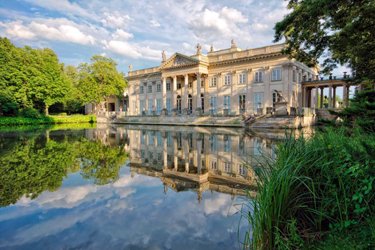
Today Łazienki serves as a museum, a venue for events of all kinds, and a favourite place for walks among locals and visitors. Wandering through the park, you come across the Palace on the Isle, the Myślewicki Palace, the White House, the Orangery, temples and statues.
One part of the park especially dear to Varsovians is the Monument to Fryderyk Chopin, born in the Polish capital and universally regarded as the prince of Romantic music. Beneath this monument, concerts are held every Saturday and Sunday, sometimes by famous pianists, paying tribute to the music of the master. If you visit Warsaw in spring or summer, take a walk through Łazienki: you will not regret it.
Opening hours and ticket prices for Łazienki Park
Opening hours: every day from dawn to dusk.
Ticket price: free.
How to get there: the park is located 2.4 km from the centre of Warsaw. By bus, the recommended entrance is on Ujazdowskie Avenue, served by routes 116, 166, 180 and 195.
The Palace of Culture and Science in Warsaw
7
Designed by Stalin himself, this huge building, known to Varsovians as “the Monster”, was a “gift from the Soviet Union to the Polish people”.
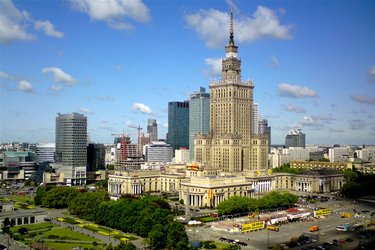
In truth, one suspects the Polish people would gladly have done without it. Yet today, with the communist regime long gone, it can be appreciated for what it is: a 42-storey skyscraper, the tallest in Poland, with 3,000 rooms, offices, museums, a swimming pool and cinemas.
The attraction that draws visitors inside is a terrace, the trzydziestka, on the 30th floor, from which there is a magnificent view over Warsaw’s rooftops and far beyond.
Opening hours and ticket prices for the Palace of Culture and Science
Opening hours: the terrace is open every day from 9 am to 8 pm. The interiors of the Palace can be visited with a guide. Info: biuro@wpt1313.com
Ticket price: full price 25 PLN, reduced 20 PLN for ages 3–26 and over-65s. Free for ages 0–3.
How to get there: the palace is located at plac Defilad 1. It can be reached on foot, by tram (4, 15, 18, 35 and 36) or by bus (127, 128 and 171).
The Praga District in Warsaw
8
Contrary to what many people think, Prague, the Czech capital, has nothing to do with the name of this district, which instead comes from the Polish word prażyć, meaning to burn or roast.
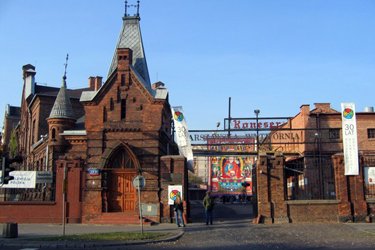
To build Praga, in fact, an entire forest was burned. A genuinely dangerous place until a few years ago, Praga is now the fashionable district — though you should still keep your wits about you — and also the most authentic part of Warsaw.
It escaped the bombings of the Second World War, but for many decades it became a rather rough area. It began to come back to life when Roman Polanski chose it as a filming location for “The Pianist” in 2002.
The Jewish Ghetto where the story is set no longer existed, and the rest of Warsaw looked too new. So he filmed in Praga.
Today the district is the favourite destination of artists, designers, architects, photographers and creatives of all kinds. New cafés, restaurants, galleries, improvised museums and exhibition spaces are constantly opening.
What to Eat in Warsaw
9
The best way to enjoy Warsaw’s cooking is to dive into a jadłodajnia, a kind of simple eatery serving generous traditional food at very modest prices, or into a Bar Mleczny, a “milk bar” inherited from the old communist regime, where food is served cafeteria-style and you will rarely spend more than 5 euros. They are scattered throughout the city.
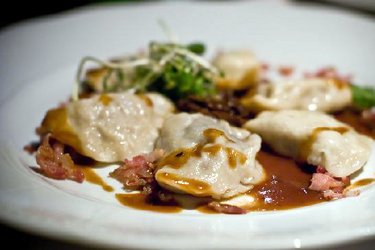
It must be said that Poland is not world-famous for its gastronomy, but Warsaw is, fortunately, an exception. The variety of dishes is certainly somewhat limited, and after a few days you may not want to see meat and potatoes again for several months.
Even so, try the pierogi, dumplings filled with cheese, meat or other ingredients; barszcz, beetroot soup often served with dumplings; chłodnik, a cold soup made with soured milk; and bigos, a hearty meat stew.
All of it, naturally, accompanied by excellent Polish beer, which flows freely here.
Where to Stay in Warsaw
10Warsaw has an excellent range of hotels, hostels and apartments at relatively accessible prices.
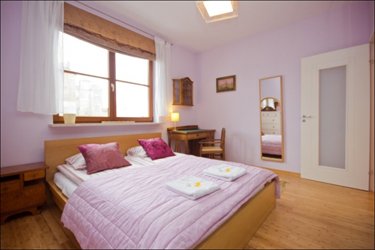
With the city’s growing success as a tourist destination, prices are rising somewhat, but they remain affordable. For a double room in the historic centre in a 3-star hotel, prices range from 40 to 80 euros per night. There are many hotels, more than 500, though many are on the outskirts. If you have little time, we recommend a hotel in the Old Town: it will cost a little more, but it will save you time.
The full range of Warsaw hotels is available on Booking.com. Around 550 hotels with photos, facilities, prices and reviews from guests who have already stayed there. Go to Booking.com