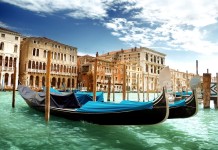

“If Paris had the sea, it would be a small Bari,” says a Bari proverb. Even though this is objectively difficult to claim, it clearly expresses the love and esteem that the people of Bari have for their city.
Even if it is not Paris, it is still a beautiful city in southern Italy, full of things to see and with other magnificent places just a few kilometres from the centre.
A visit to the city can begin from the seafront, one of the most beautiful in Italy, overlooking the crystal-clear waters of Puglia.
The two most important historic buildings are the Church of San Nicola, practically the home of Santa Claus, and the Norman-Swabian Castle, one of the most important Romanesque monuments in Italy.
Anyone who wants to discover the true spirit of Bari should not miss a visit to Bari Vecchia, by day the ancient and popular heart of the Apulian capital, and by night a fashionable meeting place for young people.
On this page we recommend the 10 things to do and see in Bari during a weekend or a holiday.
If you are looking for a hotel in Bari, we recommend choosing from those offered by Booking.com. There are around 100 hotels with prices, photos and reviews from guests who stayed before you. Go to Booking.com
The Basilica of San Nicola in Bari
1
The Basilica of San Nicola in Bari is one of the most important and evocative religious buildings in Italy.
Patron saint of Bari and dear to both Catholics and Orthodox Christians, Saint Nicholas of Myra is the bishop who, according to legend, gave rise to Santa Claus, our Father Christmas.
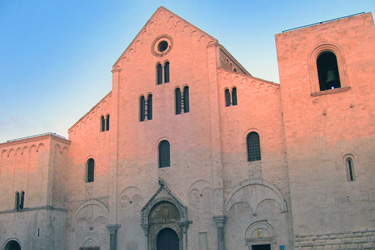
His remains rest in the crypt of this very basilica, and for this reason it is a pilgrimage destination for Catholic and Russian Orthodox faithful: it is in fact one of the few places of worship in Italy where services are celebrated according to both rites.
The Basilica of San Nicola was built precisely to preserve the saint’s remains, in 1089: today it is one of the most visited places in Puglia and is worth seeing for many reasons.
It is a remarkable example of Romanesque style, and inside you can admire gilded wooden ceilings with seventeenth-century paintings, the silver altar, the oldest ciborium in Puglia — the marble canopy above the altar, dating back to 1150, and the Chair of Elias, one of the most representative Romanesque sculptures in Puglia.
The treasure of San Nicola, which continues to grow thanks to donations and ex-votos from the faithful, is kept in the Museo Nicolaiano next to the Basilica and includes, among other things, silverware, illuminated manuscripts and precious parchments.
Opening hours and ticket price for the Basilica of San Nicola
Opening hours:
every day from 7:00 am to 8:30 pm.
Sunday until 10:00 pm.
Ticket price : admission to the museum costs €3 full price and €2 reduced.
How to get there: Largo Abate Elia 13.
Bari Vecchia
2
The district of San Nicola, Bari Vecchia to the people of Bari, stretches between the city’s two ports, the old port and the new one, faces the seafront and forms the historic centre of the city. The heart of Bari Vecchia dates back to the Middle Ages, enclosed within walls and dominated by the Norman-Swabian Castle, one of the symbols of Puglia.
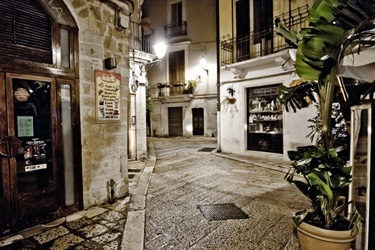
As you enter this maze of narrow lanes, it feels as though little has changed: on the doorsteps women prepare the famous orecchiette on wooden boards, armed only with water, semolina and knives; the houses stand close together, and at every corner there are churches, monuments and glimpses of the sea.
The Basilica of San Nicola is located precisely in this area, as is the evocative Cathedral of San Sabino, which dates back to 1100 and preserves, among other treasures, a precious medieval illuminated manuscript.
Walking on the “chianche” — the large paving stones — in the centre of Bari Vecchia will allow you to discover at least ten more churches, in an atmosphere suspended in time, in a place where everyone knows one another and the aromas from kitchens mingle with the sea breeze.
Also not to be missed is the Fortino di Sant’Antonio Abate, built in 1300 for defensive purposes.
Bari Vecchia is also the centre of the city’s nightlife in the evening: along the old walls, young people and families alike meet for the traditional evening stroll.
The Seafront of Bari
3
The seafront of Bari was inaugurated in 1927 during the Fascist period: beyond any ideology, today it is one of the city’s most famous promenades and a unique opportunity to admire, at a glance, a series of late Liberty-style buildings, while at the same time breathing in the atmosphere of Bari, among green parks and an incomparable view over the Adriatic.
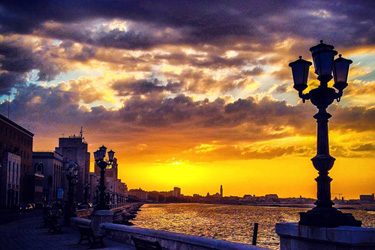
The best-known stretch of the seafront includes Via Imperatore Augusto, Via Araldo di Crollalanza and Via Nazario Sauro, from the new port to the old port.
Halfway along the route, a passage through the city walls allows you to enter the old town, while on the inner side of the seafront stand some of Bari’s most beautiful buildings, including the Albergo delle Nazioni, the Kursaal Santa Lucia theatre and the Palazzo della Provincia.
The Norman-Swabian Castle of Bari
4
Built on the site of an earlier castle commissioned by Roger the Norman in 1131 — hence part of its name — this building was completely destroyed in 1156 and rebuilt according to the wishes of Frederick II of Swabia in 1223, which explains the rest of the name.
Today, as a thousand years ago, the Norman-Swabian Castle rises above Bari’s old town, protecting its main entrance, and from here dominates the sea.
In addition to its important historical value, the Castle is home to the Superintendence for the Environmental, Architectural and Historical Heritage of Puglia and is one of the most important Romanesque monuments in Italy.
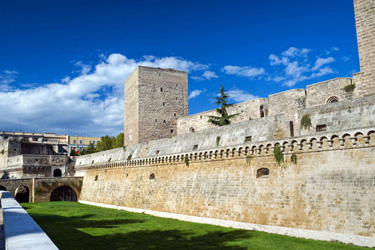
The building consists of two distinct parts: the Keep, the part rebuilt by Frederick II, includes two of the original towers, while the other part includes the bastions and other towers added in the sixteenth century.
A bridge over the moat welcomes visitors at the entrance: inside, a Gothic portal and a Renaissance courtyard open onto the inner space.
On the ground floor, the Castle houses a plaster-cast gallery with casts of some of Puglia’s most important monuments.
Opening hours and ticket price for the Norman-Swabian Castle
Opening hours: every day from 9:00 am to 7:00 pm.
Closed: Monday
Ticket price: €6.
How to get there: on foot, Piazza Federico II di Svevia 4.
The Trulli of Alberobello near Bari
5
Alberobello, the town of the trulli, is located not far from Bari, about 55 km away. The trulli, a symbol of Puglia, are also found in other areas of the region, but only the trulli of Alberobello have been included in the UNESCO World Heritage List and only here will you feel as though you have wandered into a fairy-tale village.
Trulli have existed in Puglia since prehistoric times: they are dry-stone constructions made of limestone, abundant in this area, with cone-shaped roofs formed by horizontal slabs that narrow towards the top.
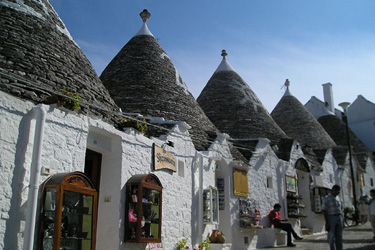
You will notice strange white symbols on the roofs of the Trulli: these are apotropaic and good-luck signs.
Besides being beautiful and distinctive, trulli have many other qualities: they are self-supporting — the beams you will notice inside were not used to support the structure but to hang utensils and work tools — and they are a perfect example of passive green building.
Thanks to the great thickness of the walls and the fact that, apart from a small skylight at the top, they have no openings other than the door, they retain heat in winter and stay cool in summer.
Alberobello has a great many trulli. We recommend the “Monti” district, where there are more than a thousand, including two twin trulli, while in Via Monte Pertica you will find the Church of Sant’Antonio, the only church made with a trullo structure, and in Piazza Sacramento the Trullo Sovrano, a two-storey trullo that now houses a museum.
The Corrado Giaquinto Art Gallery in Bari
6
The Corrado Giaquinto Art Gallery is located in the Palazzo della Provincia, on the seafront, and is an important testimony to Apulian art and culture, with collections of paintings, garments and furnishings from the year 1000 onwards.
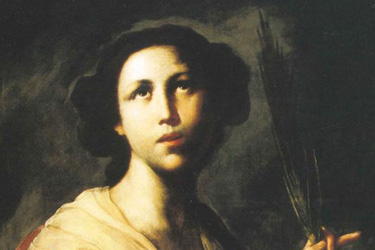
There are twenty-two rooms to visit: among the most important are those that house medieval sculptures made from 1000 to 1400, paintings from the Neapolitan school with works by Luca Giordano and Andrea Vaccaro, a series of paintings by the Apulian painter Corrado Giaquinto and the Grieco Collection, which includes fifty nineteenth-century paintings, including works by the Tuscan Macchiaioli and works from the early twentieth century: among them Pellizza da Volpedo, De Chirico and Carrà.
Opening hours and ticket price for the Giaquinto Art Gallery
Opening hours: Tuesday to Saturday 9:00 am – 7:00 pm
Sunday: 9:00 am – 1:00 pm
Closed: Monday and midweek public holidays
Ticket price: €3.
How to get there: in the Palazzo della Provincia on Bari’s seafront.
Underground Bari
7
For those who want to visit the city from a special perspective while also experiencing its extraordinarily rich history first-hand, Underground Bari is a guided night itinerary which, in the company of accredited archaeologists, starts from the underground areas of the Norman-Swabian Castle and runs beneath the entire old city.
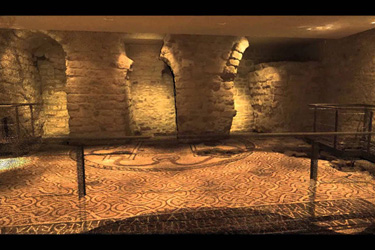
Along the route, the life of the whole city can be reconstructed: from its first settlement, with a hut dating back to the Bronze Age, through the Roman period and the glorious age when Bari was the capital of the Byzantine Empire in the West, when Christian and Byzantine churches stood close to one another and houses and workshops developed all around them, exactly as happens today in Bari Vecchia.
The guided visit of Underground Bari makes it clear that the entire old city grew on successive layers: houses and churches were built on the remains of previous ones, and even today tombs, pottery and traces of hearths can still be found:
the underground areas of the Basilica of San Nicola, for example, conceal an ancient early Christian basilica.
Opening hours and ticket price for Underground Bari
Opening hours: appointment every Sunday at 11:00 am, departing from in front of the Norman-Swabian Palace.
Ticket price: €25 for the approximately 2-hour tour.
How to get there: Norman-Swabian Castle.
The Castellana Caves near Bari
8
With more than 3 km of routes and depths of over 100 metres, the Castellana Caves are one of the most spectacular cave complexes in Italy. They are famous for the White Cave, known as the most dazzling alabaster cave in the world, and are located about 44 km from Bari.
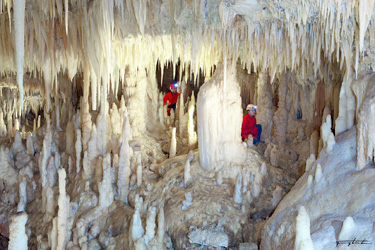
The visit descends to a depth of 7 metres, includes two types of route, and special routes are available for people with physical and psychological disabilities, as well as night visits, events and concerts.
In addition to the cave system, the complex also includes a museum and an astronomical observatory.
The complete itinerary lasts about two hours and starts from the Grave, the largest cave in the system with its 100 metres in length, and the only one with a natural access point at the surface.
It then continues among canyons, stalactites and stalagmites of astonishing shapes and colours, crossing chambers with evocative names such as the She-Wolf, the Altar and the Precipice, before reaching the White Cave, the deepest and most striking.
Opening hours and ticket price for the Castellana Caves
Opening hours: visits are available every day from 9:00 am to 6:00 pm, with different times depending on the type of route chosen.
Ticket price: €19.50 per person for the full tour in Italian.
Speleonight night visit: €26.50 per person.
How to get there: the entrance to the caves is in Piazzale Anelli, 70013 Castellana Grotte (BA).
What to eat in Bari
9
Bari’s cuisine is rightly famous for the quality of its ingredients, which are always placed at the centre rather than elaborate preparation.
You will therefore find fish, molluscs and shellfish that are always fresh from the day’s catch, seasonal vegetables and legumes, and early produce, dressed with prized Apulian extra virgin olive oil in a delicious combination that is not easily forgotten.
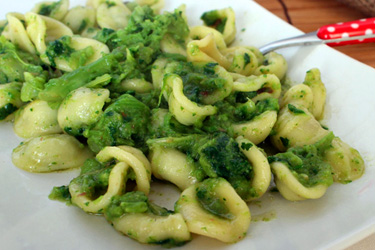
It is difficult to choose just one typical dish: you should certainly try orecchiette, handmade and served with turnip tops or horse-meat ragù, and Bari-style rice, rice flavoured with potatoes and mussels.
Also not to be missed are cavatelli with seafood and specialities such as octopus and aglievi — small cuttlefish — eaten raw, sea urchins with bread and Bari-style baked sea bream.
If you want to try a truly delicious single dish or a savoury treat, we recommend focaccia or Bari-style calzone, filled with onions, green olives, eggs, tomatoes, anchovies and pecorino, as well as sgagliozze, triangles of fried polenta. The meal ends with Bari’s delicious sweets: bocconotti, paste reali, castegnedde, zeppole.
Where to stay in Bari
10
A city of art, business and close to well-known Apulian tourist destinations, Bari has good tourist accommodation spread throughout the city and also in the surrounding towns.
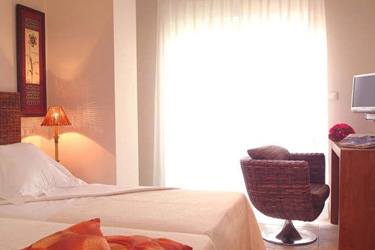
Prices are reasonable, especially outside the high season, so it is an ideal destination for a weekend of culture and gastronomy without spending too much. Prices for a 3-star hotel in the centre start from around €60 per night. Numerous other options are offered by accommodation facilities and agriturismi on the edge of the city or in nearby towns.
If you are looking for a hotel in Bari, we recommend choosing from those offered by Booking.com. There are around 100 hotels in Bari with prices, photos and reviews from guests who stayed before you. Go to Booking.com