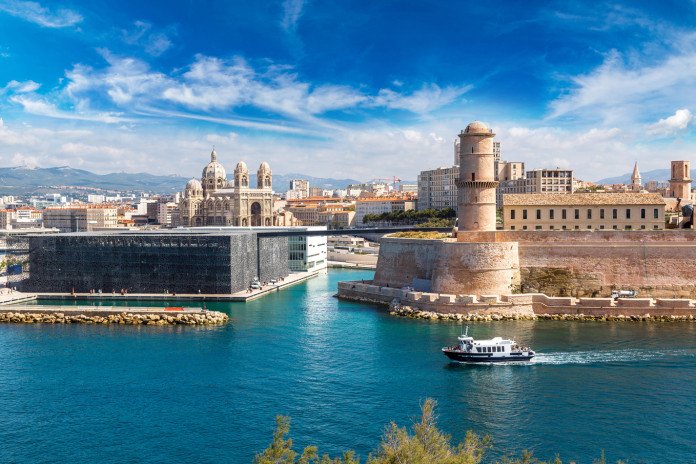
There is an old saying that Marseille has three problems: France, Provence and the Mistral. It therefore seems like a twist of fate that the French national anthem is La Marseillaise, especially because Marseille was fiercely protective of its independence until the 19th century. Today it is fully part of France — after Paris, it is the country’s largest city — but it continues to be independent in spirit, with a strong and deeply rooted personality of its own. If you have heard a few clichés about Marseille, you would do well to believe them: traffic is chaotic, fishmongers shout, petty thieves are very active, the city never sleeps and is noisy, but it is also full of life, colourful, cheerful, a place where you eat well and where there are many things to see. It is no coincidence that it is known as the Naples of France.
With its appointment as European Capital of Culture in 2013, this Provençal city embarked on a redevelopment project, especially around the port, bringing more order and new splendour to districts that had been neglected for decades. From the two defensive forts to the Château d’If, from the Corniche to the Calanques, on this page we recommend the 10 best things to do and see in Marseille.
If you are looking for a hotel in Marseille and the surrounding area, we recommend choosing from those offered by Booking.com. There are around 300 hotels with prices, photos and reviews from previous guests. Go to Booking.com.
Notre-Dame de la Garde Cathedral
1
A visit to the city should begin from the square in front of Notre-Dame de la Garde Cathedral, which dominates Marseille and offers a splendid view over the city and the Mediterranean.

Built in Romanesque-Byzantine style, which has attracted plenty of criticism, the basilica is topped by a statue of the Virgin Mary, affectionately known by the people of Marseille as Bonne-Mère. In reality, there are two churches: a lower church, shaped like a crypt, with a polychrome crucifix and a marble Mater Dolorosa. Then there is the upper church, the sanctuary dedicated to the Virgin Mary, with extraordinary gold-ground mosaics, coloured marble and countless ex-votos on the walls, signs of the miracles — alleged or real — performed by the Virgin.
Opening hours and ticket price for Notre-Dame de la Garde Cathedral
Opening hours: every day from 7 am to 6 pm.
Ticket price: cathedral: free admission. Museum next to the cathedral: €5.
How to get there: the cathedral is located in Rue Fort du Sanctuaire. It can be reached from the Old Port by car, by bus no. 60 or by tourist train, costing €9 for adults and €5 for children.
The Old Port of Marseille
2
An essential stop on any visit to Marseille, the Old Port is the perfect expression of the city’s spirit. Fish markets, boats returning to harbour, restaurants and cafés create an authentic landscape, far from artificial tourism.
For around 2,600 years, since the founding of Massalia by the Greeks, Marseille’s life has largely taken place here. From the 17th century onwards, the entrance to the port was controlled by the imposing presence of two forts: Fort Saint-Jean and Fort Saint-Nicolas.

Fort Saint-Jean was built after the sack of the city by the Aragonese in 1423, in order to defend the entrance to the port. In 1660, Fort Saint-Nicolas was built on the opposite side, with the aim of keeping the population under control.
The two forts were once connected by a spectacular bridge, later destroyed during the Second World War. Over the centuries, Fort Saint-Jean served as a garrison and later as a prison during the French Revolution.
As happened in other parts of Marseille, the Old Port has also been redesigned. The works were completed in 2013, making it more orderly and less chaotic.
There is also “La Ombrière”, a work by star architect Norman Foster: an artificial sky measuring 46 by 22 metres, made of mirrored stainless steel, offering passers-by unusual perspectives of themselves and the city. One experience not to miss is the Ferry Boat, which leaves from the Town Hall quay and crosses the port, taking passengers free of charge to the opposite bank.
The Historic Centre and Le Panier District in Marseille
3
Behind Marseille’s Town Hall, you enter the heart of the city’s historic centre, which largely coincides with the Le Panier district.
The origin of the name is uncertain, but it seems to come from an old 17th-century inn called “Le Logis du Panier”. We could describe Le Panier as a fascinating mix of Naples, Barcelona, Vietnam and other cultures from around the world.
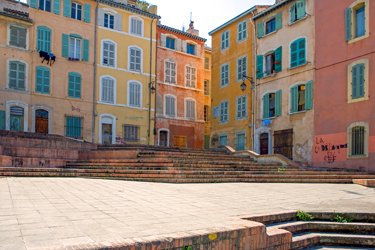
Hanging laundry, elderly people sitting outside ground-floor homes, the smell of bouillabaisse and ratatouille, people shouting and women returning from shopping.
After decades of neglect and a reputation as one of the most dangerous places in Europe, in 1983 the City of Marseille and the European Commission began the redevelopment of the district.
Bars, artists’ workshops, painters and ceramists coexist with the more working-class soul of the area and with immigrants from Corsica and North Africa.
In the district, the Church of the Accoules is worth a visit: inside is a stone from Golgotha, placed “in expiation of all the crimes committed during the Revolution”. The highlight of the district is the Vieille Charité complex, which we discuss in point 4.
The Church of the Vieille Charité
4
In the heart of Le Panier stands the Vieille Charité, an old almshouse that has been magnificently restored and renovated. Around the beautiful chapel are the rooms that once housed the poor and the destitute. The restoration of the church was the driving force behind the recovery of the whole Le Panier district, which had almost become a ghetto.
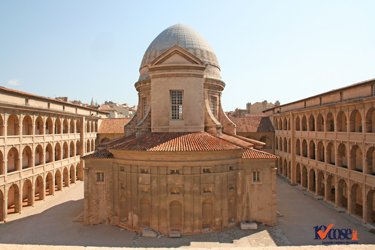
The complex was founded in 1640, when the City Council decided to create a space for the poor of Marseille. Construction began in 1670 and was completed in 1749 by Pierre Puget, architect to the king and a young man from the district, who created one of the finest architectural complexes in Europe.
The Vieille Charité complex consists of four wings of three-storey buildings overlooking an inner courtyard, with the chapel at its centre, built between 1679 and 1707.
A perfect example of Italian Baroque, it has a façade rebuilt in 1863, taking up the theme of Charity, from which the complex takes its name: an important architectural work with an ovoid shape, a perfect example of pure Italian Baroque. The current façade dates back to 1863 and reflects the theme of Charity.
After decades of neglect, since 1986 it has been a multidisciplinary centre and houses the Museum of African, Oceanic and Amerindian Arts (M.A.A.O.A), the International Poetry Centre of Marseille (C.I.P.M), the Cinémathèque Le Miroir, the Museum of Mediterranean Archaeology and several exhibition rooms.
Opening hours and ticket price for the Vieille Charité Centre
Opening hours: every day from 10 am to 6 pm. Closed on Mondays, except Easter Monday and Whit Monday.
Ticket price: admission to the permanent collections costs €6 full price, €3 reduced. Free on the first Sunday of the month.
How to get there: the centre is located in Rue de la Charité. It can be reached on foot from the Old Port in 10 minutes, or by metro line 2 from Marseille Saint-Charles station.
The Rive Neuve of Marseille
5
Opposite the Old Port lies Marseille’s Rive Neuve. The name can be misleading, because the history of this part of Marseille goes back a long way: for many centuries it was an area of unhealthy marshland and remained uninhabited until the 15th century, when it was decided to build the old arsenals, later expanded by Louis XIV in 1660.
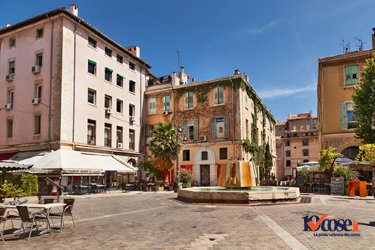
In this part of Marseille, up to 10,000 galley slaves lived — the men embarked on war galleys — often in terrible conditions. Many of them survived by working in the soap factories in this part of Marseille or through small-scale trade in the port. Today the Rive Neuve is a very lively place, where Marseille locals and tourists meet at the tables of the many bars and restaurants, among tree-lined squares and neoclassical buildings.
La Major Cathedral
6
The green and white marble of this imposing 146-metre cathedral will catch your eye as soon as you arrive in Marseille. La Major Cathedral is actually made up of two churches:
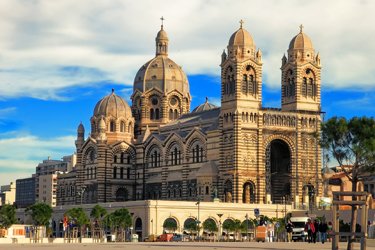
the Old Major, built in the mid-12th century, was cut in two when the New Major was built in 1850 — the part of the church currently visible and open to visitors.
The works brought to light a splendid early Christian baptistery in the central area, square on the outside and octagonal on the inside, which was then buried again. This is hard to explain, given that it is considered one of the most beautiful and largest in all of Europe.
The Old Major stands right next to the New Major, but unfortunately it is closed and cannot be visited. Built in Romanesque-Byzantine style, the New Major has a Latin-cross plan with an ambulatory and a dome around 70 metres high and 18 metres in diameter.
Opening hours and ticket price for La Major Cathedral
Opening hours: every day from 10 am to 7 pm in summer and from 10 am to 6 pm in winter. Closed on Tuesdays.
Ticket price: free admission.
How to get there: the cathedral is located in Place de la Major and can be reached on foot from the Old Port.
The Corniche, Vallon des Auffes and the Calanques
7
Looking out to sea, from the left side of the Old Port, La Corniche begins: a splendid promenade that can be enjoyed on foot or by tram along a 5-kilometre panoramic road.

La Corniche was created in 1848 with no tourist purpose whatsoever, but simply to provide work for around 8,000 unemployed labourers. The works, which lasted 15 years, created one of the most beautiful and famous roads in the world.
La Corniche stretches from Marseille’s Old Port to the Parc Balnéaire du Prado.
From the 1920s onwards, the tram line turned it into the favourite promenade of Marseille locals and a highly sought-after location for the wealthy, who built magnificent villas there.
Among sea views and the occasional concrete eyesore, we recommend stopping at the characteristic Vallon des Auffes, a small fishing harbour where you can enjoy excellent bouillabaisse — fish soup — and other local specialities.
Heading towards Cassis, instead, you enter the Calanques National Park, with its wonderful cliffs plunging down into the sea.
Château d’If and the Frioul Islands
8
Looking out to sea from almost anywhere in Marseille, you can make out the white silhouettes of the Frioul Islands, whose irregular shapes have been sculpted by the Mistral over thousands of years.

This small archipelago, 20 minutes by ferry from Marseille, is made up of four islands: Pomègues, Ratonneau, If and Tiboulen.
If is certainly the best known and most infamous, because since 1516 it has been home to a castle that served for centuries as a prison.
Anyone who has read Dumas’ “The Count of Monte Cristo” will remember that Edmond Dantès is imprisoned in these cells, where he meets Abbé Faria.
They are two fictional characters, but so famous that a hole was made in the wall of one cell to commemorate Dantès’ escape! After holding Protestants — hundreds of whom were thrown into the sea below — the insurgents of 1848 and the Communards of 1871, it ceased to be a prison and became a national monument in 1890.
The other islands are almost uninhabited and therefore unspoilt, with rugged nature but truly inviting beaches and crystal-clear waters.
Opening hours and ticket price for Château d’If and the Frioul Islands
Opening hours:
From 26 September to 31 March: 10:30 am–5:15 pm
From 1 April to 25 September: 10:30 am–6 pm
Closed on Mondays and in adverse weather conditions.
Ticket price: €6 full price, free for ages 0–25.
How to get there: by boat from the Old Port, paid separately.
What to Eat in Marseille
9
Marseille means bouillabaisse: a fantastic fish soup prepared with red scorpionfish, gurnard, John Dory, conger eel, tub gurnard, weever fish, sauces and vegetables. Bouillabaisse is prepared in all the seaside towns of Provence, but in Marseille it reaches its peak. Also from the sea come “moules à la marseillaise”, mussels seasoned with tomato.

Another scent that dominates the streets of Marseille is aioli, the equivalent of our garlic-and-oil base, used in many Marseille dishes.
Other typical local dishes include tapenade, an appetiser made with anchovies, olives, capers and garlic, and panisse, a flatbread made with chickpea flour. Marseille is a multi-ethnic city that has welcomed immigrants for decades, especially from North Africa and the East.
Their dishes have now become an integral part of the local cuisine.
We are not referring to the classic kebab, which of course is easy to find, but to the profound influence that foreign cuisine has had on the flavours and colours of Marseille’s dishes, giving rise to new culinary combinations. One example is kemia, small appetisers that are always served with Pastis, the anise-flavoured liqueur that people in Provence drink on every occasion.
Where to Stay in Marseille
10
Marseille was European Capital of Culture in 2013, a title that helped drive the city’s redevelopment. The subsequent launch of low-cost routes also contributed to the rediscovery of this beautiful Mediterranean city.
For many decades considered dangerous and chaotic, today Marseille is rediscovering its tourist vocation and offers travellers an attractive, welcoming and sunny weekend destination. Around 300 hotels and reasonable prices make it possible to find decent accommodation without spending a fortune. Three-star hotels start from €70 per night, but remember that in France breakfast is usually not included and can cost as much as €10 per person. As for areas, the best choices are the city centre, the Old Port and the Rive Neuve.
If you are looking for a hotel in Marseille and the surrounding area, we recommend choosing from those offered by Booking.com. There are around 300 hotels with prices, photos and reviews from previous guests. Go to Booking.com.