“Melior de cinere surgo”, “I rise from the ashes more beautiful than before”, is written on Porta Garibaldi in Catania. It was the motto of the mythical phoenix, reborn from its ashes each time more beautiful than before, and it is a phrase that sums up the history of this Sicilian city perfectly.
Destroyed nine times by earthquakes, eruptions and invasions, it was rebuilt nine times, each time more beautiful than before. The Catania we see today is the result of the last reconstruction, after 1693, when a devastating earthquake razed it to the ground. This was the height of the Baroque period, the style in which almost all the city’s noble palaces and churches were rebuilt.
Fortunately left intact since then, they now form an architectural ensemble of exceptional value, so much so that Catania’s historic centre is protected by UNESCO as a World Heritage Site.
Spend a few days in Catania — two are enough — and enjoy these architectural wonders, along with the lively atmosphere of its popular markets, the wild, fiery beauty of Mount Etna, and the clear sea along the coast. And do not forget: the food is excellent, and the desserts are exceptional. On this page, we point out the 10 things to see during a weekend or holiday in Catania.
If you are looking for a hotel in Catania, we recommend choosing from the options available on Booking.com. There are around 240 hotels with prices, photos and reviews from previous guests. Go to Booking.com
Piazza del Duomo in Catania
1
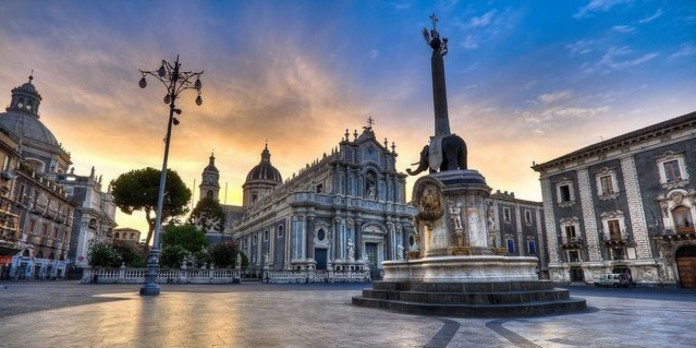
Piazza del Duomo welcomes visitors with “O Liotru”, the little elephant that is the symbol of Catania. The various legends surrounding it describe it as magical, a protector against eruptions of Mount Etna, a memory of a forgotten religion, and much more.
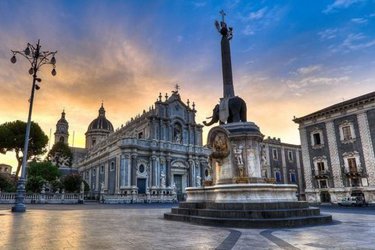
The name “O Liotru” seems to derive from a corruption of Heliodorus, the name of a nobleman regarded as a magician and necromancer, who was said to ride the stone elephant all the way to Constantinople.
The fountain took on its present form in 1736, although it is made up of several elements from different periods: the marble base, the stone elephant, the obelisk brought to Catania from the Crusades, the restored trunk and the tusks added after the damage caused by the earthquake of 1693.
Framing the fountain are the Palazzo degli Elefanti, the Town Hall, and the Palazzo dei Chierici, connected to the Cathedral (see point 2) by a passage above Porta Uzeda. Opposite the Town Hall stands the Amenano Fountain, named after the river that flows beneath Catania and can be seen just below the fountain.
Cathedral of Sant’Agata in Catania
2
If you happen to be in Catania on 5 February, you will immediately understand the love the people of Catania feel for Saint Agatha, the city’s patron saint, to whom the cathedral is dedicated.
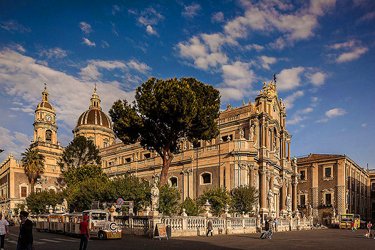
Built over the remains of ancient baths, the Cathedral of Sant’Agata has been destroyed and rebuilt several times following earthquakes and eruptions of Mount Etna.
The first building dates back to around 1070, and only the apse remains from that period; everything else was destroyed and rebuilt from scratch. Its present appearance dates from the works carried out between 1734 and 1761 by Vaccarini, for the exterior, and Palazzotto, for the interior.
The façade is built entirely of Carrara marble, incorporating columns from the ancient Roman theatre. Statues of Saint Agatha are distributed across all the levels.
The interior is majestic, with a Latin-cross plan divided into three naves. Protected behind a gate is the Chapel of Saint Agatha, with the chamber containing her relics.
In front of the altar is the tomb of Vincenzo Bellini, the Catania-born composer.
Opening hours and ticket price for Catania Cathedral
Opening hours:
Morning: from 7:45 am to 12:30 pm
Afternoon: from 4:00 pm to 7:00 pm
Ticket: free.
How to get there: on foot in the historic centre.
Catania’s popular markets
3
As in every southern Italian city, you can find the true soul of the place by visiting its popular markets. These are the places where the people of Catania show themselves as they are, going about their ordinary daily business.
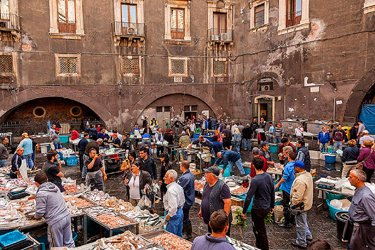
There are several markets, but two are truly unmissable.
The first is the Pescheria, the fish market behind Piazza del Duomo, and the second is Fera ’o Luni, in Piazza Carlo Alberto. The Pescheria is Catania’s most colourful, lively, chaotic and therefore characteristic fish market.
As in many Sicilian markets, here you hear the vuciate, the shouted calls of traders trying to attract customers. Not far away, in Piazza Carlo Alberto, Fera ’o Luni is a daily market selling fruit, clothes, toys and all kinds of goods; in recent years it has developed a distinctly multicultural character.
In the same square, every Sunday, there is a flea market, a delight for anyone hunting for a bargain.
Via Etnea in Catania
4
From Piazza del Duomo begins Catania’s most important and scenic street: Via Etnea, named because it heads in the direction of Mount Etna, which remains visible throughout the three-kilometre walk.

A shopping street, largely pedestrianised and recently repaved, Via Etnea is a favourite promenade for both locals and visitors.
Along the route, you can take a journey through Sicilian Baroque, since almost all the palaces and churches were built by the architects Vaccarini and Battaglia after the disastrous earthquake of 1693, which levelled Catania.
Between fashion boutiques and a stop at the historic Pasticceria Savia, do not miss Piazza Università, with the Rectorate and San Giuliano palaces, and the seven Baroque churches, including the splendid Collegiata.
The walk ends in Piazza Cavour, in what the people of Catania call “Il Borgo”, because until 1693 it stood outside the city walls.
Teatro Massimo Vincenzo Bellini in Catania
5
Catania could not fail to pay tribute to its most famous son, the composer Vincenzo Bellini. It did so in 1890, 55 years after his death at the age of just 34, with a performance of Norma, his most famous opera.
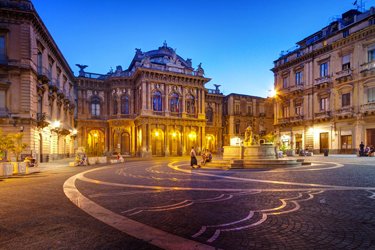
Everyone was there that evening: Luigi Capuana, Giovanni Verga, Federico De Roberto, nobles and ministers of the Kingdom. At the end of the performance, the people also entered, to admire the theatre that was said to be so beautiful.
And beautiful it is: on a guided tour you can visit the auditorium, richly decorated with four tiers of boxes and the gallery. The ceiling is frescoed with images of Bellini and his most famous works: Norma, La sonnambula, I puritani and Il pirata.
The curtain depicts the “Victory of the people of Catania over the Libyans”. Naturally, there is also a bronze statue of Vincenzo Bellini, the work of Salvo Giordano. Today the Bellini has an orchestra of 105 musicians, a choir of 84 singers and a rich concert and opera season.
Opening hours and ticket price for Catania’s Teatro Bellini
Opening hours: Tuesday to Saturday from 9:30 am to 12:00 pm.
Ticket price: guided tour €6.50.
How to get there: on foot in the historic centre.
Via dei Crociferi in Catania
6
The origin of the name is not entirely clear: perhaps it comes from the former presence of the Crucifer fathers, or fathers of the Crucifix, or perhaps from the fact that within just 200 metres there are four churches, all masterpieces of Baroque art.
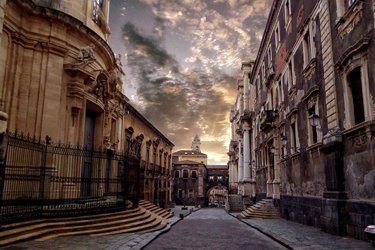
The street is entered through the Arch of San Benedetto, which connects the church of the same name with the Benedictine Convent. The church is famous for the Staircase of the Angels, a marble staircase decorated with statues of angels. Immediately afterwards you come to the Church of San Francesco Borgia and the Jesuit College, with a beautiful internal cloister of porticoes and columns.
Opposite the college stands the Church of San Giuliano, considered one of the finest examples of Catanese and Sicilian Baroque.
The walk ends at Villa Cerami, a green oasis that houses the Faculty of Law. Via dei Crociferi is protected as a UNESCO World Heritage Site, but when visiting the street it is not always easy to feel that this status is fully reflected. Parked cars, graffiti and visible neglect make it an unfinished jewel — one of many — in southern Italy.
The Benedictine Monastery in Catania
7
The Benedictine Monastery of Catania is considered one of the largest monastic complexes in Europe.
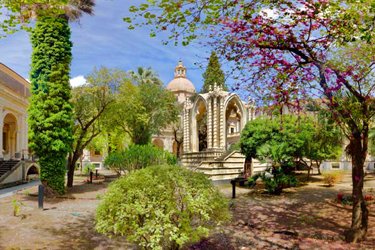
After a careful restoration, the monastery is now home to the Department of Humanities of the University and can be visited on an excellent guided tour.
This allows visitors to retrace the 500-year life of a place that has housed monks, then barracks and schools, before reaching its current function.
Before visiting, we recommend reading I Vicerè by De Roberto, the story of a Catania family after the Unification of Italy.
There are many references to this place, with the monks portrayed as gourmands — they cooked and ate a great deal — giving the leftovers to their mistresses and their children, while the servants resold what little remained.
Today the monastery is a cultural space hosting exhibitions, workshops and conferences run by the Officine Culturali association.
Opening hours and ticket price for the Benedictine Monastery
Opening hours:
Monday to Friday at 10:00 am, 12:00 pm, 2:00 pm and 4:00 pm.
Saturday and Sunday from 10:00 am to 5:00 pm, one tour every hour.
Ticket price: guided tour €8.
How to get there: in Piazza Dante. On foot in the historic centre.
Giovanni Verga’s House Museum in Catania
8
The Giovanni Verga House Museum is not among Catania’s most celebrated or best-known attractions, even though it stands in the centre, just a few steps from the main places of interest. It is nevertheless worth a visit to explore the life and story of one of Italy’s great writers.
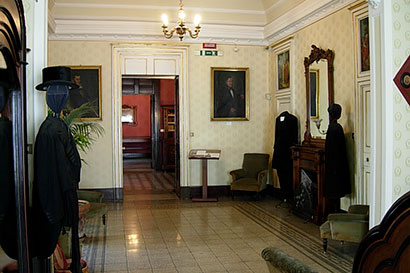
The organisation could be better: given the lack of explanatory panels, the tour of the rooms is over in just a few minutes.
Even so, there is something moving about entering the house where Verga left personal objects and memories, where the furnishings are original and the rooms are those in which the writer spent his childhood and later died.
A walk through the house-museum leaves room for the imagination, offering a sense of what life was like at the time.
The sitting room contains display cases with Verga’s manuscripts and a sculpted bust; you then move into the study-library, the main room, where more than two thousand books and many objects belonging to the author are preserved.
Next comes the bedroom, furnished as it was in his time: take a moment to look at the clothes, photographs and family portraits hanging on the walls. This is followed by the small dining room, with period cupboards, while in the corridor you can consult the family tree.
In the immediate surroundings of Giovanni Verga’s House Museum you can reach the Cathedral Basilica of Sant’Agata, Castello Ursino, Teatro Massimo Bellini, Palazzo Biscari and the Benedictine Monastery of San Nicolò l’Arena.
Opening hours and ticket price for Giovanni Verga’s House Museum
Opening hours: Giovanni Verga’s House Museum is open from Monday to Saturday in the morning only, from 8:30 am to 1:30 pm.
Ticket price: €4.
How to get there: Giovanni Verga’s House Museum is in the centre of Catania, in Via Sant’Anna. It is a little hidden but easy to reach: 100 metres from Via Vittorio Emanuele and just a few minutes’ walk from Via Garibaldi. From Piazza Duomo it is 300 metres on foot.
Castello Ursino and the Civic Museum
9
Just outside Catania’s historic centre stands Castello Ursino, home to the Civic Museum. The surrounding area is not particularly interesting in itself, but the castle is worth visiting both for its architecture and for the historical value and beauty of the works it contains.
It has a very ancient history: its construction was commissioned in the early 1200s by Frederick II of Swabia to defend Sicily’s eastern coast. Originally, the castle stood on a promontory overlooking the sea, and the project was carried out by the architect Riccardo da Lentini.
It was partially affected by an eruption of Mount Etna and was restored in the 20th century in an attempt to return it to its original state. Today it has a square plan and four corner towers.
One curiosity: the castle was also used as a prison, and in the former cells you can still see graffiti left by prisoners. Some even say that a few ghosts still wander through it.
The story of the Civic Museum collection is interesting. It began in the 19th century, when a citizen of Catania donated his artworks to the city. These were later joined by the collections of the Benedictine Fathers and the Greek and Roman finds unearthed during archaeological excavations, including terracotta objects, pottery, amphorae, coins and bronzes. Further private donations and acquisitions of important artworks followed.
A visit to the Civic Museum unfolds through several rooms: the Weapons Room at the entrance, the Picture Gallery on the first floor, and the museum route on the second floor, which includes the Numismatic section and an exhibition of drawings, photographs and engravings.
There is also a section dedicated to temporary exhibitions. Do not miss the view of Catania from above, with Mount Etna in the background. Considering the value of the works on display, the presentation could be enhanced.
There are no interactive areas to involve visitors more deeply, although audio guides can be accessed via smartphone. They are not especially exhaustive in terms of information, but they do help guide visitors through the route.
Opening hours and ticket price for Castello Ursino
The Civic Museum of Castello Ursino is open daily from 9:00 am to 7:00 pm.
Ticket: full €10; reduced €8.
The village of San Giovanni li Cuti
10
San Giovanni li Cuti is a seaside village close to the centre of Catania, reachable with a pleasant walk along the seafront. It began as a small fishing village and is now a tourist area with accommodation, bars and restaurants. It is known above all for its small black beach — black because it is of volcanic origin.
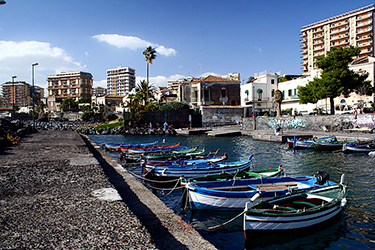
It is the city’s most unusual beach, made of stones smoothed by the sea, which the people of Catania call “li cuti lisci”, hence the name San Giovanni li Cuti. And why San Giovanni? Presumably because this was the saint to whom the district’s old parish church was dedicated — though do not try looking for it, as it has not survived.
Low houses mix with modern buildings, and traditional fishing boats are moored in the small harbour. In winter San Giovanni li Cuti is less lively, but it still has its own charm; from spring onwards, and especially in summer, it fills with visitors.
The people of Catania themselves love walking here and spending a few hours by the water, where, especially at weekends, towels and umbrellas almost always fill the shoreline. In the evening, the village of San Giovanni li Cuti is ideal for quiet walks, and when lit up it looks like a little nativity scene by the sea. There is something for everyone: those who want an aperitivo or dinner in one of the small restaurants with a view, where you can order Sicilian fish dishes, and those who want to stay out late, as the nightlife here is lively.
Do not miss the mural painted along the low wall at the entrance to San Giovanni li Cuti, the work of Catania artist Salvo Ligama. It is called “Poseidon” and depicts Neptune, god of the sea, shown from the waist up with his trident, seeming to invite visitors towards the little seafront.
How to get there
From Catania Central Station, you can get there by bus, line 530.
Excursions on Mount Etna from Catania
10
Mount Etna is Europe’s highest active volcano and never stops offering displays of lava and fire. For anyone passing through Catania, getting closer to the volcano for a better look is practically a must.
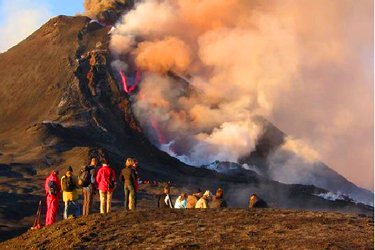
Those who want to see it much more closely can take advantage of the many excursions offered by tour operators, agencies and individual guides. But what can you see and do when going up Mount Etna? That depends on your interests.
You can visit the Valle del Bove, the summit craters, and around 200 caves that have been used since ancient times as shelters, cemeteries, sacred places, snow-storage areas and more.
You can also take jeep excursions, go skiing, walk along trails, or enjoy a more comfortable panoramic journey on the Ferrovia Circumetnea, the railway that circles the lower ring of the volcano.
Opening hours and ticket prices for visits to Mount Etna
Opening hours: always accessible. Spring and autumn are recommended.
Ticket price: guided-tour prices vary.
How to get there: Mount Etna can be accessed from one of the 20 municipalities that form part of the park.
What to eat in Catania
M
Let us start at the end, with desserts: cassate, ricotta-filled cannoli, iris pastries — fried or baked doughnuts with various fillings — olivette di Sant’Agata, brioche with granita and Catania’s generous gelati.

Before reaching that point, however, you will probably have passed through Catania’s street food: an arancino, filled with rice and ragù, crispelle or schiacciate, offal or roasted artichokes. Sitting more or less comfortably, you can try pasta alla Norma, with aubergines, pasta with sardines, caponata or falsomagro. Especially in popular districts, in the evening butchers light their grills — arrusti e mangia, “grill and eat” — and you can enjoy horse meat and other types of meat.
Where to stay in Catania
HIn recent years, thanks to low-cost flights and cruise traffic, Catania has become a highly fashionable destination.
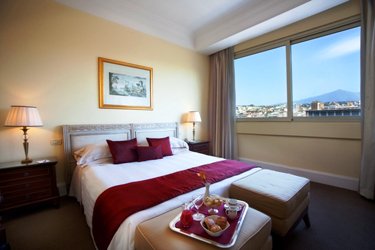
The city has adapted with a flourishing supply of small hotels, apartments and B&Bs. Despite the growth in tourism, prices are still low: a three-star hotel right in the centre costs around €70, and for a little more you can also find a four-star option. B&Bs are even cheaper, with prices starting from €40 per night.
If you are looking for a hotel in Catania, we recommend choosing from the options available on Booking.com. There are around 240 hotels with prices, photos and reviews from previous guests. Go to Booking.com