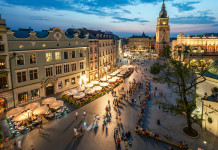
At a certain point, Lecce stepped out from the crowded ranks of Italy’s art cities and established itself as a destination no longer limited to the summer season. The rise of the “holiday in Salento” has done much to bring this beautiful Apulian town to wider attention; until then, it had mainly been appreciated by lovers of art and architecture.
Lecce, in fact, is far more than a gateway to the so-called “Maldives of Italy”: it is first and foremost a city rich in Roman, medieval and Renaissance remains and works of art.
But Lecce is above all a Baroque city. Here, Baroque art takes on a form unlike anywhere else, unfolding in such a distinctive and unmistakable style that it has earned its own name: Lecce Baroque. Flamboyant decoration covers the façades of buildings, brought to life by the intense tones of Lecce stone: a soft, compact limestone with warm golden hues, perfectly suited to carving by skilled stonemasons.
Baroque art spread through Lecce in the 17th century, during Spanish rule, replacing the classical language of earlier periods and creating a style in which fantasy and imagination could flourish. The historic centre is full of examples of this stonework, not only in monuments and churches, but also on the balconies and terraces of private homes.
Yet Baroque is not the only thing that defines Lecce. Welcoming, orderly, blessed with excellent food and exceptional beaches within easy reach, it is one of Italy’s essential places to visit. On this page, we recommend the 10 things you absolutely should see during a trip to Lecce.
If you are looking for a hotel in Lecce, we recommend choosing from the options available on Booking.com. There are around 80 hotels with prices, photos and reviews from previous guests. Go to Booking.com
Lecce’s historic centre
1
Lecce is often described as the “Lady of the Baroque”, and it is precisely Baroque art that defines the spires, portals, churches, monuments and houses of its historic centre. Passing through Porta Napoli, erected in 1548 in honour of Charles V, you enter the old town.
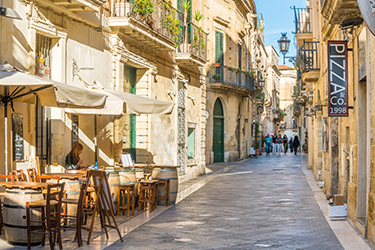
From here, some of Lecce’s most important streets branch out, lined with elegant palazzi and interesting craft workshops where objects are made from papier-mâché and Lecce stone.
A comfortable walk through the streets of the centre brings you to the Church of Santa Maria della Provvidenza, in Piazzetta Baglivi, and the Church of Santa Maria di Costantinopoli in Piazzetta Addolorata. In Via Umberto I, meanwhile, you can admire the 16th-century Palazzo Adorno and the Basilica of Santa Croce, symbol of the city and of Lecce Baroque.
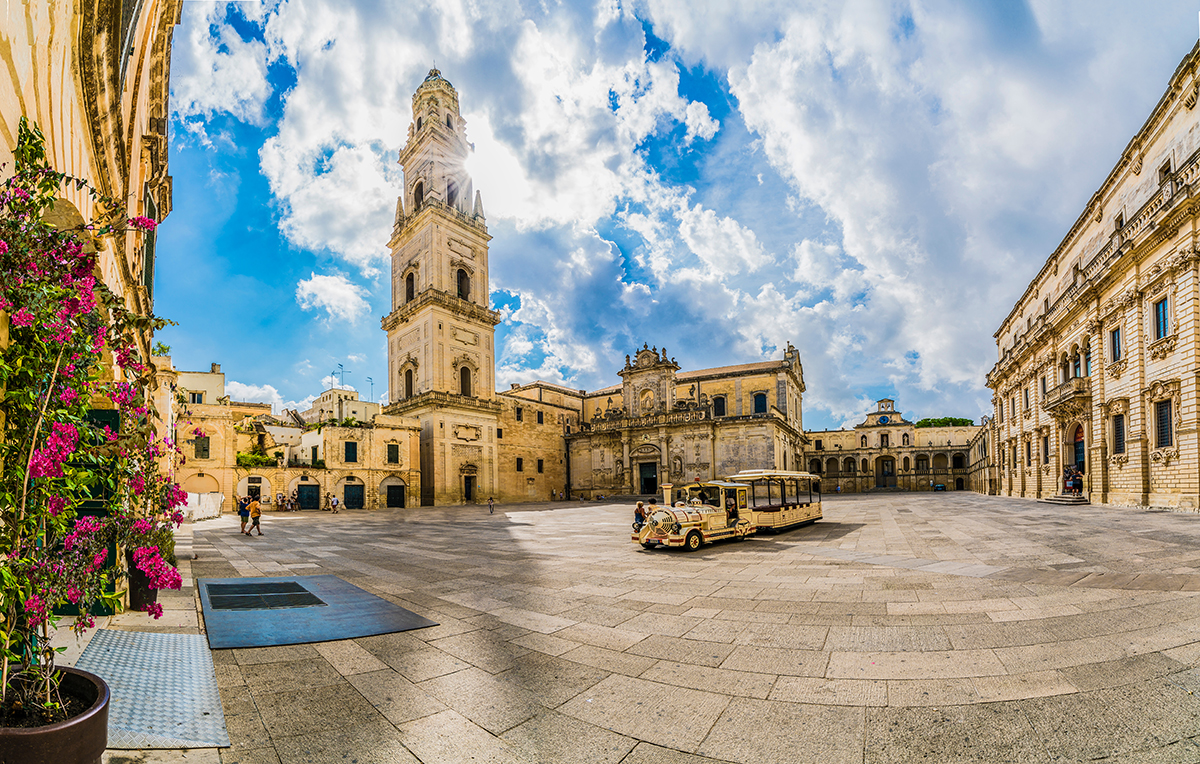
With very little effort, you reach the city’s central hub: the elegant Piazza Sant’Oronzo, the beating heart of urban life, dominated by the famous column of the patron saint; and the theatrical Piazza del Duomo, with the lavish side façade of the Cathedral and its tall bell tower, the 15th-century Bishop’s Palace distinguished by its corner loggia with arches, and the Seminary Palace, dating from 1700, now home to the Diocesan Museum of Sacred Art, the Innocenziana Library and the Diocesan Historical Archive.
For garden lovers, the Villa Comunale, located near Piazza Sant’Oronzo, makes for a pleasant pause. Dedicated to Giuseppe Garibaldi, the villa was once known by locals as “Villa della Lupa” because of a cage that housed wolves — the she-wolf appears on the city’s coat of arms, and Lecce was known to the Romans as Lupiae.
Lecce’s Amphitheatre and Roman Theatre
2
Together with the Theatre in Via Arte della Cartapesta, this is the most important surviving evidence of Roman Lecce. The Amphitheatre was built in the 2nd century AD to entertain enthusiastic spectators with the shows and games held inside it; the building could accommodate around 20,000 people.

The monumental structure was completely buried under rubble following earthquakes and destruction, and only at the beginning of the 20th century, thanks to excavation work, was it brought back to light.
The part visible today, set below street level, is however only about one third of the entire structure — essentially the lower half of the covered seating area. The rest probably still lies underground beneath the very central Piazza Sant’Oronzo, as several of the city’s historic buildings stand above it.
The Roman Amphitheatre was built with tufa pillars surmounted by an arched structure. Among the sculptural works recovered, the most interesting are a statue of the goddess Athena, now displayed in the Castromediano Museum, and several marble reliefs from the parapet separating the two tiers of seating, depicting hunting scenes and combats between men and wild animals. Today, the Amphitheatre provides a striking setting for theatrical performances and concerts.
Around 300 metres from the Amphitheatre stands Lecce’s other great Roman legacy: the Roman Theatre. Built in the same period as the Amphitheatre, it was discovered by chance in 1929 during work in the gardens of two adjoining palazzi. Still clearly visible today, the theatre could hold up to 5,000 spectators.
Opening hours and ticket prices for Lecce’s Amphitheatre
Opening hours: the Roman Amphitheatre can be visited, except on days when performances are scheduled, by booking in advance at the Castello Carlo V Info Point (+39 0832.246517 – castellocarlov@gmail.com).
Ticket price: Full ticket €2.00; reduced ticket for groups of more than 10 people: €1.00. Guided tour service: €1.00 added to the entrance ticket.
How to get there: on foot.
The Castle of Charles V in Lecce
3
Near Piazza Sant’Oronzo stands the castle commissioned by King Charles V in 1539. The project was entrusted to the architect Gian Giacomo dell’Acaya and required the demolition of the Chapel of the Holy Trinity and the Celestine Monastery of Santa Croce, after which two of the fortress towers were named.
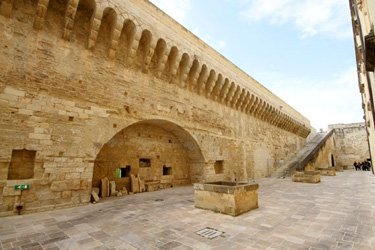
The castle, built over a pre-existing fortification dating from between the 13th and 14th centuries, consists of two concentric structures separated by an intermediate courtyard, four lance-shaped corner bastions — San Giacomo, Santa Croce, Santa Trinità and San Martino — imposing walls and a moat, which was filled in in 1872.
For a long time the fortress served to defend the territory. Later, one of its halls was used for theatrical performances in the 18th century; subsequently, it functioned as a barracks and military district from 1870 to 1979.
Today the castle, owned by the Municipality of Lecce, houses the Department of Culture and its rooms are used for cultural events, art exhibitions and food-and-wine events. Of particular value is the great hall on the first floor of the keep, known as the Salone della Duchessa, with its cross vault and ribs supported by late-Gothic capitals carved with leaf motifs and allegorical figures.
Opening hours and ticket price for the Castle of Charles V
Opening hours:
June and September: Monday to Friday from 9:00 am to 9:00 pm.
Saturday, Sunday and public holidays from 9:30 am to 9:00 pm.
July and August: Monday to Friday from 9:00 am to 11:00 pm.
Saturday, Sunday and public holidays from 9:30 am to 11:00 pm.
Ticket price: €5
How to get there: on foot.
Piazza Sant’Oronzo in Lecce
4
Piazza Sant’Oronzo is Lecce’s main square, the city’s open-air drawing room and, for generations, its favourite meeting place. Shops, cafés and offices animate this striking oval square, whose paving is decorated with a mosaic depicting the city’s coat of arms: the she-wolf beneath a holm oak tree and a crown with five towers.

The buildings that frame it, constructed between the Middle Ages and the 19th century, form an eclectic architectural ensemble: different styles coexisting in remarkable harmony.
In the past it was known as the “merchants’ square”, due to the large number of workshops and commercial activities that once stood here, later cleared to make way for the building intended to house the Bank of Italy in the 20th century.
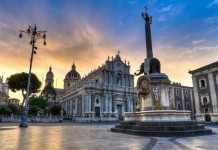
Since 1656 the square has been dedicated to the city’s patron saint. Tradition holds that during the plague epidemic that swept through the Kingdom of Naples, Lecce was spared thanks to the intercession of Oronzo, the city’s first bishop. As a sign of gratitude, the people of Lecce erected a votive column in the square , 29 metres high, topped with a statue of the saint in the act of blessing the city.
The column of Sant’Oronzo is only one of the square’s many attractions. Part of it is occupied by the remains of the Roman Amphitheatre, but it also contains the Sedile, also known as the Palazzo del Seggio, built in 1592 — or rather what remains of it: a quadrangular loggia with pointed arches. It was once the town hall and is now used for art shows and exhibitions.
There is also the ancient Church of San Marco, beside the Sedile, a reminder of the Venetian community once present in the city — note the lunette carved with the Lion of Saint Mark, symbol of the Serenissima — and the Church of Santa Maria della Grazia, built in 1590 after the discovery of a 14th-century fresco of the Virgin and Child, still preserved inside the church.
Lecce Cathedral
5
Lecce Cathedral stands in the square of the same name and represents the centre of the city’s religious life. Dedicated to Maria Santissima Assunta, the Cathedral was built in 1144, remodelled in 1230 and then completely rebuilt in 1659 by Giuseppe Zimbalo at the request of Bishop Luigi Pappacoda.

The Lecce-born architect was also responsible for the five-storey bell tower, the uppermost level of which is crowned by an octagonal dome bearing an iron statue of Sant’Oronzo.
The Cathedral has two entrances: the main one facing the Bishop’s Palace and the other, on the left side, overlooking the entrance to the square.
The main façade, carved with statues of Saints Januarius and Louis and the apostles Peter and Paul, is restrained and refined, in contrast to the more lavish secondary façade, designed according to the lines of Lecce Baroque and crowned by the statue of Sant’Oronzo between those of San Giusto and San Fortunato, co-patrons of Lecce.
The main façade suggests the internal organisation of the space, divided into three naves separated by pillars with engaged half-columns. The central nave and transept are covered by a wooden ceiling into which several works by Giuseppe da Brindisi are set, including “The Martyrdom of Sant’Oronzo” and “The Last Supper”.
The Baroque interior preserves fine stuccowork, marble floors and numerous canvases of great artistic value, as well as twelve richly decorated altars, including the high altar dedicated to the Assumption of the Virgin, made of marble and gilded bronze in the Neapolitan tradition.
Opening hours and ticket price for Lecce Cathedral
Opening hours:
April to September: daily from 9:00 am to 9:00 pm
October to March: from 9:00 am to 6:00 pm
Ticket price: €9.
Includes the LeccEcclesiae route: Cathedral – Santa Croce – Santa Chiara – San Matteo – Museum of Sacred Art.
How to get there: on foot, in Piazza Duomo.
The Basilica of Santa Croce in Lecce
6
The Basilica of Santa Croce and the adjoining Celestine Convent , now the Palazzo del Governo, form one of the city’s major architectural complexes and, above all, the most significant example of Lecce Baroque, especially in the opulence of the main façade.

Between the 16th and 17th centuries, the greatest architects of Salento — Riccardi, Penna and Zimbalo — assisted by exceptionally skilled stonemasons and carvers, worked in succession on this grand project, commissioned by the wealthy religious order of the Celestines.
The result was astonishing: never before had Renaissance elements and Baroque refinement merged so harmoniously to create a monument of such spectacular beauty. The basilica façade is divided into three sections.
The lower section, in Renaissance style, is divided by six smooth columns with zoomorphic capitals supporting a richly decorated entablature with lions and bare-breasted female figures. Above the frieze, six human figures and seven animals — telamons — support the Lecce-stone balustrade, decorated with 13 putti embracing symbols of temporal and spiritual power.
Above the side doors are the coats of arms of the Celestine order and of Santa Croce, while above the main portal, flanked by two pairs of columns, is the coat of arms of Philip III of Spain. The second section of the façade is dominated by the beautiful central rose window, Romanesque in inspiration, flanked by two niches containing statues of Saint Benedict and Saint Celestine.
At the ends stand two female statues symbolising Faith and Fortitude. Finally, at the top, the tympanum contains the triumph of the Cross. The interior, arranged in three naves divided by tall columns, is equally sumptuous. The central nave is covered by a gilded coffered wooden ceiling, while the side aisles have cross vaults and seven chapels on each side, each containing richly decorated altars and 17th- and 18th-century paintings.
Of particular value, in the Chapel of Saint Francis of Paola, is the six-column altar made by Zimbalo in 1614–15, decorated with 12 panels depicting episodes from the saint’s life and considered one of the highest expressions of Lecce Baroque sculpture.
Opening hours and ticket price for the Basilica of Santa Croce
April to September: daily from 9:00 am to 9:00 pm
October to March: from 9:00 am to 6:00 pm
Ticket price: €9.
Includes the LeccEcclesiae route: Cathedral – Santa Croce – Santa Chiara – San Matteo – Museum of Sacred Art.
How to get there: on foot, in Via Umberto I.
The churches of Lecce
7
Lecce, city of churches. This is how the Apulian capital was once described, thanks to the number and beauty of its sacred buildings. Beyond the Cathedral and the Basilica of Santa Croce, a host of other churches — around 40 — are scattered throughout the city.
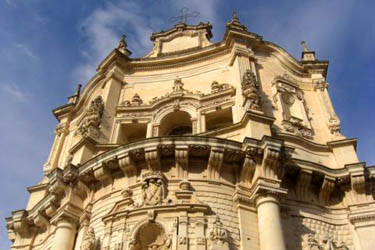
Among the oldest, the Church of Saints Nicolò and Cataldo in the city cemetery deserves mention. Built in the medieval period, in 1180, by order of Tancred of Hauteville, the last Norman king, it was remodelled in 1716, acquiring a Baroque imprint while preserving elements of its original style.
The portal is decorated with arabesques and vegetal motifs, while the interior has a Latin-cross plan with three tall, narrow naves.
The adjoining convent develops around two cloisters. In the older one, you can admire a magnificent aedicule on richly carved spiral columns, built as a covering for the Renaissance well.
Among the most original churches, the Church of San Matteo, built between 1667 and 1700, is not to be missed, with its unusual curving façade reminiscent of the Roman church of San Carlo alle Quattro Fontane.
The building has a complex two-tiered Baroque façade, while the elliptical-plan interior is lined with arched chapels containing richly decorated altars.
The altar of San Matteo is magnificent, with a wooden statue of the saint at its centre, dating from 1691. Perfectly positioned in the centre of the city is the beautiful church dedicated to Sant’Irene, patron saint of Lecce until 1656.
Built in the 16th century by the Theatine order, following the model of the churches of Sant’Andrea della Valle in Rome, Sant’Andrea delle Dame and San Paolo Maggiore in Naples, the church displays a statue of the saint above the main portal and, on the high pediment, the city’s coat of arms: the she-wolf beneath the crowned holm oak.
The interior has a single nave with three chapels on each side. Highlights include the altar dedicated to Sant’Irene, rich in decorations and statues, the grand canvas by Tiso, “The Transport of the Holy Ark” (1758), behind the high altar, and the painting of the Madonna della Libera, kept in the sacristy.
Whether medieval, Renaissance or Baroque in origin, all the churches of Lecce — of which those mentioned here are only a few examples — preserve the city’s historical, artistic and religious heritage.
Museo Faggiano in Lecce

8
In the historic centre there is a place that appears, at first sight, to be simply a house. In reality, it is a one-of-a-kind museum. It is called Museo Faggiano, located in Via Ascanio Grandi, and although it receives little publicity and sits outside the classic tourist circuit, it is absolutely worth visiting for a glimpse of Lecce’s more hidden, “secret” side.
Once you cross the threshold, the owners tell the story of the place and how it transformed their family’s life. During renovation works intended to convert the house into a restaurant, the Faggiano family broke through the floors and unexpectedly began to uncover a series of archaeological remains.
The deeper they dug, the more they realised that their home was a genuine archaeological site.
Today the four floors of this house-museum contain traces spanning more than two thousand years. Many of the finds have been handed over to the heritage authorities, while others remain here and can be visited: a 5th-century floor on which the Messapians built huts, an ancient silo for storing grain, a 16th-century cistern, a drying room used in the decomposition of bodies, and underground passages that connected the house to other places in the city.
There are also tombs and a well, ten metres deep, from which you can see the water of the Idume river. The owners introduce the visit, which then continues independently with descriptions explaining the various finds and the different layers of the building.
This museum is a discovery — just like the one the Faggiano family made almost by chance in 2001.
Opening days and hours of Museo Faggiano
Open daily from 9:30 am to 8:00 pm
Ticket price
Full: €5; reduced, ages 8 to 16: €3; free for children up to 8 years old.
The Sigismondo Castromediano Museum in Lecce

9
The Sigismondo Castromediano Museum is not heavily promoted, but it is well worth a visit because it is genuinely rich in archaeological finds. Even better, it is the oldest public museum in Puglia and admission is free.
Founded in the mid-19th century by the Lecce archaeologist Sigismondo Castromediano, it has recently been renovated and, compared with a few years ago, is now managed and organised with far greater care. On entering, it feels almost like a Salento Guggenheim: the helical ramp recalls, on a smaller scale of course, the famous museum in New York.
Now to the collection. The Castromediano Museum traces the history of Salento and of the peoples who inhabited it, following their succession over the centuries from prehistory through the Messapian civilisation to the Greeks and Romans.
The rooms are equipped with touch screens that allow visitors to consult an interactive map showing the different historical periods and their settlements, which can be clicked for information and details. The sections are organised chronologically and are filled with finds of every kind: amphorae, ceramic vases from ancient Greece, Roman funerary inscriptions and everyday objects discovered in the area’s prehistoric caves, brought to light during 19th-century excavation campaigns.
These were later joined by pieces from the museum founder’s own collection. It is an engaging journey through history and archaeology, not only for specialists, and can also be enjoyed with children. To enter the Castromediano Museum, booking is recommended. Booking is required to take part in the free guided tours held on Friday afternoons, with around twenty participants at a time.
Opening days and hours of the Castromediano Museum
Open Tuesday to Sunday: from 8:30 am to 8:00 pm.
Closed: Monday
Ticket price: free
How to get there: Viale Gallipoli, on foot from the historic centre.
The Abbey of Santa Maria di Cerrate near Lecce
9
A magnificent example of Salento Romanesque architecture, the Abbey of Cerrate is a small jewel located on the provincial road connecting Squinzano and Casalabate.

According to legend, the abbey was built around the 12th century by order of Tancred of Hauteville, on the spot where he had a vision of the Virgin Mary between the antlers of a deer — cervo in Italian — hence the name Cervate, later Cerrate.
An important religious centre until the 16th century, the complex was later sacked in 1711 and left in a state of complete abandonment until its restoration in 1965.
Little or nothing remains of the monastery, but fortunately the church still preserves its ancient beauty, despite the marks of time.
The façade features a small central rose window, a single-lancet window on each side and an elegant portal — note the reliefs on the portal depicting the Annunciation, the Visitation of Saint Elizabeth, the Magi and the Flight into Egypt. Leaning against the left side of the church is a 13th-century portico embellished with cylindrical and polygonal columns, in front of which stands a Renaissance well.
The interior of the abbey is divided into three naves. Of great artistic and religious value are the 13th- and 14th-century frescoes decorating the apses, undersides of the arches and walls. Some 15th-century frescoes, removed during restoration work, are preserved in the adjoining Museum of Popular Traditions, housed in the complex’s former olive press. The abbey is currently among the properties protected by the Fondo Ambiente Italiano.
Opening hours and ticket price for the Abbey of Santa Maria di Cerrate
Opening hours:
Tuesday to Sunday: March, April, May, September and October: 10:00 am – 6:00 pm
November and December: 10:00 am – 4:00 pm
Every day: June, July and August: 9:30 am – 1:00 pm and 3:30 pm – 7:30 pm
Last admission: 30 minutes before closing.
Ticket price: FAI members: free admission. Full ticket: €8
How to get there: The abbey is located between Lecce and Brindisi. Take state road
613, Lecce–Brindisi, exit for Squinzano towards Casalabate, SP 100.
The Church of San Fulgenzio in Lecce
10
The Church of Sant’Antonio a Fulgenzio, dedicated to Saint Anthony of Padua, dates from the early 20th century and was historically entrusted to the Franciscan Friars Minor, giving them a permanent home after they had moved between various convents in the city.
It is slightly outside the centre, yet in terms of beauty it has nothing to envy the more famous churches in Lecce’s old town; among other things, it also differs from them in architectural style. Here you do not find the classic Baroque appearance of Lecce’s religious buildings, but rather a blend of Romanesque and Apulian neo-Gothic.

The Romanesque façade is sober, with Gothic windows and a large central rose window. Inside, neo-Gothic design takes centre stage, with three naves: the central nave and two side aisles with chapels and small altars.
What is most striking about the Church of Sant’Antonio a Fulgenzio is the distinctly Franciscan sense of spirituality that pervades it.
The atmosphere is made even more evocative by the rays of sunlight entering through the windows, creating beams of light that enhance the church’s beauty and particular character.
One point of interest, perhaps the main reason to visit the church, is the iconographic cycle specially commissioned by the friars to draw the attention of the local population to this parish, which was more peripheral than the better-known churches in the heart of Lecce.
Among the artworks, the polished cement-grit flooring, paintings by Salento artists, eight marble altars and a series of fine frescoes by local artists are also of interest.
After visiting the Church of Sant’Antonio a Fulgenzio, we recommend stopping at nearby Piazza Mazzini, with the monumental Fountain of Life, a city landmark thanks to its cafés and, above all, its shops.
How to get to the Church of San Fulgenzio
By bus: M1 City Terminal line, stop in Via Cesare Battisti; from there, it is a 400-metre walk.
Salento
11
Over the past 15 years, the Lecce side of Salento has become Italy’s most famous seaside destination. What draws so many people to the heel of Italy, this narrow stretch of land between the Ionian and Adriatic seas? The first reason is, of course, the beauty of the sea, as crystal-clear as in only a handful of other places in the Mediterranean.
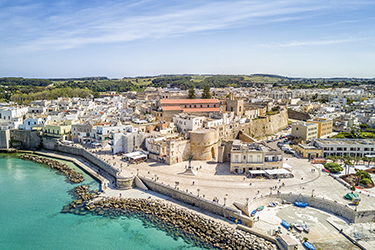
Here you find some of the most beautiful beaches in the world: Punta Prosciutto, Punta della Suina, Porto Selvaggio and others, not by chance, are often compared with the Maldives and the Caribbean.
The second reason is the hospitality of the people of Salento, shaped by centuries of encounters with other Mediterranean cultures whose echoes can still be felt today in the architecture, language, music and food.
Then there are the towns and villages, some very famous — perhaps too famous — such as Otranto and Gallipoli, crowded in July and August and best enjoyed slightly out of season. Others are less well known, but are true stone stage sets not to be missed: Galatina, Nardò and Specchia may not be the first places that come to mind for visitors to Salento, but they deserve more than a little attention.
So let us start from Lecce, heading down the Adriatic coast and then back up along the Ionian side. On this page, we recommend the 10 things you absolutely should do and see in Salento.
What to eat in Lecce
M
Good food is part of daily life in Lecce: the produce of land and sea offers an abundance of traditional dishes from Salento’s culinary repertoire. The herbs of the Mediterranean scrub — sage, mint, oregano, rosemary and more — further enhance the flavour of every dish.

Vegetables and legumes are certainly never lacking at the table: they are usually cooked in a terracotta pot, dressed with extra-virgin olive oil and served with friselle, twice-baked ring-shaped bread.
Among the typical dishes, the rustico leccese is a must: two discs of puff pastry filled with mozzarella, béchamel, tomato, pepper and nutmeg. Then there is the puccia, a small, round durum-wheat bread which, when not filled, often includes black olives in the dough: mind your teeth, as the olives are not pitted.
For the more adventurous, municeddhe are also worth trying: small snails collected when they have formed a white membrane around the opening of the shell, recalling the colour of a monk’s habit — municeddhe means, precisely, little nuns.
When it comes to desserts, the choice is almost overwhelming. Alongside the famous pasticciotto leccese, which should strictly be eaten warm, there is an endless array of delicacies made with almond paste. And the wines? Negroamaro, Salice Salentino and Primitivo di Manduria are just some of Salento’s native wines, known for the body and depth of both colour and flavour.
Where to stay in Lecce
H
In recent years, Lecce has experienced a genuine tourism boom, and the city has responded with a flourishing hospitality scene. Today this Apulian city offers an excellent choice of hotels, bed and breakfasts, agriturismi and rooms to rent, giving visitors a wide range of options.

In the historic centre there are a few luxury hotels, some three-star hotels and, above all, less expensive but very welcoming bed and breakfasts. Prices in the historic centre are slightly higher than those found in the outer districts. An excellent alternative is offered by country houses and agriturismi just outside the city, near the sea or among the olive groves. These are mostly restored old masserie, many of them with swimming pools.
If you are looking for a hotel in Lecce, we recommend choosing from the options available on Booking.com. There are around 80 hotels with prices, photos and reviews from previous guests. Go to Booking.com