Thanks to its enchanting seaside setting, its landscapes, and its rich historical, cultural and archaeological heritage, Taormina is one of the island’s most famous tourist destinations.
A place of extraordinary charm and beauty, this splendid Sicilian town has seduced poets and writers, attracted illustrious travellers and welcomed internationally renowned celebrities.
Visitors come from all over the world to this “strip of paradise on earth” (Goethe, Italian Journey, 1787): to see its Greek-Roman theatre, stroll along its medieval streets, admire its breathtaking views, enjoy its excellent cuisine and relax in the sun on its wonderful beaches. And they are invariably captivated.
After all, as the French writer Guy de Maupassant once said, in Taormina “one finds everything that seems to have been created on earth to seduce the eyes, the mind and the imagination”. Anyone who has been to Taormina knows this is true; anyone planning to visit will soon discover it. On this page, we recommend the 10 things you absolutely should see in Taormina.
If you are looking for a hotel in Taormina, we recommend choosing from the options available on Booking.com. There are around 80 hotels with prices, photos and reviews from previous guests. Go to Booking.com
The Greek Theatre of Taormina
1
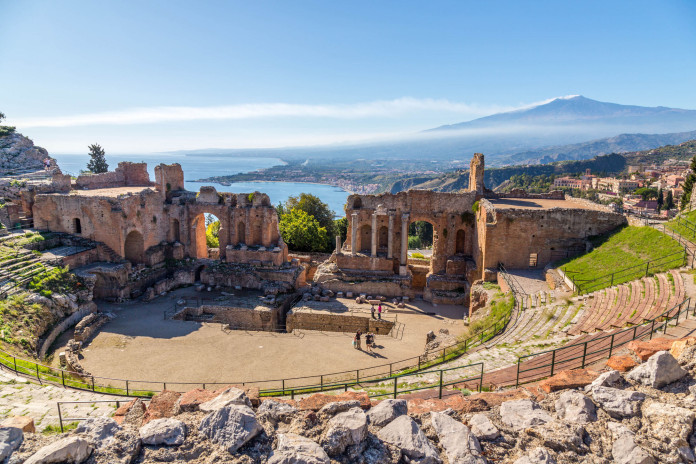
A magnificent legacy of ancient Sicily, the Greek Theatre is Taormina’s most famous monument, and the second-largest theatre on the island after the one in Syracuse.
Built by the Greeks in the 3rd century BC, who chose this dramatic promontory as a spectacular setting for their theatrical and musical performances, the theatre was modified and enlarged by the Romans in the 2nd century AD. They transformed the stage and orchestra into an arena used for gladiatorial combats and hunting spectacles, known as venationes.

From the top of the spacious cavea, the seating area carved into the rock and rising naturally with the curve of the hillside, visitors can enjoy a magnificent view of the Calabrian coast and Sicily’s Ionian coastline, with Mount Etna in the background.
Suspended between sea and sky, this extraordinary architectural masterpiece, renowned for its perfect acoustics, has for many years hosted concerts and cultural events during the summer season.
The most important of these is Taormina Arte, the international arts festival, known and appreciated for its rich programme of music, theatre, dance and cinema.
Opening hours and ticket price for the Ancient Theatre of Taormina
Opening hours: daily from 9:00 am to 7:00 pm in summer. Until 4:00 pm in winter.
Ticket price: €13.50
How to get there: Via del Teatro Antico, on foot from the historic centre.
Taormina Public Gardens
2
Rich in flowers and trees, the Villa Comunale is a pleasant oasis of tranquillity in the town centre.

These beautiful public gardens, dedicated to the Duke of Cesarò, were originally a private park created by Lady Florence Trevelyan Cacciola, the Scottish noblewoman who lived in Taormina from 1884 and later married the town’s mayor.
Designed as a typical English garden, the park was filled with a wide variety of flowers and plants from all over the world, as well as unusual exotic-style buildings used by Lady Florence, a passionate ornithologist, for birdwatching.
The most distinctive structure is known as “The Beehives”, a fanciful pavilion that, as the name suggests, recalls a beehive. Ideal for a stroll and a little shade, the gardens of the Villa Comunale also offer a wonderful view of Mount Etna and the coast.
Opening hours and ticket price for Taormina Public Gardens
Opening hours: summer from 9:00 am to midnight; winter from 9:00 am to 8:00 pm.
Ticket price: free
How to get there: Via Bagnoli Croce, on foot from the historic centre.
Palazzo Corvaja in Taormina
3
Different architectural styles, reflecting the various dominations that followed one another over the centuries, characterise Palazzo Corvaja, a splendid noble residence in the centre of Taormina. It stands in the square that was once the ancient Roman forum and, before that, the agora of Greek Tauromenion.
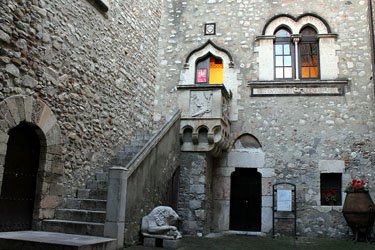
The original core of the palace was the cubic tower built by the Arabs for military purposes between 902 and 1079. Later additions included the left wing and the staircase leading from the picturesque courtyard to the first floor, in the 13th century, and, in the early 15th century, the right wing, intended to host the assemblies of the Sicilian Parliament.
The tower’s battlements are Arab in workmanship; the mullioned windows opening onto the austere façade and the entrance portal are in Catalan Gothic style; while the 15th-century hall where Parliament met is Norman in character. Residence of the noble Corvaja family from 1538 to 1945, the palace later underwent a long period of decay and abandonment.
Restored by the Municipality, the beautiful complex is now home to the Tourist Board and houses, in the first-floor halls, an interesting museum of Sicilian folk arts and traditions.
Opening hours and ticket price for Palazzo Corvaja
Opening hours: the Ethno-Anthropological Museum is open to the public every day except Monday, from 9:00 am to 1:00 pm and from 4:00 pm to 8:00 pm.
Ticket price: €2.60
How to get there: Piazza Vittorio Emanuele II, on foot from the historic centre.
Taormina Cathedral
4
The town’s cathedral, dedicated to Saint Nicholas, stands in the atmospheric Piazza del Duomo. With its austere stone façade, crenellated crown and massive bell tower, it has the appearance of a fortress.

Built around 1400 on the remains of a 13th-century church, the Cathedral has undergone several alterations, as shown by the main portal of 1636 and the two side portals, dating respectively from the 15th century on the left side and the 16th century on the right.
The interior has a Latin-cross plan with three naves and three apses. Six monolithic columns, three on each side, in pink marble and topped with decorated capitals, support the central nave and its wooden ceiling.
The 16th-century polyptych by Antonello de Saliba is particularly valuable. The exterior façade is simple, decorated with a small Renaissance-inspired rose window and two single-lancet windows.
In front of the Cathedral stands a 17th-century fountain in Baroque style, built on circular steps and surrounded by four graceful smaller fountains.
At the centre of the fountain, note the symbol of the city of Taormina: a crowned centauress holding the world in her left hand and the sceptre of command in her right.
Opening hours and ticket price for Taormina Cathedral
Opening hours: daily from 9:00 am to 8:00 pm
Ticket price: free.
How to get there: Piazza Duomo, on foot from the historic centre.
Corso Umberto I in Taormina
5
Corso Umberto I is Taormina’s main street. Bordered to the north by Porta Messina and to the south by Porta Catania, this ancient route of Greek-Roman origin crosses the historic centre of the beautiful Sicilian town.

Characterised by a succession of workshops, fashion boutiques, souvenir shops, delicatessens and cafés, the narrow street named after King Umberto I of Savoy is now a lively pedestrian promenade, crossed every day by thousands of visitors from all over the world.
As well as being an elegant shopping street, the Corso is rich in architectural and artistic evidence from different periods.
Numerous picturesque lanes open here and there along its sides, offering a welcome escape from the crowds when needed. Three squares overlook the route — Piazza IX Aprile, Piazza Duomo and Piazza Vittorio Emanuele — where you can lose yourself among splendid views, medieval churches and ancient remains.
Palazzo di Santo Stefano in Taormina
6
Incorporated into the city’s ancient defensive walls, the 14th-century palace of the Dukes of Santo Stefano is considered a masterpiece of Sicilian Gothic art, blending Arab and Norman elements.

The massive square structure, reminiscent of a fortress yet softened by unusual decorative elements, was the residence of the De Spuches, a noble family of Spanish origin, Dukes of Santo Stefano di Brifa and Princes of Galati, two centres in the Messina area.
The diamond-pattern decorative band in lava stone and limestone from Syracuse, running along the upper edge of the eastern and northern façades, is the work of Arab craftsmen. The façades are embellished with mullioned windows, which on the upper floor become richly worked arches.
Norman in origin, by contrast, is the square-plan tower crowned with battlements. The garden is charming and still preserves the well used to collect rainwater. Purchased by the Municipality of Taormina in the 1960s, the palace is now home to the Mazzullo Foundation, with a permanent exhibition of sculpture and graphic works by the artist from Messina.
Opening hours and ticket price for Palazzo di Santo Stefano
Opening hours: daily 9:30 am–12:30 pm and 3:00 pm–6:00 pm.
Ticket price: free.
How to get there: Via del Ghetto I, near Porta Catania, on foot from the historic centre.
AROUND TAORMINA
Isola Bella in Taormina
7
A small island of about one square kilometre, covered in lush vegetation and connected to the mainland by a narrow strip of sand, which, in its central section, appears and disappears beneath the crystal-clear waters of the bay with the changing tides.

This evocative tongue of land, set in the enchanting inlet beyond the promontory of Sant’Andrea, south of Taormina, is Isola Bella. A nature reserve since 1998, this beautiful “pearl of the Mediterranean”, praised by Goethe, Byron, Dillon and many others, is arranged in small terraces connected by steps and pathways, immersed in dense Mediterranean scrub and fascinating exotic shrubs.
Donated by Ferdinand I of Bourbon to the Municipality of Taormina in 1806, the island was for a long time purchased and owned by private individuals. In 1984 it was declared an asset of significant historical and artistic interest, and finally, in 1990, the Sicilian Region was able to regain possession of it by purchasing it.
Opening hours and ticket price for Isola Bella
Opening hours: the islet can be visited every day except Monday, from 9:00 am until one hour before sunset, in groups of 15 people at a time.
Ticket price: €4.
How to get there: Isola Bella beach can be reached from Taormina by the Taormina–Mazzarò cable car.
Piazza IX Aprile in Taormina
8
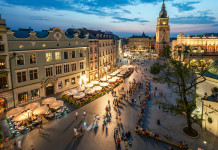
A striking panoramic terrace over the sea, a delightful meeting place and a celebrated centre of Taormina’s social life: this is Piazza IX Aprile, the most famous square in Taormina. Opening onto the town’s main street, Corso Umberto, it is framed by outdoor cafés, religious buildings and historic architecture, with its characteristic portrait artists and crowds of visitors enchanted by the spectacular view over the gulf and Mount Etna.

Overlooking the square are the Baroque Church of San Giuseppe, dating from the 17th century, the former Gothic Church of Sant’Agostino and the Clock Tower, also known as Porta di Mezzo, whose arch gives access to the old town.
Built in the 12th century and destroyed during the French invasion, the tower was rebuilt in 1679, when the clock from which it takes its name was added. Originally the square was dedicated to Sant’Agostino, but on 9 April 1860 news spread that Garibaldi had landed at Marsala to liberate Sicily from the Bourbons. Although the news turned out to be false — Garibaldi would arrive only a month later — the people of Taormina nevertheless chose to commemorate that date by dedicating their most beautiful square to it.
What to eat in Taormina
9
Contrasts of flavour and bold pairings characterise Taormina’s cuisine, shaped by a history of different dominations that also lives on in its culinary traditions.
Traditional dishes, intense in flavour and richly aromatic, preserve ancient references that go back to Arab and Spanish traditions, as well as French and Norman cuisine.
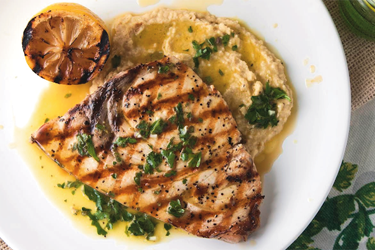
The famous rice arancini are of Arab derivation; dishes based on salt cod and stockfish are owed to the Normans; while mpanata di pesce spada, a savoury pie filled with swordfish, recalls the Iberian empanada.
Fish is the star of the table: tuna, mackerel, anchovies and, above all, swordfish, served as involtini, grilled and dressed with “sammurigghiu” — a sauce of olive oil, oregano, salt, garlic, pepper and lemon juice — or prepared alla “gghiotta”, with onions, white olives, tomato and capers. Finally, it is impossible not to mention the desserts: a triumph of sugar, cinnamon, honey, pistachio, almonds and ricotta.
These ingredients are used to prepare delicious cannoli, the famous cassata and frutta martorana, the colourful marzipan sweets shaped like fruit. Sorbets and granitas are also excellent. Made with fruit, coffee or almond, granita — still prepared artisanally — is a Sicilian speciality.
In summer, it is customary to have breakfast with granita câ panna e câ brioscia, granita with whipped cream and brioche. Try this sweet experience for yourself: it will change your day.
Where to stay in Taormina
10Small though it is, Taormina is one of the world’s most important tourist destinations.

Every year, hundreds of thousands of tourists from all over the world come to Sicily to visit this little pearl of the Messina area, or include it as part of their Grand Tour of the island.
The hospitality sector lives up to the town’s reputation: there are around 80 hotels, in addition to accommodation in the surrounding areas. During the high season — spring, summer and early autumn — it can be difficult to find a room at a good price. It is therefore worth booking a little in advance. As for prices, a room in a 3-star hotel or B&B in the historic centre starts from €45 per night.
If you are looking for a hotel in Taormina, we recommend choosing from the options available on Booking.com. There are around 80 hotels with prices, photos and reviews from previous guests. Go to Booking.com