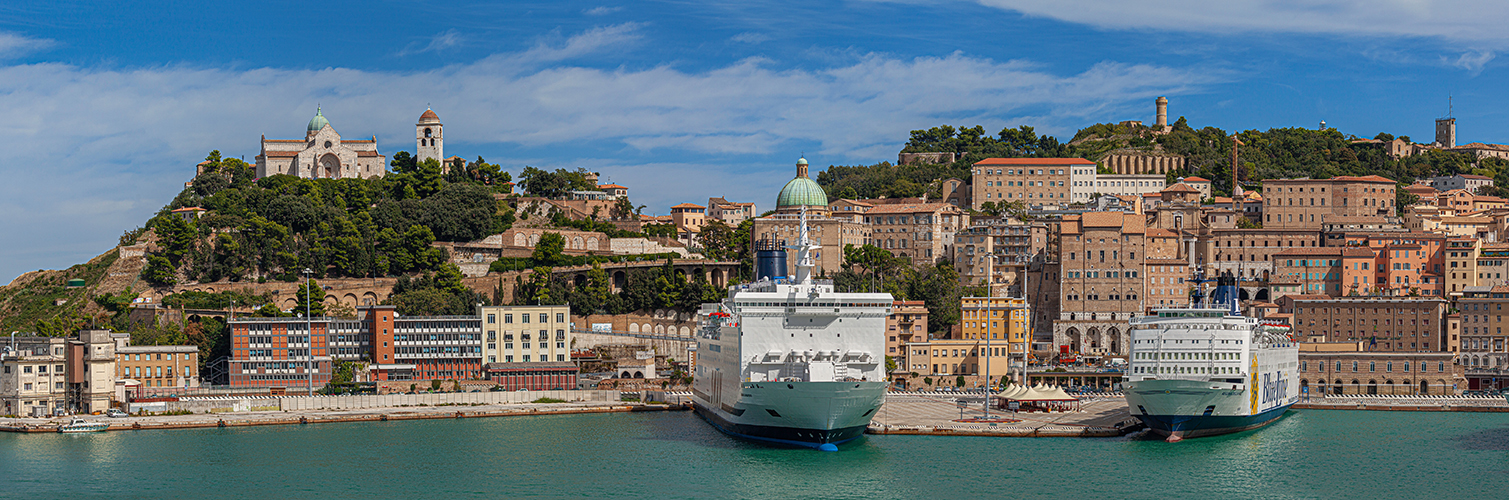
Often crossed almost absent-mindedly by those boarding ferries to Croatia or visiting the Marche for the beaches of the Cònero Riviera, Ancona actually has a great deal to offer: treasures of art and architecture, several exceptional churches, panoramas and green spaces, excellent cuisine and the traditional, sincere hospitality of the Marche. Ancona also has one very special feature: it is the only Italian city from which you can admire both sunrise and sunset over the sea.
The privileged vantage point for this spectacle is the Cathedral of San Ciriaco, a splendid Romanesque-Byzantine cathedral overlooking the sea. From this, the highest point in the city, descending towards the port you come across the harmonious Piazza del Plebiscito, the Passetto park, the Church of Santa Maria della Piazza, before reaching the Arch of Trajan and the Mole Vanvitelliana.
If you also enjoy underground itineraries, in recent years the most hidden side of this Marche city has been gradually rediscovered.
From a small door in the beautiful Fontana del Calamo, or from a manhole in Piazza Stamira, you can access the network of tunnels that once carried and distributed water throughout Ancona. On this page we recommend the 10 things to see during a holiday or weekend in Ancona.
If you are looking for a hotel in Ancona, we recommend choosing from those offered by Booking.com. There are around 125 hotels with prices, photos and reviews from people who stayed there before you. Go to Booking.com
Piazza del Plebiscito in Ancona
1
Although its official name is Piazza del Plebiscito, the people of Ancona call it Piazza del Papa, in honour of Clement VII, who in the 18th century gave new momentum to the port of Ancona and to the local economy.
The statue of the Pope stands prominently at the centre of this unusually elongated square, with the steps of the Church of San Domenico on one side.
Although the exterior façade may not immediately invite you in, the church contains two masterpieces: the Annunciation by Guercino and the Crucifixion by Titian.

Piazza del Plebiscito is overlooked by the Government Palace, the Civic Tower with its clock, which plays a short tune at noon, and several elegant noble palaces. Piazza del Papa is Ancona’s drawing room, not least thanks to the dense presence of cafés, small bars and restaurants.
Crowded until late at night, especially in summer and at weekends, it is an essential stop on any visit to Ancona.
The Mole Vanvitelliana in Ancona
2
The Mole Vanvitelliana in Ancona, which everyone in the city still calls the Lazzaretto, has served several different purposes over the centuries.
The pentagonal walls of this structure were designed by Carlo Vanvitelli on commission from Pope Clement XII, with the aim of creating a warehouse for goods arriving in the port, a defensive structure for the city and, above all, a lazaretto where people arriving from countries considered risky or unknown could be kept in quarantine.

It was built on an artificial island of about 20,000 square metres, accessible only by sea until a bridge was built in the 19th century.
Inside, the Mole is organised like a small city, with a square at the centre of which stands a neoclassical temple dedicated to Saint Roch, protector of plague victims.
In fact, it is also an ingenious system of underground cisterns that supplied the citadel with water.
Today the Mole is above all a venue for cultural events and exhibitions. To appreciate it from above, we recommend the Belvedere Casanova, in the Capodimonte district.
Do not miss a visit to the Omero Tactile Museum, unique in Europe. Along the route are around 150 reproductions of masterpieces of art, from ancient Greece to the Renaissance: the Discobolus, the Winged Victory of Samothrace, Poseidon, the Venus de Milo, as well as scale models of the Parthenon and Saint Peter’s Basilica and reproductions of Michelangelo’s masterpieces.
On the upper floor there are original works by contemporary Italian and international artists. A wonderful experience for blind and visually impaired visitors, and for anyone wishing to appreciate art not only through sight. Free admission.
Opening hours and ticket price for the Mole
Opening hours: Tuesday to Sunday from 08:00 to 20:00. Hours may vary depending on the events organised in the halls.
Omero Museum hours
Tuesday to Saturday from 16:00 to 19:00
Sunday and holidays from 10:00 to 13:00 and from 16:00 to 19:00
Closed: Monday and 24, 25, 31 December.
Ticket price for the Omero Museum
Admission is free and booking is not compulsory.
Info at 335 5696985, mobile and WhatsApp,
or by sending an email to didattica@museoomero.it
How to get there: in the Port of Ancona. 15 minutes on foot from the station or by bus 1/4.
Church of Santa Maria della Piazza in Ancona
3
Although all tourists climb the hill to visit San Ciriaco, see point 4, Santa Maria della Piazza is perhaps the most important church in Ancona.
A palaeo-Christian basilica already stood on this site in the 4th century AD, as shown by the splendid floor mosaics visible through glass panels.
The present church was built around 1100 and has a distinctive structure: a transept of the same width was added to the original plan, raised above the rest of the church.

The façade is very beautiful, with blind arches and, at the centre, a Byzantine bas-relief from Constantinople.
It represents the praying Virgin. The other two Byzantine bas-reliefs depict the Archangel Gabriel and a peacock, symbol of resurrection and eternal life.
According to scholars, it is very likely that this church is the ancient Church of Saint Stephen, built on one of the stones that struck the saint during his stoning.
Opening hours and ticket price for the Church of Santa Maria della Piazza
May – July: Thursday to Sunday, continuous opening from 10.00 to 18.00.
Tuesday and Wednesday from 10.00 to 12.00 and from 16.00 to 18.00.
Closed: closed.
August – October: every day from 10 to 18, Monday from 8 to 17.
Winter hours: Monday to Sunday from 10.00 to 12.00 and from 16.00 to 18.00
Ticket price: free.
How to get there: in the historic centre, in Piazza Santa Maria.
Cathedral of San Ciriaco in Ancona
4
Ancona Cathedral, dedicated to Saint Ciriaco, occupies an exceptional position overlooking the Adriatic Sea. In the 4th century BC, the Dorians chose this magnificent site to build a temple dedicated to Venus Euplea, beautiful goddess of safe navigation. Ten centuries later, the early Christian basilica dedicated to Saint Lawrence would be built on the ruins of that temple.

Constantly exposed to invasions from both sea and land, the people of Ancona decided to move the relics of their saints to this place, which was difficult to plunder.
Earthquakes, Goths, Saracens and various raids meant that the basilica was completed only in the 14th century, when it was dedicated to Saint Ciriaco, protector of the maritime Republic of Ancona.
The result is an extraordinary blend of Romanesque and Byzantine styles, perhaps the finest in Italy.
The crypt preserves the body of Saint Ciriaco, a Christian martyr of Jewish origin, who was tortured with molten lead poured down his throat. Inside there is a painting of the Madonna, considered miraculous, which is said to have unsettled even Napoleon Bonaparte.
Opening hours and ticket price for the Cathedral of San Ciriaco
Winter hours
Monday to Sunday from 8.00 to 12.00 and from 15.00 to 18.00.
Summer hours
Monday to Friday from 8.00 to 12.00 and from 13.00 to 19.00
Saturday and Sunday from 8.00 to 19.00
Ticket price: free
How to get there: From the centre by shuttle bus no. 11
From the railway station: Bus line 1/4 to Piazza Kennedy, then on foot.
The Podesti Civic Art Gallery in Ancona
5
A small but fascinating museum, with few works, all of excellent quality. Unknown even to some residents of Ancona, the Civic Art Gallery of Ancona brings together works from the Marche school by lesser-known painters, but also important works from the Venetian school.

These include a “Madonna and Child” by Carlo Crivelli, “Sacred Conversation” by Lorenzo Lotto, “Portrait of Francesco Arsilli” by Sebastiano del Piombo, “Circumcision” by Orazio Gentileschi, “Immaculate Conception” and “Saint Palazia” by Guercino, “Four Saints in Ecstasy” and “Musician Angels” by Andrea Lilli.
But the most important work is certainly the “Gozzi Altarpiece” by Titian Vecellio, depicting the apparition of the Virgin, considered the first signed work by the Venetian artist.
Opening hours and ticket price for the Civic Art Gallery of Ancona
Opening hours
Tuesday to Friday from 10 to 13 and from 16 to 19, booking recommended.
Closed Monday.
Saturday, Sunday and holidays: from 10.00 to 19.00, with compulsory booking the day before the visit.
Ticket price: €6
How to get there: Vicolo Foschi no. 4, in the centre of Ancona.
The murals and street art of Capodimonte
6
From Corso Giuseppe Mazzini, one of Ancona’s shopping streets, we recommend making a short detour to the Capodimonte district, Ancona’s street art quarter, which has been regenerated thanks to the creativity of Italian and international artists.
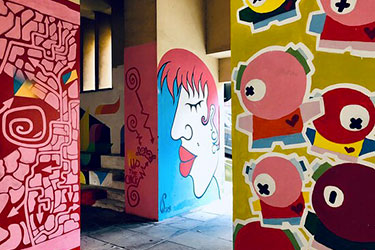
Where can you see the murals of Capodimonte? In the underpass connecting Via Cialdini and Via Astagno. The subjects depicted are vividly colourful: scarecrows, flying houses, three-dimensional staircases, fairy-tale figures, dreamlike themes and trains from a world of fantasy.
We point out the work by Bolognese artist Percy Bertolini, inspired by a real figure, the young shepherd Attilio, who in the early 20th century, at the age of seven, was already taking sheep to graze on the mountains of the Conero.
The child is brought into the present, portrayed in black and white, street-style, with a bundle of wood on his shoulders.
Interesting, and slightly unsettling, is the nearby subject depicting a series of red cars trapped among the white roots of trees.
The artist is Yiuri Hopnn. The lively, fairy-tale animals created by street artist Daniela Nasoni stand out among low walls and stairways. On a pillar appears her sailing ship, which stimulates the imagination simply by looking at it. Others include the Milanese artist Tobet with his three-dimensional works and the alien figures by Mandarino.
How to get to the Capodimonte district
Those arriving by car in the Capodimonte district can leave it at the Cialdini car park and continue on foot for a short stretch. Alternatively, you can use the Traiano car park.
On foot from Corso Mazzini, you reach the district by making a short detour via Largo Sacramento. From the railway station, take bus line 1/4, get off at Piazza Kennedy and then walk 250 metres.
The Passetto in Ancona
7
A pine grove and park for those who want to walk in spring or autumn, a viewpoint over Adriatic storms in winter, and a place to escape the heat and go to the sea in summer.
This is the Passetto, a district of Ancona with a green park in an extraordinary panoramic position overlooking the city’s sea and the Cònero.
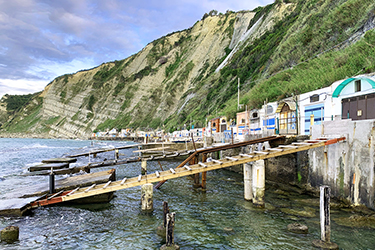
The centre of the district is the War Memorial, a small temple built in the early 1930s to commemorate the fallen of the First World War.
From the monument, two long staircases carved into the rock, or the lift, lead down to the sea.
The area is equipped with beach facilities, swimming pools and a skating rink, and is very popular with locals, especially because of its easy access.
In the evening it comes alive thanks to the venues built on stilts directly over the water.
Opening hours and ticket price for the Passetto in Ancona
Opening hours: always open
Ticket price: free
How to get there: Trolleybus lines 1, 2, 3, 4. Bus, right circular, left circular, 91
The Arch of Trajan in Ancona
8As it is now incorporated into the modern port, it takes a little imagination to reconstruct the original setting of the Arch of Trajan and its close relationship with the sea.
It was built in 100 AD by the Senate of Rome in honour of Emperor Trajan, who had enlarged the port of Ancona at his own expense so that sailors arriving from the East would have a safer landing place in Italy.
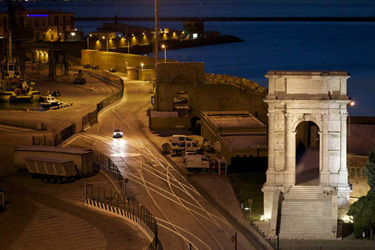
At the time of its construction it stood by the sea and was visible to all incoming ships, which, each time they entered the port, had to pay 700 baiocchi to contribute to its maintenance.
Compared with other Roman arches scattered across Europe, the one in Ancona is much more slender and elegant. Thanks to restoration work carried out in 2006, the white marble from which it is built has regained its brilliance.
A skilful night-time lighting scheme makes it a favourite evening walk destination for locals and tourists alike.
Cardeto Park
9
For a panoramic walk in Ancona, head to Cardeto Park, in the upper part of the city on Colle dei Cappuccini.
It takes its name from the fact that it has always been the habitat of goldfinches, although unfortunately only a few can be seen today; instead, you can listen to the song of other bird species.
Stop from time to time to breathe in the scents of the Mediterranean scrub, admire the sea and the city from the various viewpoints, and enjoy the evocative views over the Roman amphitheatre and the Cathedral of San Ciriaco.
In spring, Cardeto Park offers splendid flowering displays, especially orchids and the pink blossoms of Judas trees, but in summer and autumn too the scenery is a pleasure for the eyes.
The route could be better enhanced, as signage is limited, so we recommend photographing the map at the park entrance to have a reference for the points of interest to see:
the Jewish Cemetery, one of the largest in Europe, the English Cemetery, located inside the 16th-century Bastion of San Paolo, and the Old Lighthouse at the top of Colle dei Cappuccini, first built in the 19th century and rebuilt after the two World Wars.
Also worth noting are the 18th-century Forte Cardeto, the nearby Castelfidardo Powder Magazine and the former Villarey Barracks, which today houses the Faculty of Economics and Business. Entrance to Cardeto Park is free.
Opening hours, tickets and how to get to Cardeto Park in Ancona
By bus from the railway station: Line no. 6, stop Piazza Cavour. From here continue on foot for about 1 kilometre. Alternatively, Line 42 from Corso Carlo Alberto, stop Piazza Cavour, then walk to the Villarey Barracks, where you can begin the route.
Opening hours
From October to March: from 8 to 17:30; from April to September: from 8:30 to 20:30.
The Cònero Riviera in Ancona
10
Ancona is the starting point for discovering the Cònero Park, an extraordinary combination of sea, hills and medieval villages. The route begins precisely from the “Beach of the Two Sisters”, in Portonovo, a Blue Flag destination with a magnificent panorama, before entering the hills behind the coast.

Here ancient villages follow one another, some of them well known, such as Recanati , birthplace of Giacomo Leopardi.
In addition to his family home, there is the Hill of the Infinite and all the places mentioned in his poetry.
Then there is Loreto, with the Black Madonna and its much-visited sanctuary, Castelfidardo with its handmade accordions, Sirolo with its square overlooking the sea, the Beach of the Two Sisters and many other smaller villages, less known and therefore still intact and full of charm.
Around Ancona
If you have been lucky enough to travel through the Marche, there is no reason to stop only in Ancona: continue the journey.

A few kilometres by car lies the Conero Riviera, with Sirolo, Numana and, further inland, Recanati.
Here you will find the Sanctuary of Loreto, a destination for millions of pilgrims every year, with the Black Madonna and Mary’s House of Nazareth. If you are travelling by car, in an hour you can reach Urbino and Ascoli Piceno; and if you enjoy historic villages, Corinaldo, Offida and Offagna.
If, on the other hand, you love excursions into the depths of the earth, the Frasassi Caves are the right destination. While you are in the area, do not miss a visit to the Temple of Valadier, built into the rock.
What to eat in Ancona
M
We are in a seaside city, so it is no surprise that fish dominates the plate, especially when it comes to brodetto and baccalà all’anconetana.

The former is a typical fish soup, requiring 13 different varieties, to which tomato and toasted slices of bread are added.
Baccalà all’anconetana competes with brodetto for the role of Ancona’s most beloved dish, an important status given that the city has even founded an “Academy of Stockfish”.
Then there are moscioli, wild mussels, squid, anchovies and all the fish of the Adriatic.
Standing in contrast to this maritime dominance is vincisgrassi, extraordinary layered pasta with meat and tomato. This is also an area of excellent wines, especially Rosso Cònero and Verdicchio dei Castelli di Jesi.
Where to stay in Ancona
H
The city of Ancona does not have many hotels, around 25, but accommodation is widely available outside the city, in the other towns along the coast and in the hilltop villages.

There is a broad choice and accommodation is not difficult to find, except during the high season, when everyone heads for the beaches of the Cònero.
Farm stays, residences and apartments are very common, while classic hotels are somewhat fewer and quickly sell out in summer.
Prices are medium-high, in line with other Italian seaside destinations.
They are more accessible out of season and when booked in advance. For a room in a 3-star hotel, expect to spend at least 80 euros per night.
If you are looking for a hotel in Ancona, we recommend choosing from those offered by Booking.com. There are around 125 hotels with prices, photos and reviews from people who stayed there before you. Go to Booking.com