
Ascoli is a city of towers, churches, squares and palaces. Stone, therefore, is the star of the landscape: the entire historic centre was built by carving blocks of travertine from the nearby quarries of the Piceno area.
This makes it extraordinarily harmonious and uniform, elegant and welcoming. The synthesis of all this beauty can be found in Piazza del Popolo, overlooked by the Church of San Francesco, the Palazzo dei Capitani del Popolo, medieval houses and porticoes.
Considered one of the most beautiful squares in Italy, Piazza del Popolo competes for the heart of Ascoli’s inhabitants with the nearby Piazza Arringo, where the city’s other most important monuments are located: the Palazzo dell’Arringo, home to the Civic Art Gallery, the Cathedral of Sant’Emidio, the Baptistery of San Giovanni and the Episcopal Palace with the Diocesan Museum.
A city of art away from the tourist routes most travelled by Italians, Ascoli is also worth visiting for its traditional Marche hospitality and excellent gastronomy. On this page we point out the 10 things to see during a weekend or holiday in Ascoli Piceno.
If you are looking for a hotel, we recommend choosing from those offered by Booking.com. There are around 30 hotels with prices, photos and reviews from people who stayed there before you. Go to Booking.com.
Piazza del Popolo in Ascoli Piceno
1
Whichever way you enter Piazza del Popolo, the first impression you get is one of extraordinary architectural harmony.
Everything contributes to creating this feeling: the majestic façade of the Palazzo dei Capitani del Popolo, the imposing walls of the Church of San Francesco, the Renaissance palaces, the porticoes and loggias, and even the slightly old-fashioned windows of the historic Caffè Meletti.
Piazza del Popolo is Ascoli’s drawing room, an obligatory meeting point for tourists and locals, who gather here for the ritual of coffee or an aperitif.

The story of how this square became one of the most beautiful in Italy is emblematic and would be very useful even today.
Reduced to a place where construction anarchy reigned, in 1507 the governor Raniero de’ Ranieri decided that vaults with red bricks and travertine columns had to be built on three sides of the square.
Private owners who had spaces in the square and wanted to build had to follow strict rules: no more than one floor, buildings all of the same height, always made of travertine and red bricks, and with identical windows for all houses.
What do you think? Wouldn’t such strict rules be useful today too, to preserve our beautiful Italy?
Palazzo dei Capitani in Ascoli Piceno
2
The majestic outline of the Palazzo dei Capitani, the centre of Ascoli’s civic power for seven centuries, does not go unnoticed.
Built between the 1200s and 1300s in place of three small pre-existing buildings and a noble tower adapted as a bell tower, it immediately served as the “Palazzo del Popolo”, where representatives of the city guilds made government decisions.

It later became the “Palazzo del Comune”, the seat of the rulers who governed Ascoli over the centuries, including the King of Naples, the Sforza family, the Pope and the podestàs, who transformed it into the headquarters of the Fascist Party and the “Casa del Littorio”.
Set on fire at Christmas 1535 to put an end to the revolt of some local families who had barricaded themselves inside, it was rebuilt over the years and housed the senior governors until 1563.
After becoming the seat of the Papal Governors, it was necessary to wait until the Unification of Italy in 1860 for it to pass into state ownership.
Today it belongs to the Municipality of Ascoli. Its interior can be visited, with the beautiful Renaissance courtyard, the Sala della Ragione and the Sala degli Stemmi. The visit to the archaeological remains, from the Roman to the medieval period, which emerged during recent restoration work, is very interesting.
Opening hours and ticket price for Palazzo dei Capitani
Opening hours: every day from 9 to 17. Closed: 25 December and 1 January.
The archaeological area is open by reservation, turismo@comune.ascolipiceno.it. Hours: 9.00 – 12.00 / 15.00 – 18.00, weekdays and holidays.
Ticket price: free. Some exhibitions may require a paid ticket.
How to get there: on foot in the historic centre.
The Church of San Francesco in Ascoli Piceno
3
If the Palazzo dei Capitani del Popolo is the centre of Ascoli’s political power, the Church of San Francesco is one of the focal points of its religious life. Its imposing Gothic silhouette competes, again with the Palazzo, for the role of protagonist in Piazza del Popolo.
In 1215 Saint Francis visited Ascoli, where he stayed for several months: struck by his preaching, 30 young men from the city donned the habit, giving life to the Order of Friars Minor Conventual.
To welcome their community, construction of the Church of San Francesco began in 1258.

The main façade does not face Piazza del Popolo but the side street Via del Trivio: the central portal is the most interesting of the three.
The lunette is decorated with Saint John the Baptist, the Madonna and Saint Francis, while at the centre of the arch there is a lamb, in honour of the Wool Guild, which contributed to the construction costs.
The large Gothic portal opens onto Piazza del Popolo, with the monument to Julius II above it, who freed Ascoli from the tyrants Astolfo and Gianfrancesco Guiderocchi.
The interior is very simple, with a rectangular Latin-cross plan divided into three naves by ten octagonal pillars, with Gothic arches and Romanesque-style vaults.
Next to the Gothic portal is the Loggia dei Mercanti, built with donations from the Wool Guild.
Under the loggia, the travertine slab is still visible, showing the measurements of all the architectural elements used to build the Loggia, for future use in case of maintenance or replacement.
Opening hours and ticket price for the Church of San Francesco
Opening hours: every day from 7 to 19.
Ticket price: free.
How to get there: on foot in Piazza del Popolo, in the historic centre.
Piazza Arringo in Ascoli Piceno
4
Piazza Arringo, or “dell’Arengo”, competes with Piazza del Popolo for the role of Ascoli’s civic and religious centre. Much larger but no less harmonious and proportioned, the square takes its name from the public assemblies, or arenghe, that took place under an elm tree.
There are four main buildings in Piazza Arringo: the Cathedral of Sant’Emidio, patron saint of Ascoli and protector against earthquakes, is worth visiting above all for the crypt, where the mausoleum containing the saint’s body is kept, and for the wonderful Polyptych by Crivelli.

The nearby Baptistery of San Giovanni, one of the most important examples of Romanesque architecture in Italy, still preserves the 12th-century immersion baptismal font.
The most important civic building in the square is the Palazzo dell’Arengo, now home to the Civic Art Gallery and the Town Hall, while the Episcopal Palace houses the Diocesan Museum, with some works by Crivelli.
Diocesan Museum and Civic Art Gallery of Ascoli
5
In Piazza Arringo there are the two main museums of Ascoli: the Civic Art Gallery, housed in Palazzo Arringo, is a small but extraordinary collection of works from the 1400s to the present day.
It includes the few paintings still in Italy by Carlo Crivelli, a 15th-century Venetian master who is little known to most people, although his works are displayed in the world’s most important museums: the Gallery houses the two triptychs of Valle Castellana.

Alongside Crivelli, you can admire works by Cola dell’Amatrice, The Ascent to Calvary, 1527, Titian, Saint Francis Receiving the Stigmata, 16th century, Guido Reni, Annunciation, 1575, and also Lovers’ Walk, a 1901 work by Pellizza da Volpedo, the author of the famous Fourth Estate.
The Diocesan Museum, in the nearby Episcopal Palace, is also worth a visit for the works by Crivelli, including a beautiful Madonna of Poggio Bretta.
Opening hours and ticket price for the Civic Museums
Opening hours: from Tuesday to Friday from 10.00 to 13.00 and from 15.00 to 18.00:
Saturday, Sunday, holidays and pre-holidays 11.00 – 18.00. Closed on Monday, except holidays; 1 January morning; 24 December afternoon; 25 December; 31 December afternoon.
Ticket price: full €8, reduced €5.
How to get there: on foot in Piazza Arringo, in the historic centre.
Opening hours and ticket price for the Diocesan Museum
Opening hours: The Diocesan Museum of Ascoli Piceno is currently closed for renovation due to damage caused by the 2016 earthquake.
Ticket price: €3.50.
Caffè Meletti in Ascoli
6
It may seem strange to find a café among the 10 things to see in a city: but before judging, go inside and enjoy the spectacle of the historic Caffè Meletti. Listed among Italy’s 150 historic cafés, since 1905 it has been an institution in Ascoli, as well as a meeting place for painters, writers, entrepreneurs and ordinary people.

Sartre, Hemingway, Mascagni, Guttuso, Pertini, Soldati and many others have sat at the tables under the frescoed porticoes or in the Art Nouveau rooms.
On the pink façade, standing out next to the Palazzo dei Capitani in Piazza del Popolo, there is the century-old inscription “Anisetta Meletti”, the anise-based liqueur that made the café famous.
First produced in 1870 by Silvio Meletti, it is made from anise plants, Pimpinella Anisum, grown in the clay soils around Ascoli.
It is enjoyed “con la mosca”, that is, by adding a coffee bean to the glass. Every lunch or dinner in a restaurant in Ascoli always ends with an Anisetta Meletti. Obviously, do not overdo it: it is still an alcoholic drink!
Unless you intend to help your creativity, as the Roman poet Trilussa did when he said, “How many fables and sonnets Meletti has inspired in me”.
The Small Temples of Sant’Emidio in Ascoli
7
Ascoli has several places connected to the life of its patron saint. In addition to the Cathedral in Piazza Arringo, there are two small temples that are little known to tourists and almost always overlooked during a visit to the city.
The Temple of Sant’Emidio alle Grotte stands where, according to legend, the decapitated Saint carried his own head because he wanted to be buried in a consecrated place. Indeed, the Christian necropolis of Ascoli Piceno stood in that very place.

The small temple is a beautiful example of Baroque architecture integrated into the rock; it was built in 1721 to thank Sant’Emidio for saving Ascoli from the earthquake of 1703.
The patron saint of Ascoli is, in fact, also the protector against earthquakes, a role that he seems to have exercised several times over the centuries, earning the gratitude of the local population.
The Temple of Sant’Emidio Rosso, on the other hand, was built on the place where the saint was decapitated: built in an octagonal shape, it is painted red to recall the blood of the martyr. The stone on which he was decapitated is kept beneath the altar.
Opening hours and ticket price for the Small Temples
Opening hours: we recommend arranging a visit by appointment reasonably in advance.
334 3565078, Giuseppe; 328 3247179, Paolo
Ticket price: free
How to get there
Small Temple of Sant’Emidio Rosso
How: after crossing the Roman Bridge, take Via Tucci. About 10 minutes on foot from Piazza del Popolo.
Small Temple of Sant’Emidio alle Grotte
How: it is located outside the historic centre, in the Porta Tufilla area. Ask for information at the Tourist Information Point in Piazza Arringo.
Forte Malatesta
8
A must on the list of what to see in Ascoli is Forte Malatesta, one of the most beautiful Renaissance fortified structures in Italy. In reality, the fortress already existed in Roman times to defend the bridge over the Castellano River.
What we see today is the work created by Antonio da Sangallo the Younger in 1543, commissioned by Pope Paul III Farnese.
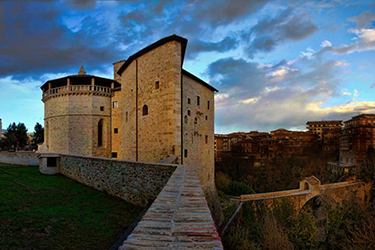
This splendid star-shaped structure, however, still bears the name given to it in 1349 by Galeotto Malatesta, commander of the Ascoli militias in the war against Fermo.
In addition, the remains of the 16th-century Church of Santa Maria del Lago are still visible.
Until 1878 it was a prison, while today it houses the Museum of the Early Middle Ages, which displays the grave goods of the Lady and the Knight found in the Lombard necropolis of Castel Trosino.
Opening hours and ticket price for Forte Malatesta in Ascoli
Opening hours:
From 1 April to 16 September: Tuesday to Friday from 10.00 to 13.00 and from 15.00 to 19.00
Saturday and Sunday, holidays and pre-holidays, from 11.00 to 19.00
From 16 September to 1 April: Tuesday and Thursday from 10.00 to 13.00; Wednesday and Friday from 15.00 to 18.00. Saturday and Sunday, holidays and pre-holidays, from 10.00 to 13.00 and from 15.00 to 18.00
Ticket price: €6
How to get there: Via delle Terme. A 10-minute walk from the historic centre.
Via delle Stelle and the Roman Bridge in Ascoli Piceno
9
The name is undoubtedly evocative and suits this medieval corner of Ascoli Piceno well. Via delle Stelle winds along the old route of the city walls, close to the right bank of the River Tronto.
The people of Ascoli call it Rretë li mierghië, “behind the battlements”, because all the buildings along the street were crenellated for military defence needs. Along the quiet, almost solitary route, there is a succession of medieval towers and small palaces, remains of ancient shops, cobbled streets and panoramic views over the River Tronto.

It seems that the name derives from the habit of lovers meeting in the evening on this street to find a little “peace and quiet”.
At the end of Via delle Stelle there is the Roman Bridge, accessed from Porta Solestà, considered an extraordinary testimony to the building skills of the Romans.
Dating from the Augustan age, it was built with a single span of about 62 metres, a true marvel for the time.
The Papal Paper Mill of Ascoli Piceno
10
The Papal Paper Mill of Ascoli Piceno is located just a few minutes’ walk from the Sestiere della Piazzarola and is completely surrounded by greenery.
As for its historical background, before the actual paper mill there was, in the 12th century, a complex used for the production of cereals and olives that exploited the driving force of the waters of the Castellano River.

Only later, at the beginning of the 15th century, was the paper mill added as we know it today, where papal “rag paper” was produced.
Popes Julius II and Clement VII commissioned the renovation of the old premises to create the paper factory, an extremely ingenious piece of architecture for its time.
Today the building is owned by the Province of Ascoli Piceno and houses the Museums of the Papal Paper Mill.
In the rooms where paper was once dried, the Water Museum has been set up: take a journey through the history of the area to understand how it has been transformed over the centuries by the action of water, then continue into the museum section dedicated to the collections of the naturalist and botanist Antonio Orsini.
The reconstructed rooms, designed to resemble the original ones and where ancient machinery is now displayed, are interesting.
A visit to the mills to see the millstones is a must: using the water of the stream, they were used for grain production. The visit to the Paper Mill museums is educational and immersive, and is therefore much appreciated by families.
We recommend a walk through the nearby Sestiere della Piazzarola, one of the most characteristic districts of the historic centre, with the Fortezza Pia, the Church of Sant’Angelo Magno, the Church of the Annunziata, and medieval-style buildings and alleyways.
Opening hours and ticket price for the Papal Paper Mill of Ascoli
Opening hours: June, July, August, September: 10-13 and 16-19 on Saturday and Sunday; on other days by reservation, minimum 4 people.
During the rest of the year by reservation, minimum 4 people.
Ticket price: full €5, reduced and students €3.
How to get there: about 15 minutes on foot from Piazza del Popolo, although the walking route is a little tiring.
The Roman Theatre of Ascoli
11
The Roman Theatre, although an important testimony to the past of Ascoli Piceno, is not usually included in the classic tourist routes. It is located just outside the historic centre, but we still recommend making a short stop there before heading to the more famous Sestiere di Porta Romana.
The theatre dates back to the Augustan age and was brought to light thanks to excavation work in the first half of the 20th century, excavations that continue to this day.
What you can admire are the ancient “stands”, that is, the semicircular steps that once hosted the spectators, who could watch the performances without ever having the sun in their eyes, since the steps faced north.
The remains of what was probably the “orchestra” and of a space where people gathered between one interlude and another, called an “exedra”, are interesting. The site was later used to obtain material for building the city walls and houses. The travertine was fired in nearby kilns to produce the lime used for construction.
Other Roman remains, those of the Amphitheatre, have been found beneath Piazza San Tommaso, 400 metres from the Roman Theatre.
Let us head to the Sestiere di Porta Romana, one of the most characteristic districts of Ascoli Piceno, with its symbol, Porta Gemina, dating back to the 1st century BC. A walk will allow you to discover the medieval atmosphere of the district and its attractions: the Palazzetto Longobardo and the Casa-Torre degli Ercolani.
From the Roman Theatre, following Corso Mazzini, you reach Piazza del Popolo, see point 1, the drawing room of Ascoli Piceno, overlooked by the Palazzo dei Capitani del Popolo and the Church of San Francesco.
The Quintana of Ascoli
12
At the Campo Giochi Ferruccio Squarcia, in the historic centre of Ascoli Piceno, the “Quintana” takes place every summer. The event includes a calendar of appointments held between July and early August: if you are in the area, you really should not miss them, because the Quintana is the most representative re-enactment in Ascoli, as well as the most historic one, with a centuries-old tradition behind it.
Representatives of the city’s six sestieri compete in contests and competitions, the so-called knightly jousts. The names of the sestieri are Porta Maggiore, Piazzarola, Porta Romana, Sant’Emidio, Porta Solestà and Porta Tufilla. Let us look at the main events on the calendar.
The Flag-Wavers’ Palio takes place on the first weekend of July in Piazza Arringo. The flag-wavers compete in various specialities, both solo and in small and large teams. The performances are of a very high standard. Then there is the Archers’ Palio, where archers compete to win the “Brocca d’Oro”.
On the eve of the Palio, the Salute to the Madonna della Pace takes place in the square in front of the Church of Sant’Agostino, where the image of the Madonna, much venerated by the people of Ascoli, is kept.
The highlight of the medieval re-enactment is the Historic Parade, which marches through the streets of the centre. There are more than one thousand costumed participants, including ladies, ladies-in-waiting, archers and consuls dressed in 15th-century garments that are true masterpieces.
The parade passes through Piazza del Popolo and heads to the Campo dei Giochi, where the Palio and the Joust of the Quintana take place. Usually two parades are scheduled: one in July and one in August.
To attend the Joust of the Quintana at the Campo Giochi, you need to purchase an entrance ticket, the cost of which varies according to the seating area, Tribuna, Curva or Prato. The ticket is reduced for children up to 6 years old.
Also interesting is the moment of the offering of candles to Sant’Emidio in front of the Cathedral and the “Lancio a Bomba” competition, that is, throwing the flag as high as possible so that it must be caught by the flag-wavers without letting it fall to the ground.
What to see around Ascoli Piceno
13
If you still have a little time left, there are many beautiful things to see around Ascoli Piceno. The first is the fortified village of Civitella del Tronto: here we are in the province of Teramo, therefore in Abruzzo.
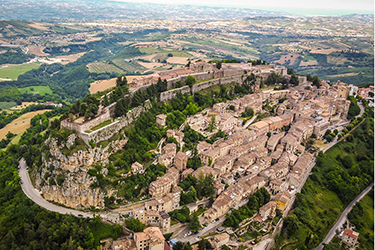
Built entirely on the slope of a rocky hill, Civitella del Tronto preserves its appearance as a fortified centre, the northernmost bulwark of the former Kingdom of the Two Sicilies.
If you have ever wondered where Southern Italy begins, now you have the answer: right here, in Civitella del Tronto, the northern border of the Bourbon possessions, historically considered the starting point of the South for those arriving from Central and Northern Italy.
A few kilometres further on there is Campli and its “Holy Staircase”, a place of pilgrimage for millions of people. This sacred building consists of 28 wooden steps to be climbed strictly on your knees and with your head bowed in order to obtain forgiveness for sins.
What to eat in Ascoli
14
You cannot understand how much work it takes to make an Ascoli-style olive until a local restaurateur explains it to you.
Ascoli’s most representative dish requires excellent ingredients, pork, chicken, beef, wine, eggs, Parmesan cheese and oil, as well as time and effort for preparation. All this for that brief moment of ecstasy, but it is worth it.

The olives are usually part of the “fritto misto”, with lamb chops, artichokes and fried custard, which can be eaten as an appetiser or as a main course.
The other dishes of the local cuisine focus on substance: chitarre, tagliatelle and macaroni from nearby Campofilone go perfectly with meat ragù, especially chicken.
Among the main courses, sliced Marche beef stands out. For dessert, anise-flavoured castagnole, Frustingo, made with walnuts, dried figs and almonds, and Pizza dolce, similar to zuppa inglese. Among the local wines to try are Rosso Piceno Superiore and Falerio. Every lunch or dinner always ends with an Anisetta Meletti.
Where to stay in Ascoli
HAlthough it is the most important tourist destination in the Marche region and one of the most visited art cities in Italy, Ascoli does not have excellent accommodation capacity. There are fewer than 30 hotels, which makes it difficult to find a room at a good price during high season, spring and early autumn.

On the other hand, prices are not high and the rooms are usually housed in splendid historic buildings. A room in a 3-star hotel in the historic centre starts from 50 euros per night.
The full range of hotels in Ascoli is available on Booking.com. Around 30 hotels with photos, services, prices and reviews from people who have already stayed there.
Go to Booking.com