
Almost on a par with Seville, Málaga is considered the quintessence of Spain and of the symbols associated with it.
Unlike the capital of flamenco, located inland in Andalusia, Málaga enjoys a privileged position on the Costa del Sol, the Spanish coastline most loved by tourists from all over the world, known for its very long beaches and warm, mild temperatures throughout the year.
But you should know that Andalusia’s second city is not only synonymous with tireless nightlife, tapas, bullfighters and long days spent in the sun. It is also an important cultural and artistic centre, rich in history and with a truly fascinating past.
Málaga was founded by the Phoenicians in 800 BC, when it was known as Malaka, a name derived from the Phoenician word for “salt”, since the most important activity at the time was the salting of food.
After passing under the rule of the Greeks, Carthaginians, Romans and Visigoths, Málaga was conquered by the Arabs in the second half of the 13th century, when it became part of the Sultanate of Granada.
Only in 1487 did the Castilians of King Ferdinand the Catholic, through the Reconquista, reclaim the Spanish city during one of the bloodiest battles in the history of Málaga.
The city’s different Roman, Phoenician and Muslim origins emerge in several places, but the most emblematic is the Alcazaba, where traces of past conquests are concentrated within just a few metres.
The ancient Roman Theatre, the imposing fortress of the kings of Granada and the castle of Gibralfaro, which dominates the entire city from above, offer visitors, at a single glance, the whole historical journey of Málaga.
Nor should we forget the role that the capital of the Costa del Sol played in 20th-century art. Málaga was, in fact, the birthplace of the famous Pablo Picasso, whose life and works can be discovered at the Casa Natal and the Picasso Museum.
On this page, we recommend the 10 things to do and see during your visit to Malaga.
If, instead, you are looking for a hotel in Malaga, we recommend choosing from those offered by Booking.com. There are around 140 hotels with prices, photos and reviews from guests who have stayed there before you. Go to Booking.com
The Alcazaba of Malaga
1
If you want to visit the city of Málaga, we recommend immersing yourself in its origins, starting from the symbolic place where the three cultures that characterise the whole city — Roman, Arab and Renaissance — come together.

The Alcazaba, which in Arabic means “fortress”, is the oldest Muslim work in Spain, built between 1057 and 1063 on a rock where Roman ruins and an ancient defensive bastion of Phoenician-Punic origin once stood. It is located at the foot of Mount Gibralfaro and behind the ancient Roman theatre.
It was King Badis ben Habús of Granada who ordered the construction of this imposing Muslim residence overlooking the city of Málaga from above.
The entrance to the structure, from Calle Alcazabilla, is through the Gate of the Columns and a climb that leads to the Arch of Christ, where the first mass was celebrated after the Christian conquest of the city by Ferdinand the Catholic.
Inside the double concentric wall that surrounds the Alcazaba, whose route climbs up the hill, you can admire Roman remains, including fortified gates, statues and columns with capitals, enchanting Arab gardens filled with splendid vegetation, the Granada rooms, where kings and governors lived, and the Moorish palace, now used as an archaeological museum.
The Alcazaba Museum
Inside, it houses Greek and Roman sculptures, Christian, Visigothic and Arab decorations, Hispano-Muslim and Arab ceramics and fragments of mosaics.
The terraces of the Alcazaba
From the terraces of the Alcazaba, you can enjoy a breathtaking view of the bay and port of Málaga. It is certainly worth a visit for a fascinating itinerary rich in history, beginning with the city’s ancient Roman origins and leading into the final phase of Moorish rule in 1487.
The Alcazaba is connected to Gibralfaro Castle by a corridor protected by walls called La Coracha.
Opening hours and ticket price for the Alcazaba
Opening hours: from April to October 9 am-8 pm. From November to March 9 am-6 pm. Last admission 45 minutes before closing.
Ticket price:
full price €3.50, €1.50 for students and over 65s.
combined ticket Alcazaba and Gibralfaro full price €5.50, €2.50 for students and over 65s.
How to get there: the Alcazaba is located at Calle Alcazabilla 2. It can be reached on foot.
Gibralfaro Castle in Malaga
2
If you want to admire the best panoramic view of Málaga from its highest point, you need to walk up the hill on which the Alcazaba stands and climb the steps along the walls to a height of 130 metres, where the Gibralfaro Castle is located.

From here, at a glance, you can see the port of Málaga, the beaches, the Roman Theatre, the bullring and the Cathedral. On a clear day, your view can stretch as far as the seaside resort of Torremolinos and the Strait of Gibraltar.
The Gibralfaro Castle, whose name derives from “Jabal-Faruk”, meaning “mount of the lighthouse”, was built in the 14th century by the Muslims on the remains of a fortress of Phoenician origin, as a refuge for troops and as protection for the Alcazaba.
It was King Yusuf I of Granada who transformed the fortress into a castle in 1340.
As you venture among the castle ruins, you will be impressed by its grandeur, characterised by two lines of walls and eight towers, which made it the most impregnable structure in the Iberian Peninsula.
Walking along the inner wall, you will explore the entire perimeter of the castle, while the external zigzagging wall, also known as La Coracha, will lead you to the Alcazaba Fortress.
The Gibralfaro Castle is famous for being the last place conquered by the Catholic Monarchs in 1487. King Ferdinand managed to take possession of the fortress after three months of siege and after defeating the Muslims, exhausted by hunger.
Inside Malaga Castle
Inside, you can visit the Centro de Interpretación, an exhibition that illustrates, through an audiovisual projection, the entire life of the castle from its origins to the Christian conquest, with models, maps, miniatures and navigation instruments, also retracing the lives of the inhabitants of the time.
The castle has a Torre Mayor, 17 metres high, and the Airón well, 40 metres deep.
Since 1931, Gibralfaro Castle has been considered a Historic Monument.
Opening hours and ticket price for Gibralfaro Castle
Opening hours: from April to October 9 am-8 pm. From November to March 9 am-6 pm.
Ticket price:
full price €3.50, €1.50 for students and over 65s.
combined ticket Alcazaba and Gibralfaro full price €5.50, €2.50 for students and over 65s.
How to get there: the castle is located at Camino de Gibralfaro, 11 and can be reached on foot or by bus 35.
The Picasso Museum in Malaga
3
The city of Málaga is famous all over the world for being the birthplace of the most celebrated and influential painter in 20th-century art history. Pablo Picasso was in fact born in a building in the very central Plaza de la Merced, where the Fundación Picasso now stands.

But the true “monument” entirely dedicated to the artist’s works is the Museo Picasso Málaga, founded in 2003 to fulfil Picasso’s dream: that his art should have its own symbolic place in his hometown.
The Picasso Museum houses more than 200 works belonging to the private collection of two of his relatives, Christine Ruiz-Picasso and Bernard Ruiz-Picasso, who inherited 155 works, including paintings, drawings, ceramics, sculptures and engravings.
In 1997, they decided to donate them to the Junta de Andalucía, which had acquired the wonderful Renaissance-style Buenavista Palace to transform it into a museum dedicated to Picasso.
These works were later joined by another 49 made available by his heirs.
Inside the gallery, which was considered a symbol of the love and esteem of the people of Málaga for their artist, you can admire much of his repertoire, through works spanning different styles, techniques and materials that allow visitors to discover all the stages of Picasso’s artistic journey.
The Picasso Museum hosts a permanent collection and temporary exhibitions and also offers cultural and educational activities for adults and children.
Picasso’s birthplace
To complete your “Picassian” walk, do not miss a visit to the Casa Natal of Pablo Picasso, at Plaza de la Merced 15, inside the current building of the Fundación Picasso.
Open to the public since 1988, the residence where the artist was born is arranged over two levels and contains personal objects belonging to Picasso’s family, photographs and several works made with mixed media, including engravings, graphic works, ceramics and illustrated books. Many engravings and graphic works by artists such as Miró, Chagall, Ernst and Bacon are also on display, as well as works by contemporary Spanish artists from Málaga such as Barbadillo and Diego Santos.
Opening hours and ticket price for the Picasso Museum
Opening hours:
from September to October and from March to June 10 am-7 pm
from November to February 10 am-6 pm
July and August 10 am-8 pm
Ticket price: full price €9, over 65s and students up to 26 years old €7. Free every Sunday during the last two hours.
How to get there: the museum is located in Palacio de Buenavista, c/ San Agustín, 8 and can be reached on foot.
The Cathedral of the Incarnation in Malaga
4
The Cathedral of Málaga is considered one of the finest architectural works of the Andalusian Renaissance.
The construction of the church of Nuestra Señora de la Encarnación, which stands in the historic centre on the remains of an ancient mosque, was ordered by the Catholic Monarchs. The work took place between 1528 and 1783, was interrupted in 1680 due to an earthquake, and was left unfinished. In fact, the finishing touches on the main façade and the south tower are missing.

This explains why the Cathedral is also called “La Manquita”, meaning “the one-armed lady”, although a legend says that the money intended to complete the works was used to finance the wars in America in the 19th century. In reality, those funds were used to finance public works.
The façade of Malaga Cathedral
The majestic Cathedral of the Incarnation has a façade characterised by Corinthian columns and three arches decorated with marbles of three different colours, while the interior, with three naves, is impressive in size and contains elements of different architectural styles: Neo-Gothic, late Gothic, Neoclassical, Baroque and Renaissance.
The interior of the Cathedral
The three naves are all the same height and are “closed” by richly decorated groin vaults that form small domes.
Do not miss a visit to the side chapels, which house precious works of art such as paintings by Pedro de Mena, Luis de Morales, José de Ribera and Alonso Cano. Inside the Cathedral, you can also visit a Cathedral Museum, which houses other important sacred works.
Opening hours and ticket price for the Cathedral of the Incarnation
Opening hours: Monday to Friday 10 am-8 pm, Saturday 10 am-6 pm, Sunday 2 pm-6 pm. The roof can be visited every hour from 11 am, and on Sundays from 4 pm.
Ticket price:
Cathedral: full price €8, over 65s €7.50, ages 13-17 €5, students aged 18-25 €5, ages 0-13 free.
Cathedral + roof visit: full price €12, over 65s €11, ages 13-17 €8, students aged 18-25 €9.
How to get there: the cathedral is located at Calle Molina Lario, 9 and can be reached on foot.
Roman Theatre of Malaga
5
One of the most surprising attractions in Málaga is the evocative Roman Theatre, located at the foot of the Alcazaba. The remains of this theatre were only discovered recently.

In 1951, during excavation work to build the Casa della Cultura, or Palace of Archives and Libraries, the archaeological remains of a Roman Theatre emerged, complete with cavea, orchestra and proscenium, having remained buried underground for centuries.
It was therefore decided, in 1988, to demolish the new building in order to continue the excavations and bring the archaeological remains fully to light.
The Theatre dates back to the 1st century AD, under the empire of Augustus, and was used by the Romans for theatrical performances until the 3rd century AD.
When the Arabs took possession of Málaga, they used some architectural elements of the theatre, such as capitals and column shafts, to build their Alcazaba, turning the ancient theatre into a quarry for storing construction material. For this reason, the precious remains remained hidden for centuries.
The city of Málaga decided to restore the ancient Roman Theatre, which can accommodate 220 spectators, and to use it once again for open-air performances.
In 1984, it hosted the International Theatre Festival.
A Centro de Interpretación, built next to the theatre in 2010, guides visitors through audiovisual projections and the display of original finds, helping them discover the history of Málaga’s Roman Theatre, which today is the oldest historical monument in the city and the only still intact symbol of its Roman origins.
Opening hours and ticket price for the Roman Theatre
Opening hours: Tuesday to Saturday 10 am-6 pm. Sunday 10 am-4 pm. Closed on Mondays.
Ticket price: free.
How to get there: the theatre is located at Calle Alcazabilla, 8 and can be reached on foot.
Plaza de Toros in Malaga
6
If you love Spanish folklore and the famous bullfights do not upset you, during your visit to the city of Málaga you can attend one of the incredible contests between bulls and bullfighters inside the famous Plaza de Toros.

But even if you do not want to watch these characteristic fights, so popular throughout Spain, we recommend taking a walk around “La Malagueta”, as the city’s bullring is called. Located along Paseo de Reding, near the port, La Malagueta was built in 1874 by the architect Joaquín Rucoba.
The first man-versus-bull fight took place on 11 June 1876. The imposing structure, built in Neo-Mudéjar style, a reinterpretation of Moorish architecture, has the shape of a 16-sided hexadecagon, a diameter of 52 metres and can hold as many as 14,000 spectators.
Bullfights and festivals in Plaza de Toros
Today, bullfights are held in La Malagueta once a week, while during festive weeks, such as Semana Santa and the Málaga Fair, the arena comes alive every day with shows and entertainment, hosting the most famous bullfighters in Spain and giving spectators engaging moments of folklore and popular tradition.
The Plaza de Toros of Málaga was declared a historic-artistic monument in 1976 and houses the Antonio Ordóñez Bullfighting Museum, dedicated to the legendary bullfighter who enjoyed his greatest moments of glory in this very arena.
The museum offers visitors an overview of the history of bullfighting, with photographs, documents and other important testimonies connected to this characteristic event.
Opening hours and ticket price for the Plaza de Toros
Opening hours: bullfights take place between April and September. The Antonio Ordóñez Bullfighting Museum is currently closed.
How to get there: the plaza is located at Paseo de Reding, s/n. – Plaza de Toros de la Malagueta. Gate 10, and can be reached on foot.
Botanical Garden and Paseo del Parque in Malaga
7
In Málaga, there is no shortage of wonderful unspoilt green areas where you can spend a few hours walking surrounded by nature.
The La Concepción Botanical Garden is a lush botanical garden created in 1856 by the Marquises of Loring, who were passionate about botany, and later enriched by the Echevarría-Echevarrieta family.
In this true oasis in the heart of the urban setting, now belonging to the “Ciudad de Málaga” botanical city council, you can admire several species of exotic, tropical and subtropical plants from Europe, America, Asia, Africa and Oceania. In 1943, the Garden was declared part of the city’s historic-artistic heritage.

Here you can spend an entire day walking along fascinating paths, among fountains and small lakes, waterfalls and streams, surrounded by splendid plants, flowers, bamboo, aquatic plants, magnolias, pines, cypresses and cedars, some over a century old, brought at the end of the 19th century from Australia, the Philippines and America by the sailing ships of the noble owners of La Concepción.
The palm collection of Malaga
The palm collection is the most spectacular in Europe. There are at least 100 species, including some unique specimens. In total, the Garden is home to more than 50,000 plants from over 2,000 species.
The aqueduct
In the Botanical Garden you will also find statues, an aqueduct, the San Telmo Aqueduct, which once brought water to the whole city, the Loringiano Museum, a small Doric-style temple, and an enchanting wisteria pergola near the palace.
The Paseo del Parque
The Paseo del Parque, on the other hand, is located along the port of Málaga and stretches for 1 kilometre along the seafront, from the historic centre to the Plaza de Toros. In this splendid garden too, you can admire tropical and subtropical flora, with beautiful and unusual plants, flowers and palms, statues, fountains and paths, statues of illustrious figures, kiosks and gazebos.
The “green” route was created in 1896 using part of the road originally intended for the port.
Numerous open-air artistic events are held inside the park, such as concerts, theatre performances and film screenings.
Opening hours and ticket price for the Botanical Garden and Paseo del Parque
Opening hours:
from April to September every day 9:30 am-8:30 pm
from October to March every day 9:30 am-5 pm.
Ticket price: full price €5.20. Over 65s, young people and students €3.10. Free on Sundays during the three hours before closing.
How to get there: the garden is located at Camino del Jardín Botánico, 3. It can be reached by bus 2, last stop.
The Port of Malaga
8
Like most Spanish cities, Málaga is known above all for its very lively nightlife.
Trendy little venues, bars with outdoor tables, kiosks where you can eat and drink follow one another along many streets and alleys in the city’s historic centre, especially around the Cathedral.

Here, finding a good restaurant where you can eat typical dishes and bars where you can enjoy cocktails and chupitos at low prices is certainly not difficult.
The evening nightlife begins around 8 pm, with aperitifs based on tapas, and continues until 4 in the morning, among the many clubs where entrance is often free and lots of PR staff invite you to have drinks at very discounted prices, especially if you enter before midnight.
The Port of Malaga
But the busiest area in the evening is above all the port, which has been completely renovated and made more accessible for residents and tourists. Elegant, refined and modern, the new Port of Málaga is now one of the liveliest and most animated places in the city, a cultural and commercial landmark.
Two new areas have been created: the Palmeral de las Sorpresas, the main promenade characterised by fountains, gardens, equipped spaces dedicated to relaxation and children’s play areas, venues and restaurants with terraces where you can admire the entire bay of the city;
the Muelle Uno, a more dynamic area dedicated to concerts and events, markets and shops. Here you can admire the luxury boats moored in the harbour, but also rent sailing boats and book fishing excursions.
In the Port of Málaga there is also the Aula del Mar, an interactive museum where visitors can discover the marine world, dedicated to environmental education, and an elevated walkway where a branch of the famous Parisian Centre Pompidou museum will be located, which was expected to open in early 2015.
Another idea for spending an evening in Málaga is to head to the city beaches, such as La Malagueta, in a modern area popular with young people, full of pubs and clubs, bars and trendy restaurants, and to Pedregalejo, where you will find typical Andalusian restaurants and the city’s most famous pubs.
What to Eat in Malaga
9
Málaga is the kingdom of tapas, and the expression “vamos a tapear” is one of the most common among the people of Andalusia, as well as throughout Spain.
If you are curious to discover what it is all about, just enter one of the “tapas bars” scattered throughout the city, especially in the historic centre.

“Tapas” are rustic snacks that Spaniards eat as an aperitif or appetiser, accompanied by alcoholic or non-alcoholic drinks.
Originally, “tapas” were served to accompany sherry, the famous sweet Spanish liqueur, and were placed on a small plate that covered, or “tapped”, wine glasses to prevent flies or dust from getting in.
There are endless varieties of tapas, and every “taperia” has its own specialities. Generally, these snacks consist of “cold” dishes based on cured meats, cheeses, anchovies, olives, salad, or “hot” ones based on chicken, meat, fish, squid, octopus, potatoes, eggs, vegetables and greens, combined in the most imaginative ways.
The habit shared by Spaniards, and one we recommend to all visitors, is to order something to drink, perhaps a glass of “tinto” red wine or beer, and two or more “tapas” in one bar, with prices per portion around €1.75, and then move on to the next place to repeat the same “ritual”.
If the tapas have only whetted your appetite, we recommend trying the typical dishes of Andalusian cuisine. The traditional dish is gazpacho, the cold soup made with vegetables and tomatoes, peppers, cucumbers and onions, accompanied by croutons.
Fish
You cannot leave the Costa del Sol without tasting fish-based dishes. There are plenty of restaurants and chiringuitos serving fresh fish, shellfish or “pescaíto frito”, fried squid, anchovies and seafood, especially along the beaches and around the port area of Málaga.
Meat
Alternatively, you can also choose meat-based dishes, such as roast loin, cochinillo asado, roast pork, chicken, chorizo, sausage, tortilla, omelette, bull’s “rabo”, or tail, for the more daring, as well as a wide variety of legume and vegetable soups, stews and the typical stuffed baked potato.
Choose typical restaurants displaying the menu del día: often a first course, second course, side dish, drink and dessert will cost you no more than €10!
Ice creams and desserts
If you love sweets, you should know that in Málaga you can taste the best ice creams in Andalusia. The most typical flavour is, of course, the famous cream with raisins and rum that bears the city’s name. Not to be missed are also tortas locas, sweets made with sweet potatoes, and the traditional Borrachuelos malagueños soaked in liqueur.
Where to Stay in Malaga
10
Málaga is a very affordable city, as are most Spanish cities. Finding a reasonably priced hotel, hostel or bed and breakfast, many of them family-run, is not difficult at all.
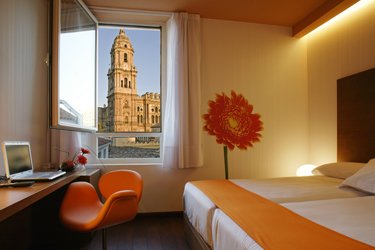
Even in the historic centre of the city, you can find accommodation from €40 to €70 per night, including three-star and higher options. Málaga is a small and compact city, and the main attractions can be reached in just a few minutes. In the immediate vicinity of the centre, on Carretera del Colmenar, there are some good-quality and reasonably priced hotels. The centre can be reached by bus 37, which arrives in Plaza de la Merced.
If you are looking for a hotel in Malaga, we recommend choosing from those offered by Booking.com. There are around 140 hotels with prices, photos and reviews from guests who have stayed there before you. Go to Booking.com