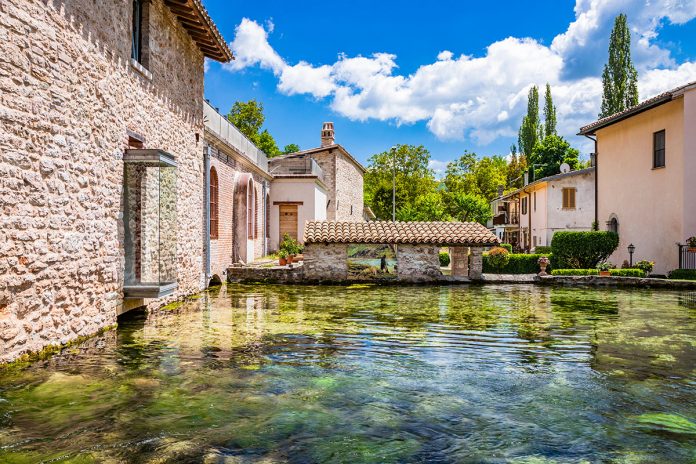
The meeting of different histories and cultures has always helped shape the identity of Umbria. One of Italy’s smallest regions still preserves clear, intact traces of its past. Holy Umbria, warrior Umbria, green Umbria: all these descriptions suit this land, yet none of them alone can contain its many dimensions.
Perugia and the other Umbrian towns offer visitors a rich artistic and cultural heritage, set within a landscape that fascinates at every turn: a landscape that still keeps something ancient within it and continues to resist industrialisation and the harsher signs of progress.
Umbria is a region where folklore events, fairs and traditional festivals hold a special meaning: they preserve local identities, distinctiveness and traditions that globalised civilisation tends to flatten.
So here are some of the most important places to visit in Umbria, ideal for discovering the art and culture of a small yet extraordinary region.
Perugia in Umbria
1
Perugia is a small jewel that reveals itself gradually before the visitor’s eyes. This Umbrian city preserves artistic and monumental treasures that bear witness to its rich past and honour Italy’s cultural primacy.
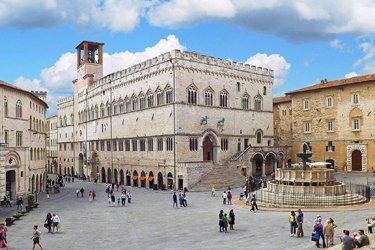
Although it still retains the appearance and rhythm of life of a small fortified medieval town, Perugia has a lively urban energy, thanks especially to one of the oldest universities in Italy, founded in 1308, as well as the country’s leading University for Foreigners.
It is not, therefore, a museum city, full of tourists by day and empty by night, but a place that deserves more than a hurried visit to its main monuments. From the National Gallery to the Etruscan Well, from the Oratory of San Bernardino to Corso Vannucci, here are the 10 things you absolutely should do and see during a visit to Perugia. The rest is a surprise you will discover for yourself.
Discover the 10 things to do and see in Perugia.Assisi in Umbria
2
Assisi is one of the most visited towns in Umbria. Saint Francis and Saint Clare lived here, and it is precisely these two figures that make Assisi the region’s main religious centre, a favourite destination for many pilgrims. The modern town developed without compromising the structure of the ancient one: a network of narrow streets connects the various squares, set on different levels and guardians of the city’s long history.
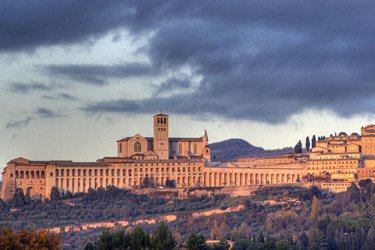
The Basilica of Saint Francis and the Church of Saint Clare are not the only places to visit in Assisi: the Temple of Minerva, the “Capitano del Popolo” palace and the imposing Rocca Maggiore, just outside the city walls, are among the attractions worth discovering. A walk in the Monte Subasio Regional Park will also give you a taste of the remarkable natural landscape that defines both the town and the Umbrian region as a whole.
Discover the 10 things to do and see in Assisi.Gubbio in Umbria
3
The blocks of limestone used to build Gubbio have earned the town the nickname “the grey city”: it is the oldest centre in Umbria and has preserved its medieval character in both its buildings and streets.
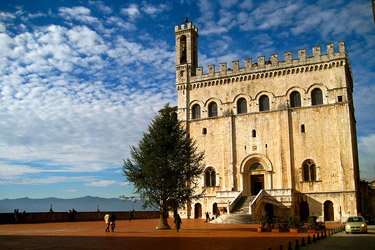
A true Umbrian town, Gubbio offers a view that is at once uniform and sublime: a repeated yet wonderfully evocative landscape.
As with Assisi, the history of this town is closely linked to Saint Francis, and in particular to his encounter with the wolf.
The Church of San Francesco is the place where the wolf is said to have taken refuge for the night, and it is only one of the sights you can visit. Starting from Piazza Grande, the city’s main square, a route among its monuments, from the Palazzo dei Consoli to the Palazzo del Capitolo and on to the Cathedral, reveals the wonders of this Umbrian town.
Discover the 10 things to do and see in Gubbio.Todi in Umbria
4
An elegant medieval town and one of Umbria’s most fascinating destinations, Todi rises austere and melancholic on the top of a hill overlooking the beautiful Tiber Valley.
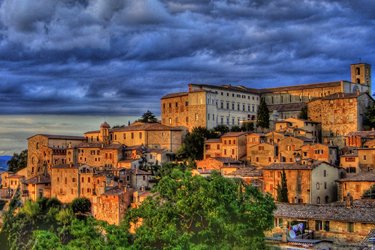
Walking through Todi’s narrow streets, you can let yourself be drawn into the charm of a town where the atmosphere of another time still lingers.
In Piazza del Popolo, once the site of the Roman forum, you can visit Todi’s main monuments: the Cathedral, the Palazzo dei Priori, the Palazzo del Capitano and the Palazzo del Popolo; all symbols of a power that once was.
In the same square, you can alternate cultural visits with pleasant stops in a café or in one of the traditional shops selling handwoven textiles.
Do not overlook Todi’s wine tradition: wine has always been a central part of life for the people of Todi. Outside the city walls, in the lower part of town, stands the Temple of Santa Maria della Consolazione, an architectural work known throughout the world and considered one of the symbolic buildings of the Italian Renaissance.
Orvieto in Umbria
5
The perfect harmony between Orvieto and the tuff cliff on which it stands is a striking example of the balanced relationship between nature and human creation. This splendid town is a favourite destination for those seeking high-quality travel: Orvieto offers visitors a rich historical, artistic, gastronomic and environmental heritage.
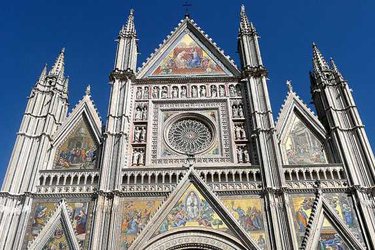
Walking through the city streets means travelling through three thousand years of history: traces of past ages appear at every turn.
A visit might begin with the Cathedral and continue with the Rocca and the Well of Saint Patrick. Heading towards Corso Cavour, after a stop in one of the old shops, you reach Piazza del Popolo, where the Palazzo del Popolo and the Papal Palaces dominate in all their splendour. Between one monument and the next, allow yourself a break in one of the traditional trattorias to enjoy the local products of this land.
Discover the 10 things to do and see in Orvieto.Spoleto in Umbria
6
The influence of the Roman age is still clearly visible, although Spoleto, with its characteristic narrow streets, retains the look of a medieval town.

The most ancient origins of Spoleto include the Roman Theatre, the Arch of Drusus and the early Christian Basilica of San Salvatore; yet towering over all the monuments is the fortress built by Cardinal Albornoz in the second half of the 14th century.
The Eroli Chapel and the Chapel of the Relics are two other attractions not to miss: in the first you can admire beautiful frescoes by Pinturicchio, while the second houses the 14th-century statue of the Madonna and Child.
The Cathedral rises majestically in the city centre, and nearby stand Palazzo Arroni and the Church of Santa Maria della Manna d’Oro. Spoleto is not only art: it also promotes major cultural events, above all the Festival dei Due Mondi, a programme of cinema, theatre, art, music and ballet.
Spello in Umbria
7
Spello stands on a spur of Monte Subasio and seems to lean forward to welcome visitors. It is the pink stone of Subasio that gives the entire town its beautiful colour. As in Spoleto, Roman and medieval traces coexist in perfect harmony in Spello. The remains of the Roman Amphitheatre and Theatre lie within the medieval walls, where the Porta Consolare and Porta Urbica are still perfectly preserved.

Walking through the distinctive streets of the centre, you can admire ancient palaces and castles whose structures have been altered over the centuries. Spello is not only a testimony to an ancient past: visitors also know it for the Infiorata, a festival celebrating Corpus Christi. Every year since the 1930s, artists have filled the streets with works made from flower petals and inspired by religious themes.
Discover the 10 things to do and see in Spello.Terni, the Marmore Falls
8
Terni developed on a broad plain where the Serra and Nera rivers meet. It is a classic example of a city open to the challenges of the future, without denying its glorious past.

Terni preserves monuments from its past, such as the Church of San Salvatore and the Romanesque Cathedral; but the futuristic tower rising above the Old Town Hall shows a city looking ahead.
Anyone visiting Terni should not miss the Marmore Falls: just a few kilometres from the city centre, you can witness one of the grandest spectacles nature has to offer.
Created by the Romans to channel the waters of the Velino River, the Marmore Falls offer a magnificent scene in which the roar of foaming waters, plunging 165 metres, blends with captivating plays of light.
The Springs of Clitunno in Umbria
9
The Springs of Clitunno are another jewel of Umbria’s natural landscape. These underground springs emerge at Campello sul Clitunno, between Spoleto and Foligno along the Via Flaminia. They then flow for 60 km before reaching a tributary of the Tiber.

Their evocative appearance, with vegetation surrounding the banks and reflected in waters of intense colour, has inspired many writers and poets. In ancient times, it was believed that the god Clitumnus dwelt in the depths of these waters, and three temples were built in his honour, later lost. The only survivor of those structures is a small temple that preserves ancient Umbrian frescoes. Emperor Caligula also came here to consult the oracle, and religious rites are believed to have taken place here as well. The Springs are therefore not only environmentally important, but also historically and culturally significant.
Norcia in Umbria
10After the 2016 earthquake, some of the places described are no longer open to visitors. Two things have made Norcia famous: Saint Benedict and gastronomy. Saint Benedict was the first monk of Christianity and the founder of the Benedictine order; the Basilica dedicated to him dates back to the 14th century but, like all the city’s historical treasures, it has been restored several times following the damage caused by repeated earthquakes.

Its mountain-flavoured gastronomy is another excellent reason to visit the town. Cured meats have made Norcia famous throughout the world, but truffles, spelt, lentils from nearby Castelluccio and cheeses are no less remarkable. In short, this small ancient jewel offers visitors the chance to alternate gastronomic excursions with visits to the works of art enclosed within its walls. In addition to the already mentioned Basilica of Saint Benedict, the Cathedral, the Castellina and the Civic Museum are also of considerable interest. If you pass through Norcia between 10 May and early July, enjoy the extraordinary spectacle of the blooming of millions of colourful flowers — poppies, cornflowers and daisies — on the plateau of Castelluccio di Norcia.
If you are looking for a hotel, we recommend choosing from those offered by Booking.com. There are around 3,000 hotels with prices, photos and reviews from guests who have stayed before you. Go to Booking.com.
Foligno in Umbria
11
Let’s begin with a curiosity: according to its inhabitants, Foligno is the centre of the world, because it lies at the centre of Italy, which lies at the centre of the Mediterranean, and so on… In truth, there is an old dispute with Rieti, which claims the same title! In any case, if you want to see where this supposed centre is physically located, you must go to the now-closed Gran Caffè Sassovivo at Corso Cavour 60. For a long time, there was a billiard pin marking the exact spot where this more-or-less realistic centre of the world was said to be. Today there is a soap shop, but a glass case in the floor still preserves that precious point!

Beyond this curiosity, Foligno is worth a visit because it is a beautiful city of art set within the typical, unspoilt landscape of Umbria.
We recommend beginning your visit in Piazza della Repubblica with Palazzo Trinci, the Town Hall, the Palazzo del Podestà and the Cathedral. It is a classic Italian square, where civic and religious power face one another.
The Middle Ages, the Renaissance and contemporary art coexist throughout the city, especially in the former Church of the Santissima Trinità in Foligno, home to one of the most debated contemporary artworks of recent decades: the “Cosmic Magnet”, a huge skeleton that is certainly worth seeing.
Discover the 10 things to do and see in Foligno.Rasiglia in Umbria
12
Overrun by visitors in recent years, Rasiglia was for a long time a little Umbrian gem unknown to the crowds.
Thanks to the water that flows from the Capovena spring, the streams crossing the village and the pools they create within the town, Rasiglia is known as the “Little Venice of Umbria” or the “Village of Streams”.

Today the water attracts visitors, but for many centuries it was Rasiglia’s only resource: it powered mills and artisan workshops.
We recommend visiting the village when the crowds are absent, so you can enjoy it at its best.
Avoid weekends, Easter holidays and spring long weekends. If you cannot go during quieter periods, no matter: Rasiglia is beautiful all the same!
Discover what to see in Rasiglia.Bevagna
13
Like Rasiglia, Bevagna too has lived for centuries around water. It is no coincidence that, of the six gates giving access to the village, the most evocative is the one with the bridge over the Clitunno River, offering a remarkable view of the Accolta, the old public washhouse of the Umbrian village.

For centuries, the power of water made it possible to produce “carta bambagina”, a paper famous throughout the world and essential for making parchments.
Today Bevagna is a quiet, perfectly preserved Umbrian village, where few signs of modernity disturb the medieval atmosphere. The food is excellent, the shops offer local products, and the pace invites real relaxation.
An unmissable destination and absolutely worth seeing on any itinerary through Umbria.
Discover what to see in Bevagna.Montefalco
14
Famous above all for Sagrantino, the prized “wine of Saint Francis”, Montefalco is one of the most beautiful villages in Italy and an essential stop on any visit to Umbria.

Built entirely uphill, Montefalco feels like a leap back into the Middle Ages. From the walls to the churches, from the squares to the towers, you have the impression of walking through places where Saint Francis once preached.
It is no coincidence that the most important church in Montefalco is dedicated to the Saint, and it alone is worth a visit to the village.
On the walls of the central apse, in fact, is one of the best-known pictorial cycles in Italian art: the life of Saint Francis, painted in 1452 by Benozzo Gozzoli, and the story of Saint Jerome, also by the same artist.
Discover what to see in Montefalco.