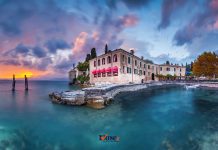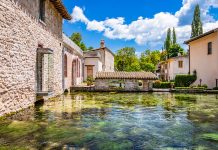
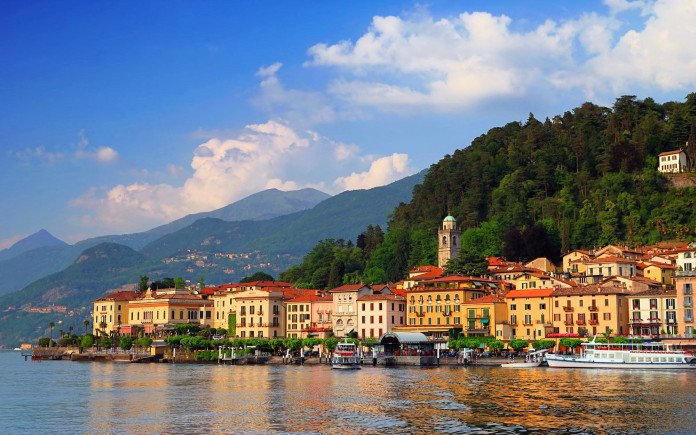
The main centre is Como, the city that gives the lake its name, with its fine monuments, charming historic centre and atmospheric views.
While ferries and hydrofoils are an excellent way to admire the city from the water and fully enjoy the beauty of the landscape, the best way to take in a wider panorama is the funicular that connects Como with Brunate. The second most important city is Lecco, famous above all as the town of The Betrothed.
Equally evocative are the lakeside towns such as Cernobbio, home to grand aristocratic villas including Villa d’Este and Villa Erba, and Bellagio, known as the “pearl of the lake” thanks to its enchanting setting.
Less known but deeply fascinating is Isola Comacina, a small green jewel surrounded by the waters of the lake, where settlements dating back to Roman times have been found. For this reason, scholars like to call it the “Pompeii of the Lario”. Here are the 10 things to do and see if you decide to spend a few days on Lake Como.
If you are looking for a hotel, we recommend Booking.com. More than 380 hotels with descriptions, photos, prices and reviews by guests who have already stayed there. Go to Booking.com
Como Cathedral
1
Considered one of the finest monuments in northern Italy, Como Cathedral is a complex and richly articulated building, begun in 1396 and completed in 1740 with the raising of the dome by Filippo Juvarra, architect to the King of Sardinia.
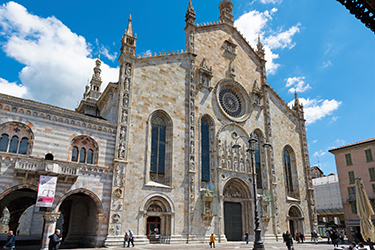
Built to replace the Romanesque cathedral of Santa Maria (1015), Como’s cathedral brings together different styles — a Gothic façade, Renaissance side elevations and portals — while preserving a harmonious and impressively unified whole.
The imposing façade, with spires and pinnacles, is richly decorated with sculpture, much of it by the workshop of Giovanni Rodari. Of particular note are the two niches dedicated to the Latin writers Pliny the Elder and Pliny the Younger, and the decoration of the three portals. The left-hand portal is known as the “Frog Door” because of a frog carved on the door pilaster: it appears to leap out of a pond and climb through the foliage as if about to surprise a butterfly.
The Gothic interior is divided into three naves by 10 pillars and preserves numerous works of considerable importance.
Highlights include paintings by Bernardino Luini (Adoration of the Magi) and Gaudenzio Ferrari (Marriage of the Virgin and Flight into Egypt), Renaissance tapestries — some based on designs by Giuseppe Arcimboldo — the 16th-century altarpiece of Saint Abbondio, patron saint of the city, the small baptistery temple of 1590 and two Romanesque column-bearing lions from the ancient church of Santa Maria.
Opening hours and ticket price for Como Cathedral
Opening hours for visitors:
Monday – Friday: 09:30 – 17:30
Saturday: 10:45 – 16:30
Sunday and public holidays: 13:00 – 16:30
Ticket price: free.
How to get there: Piazza del Duomo.
The Basilica of Sant’Abbondio in Como
2
Built at the end of the 11th century on the site of an early Christian church dedicated to Saints Peter and Paul, the Basilica of Sant’Abbondio is a magnificent example of Lombard Romanesque architecture and a masterpiece of the so-called Maestri Comacini — the masons, architects and sculptors who spread the Lombard style not only in Italy but throughout Europe.
Built by Benedictine monks and dedicated to Como’s fourth bishop, the church underwent major alterations from the 16th century onwards, which changed its original appearance. Fortunately, its early character was recovered thanks to 19th-century restoration work.

The façade in Moltrasio stone is marked by powerful pilaster strips dividing it into five sections, corresponding to the internal naves, and by a beautiful portal decorated with low-relief sculpture.
The twin bell towers, with a distinctly northern inspiration, are particularly interesting. The interior, with five naves separated by tall columns with finely carved capitals, preserves in the apse a splendid 14th-century fresco cycle by the Master of Sant’Abbondio, narrating the life of Christ in twenty scenes.
Opening hours and ticket price for the Basilica of Sant’Abbondio
Opening hours: every day from 08:00 to 18:30.
Ticket price: free.
How to get there: Via Regina Teodolinda, about 1 km outside the historic centre.
Palazzo Broletto in Como
3
The former town hall, the Broletto — from the Latin “brolo”, meaning a field or open space where citizens gathered, and by extension the place where civic assemblies were held — was built in 1215 at the request of the podestà Bonardo da Cadazzo beside the Cathedral. Its position almost symbolised the continuity between the bishop’s civil authority and the new communal power that extended its control over the diocesan territory.

The Broletto consists of a two-level body — arcades on the ground floor and three-light windows on the upper floor — with bands of white, grey and red marble, and a tower built using rusticated masonry.
Over time, the building where citizens’ assemblies were held and justice was administered underwent many changes and alterations.
In the second half of the 15th century, a large part of the building was demolished to make more space for the Cathedral, which was being rebuilt; in 1764 it was converted into a theatre; later it was used as a notarial archive until the end of the 19th century.
Restored several times from 1899 onwards, it was returned to its original forms only in 1972. Today Palazzo Broletto, owned by the municipality, hosts art exhibitions and conferences.
Opening hours and ticket price for the Broletto of Como
Opening hours for visitors: the Broletto and the tower are not normally open to visitors. The building opens only for exhibitions and special events.
Ticket price: varies according to the exhibition.
How to get there: Piazza del Duomo.
Tempio Voltiano in Como
4
This building in the form of a neoclassical temple, standing on the lakefront, celebrates the life and work of the great Como-born physicist Alessandro Volta.
The museum, conceived and financed by the industrialist and patron Francesco Somaini, was built for the first centenary of the death of the inventor of the battery (1927), to house the scientific instruments that had belonged to him.

Many of these instruments are originals, while others are reconstructions of those destroyed by the fire of 1899 during the International Exhibition of Electricity.
The main body of the mausoleum, crowned by a hemispherical dome, is preceded by a broad pronaos with statues of Faith and Science, reached by two symmetrical staircases.
The interior is arranged over two floors. In the central hall on the ground floor, visitors can see the apparatus, machines and devices used by the distinguished scientist for his experiments in physics and electricity, as well as for the study of gases and their properties.
The first-floor loggia displays memorabilia, letters, publications, portraits of Alessandro Volta as scientist, politician and professor, and the honours paid to him during his lifetime and after his death.
Opening hours and ticket price for the Tempio Voltiano
Opening hours:
Tuesday to Sunday: from 10:00 to 18:00
Last admission at 17:30.
Ticket price: €5.
How to get there: Viale Marconi on Como’s lakefront.
Como–Brunate Funicular
5
Opened in 1894, the Como–Brunate funicular connects the city with the Larian “balcony”, linking lake and mountain and offering a magnificent view over Como and its lake from above.
The “journey” begins in a tunnel and then continues outside, where the two small carriages climb a steep hillside, allowing passengers to admire the splendid panorama. The funicular runs on a single track, which doubles only halfway along the route, where the two cars pass each other.
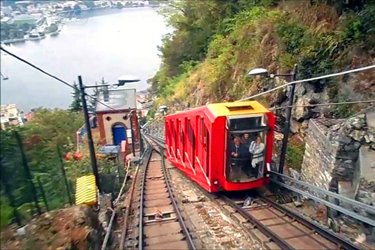
The 1,084-metre route, with a maximum gradient of 55%, overcomes a difference in altitude of about 500 metres and reaches the small village of Brunate in just under 7 minutes.
A pleasant holiday resort especially popular with locals from Como and Milan, Brunate is also known as the “balcony” of the Alps for its enchanting viewpoints over Como, the lake branch, the Lombard plain, the Alps, Monviso and Monte Rosa.
Unique of its kind in Europe, this daring construction is one of Como’s best-known attractions. Though short, the funicular ride is thrilling and memorable. It is well worth trying.
Operating hours and ticket price for the Como funicular
Operating hours:
Every day: from 06:00 to 22:30. In summer, until 24:00.
Saturday: from 06:00 to 24:00.
Ticket price: €3.10 one way. €5.70 return.
How to get there:
Departure/arrival stations: Piazza A. De Gasperi in Como, Piazza A. Buonacossa in Brunate.
Cernobbio on Lake Como
6
Leaving Como and following the western shore of the lake, you reach Cernobbio, an elegant resort at the foot of Monte Bisbino. Cernobbio takes its name from an ancient Cluniac monastery (Coenobium) built around the year 1000. The heart of the town is Piazza Risorgimento, also known as the “Riva”, which overlooks the lake directly.

Besides its enchanting views, Cernobbio is known for its many prestigious villas. The imposing Villa Erba, built in 1898, is a large complex made up of the main house, guesthouse, greenhouses, boathouse, stables and service buildings, surrounded by an extensive park.
A noble residence of the family of Luchino Visconti — the great director loved spending his summers here — the villa is now an important congress centre hosting events and exhibitions.
Cernobbio’s most precious treasure, however, is 16th-century Villa d’Este — renamed by Caroline of Brunswick, Princess of Wales, in honour of her supposed Este origins — which was transformed in 1873 into a luxury hotel with princely interiors and a beautiful Italian garden overlooking the lake.
Walking along the lakefront, you can also admire Villa Bernasconi in Art Nouveau style, Villa Pizzo, made up of two buildings, one of which — the lower Pizzo — stands on the lake, and 18th-century Villa Fontanelle, immersed in a splendid park.
Laglio and Torriggia
7
Beyond Cernobbio, where Lake Como narrows and the two shores almost seem to touch, you come to Laglio and its hamlet of Torriggia. This tiny village, visited only by the most curious travellers, enjoyed a splendid anonymity until George Clooney decided to buy historic Villa Oleandra and use it as his holiday home in Italy.

Since then, crowds of curious visitors have filled the streets, waiting for the lucky moment when they might meet the actor — something that rarely happens. These gossip tourists often leave disappointed, forgetting to discover what Laglio actually has to offer.
In addition to the pleasant lakeside walk, in the hamlet of Torriggia you will find the so-called Buco dell’Orso, a karst cave with three underground lakes, named after bear remains found there in the 19th century.
If visiting a cemetery while on holiday does not trouble you, the cemetery of Laglio contains a very unusual monument: the pyramid of Joseph Frank, a roughly 20-metre-high stele erected in 1851 in memory of this German doctor and pupil of Alessandro Volta.
Apparently this block of grey-black granite, inspired by the Pyramid of Cestius in Rome, was meant to be built near the Tempio Voltiano, but the people of Como objected. Do not leave Laglio before heading a little higher into the hills rich in olive trees and vines, where the views are wonderful and the photos are superb.
Lecco on Lake Como
8
Lecco is the city that gives its name to the eastern branch of Lake Como. Its fame is inseparably linked to Alessandro Manzoni, who drew inspiration from these places for the events of The Betrothed.

Here, almost everything recalls the famous novel and its author: Pescarenico, the Lecco district explicitly mentioned by Manzoni, where traces of Fra Cristoforo’s convent can be found; the districts of Acquate and Olate, identified as the villages of Renzo and Lucia; the supposed house of Lucia in Olate and the church of Saints Vitale and Valeria, considered the parish church of Don Abbondio; and the promontory of Zucco, where until 1938 one could admire the 16th-century palace of Don Rodrigo, now completely transformed.
There is, of course, the monument to Manzoni in the square that bears his name, and the Manzoni Museum, housed in the villa where the writer spent his childhood and adolescence, displaying memorabilia, manuscripts and rare editions of his celebrated literary work.
Also worth visiting are Piazza XX Settembre, the former market square, with the Visconti Tower (16th century), the Basilica of San Nicolò, now the city cathedral, the 19th-century Town Hall (Palazzo Bovara) and the Azzone Visconti Bridge with its arches.
Built in the Renaissance period, the bridge connected Lecco with the Duchy of Milan and still today marks the entrance to the city for those arriving from Milan or Como.
Bellagio on Lake Como
9
A captivating town known for its enchanting position and characteristic historic centre, Bellagio is an exceptional travel destination. The so-called “pearl of Lake Como” sits romantically on the tip of the promontory that divides the lake into the Como and Lecco branches, in a wonderfully scenic setting.

Colourful houses, picturesque lanes, characteristic stairways and ancient churches make the old village a place of great charm.
Between the 18th and 19th centuries, Lombard nobles and wealthy bourgeois families built luxurious villas here, welcoming distinguished Italian and foreign guests.
Napoleon Bonaparte was a guest of Count Melzi d’Eril at Villa Melzi, a beautiful neoclassical villa surrounded by a splendid English-style garden dotted with statues, where pianist and composer Franz Liszt loved to linger.
Emperor Francis I, Kaiser Wilhelm and Alessandro Manzoni, on the other hand, stayed at the old Villa Serbelloni, a magnificent complex immersed in a spectacular terraced park of paths, clearings, exotic plants and many rose gardens. Today the villa belongs to the Rockefeller Foundation of New York, which has turned it into a study and conference centre.
Opening hours and ticket price for Villa Melzi
Opening hours:
The Gardens of Villa Melzi are open from late March to early November every day, from 09:30 to 18:30.
Ticket price: €8.
The Park of Villa Serbelloni can be visited from 22 March to 3 November every day except Monday and in bad weather, only on guided tours for a minimum of 6 and a maximum of 30 people, lasting about 1 hour and 30 minutes, departing at 11:00 and 15:30 from the Promobellagio Office (Piazza della Chiesa di S. Giacomo – Medieval Tower).
Ticket price: €9.
Isola Comacina on Lake Como
10
The only island on Lake Como, Isola Comacina is a place of great fascination, where history, nature, art and archaeology intertwine on this tiny, almost uninhabited fragment of land.
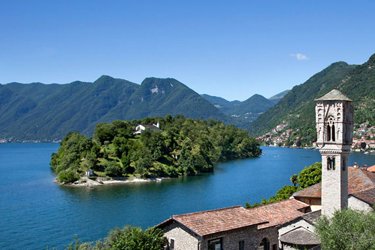
Lush nature and a gentle landscape frame the remains of its illustrious past as a fortified citadel — first Roman, then Byzantine — as an important religious centre of the Diocese of Como and as a powerful Larian commune until the 12th century, when the people of Como razed it to the ground (1169) to punish its loyalty to Milan.
Cavaliere Caprani, the island’s last owner, donated it to King Albert I of Belgium, who, wishing to turn it into an artists’ colony, donated it to the Italian State, which entrusted it to the Brera Academy of Fine Arts (1920).
Among the island’s “treasures” are the ruins of the great Romanesque church of Sant’Eufemia, where the three-nave and three-apse plan, the beautiful crypt and the winged portico in front are still visible; the remains of a Roman marble colonnade preserved beneath the church of San Giovanni; and the three Artists’ Houses built between 1936 and 1940 by architect Pietro Lingeri in Rationalist style inspired by Le Corbusier, designed to host internationally renowned artists for short stays in search of inspiration.
Opening hours and ticket price for Isola Comacina
Opening hours:
Every day from 10:00 to 18:00 / last taxi-boat departure from Ossuccio at 17:00.
Ticket price: €6 for entrance to the island and the Antiquarium.
How to get there: by taxi-boat from Ossuccio (€8) or with Navigazione dei Laghi from Como, Tavernola, Cernobbio, Moltrasio, Torno, Urio, Pognana L., Careno, Nesso, Brienno, Argegno, Lezzeno, Lenno, Tremezzo, Bellagio, Menaggio, Varenna, Bellano, Gravedona, Domaso, Piona and Colico.
Varenna on Lake Como
11
Varenna is one of the most beautiful destinations on Lake Como. Thanks to its central location, it is always very popular: it is a twenty-minute drive from Lecco, easily reached from Bellagio and other lake towns by ferry, and from Milan by direct train.

Among the things to see in Varenna, we recommend the Castello di Vezio, of medieval origin, where in addition to visiting the walls, gardens, underground rooms and tower with its striking lake view, you can also watch birds of prey in flight.
Varenna is known for its villas of great scenic value: Villa Cipressi, now a renowned hotel and restaurant, and Villa Monastero, famous for its botanical garden and house museum.
The historic centre of Varenna is a jewel box of narrow lanes, little squares, characteristic venues and steps leading down to the lakefront.
As for religious sights, in the main square, Piazza San Giorgio, stands the Church of San Giorgio, in Lombard style and dating back to the 14th century. Go inside to admire the 13th-century frescoes, the Baroque high altar and the flooring in black Varenna marble.
The nearby Church of San Giovanni Battista is also worth a visit, with traces of ancient frescoes. Its simplicity conveys the very essence of a place of worship. It is one of the oldest churches on the Lario, dating to the 11th century.
Varenna is appreciated for its panoramic walks along the lake, suitable for families with children too. One of the most evocative is the walk from Varenna to Bellano, taking two to three hours depending on stops.
Another of the most romantic and scenic routes on Lake Como is the Passeggiata degli Innamorati, the Lovers’ Walk, about 500 metres long, running between the rock and the lake shore and linking the historic centre to the ferry pier. Do it at sunset, when the view becomes magical, and you will not regret it.
Menaggio on Lake Como
12
Menaggio is a village overlooking the western shore of Lake Como. Thanks to its strategic location, it is an excellent starting point for taking the ferry to other lake destinations such as Varenna, Lenno and Bellagio, and for excursions towards Switzerland, Lugano or Saint Moritz.
The walk through the historic centre, with its lanes and little squares filled with attractive shops, bars and restaurants, is very pleasant. Sit at one of the outdoor tables for an ice cream or an aperitif while admiring a view that certainly holds its own. The heart of the town is Piazza Garibaldi, from which you can walk to the medieval castle dating back to the 10th century.
Among the religious sights, we recommend the Church of Santo Stefano, located 100 metres from Piazza Garibaldi and dating originally to the 17th century. Its three-nave interior preserves a series of 15th- and 16th-century paintings. Smaller but also worth visiting is the 18th-century Church of Santa Marta, with a neo-Gothic façade and 17th- and 18th-century paintings.
Menaggio is also known for the private villas in the hamlet of Loveno: Villa Govone and Villa Mylius Vigoni. The latter can be visited only at certain times of the year by booking a guided tour.
The lakeside promenade is especially beautiful, enhanced by well-kept flowerbeds and benches. It is one of the most elegant on the Lario: it starts at the small harbour, runs alongside the historic centre and reaches the Menaggio lido. Along the way, you will come across the modern sculpture representing The Weaver.
As for beaches, in summer you can sunbathe and swim in the lake using the facilities of Lido Menaggio, which offers pools for children and adults and a green lawn with sun loungers. Alternatively, you can choose one of the free beaches, including Spiaggia Lerai, near Camping Europa Menaggio and a free car park.
The Orrido di Bellano on Lake Como
13
The Orrido di Bellano is one of the best-known attractions in Bellano and on Lake Como. It is a large natural gorge formed more than ten million years ago by the erosive action of the waters of the Pioverna stream. Today it is open to the public and can be visited along a route winding through rocks and caverns.
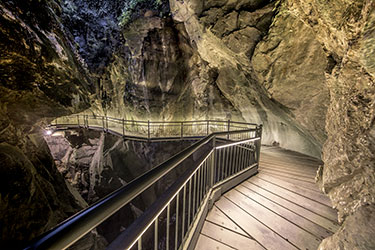
The route is easy, takes about twenty minutes and is also suitable for children, although for safety reasons pushchairs are not allowed.
You walk along a system of bridges and walkways connecting the different areas of the canyon as far as the great waterfall, where the visit ends. Originally, the route extended even deeper into the rock than it does today.
During the Christmas holidays, the gorge is illuminated for the Orrido Magic Christmas Lights event.
Included in the ticket price is a visit to “Cà del Diavul”, a three-storey tower with screens and audiovisual stations telling the story of Bellano and the geological formation of the site. One section is dedicated to the “Pesa Vegia” (Old Weighing), a costumed re-enactment held during the Epiphany period and deeply felt by the people of Bellano.
A curiosity: in the upper part of the tower, frescoes depicting the devil and other mythological figures were found, hence the name House of the Devil. Entrance to the Cà del Diavul is organised by time slots: 8 people at a time every quarter of an hour. Visitors must arrive at the ticket office 10 minutes before entry.
Opening hours and ticket price for the Orrido di Bellano
Opening hours: the Orrido di Bellano is open Monday to Friday from 09:00 to 18:00; Saturday and Sunday from 09:00 to 19:00.
How to get there: Address: Piazza S. Giorgio. The attraction is a few minutes on foot from Bellano Tartavalle Terme railway station.
Ticket price: full €15; reduced €10 (ages 6–12); reduced €5 (ages 0–5); €4 for holders of train and lake ferry travel tickets.
Villa del Balbianello on Lake Como
14
Villa del Balbianello is one of the most beautiful and spectacular historic residences on the whole of Lake Como. It stands in Lenno, on the small Lavedo peninsula, and its greatest strength is its exceptional location. Those arriving by car can leave it in the car park on Via degli Artigiani and continue to the villa with a twenty-minute uphill walk.
Alternatively — and in our view this is the most practical and comfortable option — once you have parked, head to the pier just a few steps from the car park: on the way there, take the taxi boat so you can see the villa from the lake and avoid the uphill walk. On the way back, return on foot along the downhill path, a pleasant and not tiring walk. Another option is to take the taxi boat directly from Tremezzina without using the car.
Its beauty is already clear from the outside, but the interiors do not disappoint. Villa Balbianello can be visited only by joining a FAI guided tour, with prior booking and ticket purchase. The park can be visited independently. Booking in advance is recommended, especially at weekends.
With knowledgeable guides, visitors tour the beautifully preserved rooms and then continue through the meticulously maintained gardens. The visit lasts about 45 minutes. The story of the villa’s last owner, Guido Monzino, entrepreneur and traveller, is particularly interesting: every room reflects his taste and his journeys, especially the library with thousands of books from all over the world.
Opening hours and ticket price for Villa del Balbianello
The villa is open from 10:00 to 18:00.
Closed: Monday and Wednesday.
It is advisable to check the opening calendar on the official FAI website > https://fondoambiente.it/luoghi/villa-del-balbianello/visita
Park-only ticket: full €11; reduced (ages 6–18) €6; students (up to age 25) €9; free for children up to age 5.
Villa + Park ticket: full €22; reduced (ages 6–18) €12; students (up to age 25) €16; free for children up to age 5.
Tremezzina on Lake Como
15
The municipality of Tremezzina, in the province of Como, includes the hamlets of Lenno, Ossuccio, Mezzegra and Tremezzo.
For lovers of medieval villages, we recommend reaching Rogaro, on a small hill in Tremezzina, where you can visit the church with the statue of the Black Madonna, said to come from the Sanctuary of Einsiedeln in Switzerland. Just outside the village stands the medieval Tower of Rogaro.

From Tremezzina, a stop at nearby Isola Comacina is a must: this evocative little island on Lake Como can be reached by boat excursion from the pier at Ossuccio.
It is an ideal one-hour outing to visit a distinctive, green and less chaotic place than the lake’s more celebrated destinations.
There is an entrance ticket for the walking tour of the island among small churches, summer residences of Italian and foreign artists and archaeological remains dating to the Early Middle Ages.
A religious complex worth visiting in the area is that of the Beata Vergine del Soccorso, included on the UNESCO World Heritage list. The visit unfolds between the Sanctuary and the many chapels scattered along a panoramic path on Monte Ossuccio.
Another unmissable attraction is Villa Carlotta, located on the lake shore in a panoramic position facing Bellagio. It is open from March to November and can be visited by reservation only.
The entrance ticket gives access to the Botanical Garden, divided into various sections including the Italian Garden and the Romantic Garden; it also includes entry to the Museum, where objects, furnishings and furniture belonging to Princess Carlotta, wife of the Duke of Saxe-Meiningen, are preserved.
The most famous painting is undoubtedly The Last Kiss of Romeo and Juliet by Francesco Hayez, just as the statue of Palamedes by Antonio Canova is not to be missed.
Ticket price: full €15; over 65 €13; ages 6–17 €6; free for children up to age 5.
A highlight of the cultural calendar is the LacMus Festival, held every year from early to mid-July in the most beautiful historic buildings and villas of Tremezzina. The landscape setting is unique: Lake Como provides a spectacular backdrop to a programme of classical music by renowned national and international artists.
Where to stay on Lake Como
H
For almost two centuries, Lake Como has been a travel destination for nobles, artists and ordinary visitors alike. Its great tradition of hospitality is reflected in a wide and good-quality range of accommodation, with prices for every budget.

In Como, Lecco and the many small towns overlooking the lake, you will find hotels, guesthouses, agriturismi and a large number of Bed and Breakfasts. Lake Como is an international tourist destination all year round, especially in high season — Easter, Christmas, long weekends and summer holidays. To find accommodation suited to your budget, it is best to book in advance.
If you are looking for a hotel, we recommend Booking.com. More than 380 hotels with descriptions, photos, prices and reviews by guests who have already stayed there. Go to Booking.com