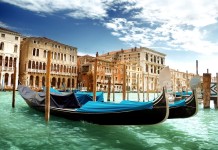
Too often considered only a stopover city for those heading to spend the summer in Istria or Slovenia, Trieste actually deserves much more than a visit of just a few hours.
Of course, it is not helped by its reputation as a decadent city with little to offer. In reality, as Umberto Saba, who was born and lived here, wrote, Trieste is a city with a gruff grace. So do not expect the postcard-perfect welcome that other cities reserve for tourists arriving with money to spend. Trieste is simply there, and reveals itself only to those who truly want to discover it.
It is no coincidence that it has exerted a special fascination over artists and writers such as James Joyce and Stendhal. As Saba also wrote, at the end of the same poem dedicated to his much-loved city, Trieste is a thoughtful and reserved city.
But not boring, we would add. We therefore recommend visiting it at any time of year, and on this page we point out the main places of interest and the 10 things to see during a weekend or holiday in Trieste.
If you are looking for a hotel in Trieste, we recommend choosing from those offered by Booking.com. There are around 70 hotels with prices, photos and reviews from previous guests. Go to Booking.com.
Piazza Unità and Molo Audace
1
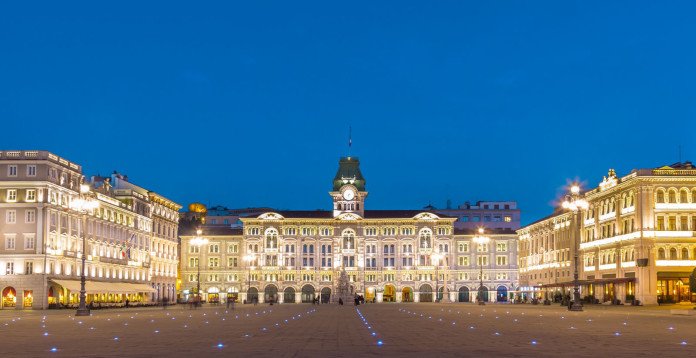
The names this large square has had over the centuries reveal the troubled history of Trieste, a borderland that has always been contested. Originally called Piazza San Pietro because of the presence of a small church, it later became Piazza Grande and, in 1918, Piazza Unità.

After the end of the Second World War and the return to Italy of the “Free Territory of Trieste”, it took its definitive name: Piazza Unità d’Italia. The people of Trieste boast that it is the largest square overlooking the sea in Europe, and it most probably is.
From left to right stand the Palace of the Austrian Lieutenancy, now the seat of the Prefecture; Palazzo Stratti, with the famous Caffè degli Specchi; Palazzo Modello, the Town Hall; Palazzo Pitteri, the oldest building in the square; the hotel in Palazzo Vanoli; and the Palazzo della Regione, which has always belonged to the Lloyd Triestino shipping company.
In the square stands the Fountain of the Four Continents, built between 1751 and 1754. The figures are an allegory of the four continents known at the time: Europe, Asia, Africa and America. The reference to “foreign” figures was not appreciated by Mussolini, so in 1938, on the occasion of the Duce’s visit, the fountain was removed.
In front of the square stretches Molo Audace, named after the first ship that managed to enter the port of Trieste after the end of the First World War and the city’s annexation to Italy. The bronze wind rose on the pier was obtained by melting down an Austrian ship sunk by the Italian Navy.
If you have ever seen a photo of Trieste, it probably showed the Borgo Teresiano, with its canal and colourful boats.
The Borgo Teresiano
2
If you have ever seen a photo of Trieste, it probably showed the Borgo Teresiano, with its canal and colourful boats. The district takes its name from Maria Theresa, the first Empress of Austria, who in the 18th century decided to build an entire neighbourhood by filling in the salt pans.

It is an orderly district with the Canal Grande at its centre, which allowed goods to be brought directly from the sea into the city. The best place from which to admire the canal is the Ponte Rosso, where a colourful fruit, vegetable and flower market has been held for centuries.
Framing the view is Trieste’s largest church, Sant’Antonio Nuovo.
Maria Theresa was a very tolerant woman and allowed the construction of the Serbian Orthodox Church of San Spiridione and the Church of San Nicolò, belonging to the Greek Orthodox community. Today the Borgo Teresiano is one of the hubs of life in Trieste, as it has seen the birth of many cafés, restaurants and shops.
The Cathedral of San Giusto in Trieste
3
The Cathedral of San Giusto is the most important church in Trieste and stands on the hill of the same name overlooking the city. The church is the result of the union of the Church of Santa Maria and the church dedicated to San Giusto, which took place between 1302 and 1320.
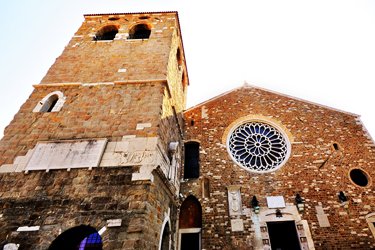
The façade is simple, embellished by a large Gothic rose window and by a central portal incorporating elements of a Roman funerary stele. The plaque above the door recalls the Austro-British bombardment of 1813 against the Napoleonic troops hiding in the nearby Castle.
Some cannonballs are visible in the wall of the bell tower, which also incorporates the remains of the propylaeum of a Roman temple and a shrine with the statue of San Giusto.
What to see in the Cathedral of San Giusto
The interior has five naves, with splendid frescoes of the Venetian school in the apse of the left nave — the Madonna enthroned with the blessing Child and the archangels Michael and Gabriel. The central nave is also decorated with a mosaic — Christ between Saints Justus and Servulus — dating from the late 13th century.
The Baptistery of Trieste
To the left of the Cathedral, visitors can access the Baptistery and the Museum with the Treasury, which also includes “the halberd of Saint Sergius”, brought to Trieste by veterans of the First Crusade.
Next to the Cathedral stands the Castle of San Giusto, another symbol of Trieste, built in 1468 at the request of the Austrian emperors as a base from which to defend and control the city. Today, the halls and walkways house a museum mainly preserving medieval bladed weapons and firearms.
Opening hours and ticket price for the Cathedral and Castle of San Giusto
Cathedral opening hours: every day from 8 a.m. to 6:30 p.m. Sundays and holidays from 9 a.m. to 7:30 p.m.
Bell tower opening hours: from 1 April to 30 September, from 9 a.m. to 5:30 p.m. every day. From 1 October to 31 March by reservation, by calling Sergio Schiberna, tel. 393 954 3131.
Ticket price: free admission; donations are welcome.
Castle and Museum opening hours: from 1 April to 30 September, every day from 10 a.m. to 7 p.m. From 1 October to 31 March, Tuesday to Sunday from 10 a.m. to 5 p.m.
Ticket price: full €5, reduced €3 for ages 6 to 26 and over 65s, free up to 6 years old. The ticket includes the walk around the walls, the Civic Museum of the Castle of San Giusto – Armoury and the Tergestine Lapidarium.
How to get there: the castle and cathedral are located in Piazza della Cattedrale 3, Trieste, and can be reached from the centre in a few minutes by bus 24 or by car.
Miramare Castle in Trieste
4
“A love nest built in vain”: this is how Giosuè Carducci describes Miramare Castle in the poem of the same name. The Castle was in fact commissioned in 1850 by Archduke Ferdinand Maximilian of Habsburg as a residence for himself and his wife, Charlotte of Belgium.
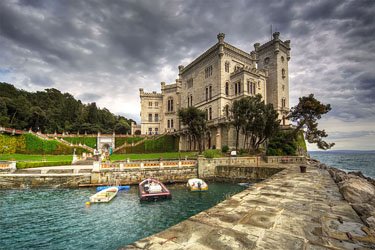
Overlooking the sea and surrounded by large green spaces, it was ideal for the Archduke, an experienced seaman and botany enthusiast.
In reality, Miramare never became the royal couple’s love nest, because Maximilian was executed by firing squad in Mexico. Charlotte, driven mad by the loss, lived in the adjoining small castle for a few years before being transferred to Belgium.
The eclectic style of the palace is striking, combining Gothic, Renaissance and medieval elements.
What to see in Miramare Castle in Trieste
On the ground floor are the apartments of Charlotte and Maximilian, which have remained almost unchanged since the time of construction.
On the first floor are the guest apartments, slightly modified when Amedeo d’Aosta turned the Castle into his residence in 1930. The immense park is now one of the favourite places of the people of Trieste, who use it for walks, running and sunbathing.
If the weather allows, it is lovely to reach Miramare along the Barcola seafront, which leads from the centre to the Castle.
Opening hours and ticket price for Miramare Castle
Castle opening hours: the castle is open every day from 9 a.m. to 7 p.m.
Ticket price: full €12: includes the exhibition Ars Botanica. Paper Gardens. Reduced €2 for ages 18 to 25; free up to 18 years old and every first Sunday of the month.
Opening hours and ticket price for the park
The park is open every day from 8 a.m. In January, November and December it closes at 4 p.m. In February and from 15 to 31 October it closes at 5 p.m.; from 1 to 14 October and in March at 6 p.m. From April to September it closes at 7 p.m.
Ticket price: admission is free.
How to get there: 8 km from the centre of Trieste. On foot from the Barcola seafront.
By car: direction Miramare.
By bus: lines 6 and 36.
The Historic Cafés of Trieste
5
It seems that James Joyce wrote many pages of Ulysses and Dubliners at the tables of Pasticceria Pirona.
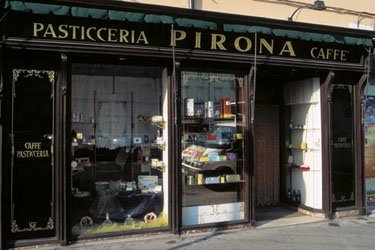
During the years he spent in Trieste, it was not unusual to see the Dublin-born writer writing or reading while enjoying a pastry or a coffee.
Writers, poets and the cafés of Trieste form an inseparable trio: Svevo, Saba, Stendhal and others sat at the tables of the city’s historic cafés.
In many of these places, nothing has changed since they frequented them, and today they are real tourist attractions. Do not miss Caffè degli Specchi in Piazza Unità, or Caffè Tommaseo, founded in 1830 and the oldest in Trieste.
The intellectuals of yesterday and today meet at Caffè San Marco, while Caffè Pirona remains the place to taste or buy typical sweets, welcomed by a photo of James Joyce that seems to approve.
The Revoltella Museum in Trieste
6
The Revoltella Museum is located in the centre of Trieste, 400 metres from the Maritime Station. It takes its name from its founder, Baron Pasquale Revoltella, a prominent city figure who at the end of the 19th century donated his palace and all its artworks to the city. Over the years, the museum had to expand due to the acquisition of many new works. It was the architect Scarpa who left the main mark on this transformation.
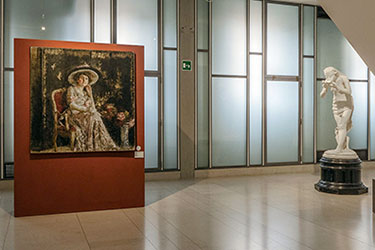
The museum route unfolds over several floors connected by the splendid spiral staircase. On the ground floor is the introductory section, which offers an excursus through the history of Trieste and the museum, mainly through portraits, including that of Baron Revoltella.
The visit continues on the second floor in the baron’s private apartment: first you encounter Pietro Magni’s sculpture “The Cutting of the Suez Isthmus”, before entering the dining room, the bedroom and the sumptuous “green drawing room”. Works by 19th-century artists follow one another, including Alberto Rieger, Ippolito Caffi and Giuseppe Tominz. Also worth noting are the historical paintings by Francesco Hayez and the female portraits by Natale Schiavoni.
On the second floor are the richly decorated reception rooms: the vestibule, the blue drawing room, the yellow room, the ballroom, the mirror room and the small domed room. Among the works on display are sculptures by Luigi Ferrari, bronze coats of arms by Pietro Magni, and paintings by Augusto Tominz, Abraham Hondius, Marco Ricci and Sebastiano Ricci.
Equally fascinating is the museum area dedicated to contemporary art, with works by artists such as Burri, Pomodoro, Scomparini and Fontana, as well as other major 20th-century Italian artists including Felice Casorati, Filippo De Pisis, De Chirico, Carrà, Savinio and Sironi.
There is also a bookshop with a reading space and a sea-view terrace that opens during the warmer season, where visitors can sit at the tables during the day and attend events in the evening.
Opening hours and ticket price for the Revoltella Museum in Trieste
Opening hours: The Revoltella Museum is open every day except Tuesday from 9 a.m. to 7 p.m. — ticket office closes at 6 p.m.
Ticket price: €7 adults and €5 reduced — ages 6 to 26 and over 65s. Access to the museum is included in the FVG Card tourist pass.
How to get there: Bus lines 8 and 9, Riva Nazario Sauro stop
The Statues of Trieste
7
Trieste is full of statues scattered around various parts of the city. Among them, we highlight the four life-size bronze statues dedicated to illustrious literary figures. Let’s see which they are and where to find them.
A selfie with the statue of James Joyce on Ponterosso, on the Canal Grande, is a must. The writer really seems to be strolling through the streets of the city where he spent part of his life until adulthood.
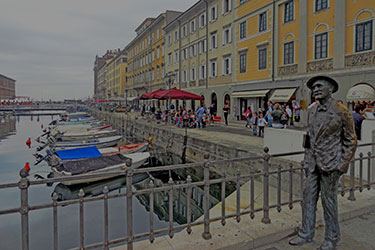
We then reach nearby Piazza della Borsa, where we encounter the statue of Gabriele D’Annunzio sitting on a bench with his legs crossed, focused on reading with his elbow resting on a pile of books.
Continuing the itinerary, we head to Via Dante Alighieri, where the statue of Umberto Saba stands in the middle of the pedestrian street and seems to be walking towards the bookshop a few metres away that once belonged to him. This work too is very realistic: the writer seems to be truly walking among the people. At the foot of the statue, a plaque bears a verse from his 1944 poem “Avevo”.
In Piazza Attilio Hortis, near the Revoltella Museum, stands the statue of Italo Svevo, portrayed with a hat and a book in his hand, his gaze turned towards the Civic Library, where he often spent time studying and reading.
On the seafront near the Teatro Verdi, next to Molo Audace, stands the statue of the Girls of Trieste, two Triestine women — the “mule” in local dialect — intent on sewing the Italian tricolour. The statue, a patriotic symbol, was created in 2004 to celebrate the 50th anniversary of Trieste’s return to Italy.
In the Parco della Rimembranza, near the Cathedral of San Giusto, you can admire the Monument to the Fallen of Trieste, dedicated to the soldiers who died during the First World War, a tribute to the city’s liberation from Austro-Hungarian rule. It depicts five naked warriors, one of whom is wounded while the others try to protect him.
Also worth mentioning are the statue of Empress Elisabeth of Austria in the small gardens in front of the railway station and the statue of Nazario Sauro, a naval officer, in Piazzale Marinai d’Italia near the Molo dei Bersaglieri, opposite the Maritime Station.
The Risiera di San Sabba in Trieste
8
Not everyone will approve of the idea of including a fascist concentration camp in a tourist itinerary.

But if travel is above all discovery and awareness of the past, anyone passing through Trieste should visit the Risiera di San Sabba. A rice-husking plant from 1913 to 1943, after 8 September — the armistice — the Nazis turned it into a prison camp for the deportation and elimination, by weapons or crematorium, of hostages, partisans, political prisoners and Jews.
More than 3,500 people were killed and 8,000 deported to extermination camps in Northern Europe. The chimney and furnace were blown up by the Nazis in an attempt to hide their crime, but their existence was confirmed by survivors. Today, a metal plaque marks the place where the furnace stood.
Today the Risiera is a Museum, where even the names of the sections recall the terrible function of this place: the “Death Cell”, the “micro-cells”, where people were packed like animals, and the “Hall of Crosses”. Faded inscriptions remain on the walls, while many testimonies are displayed in the “Hall of Commemorations” and in the Museum room.
Opening hours and ticket price for the Risiera di San Sabba in Trieste
Opening hours: every day from 9 a.m. to 7 p.m. Last admission 6:30 p.m.
Ticket price: free.
How to get there: the Risiera is located at Via Palatucci 5, Trieste.
By bus: 52, 10.
By car: A4 motorway link road. Exit: Valmaura/Stadio/Cimitero
The Victory Lighthouse in Trieste
9
Rhetorical and patriotic, the Victory Lighthouse is a monument full of symbols, an excellent place from which to see Trieste from a different perspective and also a very useful navigation aid in the Adriatic!
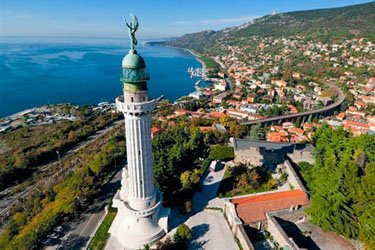
Built in 1923, in the heart of the Fascist period, it commemorates the Italian sailors who fell during the First World War, but in its symbols and materials it also clearly celebrates the Italian victory over the Austro-Hungarian Empire.
The lighthouse was built where an Austrian fortress once stood, and the anchor fixed into the Istrian stone, just below the sailor, is that of the Audace, the first destroyer to enter the port of liberated Trieste. On the base is the inscription created by Gabriele D’Annunzio: “Shine and remember those who fell at sea”.
At the entrance to the lighthouse there are two shells from the Austro-Hungarian battleship Viribus Unitis, sunk by the Italian Navy, whose anchor chain surrounds the flowerbed at the base of the lighthouse. At the top stands the Winged Victory, a seven-metre statue holding a laurel wreath in her right hand and a torch in her left.
To protect it from the strong Bora wind, it was designed with a complex internal mechanism that makes the wings “beat” imperceptibly in order to absorb gusts of wind. Beneath the statue is the lighthouse itself, still the most powerful in the Adriatic.
Opening hours and ticket price for the Victory Lighthouse
Opening hours: April, May, June and September: Friday from 3 p.m. to 7 p.m.; Saturday and Sunday 10 a.m.–1 p.m. and 3 p.m.–7 p.m.
July and August: Wednesday to Sunday 10 a.m.–1 p.m. and 4 p.m.–7 p.m.
October — except 7, 8 and 9: Friday from 3 p.m. to 6 p.m.; Saturday and Sunday 10 a.m.–1 p.m. and 3 p.m.–6 p.m.
From 5 to 9 October, continuous opening 9:30 a.m.–5:30 p.m. — Barcolana.
November: from 1 to 4: continuous opening 9:30 a.m.–4:30 p.m.
Ticket price: free. Last admission 30 minutes before closing.
How to get there: The Lighthouse is located at Strada del Friuli 141, Trieste.
Bus: from Piazza Oberdan, lines 42, 44
The Opicina Tram in Trieste
10
Temporarily out of service. For 110 years, the Opicina Tram, or de Opcina as the people of Trieste call it, has rattled through the centre of Trieste and climbed up to a height of 348 metres on the Karst hills overlooking the Julian city.

The journey begins slowly, in Piazza Oberdan, but immediately after, the climb starts to become interesting. Several panoramic viewpoints open up along the route, which crosses the greenest part of Trieste.
We recommend getting off a little before the terminus in Opicina to enjoy the spectacle of the Adriatic seen from above. The Obelisco stop is recommended for those who want to walk along the Via Napoleonica, a panoramic road that leads, after 4 km, to the Marian Sanctuary, nicknamed formaggino — little cheese — by the people of Trieste because of its unusual shape.
Those who decide to walk the final uphill stretches can reward themselves by sitting at the tables of one of the many Osmizze, simple, very rustic trattorias with only a few tables, where farmers cook local dishes and sell their own wine. You can recognise the ones that are open by the branch hanging at the entrance or near the signs.
Opening hours and ticket price for the Opicina Tram
Opening hours: the Opicina Tram service is temporarily suspended. For updates, visit the Trieste Trasporti website.
Ticket price: €1.35 for a 60-minute ticket.
How to get there: the Opicina Tram departs from Piazza Oberdan in the centre of Trieste and reaches Villa Opicina.
The Grotta Gigante
11
Nature took 10 million years to create this masterpiece, but humans have had the chance to visit it for just over a century. Discovered by chance in 1890, it welcomed its first tourists in 1908.

Since then, not much has changed: visitors enter through a natural opening and begin to descend towards the Great Hall, located about 80 metres underground. The chamber consists of one single, spectacular space, 98.50 metres high, 167.60 metres long and 76.30 metres wide.
The hall, coloured in countless shades, contains stalagmites, stalactites and calcium carbonate flows deposited by rainwater. The most imposing stalagmite is the Ruggero Column, 12 metres high.
At the centre of the cave is the geophysical research station of the University of Trieste, used to study the movements of the Earth’s crust. Visitors climb back up along the Carlo Finocchiaro Path to reach a Belvedere 95 metres high, offering an extraordinary view. Sweatshirts and very comfortable shoes are recommended.
Opening hours and ticket price for the Grotta Gigante
Opening hours: the cave can be visited from Tuesday to Sunday, with guided tours every hour from 10 a.m. to 4 p.m. Booking is compulsory: tel. 040 327312.
Ticket price: full €15, €10 for over 65s and university students up to 26 years old, €8 for ages 6 to 18, free up to 5 years old and with the FVG Card, which includes one additional free admission for a child up to 12 years old.
How to get there: Borgo Grotta Gigante.
By bus: line no. 42 departing from Piazza Oberdan.
By car: from the A4 from Venice towards Sgonico, from Trieste towards Prosecco.
What and Where to Eat in Trieste
12
The centuries-old Austro-Hungarian influence is very present in Triestine cuisine, so much so that, reading the menus, you might think you had ended up in Vienna or Prague. Fortunately, the sea offers valid alternatives to the meat, potato and vegetable-based cuisine typical of Central Europe.

Among the typical dishes to try are Jota, a soup made with beans, sauerkraut, potatoes and sausages; minestra de’ bobici — corn and beans — and bread gnocchi, liver gnocchi or gnocchi with plums.
Among the meat main courses, especially in winter, goulash and lamb with kren are always present. Among the fish dishes, highlights include canocchie alla busara — mantis shrimp with tomato, pepper and wine — alici in savor and salt cod.
For a quick meal, it is best to enjoy a sandwich with porcina — pork — sauerkraut, mustard and horseradish, along with a good beer, for example at Pepi in the old town. Friuli Venezia Giulia is a land of great wines, although the typical wines of the province of Trieste are only Terrano and Vitovska.
Where to Stay in Trieste
HTrieste is a stopover destination for many people heading towards Eastern Europe, whether for work or holidays.
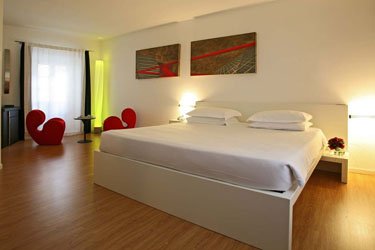
To these we must add the tourists attracted by the charm of this elegant and orderly “old lady”. There is therefore a good demand for hotels, but it is rarely difficult to find a place and there is no need to spend excessive amounts.
If you are looking for a hotel in Trieste, we recommend choosing from those offered by Booking.com. There are around 70 hotels with prices, photos and reviews from previous guests. Go to Booking.com