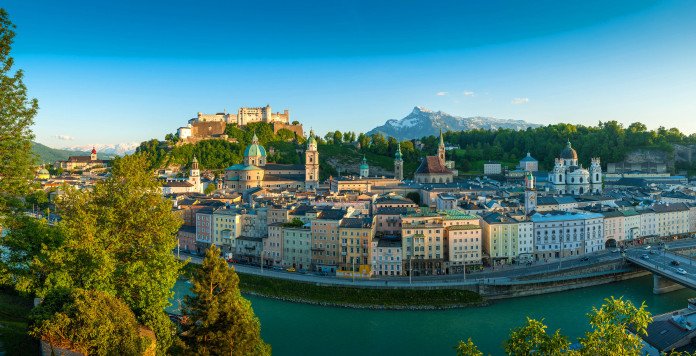
Salzburg is a city that fascinates and seduces like few others. Lying on the banks of the Salzach River, framed by splendid mountains and just a few kilometres from the paradise of the Salzkammergut, Salzburg looks like a fairytale city, beautiful and magical.
From the top of the Mönchsberg, the Hohensalzburg Fortress rises above the rooftops and spires of the historic centre, the Altstadt, a small architectural jewel embellished with squares, palaces and churches where the Baroque shines, declared a World Heritage Site in 1997.
It was three prince-archbishops, lovers of art and Italy, who transformed the small town between the 16th and 17th centuries into the splendid city it is today. Walking through the cobbled streets of the centre, the ancient Austrian city reveals all its treasures: historic buildings such as the imposing Cathedral; magnificent monuments such as Mirabell Palace with its beautiful garden, the sumptuous episcopal palace; picturesque streets with wrought-iron signs; fantastic pastry shops and elegant cafés.
Salzburg is also known as the city of music, in particular as the birthplace of Mozart, who is the main figure of the famous Salzburg Festival, an event that attracts lovers of orchestral music, theatre and opera from all over the world.
The city offers thousands of events throughout the year — the Easter Festival, Advent Singing, Mozart Week, just to name a few — and is rich in cultural institutions, including theatres, concert halls, galleries and museums.
Salzburg is also one of the favourite destinations for those who love Christmas markets. Christmas carols, the seductive scent of roasted almonds and the festively decorated squares create great emotions and enchant visitors, wrapping them in a joyful atmosphere rich in tradition. On this page we recommend the 10 most important things to do and see in Salzburg.
If you are looking for a hotel in Salzburg, we recommend choosing from those offered by Booking.com. There are around 130 hotels with prices, photos and reviews from people who stayed there before you. Go to Booking.com.
Hellbrunn Palace in Salzburg
1
In 1612, Prince-Archbishop Markus Sittikus commissioned the architect Santino Solari to build an Italian-style summer residence at the foot of Mount Hellbrunn, just outside Salzburg. Only a few years were needed to create a splendid suburban villa surrounded by a large park, still considered one of the most beautiful Renaissance buildings north of the Alps and therefore absolutely worth seeing.

The rich water springs of the mountain, ingeniously used, gave the sumptuous residence a unique and original character, turning it into a magical place made of spectacular fountains, mysterious grottoes, mechanical games and enchanting gardens, where peace and nature combine with pleasure, also offering plenty of fun.
For over four centuries, in fact, Hellbrunn Palace has been famous above all for the Wasserspiele, or trick fountains, in the palace gardens, designed by the archbishop, who loved subjecting his guests to constant games and jokes based precisely on treacherous jets of water in order to “brighten” their stay.
The palace was also the setting for great parties, celebrations and cultural events of all kinds, while the “stone theatre”, the oldest open-air theatre in Europe and strongly desired by Sittikus, a great lover of music and theatre, mainly hosted pastoral plays.
During the guided tour, between one surprising water game and another, you should see: the hydraulic theatre (1749-52), where about two hundred figures move thanks to the power of water to the sound of an organ in a three-storey Baroque palace; the Neptune Grotto, or Rain Grotto, covered with a mosaic of gravel and shells; the Festival Hall and the Octagon, with walls and ceilings decorated with perspective frescoes and trompe-l’oeil by Donato Mascagni (1615).
Opening hours and ticket price for Hellbrunn Palace
Opening hours: every day from 1 April to 1 November 2022
Trick fountains, palace, Folklore Museum
April: 9.30-17.30
May, June: 9.30-18.30
July, August: 9.30-19
September: 9.30-18.30
October, 1 November: 9.30-17.30
(last admission one hour before closing)
Ticket price: adult €13.50. 2 adults + child €29.50
How to get there: bus, line 25, from the station or city centre.
Salzburg Cathedral
2
Salzburg Cathedral is the most important sacred building in the city. The powerful octagonal dome, the twin towers and the elegant Untersberg marble façade decorated with statues of bishops and saints characterise this monumental construction.

Founded in 767 by Bishop Virgil in honour of Saints Rupert and Virgil, the patrons of the region, the cathedral was destroyed and rebuilt, enlarged and modified several times.
Its current form, dating from the first half of the 17th century, is the work of the Italian architect Santino Solari, who made it the first early Baroque sacred building north of the Alps.
Severely damaged by bombs during the Second World War, the church returned to its splendour in 1959 thanks to restoration work that rebuilt the dome and part of the presbytery destroyed during the bombings of 1944.
The grand interior, accessed through three bronze portals symbolising faith, hope and charity, has a single nave flanked by four side chapels embellished with stuccoes and paintings.
The polychrome decorations of the dome, with scenes from the life and Passion of Christ, and Mascagni’s Resurrection altarpiece on the high altar are beautiful.
Do not miss the splendid main organ surrounded by little angels holding musical instruments, and the Romanesque baptismal font (1321) where Mozart was baptised.
In the crypt are the tombs of the prince-archbishops and the remains of earlier buildings. Every year since 1920, at the opening of the Salzburg Festival, the Cathedral has served as the backdrop for the performance of the play “Jedermann”, while during the Christmas period it becomes a striking stage for Advent songs.
Opening hours and ticket price for Salzburg Cathedral
January, February: Monday-Saturday 8-17, Sunday and public holidays 13-17
March-October: Monday-Saturday 8-18, Sunday and public holidays 13-18
November: Monday-Saturday 8-17, Sunday and public holidays 13-17
December: Monday-Saturday 8-18, Sunday and public holidays 13-18
Ticket price: free, although the Cathedral cannot be visited during Mass.
How to get there: Domplatz 1a, on foot in the historic centre.
Hohensalzburg Fortress in Salzburg
3
From the top of the Mönchsberg, the mighty Hohensalzburg Fortress has dominated the Altstadt, the oldest part of the city, since 1077.
As well as being one of Salzburg’s most famous emblems, the medieval military complex is also one of the largest and best-preserved fortresses in Europe.
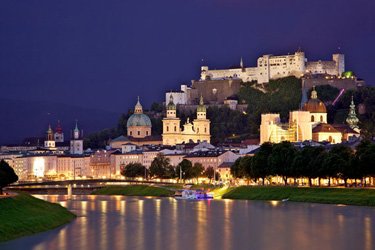
Built in the 11th century at the request of Archbishop Gebhard during the conflict between the Papacy and the Empire over the right to appoint bishops, the defensive bastion was later expanded by Archbishop Leonhard von Keutschach, the last feudal lord of the city, between the 15th and 16th centuries as a testimony to the power of Salzburg’s prince-bishops.
Thus the arsenal, granary, warehouses and church built beside the central palace, which was enlarged and embellished, and the great crenellated towers turned the stronghold into a small city where the ecclesiastical princes resided.
First a defensive bulwark, then a barracks and prison, today the fortress is home to two museums, the Marionette Museum and the Fortress Museum, and hosts important events such as the Fortress Concerts and the Sommerakademie, the art academy held in summer.
The most interesting rooms in the fortress are the Princes’ Chambers, among which the late-Gothic “Goldene Stube”, the Golden Room, stands out, clad in carved, polychrome and gilded wood and with an ancient majolica stove beautifully decorated, as does the “Goldene Saal”, the Golden Hall, with a ceiling decoration that imitates a starry sky.
Also not to be missed, inside the Trompeterturm, or Trumpeter’s Tower, is the 16th-century pipe organ called the “Salzburger Stier”, the Salzburg Bull, because the opening and closing chords imitate the bellowing of a bull. In the past, it was used to announce the opening and closing of the fortress gates. The view from the panoramic terrace, the Reckturm, over the old town and the Alps is extraordinary.
Opening hours and ticket price for Hohensalzburg Fortress
January-April*: 9.30-17
May-September: 9.00-20.00; Museums, Princes’ Chambers, Magic Theatre 9-19
October-December*: 9.30-17
*Easter and Advent weekends: 9.30-18
24/12: 9.30-14, last admission at 14
Ticket price: €13.30. Ascent and descent with the Fortress funicular included.
How to get there: from the city centre, Festungsgasse, on foot, about 15 minutes, or by funicular.
The Residenz in Salzburg
4
The Residenz is one of the city’s most important historic buildings, a symbol of the power of Salzburg’s prince-archbishops.
The palace was built between 1596 and 1619 by Prince-Archbishop Wolf Dietrich von Raitenau on the site of the old 11th-century bishop’s residence, and was expanded in 1788-92.
The grand building was the urban residence and representative seat of the powerful archbishops until the beginning of the 19th century, when Salzburg became part of the Habsburg Empire.

The sumptuous rooms, the Prunkräume or state rooms, of the Baroque residence overlooking the beautiful Residenzplatz reveal small and great treasures to visitors, including paintings, monumental stoves, statues, crystal chandeliers, tapestries and frescoes.
Particularly interesting are: the Carabinieri Hall, named after the bodyguard of the prince-archbishops, a vast hall of about 600 square metres with a frescoed ceiling, now used as a concert hall;
the Knights’ Hall with paintings by J.M. Rottmayr;
the Audience Hall with an inlaid astronomical clock;
the Conference Hall, where the young Mozart gave many concerts.
On the third floor of the Residenz is the Gallery, with a collection of European paintings from the 16th to the 19th century. The collection includes 17th-century Dutch works, Italian, Austrian and French Baroque paintings and, above all, 19th-century Austrian paintings.
Opening hours and ticket price for the Residenz
Tuesday-Sunday: 9-17
July and August: every day 9-17
31 December: 9-14
1 January: 11-17
Closed: every Monday and 1/11, 24/12, 25/12
Ticket price:
Adults €9.00
Children and teenagers, 6-15 years, €3.00
Young people, 16-26 years, €4.00
How to get there: Residenzplatz, on foot from the city centre.
Mozart’s Places in Salzburg
5
Salzburg is the homeland of Mozart, the greatest genius of classical music of all time. Although the composer did not love his native city, he was and remains its most famous citizen, and his presence can be felt everywhere. 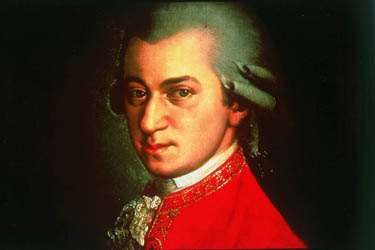
A square and a bridge have been renamed after him, the Mozarteum was named in his honour, one of the most important music academies in Europe, cafés and restaurants bear his name, exquisite chocolate balls filled with marzipan, the famous “Mozartkugeln”, or “Mozart balls”, celebrate him, and souvenir shops overflow with gadgets bearing his face.
At No. 9 Getreidegasse, in the heart of the city, stands the house where Mozart was born on 19 January 1756 and where he spent the first 17 years of his life.
The small palace, converted into a museum in 1880, preserves on the third floor portraits and family memorabilia, official documents, personal belongings and some of the instruments used by the composer, including a clavichord, grand piano, viola, concert violin and the small violin played by Amadeus as a child.
At Makartplatz 8, instead, is the apartment where the Mozart family moved in 1773 and where Amadeus lived until 1780, the year he moved to Vienna.
The museum exhibition focuses on the life and works of the great musician, who within these walls composed “Il re pastore” K. 208, began “La finta giardiniera” K. 196 and “Idomeneo” K. 366.
Opening hours and ticket price for Mozart’s Birthplace
Opening hours: every day 9-17.30
24 December: 9-15
(last admission 30 min. before closing)
Ticket price: Adults €12.00
How to get there: Getreidegasse 9; Makartplatz 8, on foot from the city centre.
Christmas Markets in Salzburg
6
If you are looking for a city where the Christmas atmosphere is truly magical, where sparkling lights and decorations give it a special charm, and where hundreds of stalls fill the historic centre with their scents and flavours, then Salzburg is your ideal destination.

Every year during Advent, the Austrian town dresses up for the festive season: moving live choirs, concerts, shows and, above all, the traditional Christmas markets, which for about a month colour and enliven streets and squares, attracting thousands of visitors from all over the world.
The Salzburger Christkindlmarkt, the Christ Child Market, which extends across Residenzplatz and Cathedral Square, is one of the oldest markets, as well as one of the largest and most beautiful in Europe.
The characteristic wooden huts not only offer countless shopping opportunities, including local handicrafts, toys, Christmas decorations and nativity figurines, but are also an opportunity to taste typical sweets and traditional dishes, warming yourself with the typical “Jagatee”, black tea with obstler or rum, or with steaming, fragrant mulled wine.
All the other markets scattered around the city and its surroundings also offer moments of great joy and wonder.
Absolutely not to be missed: the atmospheric Christmas market in the courtyard of Hohensalzburg Fortress, from which there is an enchanting view of the illuminated city; the one held in front of Hellbrunn Palace, whose façade is transformed for the occasion into a huge Advent calendar; and finally, the small but very popular market in Mirabell Square, full of inviting stalls.
The Music Festival in Salzburg
7
For six weeks a year, Mozart’s city becomes the protagonist of one of the most prestigious cultural events in Europe: the Salzburg Festspiele, the music festival with a very rich programme of concerts, theatre performances and operas staged in various places around the city, including theatres, squares, concert halls and parks.
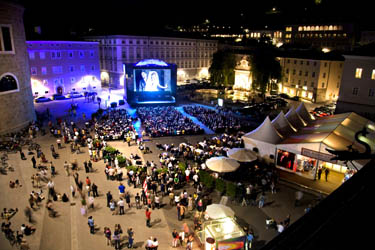
Every summer, between July and August, Salzburg turns into the most important international stage, where great musicians, conductors, singers, actors and directors perform, making this event a unique appointment with culture and entertainment.
It was the writer Hugo von Hofmannsthal, the theatre director Max Reinhardt and the composer Richard Strauss who, in 1920, laid the foundations of the Festival, which was born in August of that year with the performance of the play Jedermann in Cathedral Square.
In the following years, the event was enriched with concerts and high-quality operas that increased its fame and popularity.
After a setback during the Second World War, in 1948 the Festival regained its celebrity thanks above all to the work of Herbert von Karajan, with whom the Festival became even more international.
More “daring” than the previous ones, the latest editions of the Festival are characterised by a policy of openness aimed at broadening and modernising the programme in order to attract different and younger audiences as well.
Tradition and innovation, therefore, are the ingredients behind the success of the acclaimed Festival that makes Salzburg the capital of music.
Mirabell Palace
8
In 1606, Prince-Archbishop Wolf Dietrich von Raitenau had a palace built for his lover Salome Alt, with whom he had 15 children. After Wolf Dietrich’s death, Altenau Palace was renamed Mirabell by order of Archbishop Markus Sittikus, who succeeded him after his death.

Completely rebuilt in Baroque style between 1721 and 1727, destroyed by a fire in 1818, the palace was reconstructed in a more sober style by Peter de Nobile, court architect and director of the Viennese school of architecture.
Today the sumptuous building houses the offices of the mayor and the Salzburg city council. Only a few traces of its prestigious past remain, fortunately spared by the fire: the grand staircase and the Marble Hall.
The monumental staircase by Lukas von Hildebrandt, with cherubs decorating the imposing marble balustrade, is one of the palace’s greatest treasures. The sculptures in the niches, on the other hand, are masterpieces by the famous Georg Raphael Donner and are among the finest examples of European Baroque.
The sumptuous Marmorsaal, the former ballroom splendidly decorated with coloured stuccoes and gilding, is today one of the most beautiful wedding halls in the world, as well as an excellent concert hall. What makes the palace famous, however, are its French-style gardens, which appeared in the film “The Sound of Music”.
Designed in 1690, the gardens boast beautiful tree-lined avenues, perfectly maintained flowerbeds, statues and fountains decorated with sculptures. Do not miss the amusing stone dwarfs symbolising the trades, which populate the so-called Dwarf Garden, and the Heckentheater, or hedge theatre, built around 1717, where the tall hedges served as theatre wings behind which the actors waited before entering the stage.
Opening hours and ticket price for Mirabell Palace
Opening hours:
Mirabell Palace and the Angel Staircase: every day from around 8 to 18.
The Marble Hall: Monday, Wednesday, Thursday around 8-16, Tuesday and Friday 13-16.
Mirabell Garden: open every day from around 6 in the morning until evening, with partial closures in winter
Hedge Theatre: closed in winter
Orangery: open all year round, every day 9-16
Dwarf Garden: closed in winter
Ticket price: free.
How to get there: Mirabellplatz, on foot from the city centre.
What to eat in Salzburg
9
Traditional Austrian and Bavarian cuisine has greatly influenced Salzburg’s gastronomy, whose rich and hearty dishes fully satisfy the palates of food lovers.
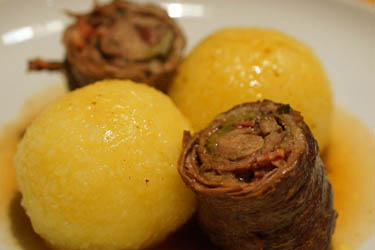
The meal usually begins with a soup made with vegetables and/or meat, followed by a meat dish such as fleischknödel, small meat dumplings, or bierfleisch, beef stew with beer, or the classic boiled sausage with mustard.
In autumn, game is very popular, especially duck, pheasant and venison, cooked in all kinds of ways. There are also recipes based on fresh local fish, such as trout.
Those with a sweet tooth can also relax: the typical desserts are truly delicious!
Try Kaiserschmarrn, a type of pancake served with icing sugar and apple and/or plum sauce; Bierkuchen, a cake made with beer, raisins, ginger, nutmeg, cinnamon and hazelnuts.
Do not miss the famous Apfelstrudel, or apple strudel, and the Salzburger Nockerl, a soufflé with an unusual three-peaked shape, covered with icing sugar.
Among drinks, beer takes first place. The most common in the city are the lager “Märzen”, “Bockbier”, a very strong beer with about 10% alcohol, and “Dunkles Hefeweizen”, with a fruity flavour. Red Bull is also very popular, especially among young people; its inventor, Dietrich Mateschitz, lived in Salzburg.
Where to stay in Salzburg
10
Salzburg has a good tourist accommodation offer, which however proves insufficient during two periods of the year: at Christmas, when the markets occupy every space in the city and Salzburg is besieged by tourists from all over the world;
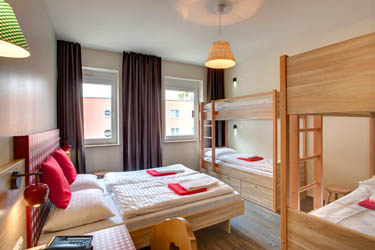
in summer, with the extraordinary Salzburg Festival, one of the most important cultural events in Europe. Apart from these two periods, it is easy to find accommodation in the city, although it is not always cheap. The standard of hospitality is excellent, in line with Austrian tradition. A 3-star hotel in the centre costs from 80 euros per night in a double room.
If you are looking for a hotel in Salzburg, we recommend choosing from those offered by Booking.com. There are around 130 hotels with prices, photos and reviews from people who stayed there before you. Go to Booking.com.