
Rimini is not just a city, but an entire collective imagination. Postcards, films and songs have, for decades, handed down the dream of a place that has become, around the world, synonymous with sea, summer and fun.
And yet, behind its reputation as a city to visit only for holidays, Rimini has another soul, one that also satisfies travellers in search of art, monuments and historical heritage.
To discover this hidden side of Rimini, simply follow the main street of this Romagna city: Corso d’Augusto. The route begins at the Arch of Augustus, the most important of its kind in northern Italy and a clear sign of the greatness of Rimini as a Roman colony.
A little further on is Piazza Tre Martiri, the ancient Roman forum, where Julius Caesar is said to have addressed his troops after crossing the Rubicon. Nearby stands the Tempio Malatestiano, Rimini’s cathedral, home to the Crucifix by Giotto and frescoes by Piero della Francesca.
Continuing along the corso, you reach Piazza Cavour and the historic centre, rich in monuments and nightlife areas, before arriving at the “Domus del Chirurgo”, the extraordinary Surgeon’s House, a remarkable legacy of Roman Rimini together with the nearby Bridge of Tiberius.
Beyond the bridge lies Borgo San Giuliano, the most picturesque and authentic part of Rimini, where you can still feel the atmosphere of Fellini. Born in this city, the master filmmaker did more than anyone else to reveal a different Rimini from the one most people imagine. And it is well worth discovering.
Here, then, are the 10 things you absolutely should do and see in Rimini.
If you are looking for a hotel in Rimini, we recommend choosing from the options available on Booking.com. There are around 1,300 hotels with prices, photos and reviews from previous guests. Go to Booking.com.
The Tempio Malatestiano, Rimini Cathedral
1
Let us start with the name: Tempio Malatestiano, which might suggest a monument with no connection to Catholic worship. In fact, it is a church, dedicated to Saint Columba, and also Rimini’s Cathedral.
The word “temple” refers to its classical forms, while “Malatestiano” comes from Sigismondo Pandolfo Malatesta, Lord of Rimini from 1432 to 1462, who commissioned it.

To replace the pre-existing Church of San Francesco, Sigismondo called upon the most celebrated architect of the Renaissance: Leon Battista Alberti, who took the Roman triumphal arch as the inspiration for the façade.
He used marble from the Arch of Augustus (see point 2) and, on the Istrian-stone base, had garlands inserted with the Malatesta symbols: the elephant, the intertwined “I” and “S” — the initials of Sigismondo and Isotta, his wife — the double chequered band and Isotta’s flower.
Before entering, visit the right-hand side, with its seven arches housing the sarcophagi of the most illustrious figures from Sigismondo’s court.
The interior, by contrast, is Gothic, with a single nave and six side chapels. Worth seeing are the “Chapel of the Planets”, with the oldest image of Rimini, and the “Chapel of the Ancestors”, with the “Ark of the Ancestors and Descendants” sculpted by Agostino di Duccio. Here lie the remains of the Malatesta ancestors.
The Cathedral’s principal works are the Crucifix by Giotto, dating from 1312, and a fresco by Piero della Francesca depicting Sigismondo kneeling at the feet of Saint Sigismund.
Opening hours and ticket price for the Tempio Malatestiano
Monday to Friday: 8:30 am – 12:00 pm 3:30 pm – 6:30 pm
Saturday: 8:30 am – 12:30 pm 3:30 pm – 7:00 pm
Sunday: 9:00 am – 12:30 pm 3:30 pm – 6:30 pm
Ticket price: free
The Arch of Augustus and Piazza Tre Martiri
2
From the Tempio Malatestiano, it takes just one minute to reach Piazza Tre Martiri, the city’s ancient Roman forum. Since the foundation of Ariminum in 268 BC, the square has always served as Rimini’s political and commercial centre.
The statue of Julius Caesar reminds us that this space was once dedicated to him. A stone marker placed here in the 1500s recalls that it was supposedly in this very spot that the emperor addressed his legions after crossing the Rubicon and uttering the famous phrase “the die is cast”.
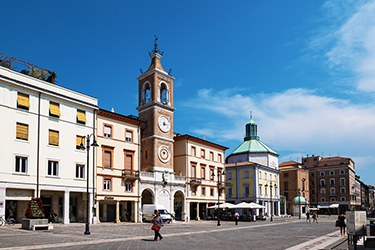
Today the square is dedicated to three young partisans — Mario Capelli, Luigi Nicolò and Adelio Pagliarani — hanged by the Nazis on 16 August 1944.
The site of the execution is marked by a slanting marble slab in the square, just a few metres from the small temple dedicated to Saint Anthony of Padua.
The Clock Tower
The most photographed monument in the square is the Clock Tower, built in 1547 with a dial showing the calendar, zodiac movements and phases of the moon. Together with Piazza Cavour, Piazza Tre Martiri is the centre of city life in Rimini and an obligatory stop on any visit.
The Arch of Augustus in Rimini
From the square you can glimpse the Arch of Augustus, the oldest surviving Roman arch in northern Italy. Built in 27 BC as a monumental gateway, it marked the entrance into the city for those arriving from the Via Flaminia. A statue of the emperor on horseback, or in a quadriga, was probably placed on the top.
Note the roundels with Jupiter and Apollo facing Rome, and, on the other side, Neptune and the goddess Roma. A curiosity: the arch was so wide that doors could not be fitted into it. This openness was meant to symbolise that, under Augustus, Rimini had nothing to fear.
Piazza Cavour and the historic centre
3
Walking along Corso d’Augusto, you come to Piazza Cavour, Rimini’s most important square and a meeting place for both locals and visitors. The “Fontana della Pigna”, or Pinecone Fountain, is a reliable landmark for arranging to meet in this busy square, lively in every season thanks to its bars and restaurants. Originally, the top of the fountain carried a statue of Saint Paul, replaced by the pinecone in 1809. Until 1912 it was the only source of drinking water in the centre of Rimini. Its harmonious form and play of water fascinated even Leonardo da Vinci, as the inscription recalls.
Rimini’s Palazzo dell’Arengo
Next to the fountain stands the monument to Paul IV, and opposite is the Palazzo dell’Arengo, the finest expression of medieval civic architecture in Rimini. The council of the people of Rimini met in this palace, and in the street-level loggia stood the “Stone of Shame”, where bankrupt debtors were required to strike their backside three times.
The Palazzo del Podestà
Beside it is the 14th-century Palazzo del Podestà: the rope used for hangings once dangled from its central arch. Nearby stands the beautiful Teatro Comunale, a Neoclassical theatre inaugurated by Giuseppe Verdi in 1857.
The Old Fish Market
From the square you can access the Old Fish Market, one of Rimini’s most characteristic places: fish was once sold beneath its arches and on its marble counters.

Immediately afterwards comes the “Piazzetta delle Poveracce”, named after the local dialect word for clams, which were sold here together with the lower-value fish that was not allowed in the main fish market.
Today this area is the heart of Rimini’s nightlife, with an endless number of venues, small restaurants, bars and beer houses. Do not miss a visit to Libreria Riminese, one of the city’s oldest bookshops.
The Surgeon’s House
4
In 1989, during roadworks in Piazza Ferrari, a digger accidentally went too deep. The experts called to the site were astonished when the walls of a Roman building began to emerge, followed by mosaics, coins and medical instruments.

What had just been discovered would later be called the “Domus del Chirurgo”, the Surgeon’s House. In reality, it is a complex of Roman origin that over the centuries was also used as a vegetable garden, church and cemetery, as shown by the 30 tombs with skeletons still visible.
The most beautiful structure is the villa inhabited until the 2nd century AD by a certain Eutyches, a military doctor of Greek origin who must have seen just about everything.
The surgical instruments of the domus
His collection of 150 surgical instruments was in fact specialised in wounds and war trauma, including a very rare Diocles’ spoon, used to extract arrowheads lodged in the body. The villa still preserves perfectly visible beautiful mosaics, including the one of Orpheus in the Rimini surgeon’s “medical office”.
Thanks to walkways built above the mosaics and the foundations of the complex, visitors can retrace the architecture and history of this residence.
The City Museum of Rimini
To complete the visit, it is essential to see the City Museum of Rimini (see point 5), where the instruments and other finds are kept and where visitors can admire a full-scale reconstruction of the rooms of the domus.
Opening hours and ticket price for the Surgeon’s Domus and the City Museum
From 13 June to 31 August
Monday closed, unless a public holiday
Tuesday to Saturday 10:00 am–7:00 pm
Sunday and public holidays 10:00 am–1:00 pm and 4:00 pm–7:00 pm
Wednesday also 9:00 pm–11:00 pm
WINTER HOURS
Monday closed, unless a public holiday
Tuesday to Saturday 9:30 am–1:00 pm and 4:00 pm–7:00 pm
Sunday and public holidays 10:00 am–7:00 pm
Ticket price: €7
Official website: Domus del Chirurgo
The City Museum
5
A few steps from the “Domus del Chirurgo” stands the City Museum of Rimini. Housed in a former Jesuit convent and former civic hospital, the museum collects finds and works recovered from the city’s churches and buildings.
Its two main collections are the archaeological section and the picture gallery, with works from the 14th century. The archaeological collection begins in the entrance garden, with funerary stones recovered from the various necropolises scattered around Rimini, and continues with the finds from the Domus (see point 4).
The Rimini Picture Gallery
Although less well known than those of other Italian cities, the picture gallery preserves many masterpieces of Italian art. Particularly rich is the section devoted to 14th-century works of the Rimini school, strongly influenced by the arrival in the city, in 1303, of the master Giotto.
Among the masterpieces on display in the museum are a Crucifix by Giovanni da Rimini, the polyptych with the “Crucifixion and Saints Damian, Cosmas, Catherine and Barbara”, and a precious polyptych by Giuliano da Rimini. Magnificent too is the Last Judgement, a fresco attributed to Giovanni da Rimini from the Church of San Giovanni Evangelista, also known as Sant’Agostino.
The Malatesta Rooms contain works commissioned by Rimini’s powerful ruling family from great artists such as Giovanni Bellini, Domenico Ghirlandaio, Agostino di Duccio, Pisanello and Matteo de’ Pasti, Guido Cagnacci, Centino and Guercino.
Also very beautiful is the section dedicated to the Rimini-born artist René Gruau. A world-famous fashion illustrator, he worked for the most important magazines in the world, including Vogue and Marie Claire, and for exclusive fashion houses such as Dior, Biagiotti and Balenciaga. He was the artist who designed the poster for Fellini’s La dolce vita.
Opening hours and ticket price for the City Museum and the Domus
From 13 June to 31 August
Monday closed, unless a public holiday
Tuesday to Saturday 10:00 am–7:00 pm
Sunday and public holidays 10:00 am–1:00 pm and 4:00 pm–7:00 pm
Wednesday also 9:00 pm–11:00 pm
WINTER HOURS
Monday closed, unless a public holiday
Tuesday to Saturday 9:30 am–1:00 pm and 4:00 pm–7:00 pm
Sunday and public holidays 10:00 am–7:00 pm
Ticket price: €7
Official website: Rimini Museums
The Bridge of Tiberius
6
The repeated floods of the Marecchia river, the Nazis and, before them, the Byzantines all tried to bring down the Bridge of Tiberius, yet its five arches have not shifted by a centimetre. Built in 14 AD by order of Emperor Augustus, it was completed in 21 AD by Tiberius, from whom it takes its name.

For 2,000 years, the bridge has marked the start of two historic roads of the Roman Empire: the Via Emilia towards Piacenza and the Via Popilia towards Aquileia.
Built entirely of Istrian stone, the bridge is a small masterpiece of architecture and functionality: the piers have vertical cutwaters designed to reduce the force of the water, and the bridge structure rests on a system of wooden piles perfectly isolated from the water.
Rimini’s Devil’s Bridge
This extraordinary resistance has given rise to several legends, including the one that describes it as a “Devil’s Bridge”, built in a single night in exchange for the soul of the first person to cross it.
When Tiberius failed to honour the pact, the devil tried to kick the bridge down: his cloven hoofprints can still be seen on the bridge parapet. To admire it properly — cars do cross it — we recommend going down to the brand-new “Piazza sull’Acqua”, a park at the foot of the arches where you can stroll, relax and discover the history of the bridge through the archaeological route “Le pietre raccontano”, “The stones tell their story”.
Borgo San Giuliano
7
Once you cross the Bridge of Tiberius, Rimini changes face: the city atmosphere gives way to that of a seaside village, with low colourful houses, narrow lanes, washing hung out to dry and small traditional osterias.
This is San Giuliano, a fishermen’s district, where people have lived since the year 1000 in houses close to the Marecchia river. Coming in from the sea, they could “park” their boats directly below their homes.
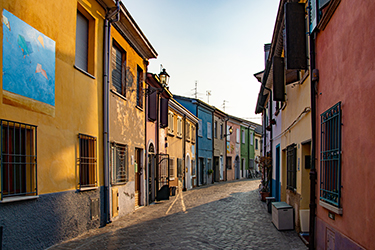
After risking demolition in the 1990s, Borgo San Giuliano is now one of Rimini’s nightlife areas, though very different from the seafront scene.
People come here for an aperitivo in a relaxed, more authentic atmosphere, or for a candlelit dinner in small, intimate restaurants.
The district loved by Federico Fellini
The history of the borgo is inseparable from that of Federico Fellini, who loved this place and its characters, later reimagined in his films, especially in Amarcord.
The murals of Rimini
The borgo has paid tribute to the maestro with a series of murals depicting scenes and quotations from his films: there is Scureza, there is la tabachera, there are Benigni and Villaggio, Mastroianni and Ekberg, as well as murals dedicated to historic figures from the neighbourhood.
If you are in Rimini during the first week of September in even-numbered years, do not miss the Festa de’ Borg, an event held in Borgo San Giuliano with street food, performances and stories from the history of the district.
The places of Federico Fellini
8
Rimini and Fellini are an inseparable pair. Many of the places to which the director felt deeply connected are still active and open to visitors. We have already spoken about Borgo San Giuliano in point 7, but two beautiful places still deserve mention: Cinema Fulgor and the Grand Hotel on the seafront.

In the Art Nouveau building on Corso d’Augusto, Fellini saw his first films, paying for admission by drawing promotional posters for the owner at the time. It was here that the whole of his imagination began to take shape, later flowing into his films: he watched his first film on his father’s knees and fell in love with Gradisca, the female character he would later bring into Amarcord.
Cinema Fulgor has finally reopened
Closed for 20 years, Cinema Fulgor reopened in 2018 with a new interior designed by multiple Oscar winner Dante Ferretti. It feels like stepping onto the set of a 1940s or 1950s film, the era Fellini loved so much.
The Grand Hotel Rimini
The Grand Hotel on the seafront always kept a room reserved for Fellini, who lived in Rome but often returned to Rimini. As a child, Fellini was fascinated by this majestic Art Nouveau building and referred to it in several scenes of the film Amarcord.
Parco Fellini
At the foot of the hotel lies Parco Fellini. To enjoy the hotel for a few minutes, you do not need to book one of its very expensive rooms: you can simply have an aperitivo on the terrace.
To the right of Federico Fellini Park stands Fellinia, a giant camera much photographed by visitors. True fans of the maestro should not miss a visit to the Federico Fellini Foundation, in Via Gambalunga 27.
Places for entertainment
9
This is Rimini, one of the world capitals of summer entertainment, and the choice is almost overwhelming. Let us start with families, who can spend a few hours with younger children at “Italia in Miniatura” or in one of the 16 theme parks of the Romagna Riviera, including Mirabilandia and Aquafan.
For younger visitors, evening entertainment is concentrated along the seafront, the harbour and Marina Centro. Beneath the shadow of the sea-view Ferris wheel, a kilometre-long route unfolds, lined with bars, restaurants, trendy venues, places to listen to music and much more, in a seemingly endless offering.
Some venues have become almost legendary: Altromondo Studios, which has been astonishing visitors with spectacular futuristic sets since 1967; Coconut, with its four dance floors and fashionable atmosphere; and Carnaby, founded in the 1960s as an English pub and later transformed into a nightclub.
Among the most spectacular, do not miss Bounty, furnished like an old 18th-century sailing ship, and Rock Island, suspended above the sea of Rimini.
What to eat in Rimini
10We are in Romagna, at the heart of one of Italy’s great gastronomic traditions. At any time of day, a piadina is always available: a flatbread made with flour, water, salt and lard, filled with Squacquerone DOP cheese and local cured meats, especially those made from Mora Romagnola pork. You will find them in the many kiosks throughout Rimini, although the advice is to try the ones at “dalla Lella” and “Casina del Bosco”. But do not limit yourself to piadine, however delicious they may be: explore the richness of the local cuisine.
First courses in Rimini
All year round, but especially in cold weather and at Christmas, cappelletti — filled with ricotta, cheese, eggs and herbs — served in broth or with meat sauce are the festive dish par excellence. Romagna has a great tradition of fresh pasta, and the local sfogline, the women who roll pasta by hand, produce other delicacies such as passatelli, tagliatelle and lasagne, to be served with meat sauces, fish sauces or in broth.
Main courses in Rimini
Grilled fish and fried fish are always present on local menus, but make sure the fish comes from the Adriatic: in summer Rimini is very crowded, and frozen products are common. To be sure of tasting local fish, ask for sardoncini, small Adriatic anchovies, also served in piadina, or a brodetto, a very old recipe once eaten by fishermen on their boats.
Also worth trying, perhaps in the villages around Rimini, is coniglio in porchetta, a delicious dish combining rabbit, pancetta and a mixture of aromatic herbs. There are no especially famous local desserts, but the wines are excellent: Sangiovese, Albana bianco, Pagadebit, Trebbiano and Colli di Rimini.
What to see around Rimini
Behind Rimini lie hills, valleys and villages whose natural beauty has nothing to envy the more famous landscapes of Tuscany and Umbria.
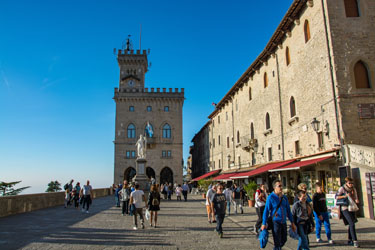
So, if you are tired of the sea and entertainment and have a little time, you can head inland and visit Montebello, the castle-village linked to the sad story of Azzurrina.
Montebello is a small old-world place made up of low houses, a defensive tower, a few workshops and small shops, the Church of San Pietro Apostolo and, of course, the castle, the main destination for visitors.
Not far away is one of the most beautiful villages in Italy: San Leo. Two churches, a square, a fortress and a rocky spur 600 metres above sea level make this village feel outside time. A little farther on is San Marino, the world’s oldest republic, also ideal for some relatively good-value shopping.
Hotels in Rimini
If you are looking for a hotel in Rimini, we recommend choosing from the options available on Booking.com. There are around 1,300 hotels with prices, photos and reviews from previous guests. Go to Booking.com.