Palermo has been a Phoenician, Greek and Roman city, an Arab capital, and a land conquered by the Normans, Swabians, French and Spanish.
Centuries of history and domination have shaped the Sicilian capital, a city of a thousand faces, a crossroads of peoples, and a blend of different cultures and traditions: beautiful and fascinating.
Palermo proudly displays the traces of its glorious past, which lives on in the grandeur of its artistic and architectural heritage, often neglected or undervalued.
Good and bad coexist in a city that, like Naples, represents the essence of Southern Italy, suspended between a desire for rebirth and missed opportunities.
In the “city of delights“, the Arab domes of San Cataldo coexist harmoniously with the shining Byzantine mosaics of the Martorana, the excesses of Baroque art with the grace of Art Nouveau palaces, death as a warning in the Capuchin Catacombs and life triumphing in the bustling historic markets of Ballarò and Vucciria.
It is impossible not to be fascinated by this undeniably splendid city, which will make you forget the signs of neglect and decay thanks to its mild climate, the liveliness of its people and its extraordinary cuisine.
On this page, we show you the 10 most important things to do and see in Palermo.
If you are looking for a hotel, we recommend choosing from those offered by Booking.com.
170 hotels in Palermo with prices, photos and reviews from guests who have stayed before you. Go to Booking.com.
Church of the Martorana and San Cataldo
1
Built in 1143 at the behest of George of Antioch, admiral of Roger II, the Church of Santa Maria dell’Ammiraglio is also known as the “Martorana”.
In fact, in 1433 it was handed over by King Alfonso of Aragon to the Benedictine nuns of the nearby convent founded by the noblewoman Eloisa Martorana.
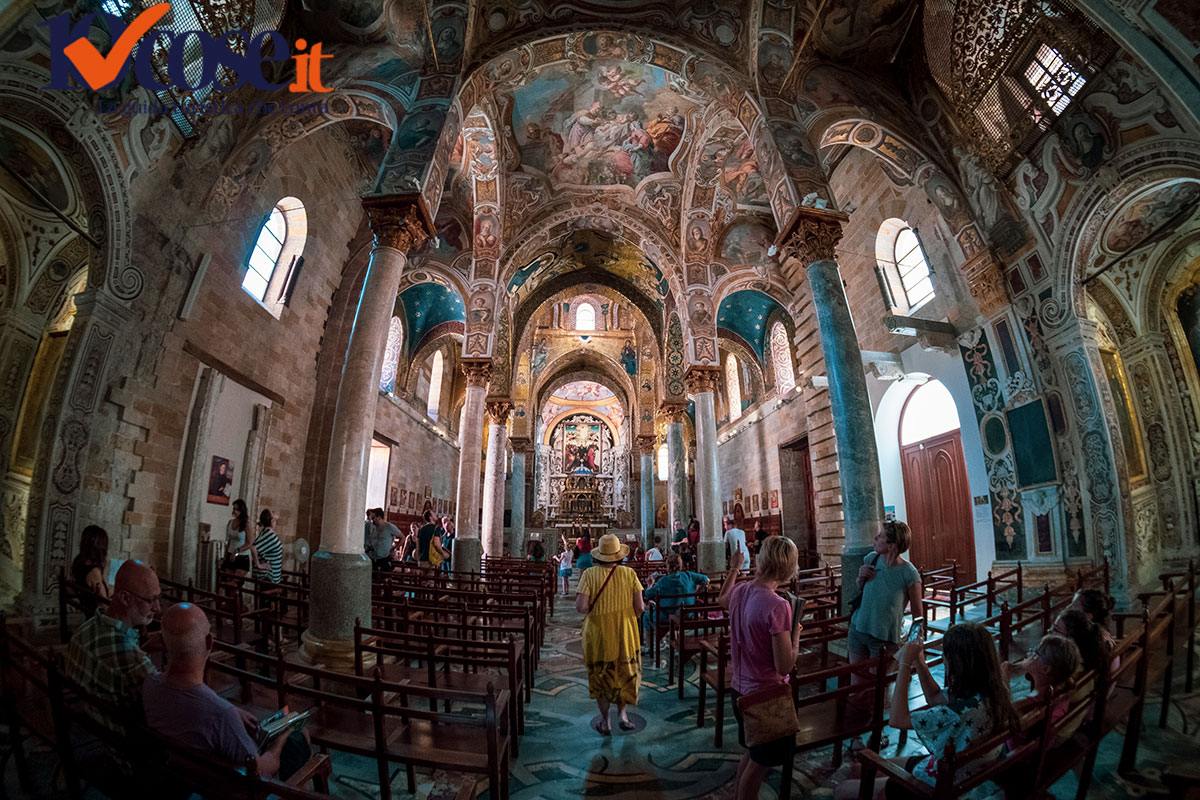
Despite the transformations carried out in the 16th and 17th centuries — the Baroque façade is one example — this fascinating sacred building preserves its original Arab–Norman style.
This can be seen in the square body of the building, topped by a small hemispherical dome, and in the beautiful bell tower opened by arches and three orders of large mullioned windows.
The interior of the church features, in the upper part of the walls, in the underarches and in the dome, magnificent Byzantine mosaics considered the oldest in Sicily.
The central focus of the entire mosaic decoration is the image of Christ Pantocrator, surrounded by archangels, apostles, saints and prophets.
The cycle is completed by mosaics depicting the Nativity of Jesus, the Dormition of Mary, the Annunciation and the Presentation in the Temple.
Right next to the Martorana, do not miss a visit to the Church of San Cataldo, with its Arab-style red domes.
Founded around 1200, it has been through a great deal, even serving as a post office!
Today it has been fully restored and is entrusted to the care of the Equestrian Order of the Holy Sepulchre of Jerusalem.
Opening hours and tickets for the Church of the Martorana and San Cataldo
Church of the Martorana
Opening hours: Tuesday to Saturday: 10.00 am – 1.00 pm. Sunday and holidays: 9.00 am – 10.30 am.
Ticket price: €2
How to get there: in Piazza Bellini, right in the historic centre.
Church of San Cataldo
Opening hours: Tuesday to Sunday from 10.00 am to 6.00 pm.
31 December: 9.30 am – 12.30 pm
1 January: 3.00 pm – 6.00 pm.
Closed: 25 December and 15 August.
Ticket price: €2.50
How to get there: in Piazza Bellini, right in the historic centre.
Palermo Cathedral
2
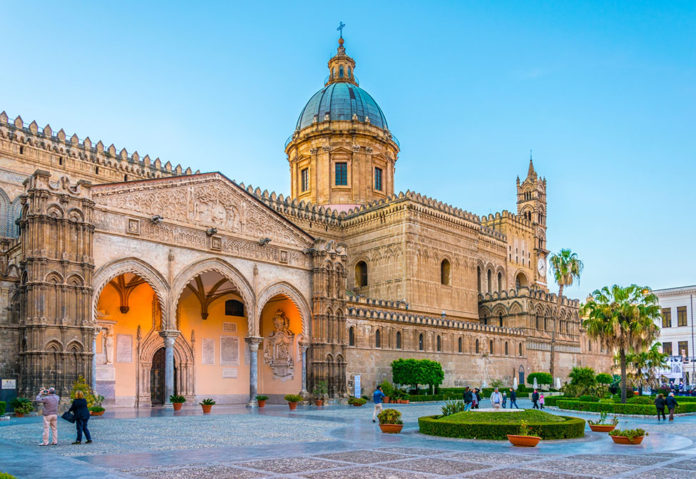
It was in 1185 that the construction of Palermo Cathedral was completed.
The immense religious building, dedicated to the Assumption of the Virgin Mary, stands on the site previously occupied by a Christian basilica (604), transformed by the Saracens into a mosque (831), and later converted back to Christian worship by the Normans (1072).
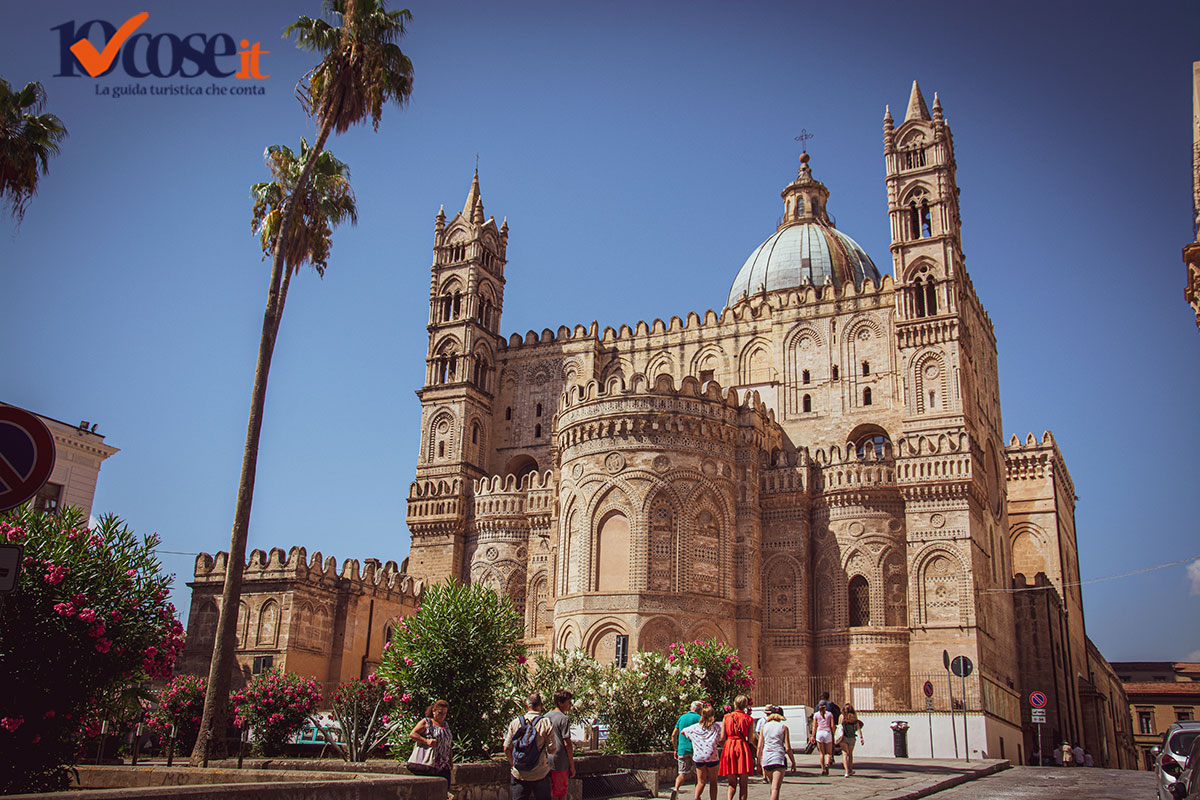
Alterations and restorations carried out over the centuries have changed its original appearance, which is characterized by the presence of different architectural styles.
The main façade, set between two small towers, features a large 15th-century portico in Catalan Gothic style; the dome is late Baroque, while the oldest part is the apse, with splendid Arab-Norman decorations.
The interior, rebuilt in the 19th century in Neoclassical style to a design by Ferdinando Fuga, has a Latin cross plan with three naves. It houses the remains of the Sicilian royals, including Frederick II and Roger II, as well as those of Saint Rosalia, patron saint of Palermo.
Other tombs can be found in the crypt, dating back to the 6th century.
In the Treasury rooms, visitors can admire the gold tiara of Queen Constance of Aragon, together with other precious objects found in the royal tombs.
Do not miss a visit to the rooftops, which offer an exciting route above the structure of the Cathedral and a magnificent view over the square.
Opening hours and tickets for Palermo Cathedral
The Cathedral is divided into two parts: a free-entry area and the paid monumental area.
Cathedral opening hours:
Monday to Saturday: from 7.00 am to 7.00 pm
Sunday: from 8.00 am to 1.00 pm and from 4.00 pm to 7.00 pm
Monumental Area opening hours:
(Rooftops, Royal Tombs, Crypt, Apses, Treasury, Underground Areas and Crypt of the Beneficiali).
Monday to Saturday: from 9.00 am to 6.00 pm, last admission at 5.30 pm
Sunday: from 10.00 am to 6.00 pm, last admission at 5.30 pm
Ticket price: €12
How to get there: in Piazza della Cattedrale, right in the historic centre.
Palatine Chapel and Norman Palace
3
The Norman Palace, also known as the Royal Palace, is one of Palermo’s main monuments.
The fortress built by the Arabs in the 9th century was transformed and enlarged by the Normans, who made it the centre of their power.

Roger II’s palace was a rich and sumptuous royal residence, as shown by the royal apartments decorated with mosaics depicting hunting scenes (12th century), and by the Palatine Chapel, the royal family’s church, decorated with splendid Byzantine mosaics, considered among the most beautiful in all Sicily, and with its wonderful wooden stalactite ceiling.
After a period of neglect, the Palace returned to splendour in the 16th century, when the Spanish viceroys chose it as their residence.
During those years, the Norman towers were demolished — with the exception of the surviving Pisan Tower — two large inner courtyards were added, as well as further state rooms, including the Sala d’Ercole, named after the frescoes by Velázquez depicting the twelve labours of the Greek hero.
Since 1947, the majestic Palace has housed the Sicilian Regional Assembly.
Opening hours and tickets for the Norman Palace
Opening hours:
Monday to Thursday: from 8.30 am to 2.30 pm
Friday and Saturday: from 8.30 am to 4.30 pm
Sunday and holidays: from 8.30 am to 12.30 pm
Ticket price: from €14.50 to €19 depending on the admission period. The ticket includes the Palace, Palatine Chapel and Royal Gardens.
How to get there: 300 metres from the Cathedral. Tourist entrance from Piazza Indipendenza.
San Giovanni degli Eremiti in Palermo
4
Just a few steps from the Norman Palace stands one of the most beautiful complexes in Palermo: the Church of San Giovanni degli Eremiti with its cloister.
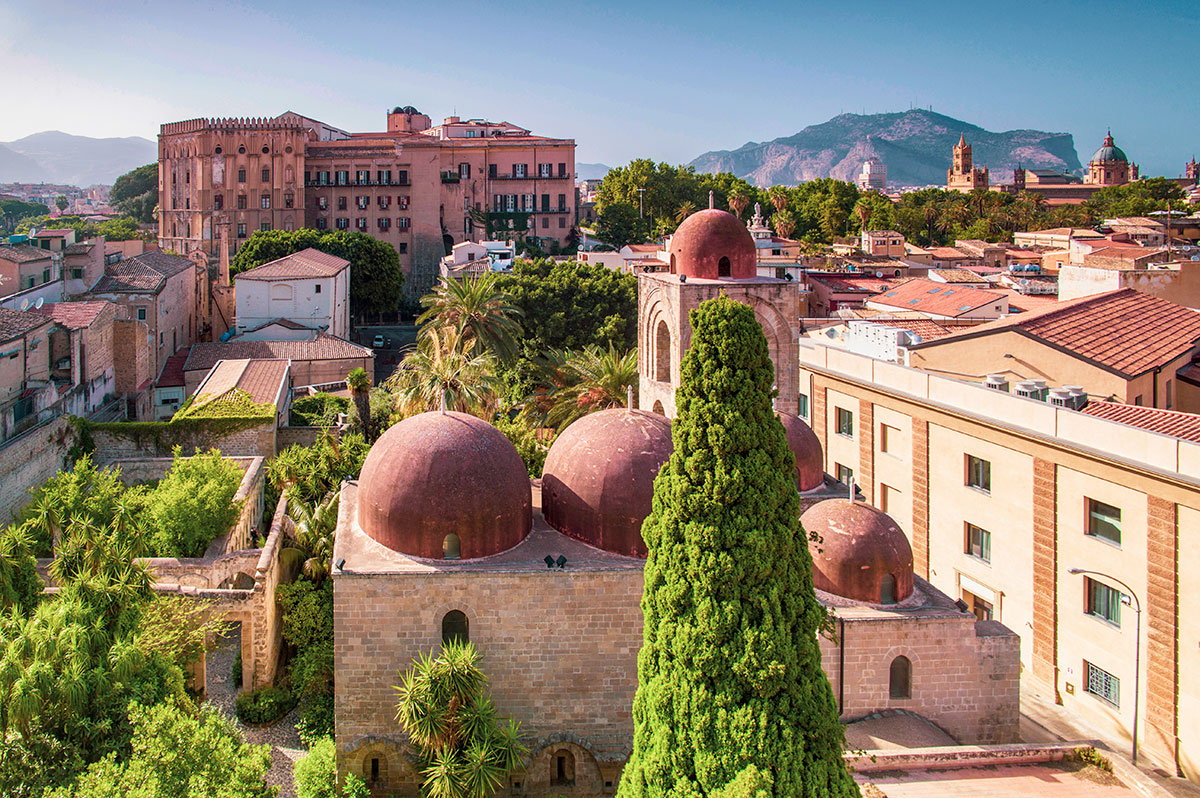
The red domes and palm trees rising above it transport visitors into an Eastern atmosphere.
This vision is the legacy of Arab rule, which transformed this 6th-century complex into a mosque.
Although the exterior has undergone several alterations, the interior and the cloister are almost intact.
The church has a Latin cross plan topped by red domes. From the church, through a small door, you enter the Arab Hall, with a cross vault and a Byzantine fresco depicting a Madonna and Child between two saints.
The cloister is an oasis of peace, with pointed arches and decorated capitals. In this place, even a city as lively as Palermo seems to disappear into an unreal silence.
Opening hours and tickets for San Giovanni degli Eremiti in Palermo
Opening hours:
Tuesday to Saturday: from 9.00 am to 7.00 pm (last admission at 6.30 pm);
Sunday and holidays: from 9.00 am to 1.30 pm (last admission at 1.00 pm).
Online booking is compulsory at least 24 hours in advance for Saturdays, Sundays and holidays. (http://laculturariparte.youline.cloud/)
Ticket price: full ticket €6, reduced ticket for teachers and children €3.
Combined ticket for: San Giovanni degli Eremiti, Monreale Cloister, Zisa and Cuba €12.
How to get there: Via dei Benedettini 20, a few metres from the Norman Palace.
The Cuba Castle in Palermo
5
Just a few more metres from the Royal Palace, you reach the Cuba Castle, one of Palermo’s wonders usually overlooked by hurried tourists.
It is a “delizia”, a pleasure palace built in 1180 for the rest and entertainment of King William II.
Its style is Arab-Norman, characteristic of Sicily and born from the encounter between Northern European architecture and Arab expertise in building palaces in very hot places.

Indeed, the entire structure of the Cuba, although today it may appear awkward and overly square, was designed according to precise criteria: it allowed the building to catch the cool sea breezes during the hottest hours, also thanks to the lake in which it once stood, now drained.
All around there were citrus trees and fountains. It is no coincidence that this place was also called Genoardo by the Arabs, from Jannat al-ard — Garden or Paradise on Earth.
Boccaccio set one of the tales of the Decameron in the Cuba: the story of the love between Gian di Procida and Restituta, a beautiful girl kidnapped to be offered as a gift to King Frederick II of Aragon.
Opening hours and tickets for the Cuba Castle
Opening hours:
Tuesday to Thursday: from 9.00 am to 1.30 pm.
Friday and Saturday: from 9.00 am to 6.30 pm.
Online booking is compulsory at least 24 hours in advance for Saturdays, Sundays and holidays (http://laculturariparte.youline.cloud/)
Ticket price: full ticket €2, reduced ticket for teachers and children €3.
How to get there: Corso Calatafimi 100, a few metres from the Norman Palace.
The Zisa Castle in Palermo
6
Not far from the Cuba, still in what was once the Genoardo, stands another wonderful Arab-Norman castle:
the Zisa, linked to many legends and to some expressions used by the people of Palermo.
This palace too served as a “delizia” for the Norman kings; it was begun by William I and completed by William II in 1167.

The name comes from Al-Aziz, a beautiful girl, daughter of the Emir, who fled from Libya to Palermo to live with Azel Comel, son of the Sultan, after they had stolen a treasure with which to build the Zisa.
When Aziz’s mother committed suicide out of grief, she did the same. Azel killed himself by throwing himself into the sea, but not before “entrusting” the treasure to the “devils of the Zisa”, the figures that can be seen in the fresco on the arch of the main façade.
According to legend, these devils cannot be counted, and anyone who has tried has never succeeded.
They themselves come to life and mock anyone who attempts to find the hidden treasure in the palace.
It is no coincidence that, even today, Palermitans refer to the devils of the Zisa when talking about complicated situations in which things do not add up.
The Zisa is a masterpiece of sustainable engineering and architecture: it faces the sea to catch the cool breeze and had a ventilation system with holes in the floor that allowed air to circulate, cooled by a water system that is still partly visible today.
Today the Zisa houses the Museum of Islamic Art, with artefacts from all over the Mediterranean.
Opening hours and tickets for the Zisa Castle
Opening hours:
Tuesday to Saturday: from 9.00 am to 7.00 pm (last admission at 6.30 pm);
Sunday and holidays: from 9.00 am to 1.30 pm (last admission at 1.00 pm).
Online booking is compulsory at least 24 hours in advance for Saturdays, Sundays and holidays (http://laculturariparte.youline.cloud/)
Ticket price: full ticket €6, reduced ticket for teachers and children €3.
How to get there: Piazza Guglielmo il Buono. About 2 km from the Norman Palace.
Buses 110 or 124 from Piazza Indipendenza.
The Capuchin Catacombs of Palermo
7
The underground cemetery of the Capuchin Convent, mistakenly known as “the catacombs”, preserves the mortal remains of friars, famous figures, wealthy Palermitans and ordinary people.
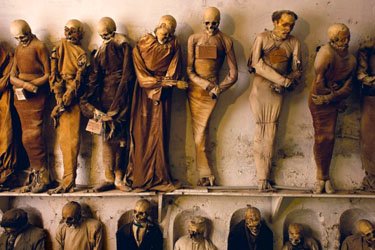
There are around eight thousand mummified bodies placed from the 17th century until the end of the 19th century in the galleries built beneath the Convent and the adjoining church dedicated to Our Lady of Peace.
The microclimatic conditions of these burial places and the methods used by the friars to embalm the bodies have allowed the corpses to remain almost intact and highly recognizable.
The Catacombs of Palermo, despite being located a little outside the heart of the city, are one of the most popular tourist destinations among visitors to the Sicilian capital.
The fascination of the macabre, preserved frighteningly intact since 1599, never goes out of fashion.
Be careful: the rules are very strict and it is forbidden to take photographs, film or touch the remains.
Opening hours and tickets for the Capuchin Tombs
Opening hours: every day (including Sundays and holidays) 9.00 am-12.30 pm and 3.00 pm-5.30 pm. From late October to late March, the catacombs are closed on Sunday afternoons.
Ticket price: €3.
How to get there: Via dei Cappuccini 1, outside the historic centre. From Piazza Indipendenza take bus 327 or walk along Via Cappuccini (15 minutes).
Official website of the Catacombs: http://www.catacombepalermo.it/
The Pretoria Fountain in Palermo
8
Created in the 16th century by the sculptor Camilliani for the Florentine villa of Don Pietro di Toledo, it was later purchased by the Senate of Palermo.
Since 1581, the monumental Renaissance fountain has stood proudly in beautiful Piazza Pretoria, surrounded by splendid buildings, including Palazzo Pretorio (seat of the Municipality), and ancient churches such as San Giuseppe dei Teatini and Santa Caterina.
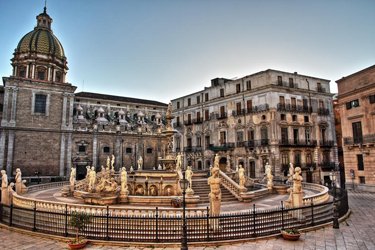
The spectacular elliptical water feature is surrounded by an elegant balustrade, inside which are the basins — three concentric ones plus a series of small and medium-sized basins.
Then come four stairways, statues depicting various pagan deities — Apollo, Venus, Diana, Bacchus, Adonis, Ceres, Hercules — allegories of the four rivers of Palermo — Gabriele, Oreto, Maredolce, Papireto — sea monsters, nymphs and animal heads.
The nudity of the statues decorating it led the people of Palermo to rename it the “Fountain of Shame”.
Considered one of the most beautiful fountains in Italy — it is no coincidence that Giorgio Vasari called it a “most splendid fountain” — the magnificent architectural construction has returned to shine once again after a long restoration.
The Quattro Canti of Palermo
9
A few metres from the Fountain are the “Quattro Canti”, one of the most scenic and photographed corners of Palermo.
It is the intersection between Via Maqueda and Via Vittorio Emanuele, two fundamental streets of Palermo.

The construction of Via Maqueda in 1600 divided the city into four “Mandamenti”, and therefore, at the intersection, into four corner buildings, from which the square takes its name.
The Quattro Canti are also called the “octagon” because of their shape, or more often the “Theatre of the Sun”, because on every day of the year, at least one of the four corners is illuminated by sunlight.
Each corner has three orders in Doric, Ionic and Composite style.
At the bottom are the statues of the seasons, in the middle section the statues of Spanish kings, and at the top the patron saints of each district: St Olivia, St Christina, St Agatha and St Ninfa.
Santa Maria dello Spasimo in Palermo
10
Unfinished churches always have a certain charm.
This is true of San Galgano in Siena, the Goleto complex in Avellino, and the Carmo Church in Lisbon.
The same is true of Santa Maria dello Spasimo in Palermo, a 16th-century complex in the Kalsa district, whose centuries-old history today tells the story of its nature as an unfinished church.
At the beginning of the 1500s, Jacopo de Basilicò began building a church to fulfil the last wishes of his wife Eulalia Rosolmini, who was particularly devoted to the sorrow — “Spasimo” — of the Virgin Mary at the death of Christ.

The original project included a church and a monastery, but only the church was fully built.
First lack of funds, then Turkish raids, prevented the works from being completed.
There was time, however, for a masterpiece to arrive: Raphael’s Andata al Calvario, known as the Spasimo di Sicilia.
The painting stood above a splendid altar created by the sculptor Antonello Gagini. Today the painting is housed in the Prado Museum in Madrid.
After the addition of a moat and further walls, the complex began its centuries-long decline: it was used as a hospice for the poor, a warehouse, a public theatre and eventually became a rubbish dump.
Floods, earthquakes and the bombings of the Second World War did the rest.
Over the last 30 years, a slow restoration process has begun, with the altar finally covered again and a copy of Raphael’s work installed. Today the Spasimo is a multifunctional centre for concerts and performances.
Opening hours and tickets for Santa Maria dello Spasimo
Opening hours: Tuesday to Sunday from 9.30 am to 6.30 pm.
Booking is compulsory at spasimo@comune.palermo.it
Ticket price:
How to get there: Via dello Spasimo in the Kalsa district.
Palazzo Abatellis and the Regional Gallery of Sicily
11
Four hundred metres from Santa Maria dello Spasimo is another unmissable place in the Kalsa district: Palazzo Abatellis, located along Via Alloro, the most important and beautiful street in the neighbourhood.
Built in the 1400s at the behest of the Master Portulan Francesco Abatelli, it has housed the Regional Gallery of Sicily since the post-war period.
The masterpieces begin on the ground floor, with wooden works and sculptures from the 14th and 15th centuries, including the Madonna del Latte by Gagini and the wonderful Bust of a Gentlewoman by Francesco Laurana.
On the second floor, visitors are welcomed by the extraordinary large fresco of the Triumph of Death, in which Death, riding a skeletal horse, bursts into a garden after having slaughtered popes and emperors, nobles and cardinals, sparing only a group of poor people.
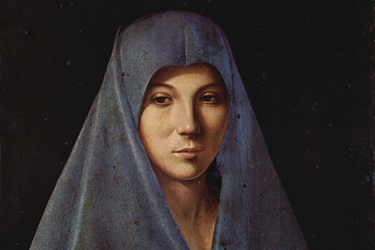
The most famous masterpiece in Palazzo Abatellis is the Annunziata by Antonello da Messina, considered one of the symbols of the Italian Renaissance.
Another great protagonist of the Regional Gallery is Anthony van Dyck, who painted these masterpieces after finding himself in Palermo during the plague of 1624: “Saint Rosalia Crowned by Angels”, the “Madonna and Child” and the “Lamentation”.
The other rooms feature works by Jusepe de Ribera, known as “Lo Spagnoletto”, Giorgio Vasari, Andrea Vaccaro, Mattia Preti and Luca Giordano.
Opening hours and tickets for Palazzo Abatellis
Opening hours:
Tuesday to Friday 9.00 am-6.30 pm
Saturday and Sunday 9.00 am-1.00 pm
Closed: Monday.
Ticket price: single ticket €8. €10 with admission also to the Zisa Castle, the Cloister of San Giovanni degli Eremiti and the Cloister of Santa Maria La Nuova in Monreale Cathedral.
How to get there: Via dell’Alloro in the Kalsa district.
The Teatro Massimo in Palermo
12
Even if you do not love opera, a visit to the Teatro Massimo in Palermo remains essential.
It is the largest opera house in Italy, surpassed in Europe only by those of Paris and Vienna.
The “Massimo” was built starting in 1866 on the site where there had previously been three churches and as many monasteries: the Church and Monastery of the Stimmate, San Giuliano and Sant’Agata.
Legend has it that one of the nuns whose tomb was destroyed still wanders through the theatre.
From the outside, the large staircase leading to a pronaos with six Corinthian columns is striking.

Giovanni Battista Basile, who designed the theatre, was an expert in Greek and Roman art and drew inspiration from it for the building.
Indeed, the feeling is that of standing before the great public buildings of Athens or Rome, with an impression of order, clarity and majesty.
On the façade is carved a warning for those who create or attend performances:
“Art renews peoples and reveals their life. Vain is the pleasure of the stage if it does not aim to prepare the future.”
After passing the two bronze lions, allegories of tragedy and lyric opera, you enter the large horseshoe-shaped auditorium in Art Nouveau style.
There are five tiers of boxes and a gallery, surmounted by an enormous hemispherical dome.
Opening hours and tickets for the Teatro Massimo
Opening hours: every day from 9.30 am to 5.30 pm (last visit at 5.00 pm)
Ticket price: €8 for a 30-minute guided tour.
Information and bookings: visiteguidate@teatromassimo.it – 091 6053267
How to get there: in Piazza Verdi, in the centre of Palermo. From the Quattro Canti, walk along Via Maqueda for about 10 minutes.
What to see in Palermo: Stanze al Genio
13
Opened in December 2008, the unusual “Stanze al Genio House Museum”, named after the cultural association of the same name, houses one of the largest collections in Europe of ancient Neapolitan and Sicilian majolica tiles, with more than 5,000 items on display dating from the late 16th century to the early 20th century, as well as smaller collections of contemporary art and modern antiques.
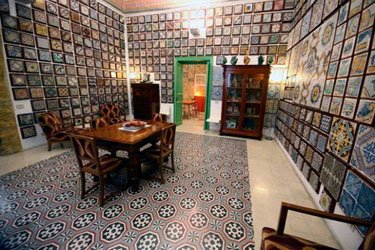
The House Museum is housed inside an elegant private residence occupying part of the piano nobile of the historic Torre-Piraino palace, in Palermo’s historic centre.
The museum space is divided into 8 splendid rooms — including the Entrance Hall, Kitchen Room, Flower Room and Neoclassical Room — which are also used for cultural events.
The exhibition layout adopted for the majolica tiles follows a distinction by period, geographical origin and production, highlighting the most beautiful and valuable pieces in each category.
Opening hours and tickets for Stanze al Genio
Opening hours: guided tours by reservation (call 340 0971561 – 335 6885379)
Ticket price: ordinary membership card €10; reduced ticket (students and over 65s) €5.00.
How to get there: Via Garibaldi 11, about 800 metres from the Pretoria Fountain.
Official website: https://www.stanzealgenio.it/
What to see in Palermo: the markets of Vucciria, Ballarò, Capo and Borgo Vecchio
14
The neighbourhood markets of Palermo are timeless places that have preserved the charm of a culture that has left unmistakable traces here.
The markets of Ballarò and Vucciria, located respectively near the station and the Church of the Martorana, are the most visited, where the colours and scents of Palermo and of Sicily as a whole gather on the stalls of street vendors.
Ballarò is the one that is still alive and genuinely popular, while the Vucciria has been somewhat subdued for a few years, almost decadent, although it is still worth a visit.
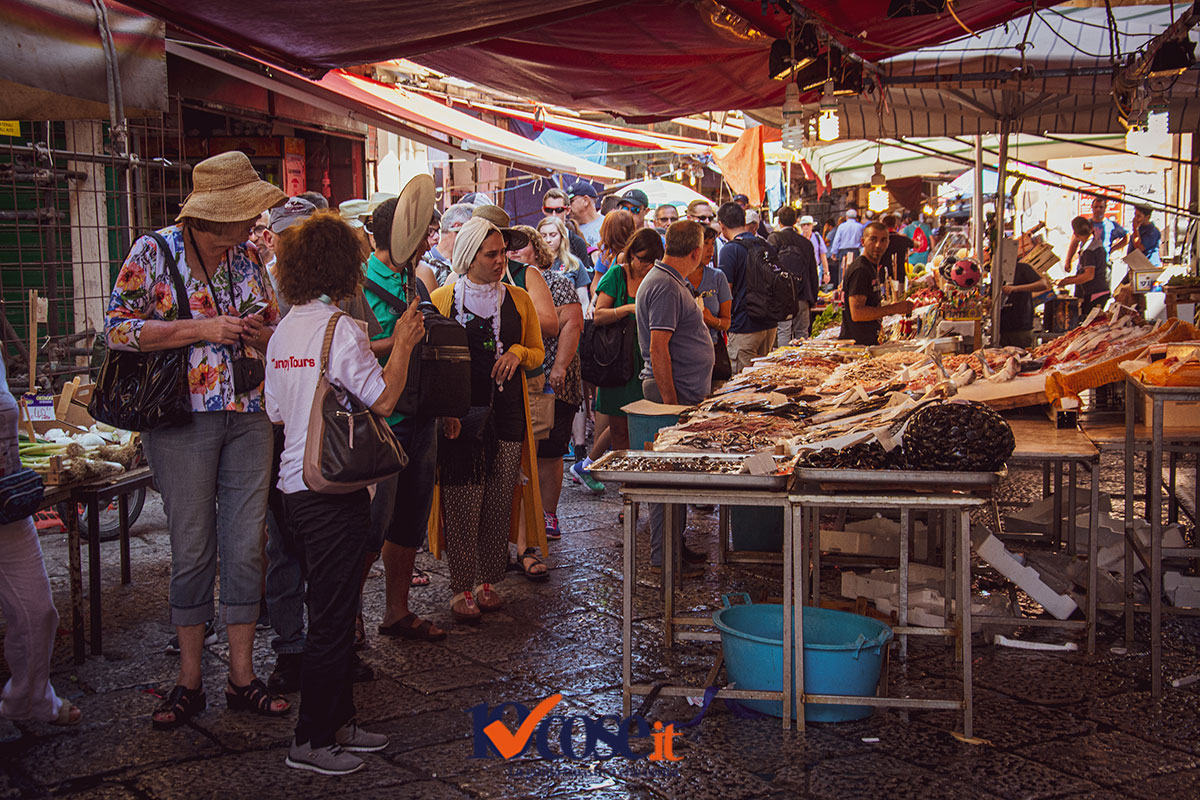
Two other markets that are absolutely worth visiting are Capo, located behind the Teatro Massimo, and Borgo Vecchio, near the port and open even at night.
Four places not to be missed if you want to relive an ancient Palermo that never loses its charm, and to take home some zero-kilometre, very low-cost gastronomic souvenirs.
Casa Professa or Church of the Gesù in Palermo
15
The presence of the Jesuits in Palermo left behind an extraordinary church, although many tourists miss it even while passing right in front of it on their way out of Ballarò.
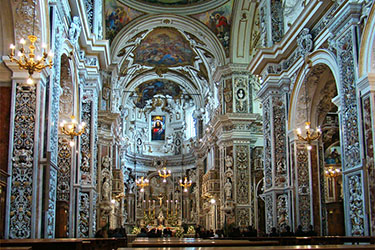
The Casa Professa, or Church of the Gesù, is the triumph of Baroque par excellence.
Stucco work, frescoes, marble and decorations across the three naves make the church the most important Baroque monument in Sicily.
The three immense naves built in 1564 by the Jesuit fathers were decorated starting in 1658. On the first floor is the Oratorio del Sabato.
Do not miss the Museum, with themed rooms dedicated to the “Treasure of the Jesuits”, where many sacred furnishings are displayed, including coral and silver objects from the Trapani craftsmanship of the 17th and 18th centuries.
The Chinese Palace
16
A small Chinese-style palace is the last thing you would expect to find in a city like Palermo: yet it is there.
Indeed, this small residence built in the Favorita Park is a truly unique building, a meeting point between Neoclassicism and the Romantic fascination with the East.
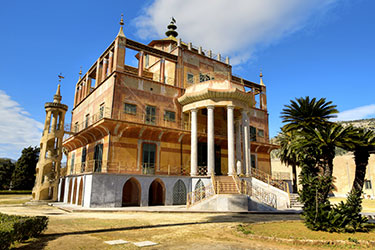
It was commissioned in 1799 by Ferdinand III of Bourbon, who, having fled Naples after the Napoleonic invasion, decided to purchase and modify a small house belonging to the Barons Lombardo, which already had an Oriental style.
The architect Marvuglia adapted the old building, transforming it into a small four-storey royal residence.
In the basement there is a large ballroom in Louis XVI style and the room containing the original lift mechanism known as the “Mathematical Table”.
This wonderful and unique mechanism made it possible to send dishes up to the upper floor immediately after they had been prepared in the kitchens.
On the raised ground floor, in fact, is the Chinese-style reception hall, also known as the audience hall, with the king’s private rooms on either side: the games room, dining room and bedroom.
On the second floor are the most beautiful rooms: the apartments of Queen Maria Carolina, with the “Turkish salon”, the “Herculaneum room” in Empire style, the bedroom with Neoclassical alcove and the wonderful “hardstone cabinet”.
On the top level, instead, there is a large octagonal terrace covered by a pagoda and the “Room of the Winds”, which was intended to serve as an observatory.
Opening hours and tickets for the Chinese Palace
Opening hours:
Tuesday to Thursday: from 9.00 am to 1.00 pm
Friday and Saturday: from 9.00 am to 6.00 pm.
Sunday: only the first Sunday of each month from 9.00 am to 1.00 pm (currently suspended)
Closed: Monday.
Ticket price: free.
How to get there: Via Duca degli Abruzzi, 1. Buses 101 and 106 from the centre of Palermo.
Palazzo Valguarnera-Gangi (Palazzo del Gattopardo)
17
Palazzo Valguarnera-Gangi is commonly known as the “Palazzo del Gattopardo” because it was used as a film set for Luchino Visconti’s film “The Leopard”, based on the novel by Giuseppe Tomasi di Lampedusa.
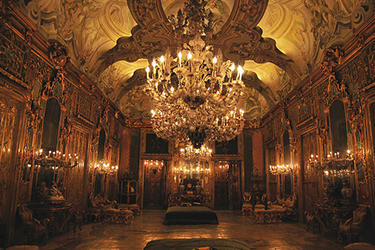
Anyone who has seen it will certainly remember the famous ballroom scene between Claudia Cardinale as Angelica Sedara and Prince Don Fabrizio di Salina, played by Burt Lancaster.
The scene was filmed in the Ballroom, also known as the Yellow Hall, with its double ceiling and three large Murano glass chandeliers.
The palace is located in Palermo’s Piazza Croce dei Vespri, in the Kalsa district.
It was commissioned by Pietro Valguarnera, Prince of Gangi, who in the first half of the 18th century entrusted the architect Andrea Gigante with the renovation of a pre-existing 16th-century building.
This is how the Palazzo del Gattopardo was born. Over time, renowned painters frescoed the interior rooms, together with carvers, plasterers and other artists.
Palazzo Valguarnera-Gangi is a perfectly preserved example of Palermo Rococo, as well as one of the most beautiful and important noble palaces in all Sicily from an artistic and architectural point of view.
To visit the Palazzo del Gattopardo, booking is compulsory by telephone on 0916162718 or by email at palazzogangi@hotmail.com.
Alternatively, you can contact one of Palermo’s cultural associations or the Association of Sicilian Museums, which organize guided tours.
The tour leads through many of the palace rooms, such as the Hall of Honour, the Yellow Hall and the Gallery of Mirrors with its large central fresco.
The visit is like a journey into the splendour of that era: the palace has preserved its original furnishings in every detail, from objects to fabrics and lavish decorations.
How to get to the Palazzo del Gattopardo
How to get there: The Palazzo del Gattopardo can easily be reached on foot from the centre of Palermo or by bus (Lines 101 and 102).
Palazzo Mirto in Palermo
18
In Via Merlo in Palermo, 100 metres from Piazza Marina and the Garibaldi Garden in the Kalsa district, stands Palazzo Mirto.
It was built as a noble residence to house the historic Filangeri family, one of the most important families in Palermo and all Sicily.
The name Mirto derives from the title “Prince of Mirto”, granted to Giuseppe Filangeri.
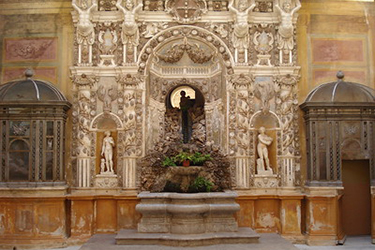
It is one of the oldest palaces in Palermo, dating back to the Norman period, and over the centuries it underwent various alterations until it took on, towards the end of the 18th century, the appearance it has today.
Today the palace is no longer inhabited by the Filangeri family and belongs to the Municipality of Palermo, which has transformed it into a house museum.
The rooms preserve the luxury of the past and tell the story of the family that lived there for four centuries.
The furnishings are original, as are the objects, from clocks to porcelain pieces preserved in display cases, which are a source of pride for the museum due to their uniqueness and beauty.
Among the rooms, we point out the Sala Salvatore Rosa, which houses works by the Neapolitan painter of the same name.
The Sala del Trucco preserves a period dressing table in Louis XV style, while the Sala degli Arazzi contains paintings by Giuseppe Velasco depicting the myth of Cupid and Psyche.
The reception hall, the Salone del Baldacchino, is particularly interesting for its cycle of allegorical paintings and scenes from Jerusalem Delivered.
From the piano nobile, you enter the hanging garden, where one of the palace’s gems can be found: the Rococo-style fountain, made with shells and statues, an undoubtedly unusual and scenic piece.
Overall, Palazzo Mirto is impeccably maintained. The tour takes place in the company of staff in charge of guided visits.
The palace hosts exhibitions, concert seasons and cultural events.
Opening hours and tickets for Palazzo Mirto
Opening hours:
Tue to Sat: from 9.00 am to 7.00 pm
Sun and holidays: from 9.00 am to 1.00 pm
Closed: Monday
Ticket price:
Full ticket: €6.00
Reduced ticket: €3.00
Combined ticket valid for 3 days: €10.00, including admission to Palazzo Mirto, Palazzo Abatellis and the Oratorio dei Bianchi.
How to get there: Palazzo Mirto is 1 km from Palermo Central Station. From here it can be reached by bus (Lines 101, 102, 124), or on foot from the historic centre in the direction of Kalsa.
What to see in Mondello
19
After visiting the Chinese Palace, it is a must to travel 3 km and reach Mondello, the beach par excellence of the people of Palermo.
The history of the two places is connected: when the King moved to Palermo, the nobles donated some properties in the Mondello area to him, which he transformed into a hunting and fishing reserve.
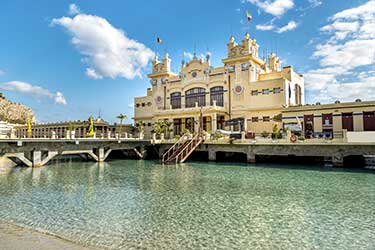
After the Unification of Italy, in the early 1900s, the Florio family of Favignana brought the cream of European aristocracy to Mondello, transforming this bay into an exclusive holiday and meeting place.
A sort of competition began among Palermo’s wealthy families to build the most beautiful villa: this was the height of Art Nouveau, which explains the succession of villas, small towers, wrought gates, gardens and all kinds of decorative details along the seafront.
The synthesis of all this beauty is the seaside establishment, the symbol of Mondello for more than a century, designed by the Belgian architect Rudolf Stualker.
Of course, the sea of Mondello is splendid, as is the beach, which has one particular feature: it is very fine and pink because it is made up of decomposed shells and Posidonia, not simple sand.
This makes it more like a Caribbean beach than a Mediterranean one.
The Sanctuary of Santa Rosalia
20
The Sanctuary dedicated to Saint Rosalia may not be among the most famous tourist sites in Palermo, but it is worth a visit for its evocative location and out of devotion to the patron saint, who is deeply venerated by the people of Palermo.
The Sanctuary is located on Mount Pellegrino, thirteen kilometres from the centre, and its special feature is that it is completely set into the rock.

It is said that Saint Rosalia lived as a hermit on this mountain, and that her remains were found in what is now the sacred cave of the Sanctuary, open to the public and visitable.
The cave houses the altar with the simulacrum dedicated to her, “The Reclining Saint”, a 17th-century work of art made of marble and covered in gold leaf. Its author is Gregorio Tedeschi.
The visit continues into the Treasury Rooms, which preserve busts, ex-votos, sacred objects and symbols linked to the life of Saint Rosalia, such as the crown of roses and the staff.
As for visiting the Sanctuary, you can enter independently or, to learn more about its history, you can join a guided tour.
Every year in September the traditional “Acchianata” takes place: on the night between 3 and 4 September, the faithful climb on foot to the Sanctuary along an ancient four-kilometre path.
After the visit, we recommend continuing along the uphill road that leads to the panoramic viewpoint at the top of Mount Pellegrino, where the statue of Saint Rosalia stands.
This is one of the most beautiful viewpoints over Palermo and the Tyrrhenian coast of the Palermo area.
Opening hours and how to get to the Sanctuary of Santa Rosalia
Opening hours: Monday to Saturday: 9.00 am-6.00 pm. Sunday and holidays: 8.00 am-7.00 pm
How to get there: AMAT bus line no. 812 from Largo Sellerio, alternatively by shuttle bus with several departures.
On foot: The Sanctuary can be reached on foot in about an hour with a panoramic walk along the “Scala Vecchia” (starting from Piazza Sellerio). This is the easiest route; alternatively, there is the wilder Valle del Porco path.
Monreale Cathedral
21
About 8 km from Palermo, in the town of Monreale, stands the beautiful Arab-Norman cathedral dedicated to the Virgin Mary, a destination for tourists and pilgrims from all over the world.
The grand religious building was built in 1174 at the behest of the Norman king William
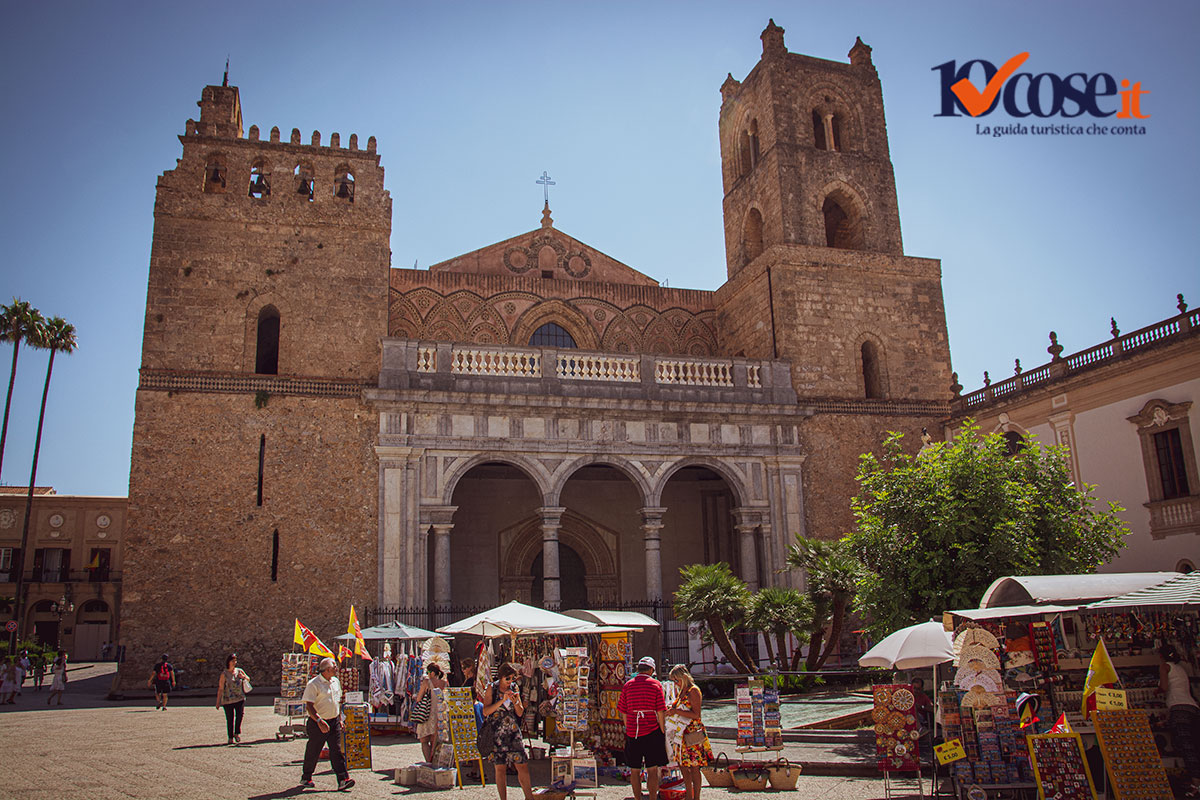
II following an apparition of the Madonna, who appeared to him in a dream and asked him to build a temple in her honour, showing him where to find the treasure needed to do so.
On the outside, the Cathedral has a three-light portico beneath which is the valuable bronze portal by Bonanno Pisano, and two large square towers, one of which was converted into a bell tower.
The Latin cross interior is divided into three naves by columns topped with beautifully carved capitals;
the walls are covered with magnificent gold-ground mosaics of the Byzantine school (12th and 13th centuries), depicting episodes from the Bible and stories of the Church, with the figure of Christ Pantocrator added in the central apse.
Among the many treasures preserved here, the following deserve mention: the high altar by the silversmith Valadier (1711), the sarcophagi of William I and William II, and the 20th-century organ with six keyboards.
Do not miss the Chapel of the Crucifix, a fine example of Sicilian Baroque, which houses the Cathedral Treasury with the reliquary containing a thorn from Christ’s crown.
Also worth visiting is the arcaded cloister of the Benedictine convent (12th century) next to the cathedral, where you can admire the rich decoration of the capitals of the historiated small columns.
Opening hours and tickets for Monreale Cathedral
Opening hours: Monday to Saturday: from 9.00 am to 12.45 pm (last admission) – from 2.00 pm to 5.00 pm (last admission)
Sunday and holidays: morning visits suspended – afternoon from 2.00 pm to 5.00 pm (last admission)
Ticket price: Cathedral, cloister, chapel, museum and rooftops €10
How to get there: from Piazza Indipendenza, AMAT city buses no. 824 (Politeama-Sant’Erasmo) and no. 108 (Politeama-Ospedale Civico).
Palermo cuisine
M
Palermo’s cuisine is varied, good and tasty.
From starters to desserts, Palermo offers absolutely unmissable traditional dishes: an extraordinary combination of ingredients, flavours and aromas, the result of the many civilizations that have succeeded one another here and left their mark on the city’s cuisine as well.
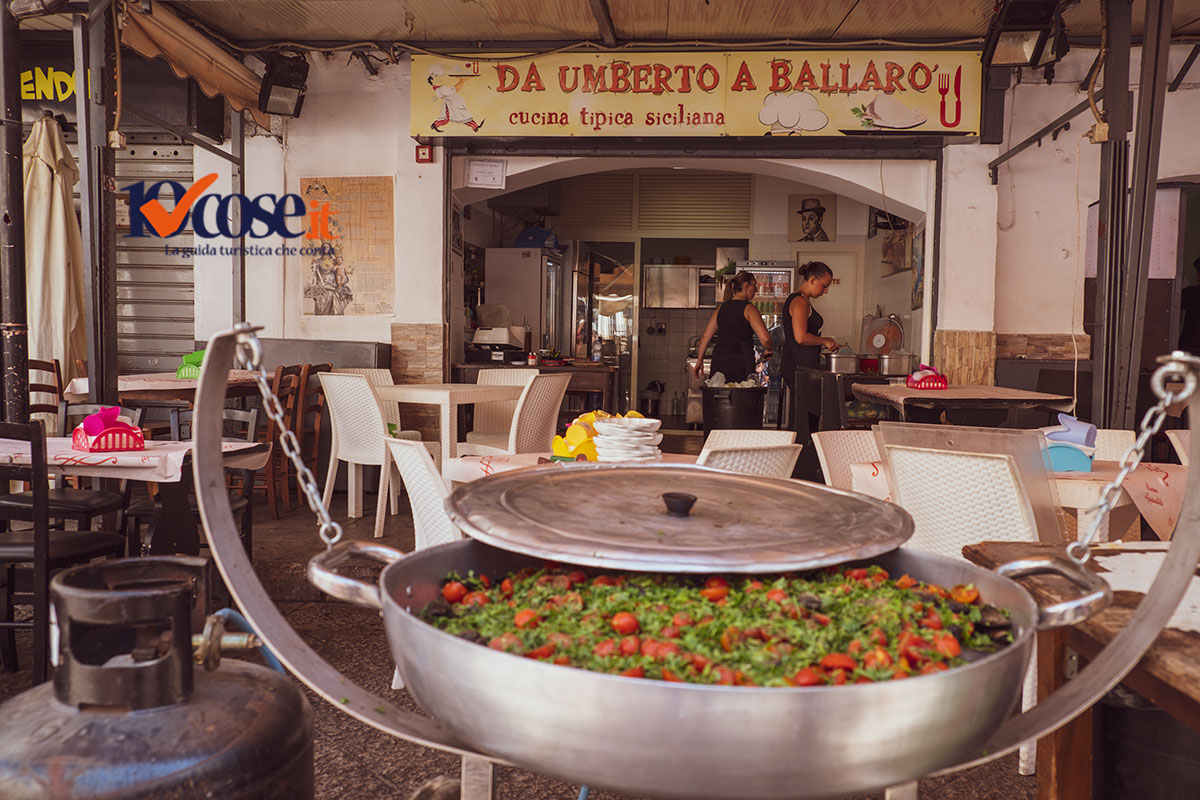
Saffron, pistachios, dairy products, prickly pears and flavourings for granitas are just some of the ingredients used in Palermo’s imaginative cuisine.
Do not fill yourself up on cannoli and cassata; also try the traditional dishes of the popular “street cuisine”, such as the famous arancine — breaded and fried rice balls generally filled with ragù, mozzarella and peas;
crocchè or “cazzilli”, made from potatoes; panelle, chickpea flour fritters;
sfincione, a thick sheet of leavened dough topped with a sauce made from fresh tomato, onion, anchovies and caciocavallo cheese;
and the proverbial u pane ca’ meusa, a bread roll filled with pieces of spleen, lung and trachea cooked in lard, in the “schietta” version, meaning plain — so to speak! — and the “maritata” version, with ricotta.
Where to stay in Palermo
Palermo is equipped to welcome every type of traveller.
Luxury hotels such as the Grand Wagner, or more affordable Bed & Breakfasts, are scattered close to the city’s most important tourist attractions.
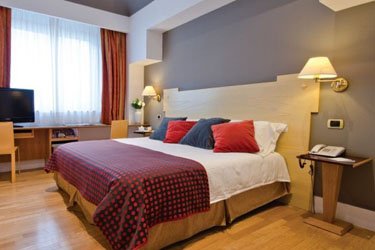
The offer is good and prices are not very high: a double room in a 3-star hotel for one night in the city centre costs around 50 euros.
We recommend looking for accommodation in the central area, both to optimize visiting times and because internal transport connections are not always very reliable.
If you are looking for a hotel, we recommend choosing from those offered by Booking.com. 170 hotels with prices, photos and reviews from guests who have stayed before you. Go to Booking.com