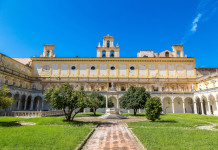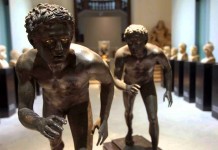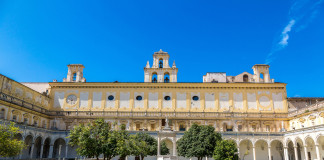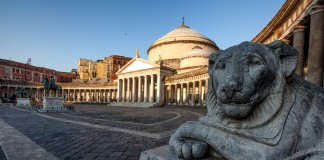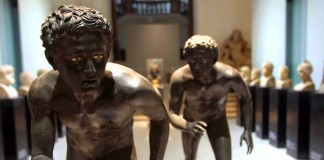

Spaccanapoli is the street that runs from the Spanish Quarters to the Forcella district, cutting straight through the city of Naples. You will understand why it is called this if you look at it from San Martino, in the highest part of the city. This artery has extremely ancient origins: it is, in fact, one of the three decumani — the one closest to the sea — along which the Romans, building on the earlier Greek layout, organised the city.
A walk along Spaccanapoli is a journey — obstacles included — through the thousand-year history of the city, and it is absolutely one of the unmissable things to see in Naples.
Here you will find not only old palaces and churches, but also legends and the unmistakable aromas of Neapolitan cooking. Do not be surprised by anything: along Spaccanapoli you may come across splendid churches and families living in ground-floor bassi, artist-artisans and street vendors selling almost everything imaginable.
In recent years, small hotels and bed and breakfasts have opened along the route, allowing visitors to experience Naples much as Neapolitans do. Spaccanapoli is a narrow urban corridor where Neapolitans, tourists and scooters coexist — not always peacefully.
And yet there is no place in the city that can tell you more vividly about the soul of Naples, its essence revealed here without disguise. Spaccanapoli is not a tourist postcard: it is Naples.
Piazza and Church of Gesù Nuovo
1
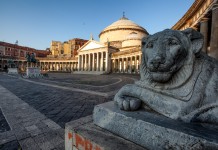
Born almost by chance as the city expanded westwards, Piazza del Gesù is one of the most important squares in Naples.
The square opens suddenly along the route of Spaccanapoli, revealing three jewels at a glance: the Church of Gesù Nuovo, the Obelisk of the Immaculate Conception and the Monastery of Santa Chiara. The church is a typical example of Neapolitan Baroque architecture, rich in marble, decoration and paintings.

According to legend, the building was constructed with magical stones capable of attracting positive energies.
Not legends but miracles are evoked by the chapel of Saint John Bosco inside the church. Thousands of votive offerings hang on the walls, left in gratitude by those who believed they had received a miracle.
The obelisk in the square is itself wrapped in a legendary aura: seen at certain times of day, thanks to a play of light and shadow, it seems to reveal the image of death… keep your eyes sharp!
Opening hours and ticket price for the Church of Gesù Nuovo
Opening hours:
Monday to Saturday: 7:30 am–12:30 pm and 4:00 pm–7:30 pm.
Sundays and public holidays: 7:45 am–1:30 pm and 4:00 pm–8:00 pm.
The Baroque Machine is open every day at 5:30 pm.
Ticket price: free.
How to get there: the church is in Piazza del Gesù Nuovo 2, in the historic centre.
Monastery of Santa Chiara
2
First a Gothic building, then radically transformed into an example of Baroque art, before returning, after post-war restoration, to the charm and simplicity of its origins.

The Monastery of Santa Chiara was founded at the wish of Robert of Anjou and, under the Angevins, became the centre of civil and religious ceremonies.
Next to the monastery is the majolica-tiled cloister, with pillars entirely covered in majolica, where blue, yellow and green predominate: colours that harmonise perfectly with the surrounding environment.
The cloister is a true oasis of peace in the heart of chaotic Naples.
Opening hours and ticket price for the Monastery of Santa Chiara
Opening hours:
Monday to Saturday 9:30 am–5:30 pm
Sunday 10:00 am–2:30 pm. Last admission 30 minutes before closing.
The basilica is open Monday to Saturday 8:00 am–12:45 pm and 4:30 pm–8:00 pm; Sunday 9:00 am–12:45 pm and 4:30 pm–8:00 pm.
Ticket price: adults €6; ages 8–18 €3.50; students under 30 and over 65 €4.50.
How to get there: the monastery is at Via Santa Chiara 49c, in the historic centre, in Piazza del Gesù. The nearest Metro Line 2 stop is Montesanto; on Line 1, Dante.
Piazza San Domenico Maggiore
3
Piazza San Domenico Maggiore rises in the centre of Naples like a world apart from the chaos and traffic surrounding it. Far removed from everything modern, the square captures the gaze of all who pass through it.

At its centre stands the monumental obelisk commissioned by the Dominicans as thanks for the end of the plague in 1556, followed by the basilica in full Baroque style.
Tourists and young people fill the square by day and by night, but if you find yourself here, as well as admiring the harmonious variety of its architectural styles, it is worth stopping by Scaturchio, Naples’ most famous pastry shop.
Sansevero Chapel on Spaccanapoli
4
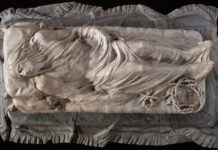
At San Domenico, taking the uphill street beside the square, a short detour from the main route leads to one of Naples’ most mysterious places: the Sansevero Chapel.

A legend tells of a man unjustly arrested who, as he was being taken to prison near the wall of the De Sangro property, called upon the Blessed Virgin for help.
At that moment the wall collapsed, revealing a painting of the Madonna. Once acquitted, the man had the painting restored; it later became an object of devotion, and the Chapel rose around it. The place soon became a pilgrimage destination, with people turning to the sacred image to request every kind of grace.
But the story of this place continues, between history and magic. Read it on our page dedicated to the Sansevero Chapel and the Veiled Christ.
Piazzetta Nilo on Spaccanapoli
5
Piazzetta Nilo was the home of the Alexandrians: here they pursued their interests, and here they had their workshops and houses.

To preserve the memory of their presence and of their distant homeland, they had a statue of the god Nile created, depicted as a bearded, half-naked old man resting his feet on the head of a crocodile.
For more than two thousand years, the square has kept this name, together with the statue, although Neapolitans prefer to call the place Corpo di Napoli — the “Body of Naples” — because it stands at the very heart of the ancient centre.
Maradona’s shrine on Spaccanapoli
6
Maradona, El Pibe de Oro, embodies the citizens’ spirit of redemption, making them proud to be Neapolitan and uniting them in a single faith. The footballer has become a legend and continues to be loved by Neapolitans and non-Neapolitans alike, to the point of becoming an object of devotion.

Just after Piazzetta Nilo, you will come across a small shrine built in his honour: a display case holds a photograph of Maradona and one of his hairs. Before important matches, some fans would come here to ask for a grace. In theory, the shrine is “managed” by the adjacent bar: queue up for your photo and then have a coffee as a contribution to expenses! At least, that is what a sign invites you to do.
Sacro Monte di Pietà on Spaccanapoli
7
The Sacro Monte di Pietà is an old palazzo dating back to 1539, when a group of Neapolitan nobles decided to create a charitable institution to grant non-profit loans.
An inscription on the façade sets out the charitable purposes of the association; the building is further enriched by sculptures by Pietro Bernini and, on the pediment, by The Pietà by Michelangelo Naccherino.
Inside, the frescoes are framed by gilded stucco, while the three rooms once used for auctions, together with the Chapel, now house the Museum, which preserves furnishings and paintings from the Banco di Napoli and a collection of liturgical objects.
Opening hours and ticket price for the Sacro Monte di Pietà
Opening hours: hours vary. It is generally open on Saturday, 10:00 am–6:00 pm, and on Sunday, 10:00 am–2:00 pm.
Ticket price: free.
How to get there: the building is at Via San Biagio Dei Librai 114, in the historic centre.
San Gregorio Armeno
8
And here we are at San Gregorio Armeno, the Street of Nativity Scenes, one of the most famous streets in Naples and the undisputed home of the city’s nativity-scene tradition. It is a street where, even in the hottest months, you can breathe a Christmas atmosphere thanks to the shopkeepers who work all year round creating cork nativity scenes and terracotta shepherds.

Their creations are then displayed before crowds of locals and tourists who fill the street in the months leading up to Christmas. Not only traditional figures: the statuettes also portray figures from current events and contemporary culture. It is precisely the creative flair of these masters that has kept alive one of Naples’ most enduring arts.
This street crosses Spaccanapoli vertically and, walking uphill along it, you reach Via dei Tribunali, the other great artery that runs parallel to Spaccanapoli and leads from Port’Alba to Naples Cathedral.
Basilica of San Lorenzo Maggiore
9
At the end of San Gregorio Armeno, you cross the Decumanus Maximus, known as Via dei Tribunali. On the right you will immediately notice the façade of San Lorenzo Maggiore, an important expression of Gothic art in southern Italy. Several famous figures are associated with its name: many members of the Angevin family are buried here, as are the musician Francesco Durante and the writer Giovan Battista della Porta.

The church was also the setting for the famous and charming meeting between Giovanni Boccaccio and Fiammetta, and Petrarch too is said to have stayed for a few days in the adjoining convent. The bell tower overlooking the church, meanwhile, was used to store weapons during the uprisings of 1647, which is why it is known as the Tower of Masaniello. The church preserves important archaeological excavations that allow visitors to explore the ancient Greek agora, one of the places where the history of Naples began.
Opening hours and ticket price for the Basilica of San Lorenzo Maggiore
Opening hours: every day 9:30 am–5:30 pm; optional guided tours from 1:30 pm onwards until Thursday.
Ticket price: adults €9; students and over 65s €7; ages 6–18 €6.
How to get there: the basilica is in Piazza S. Gaetano 316, in the historic centre.
The Doll Hospital in Naples
10
There is an extraordinary place at the end of Spaccanapoli: a Doll Hospital that has been taking care of children’s favourite toys since 1840. If, as a child, you struggled with horror films featuring murderous dolls, you may prefer simply to look at the hospital from the shop window.
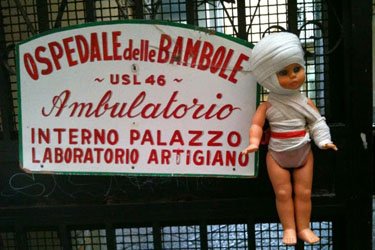
If, on the other hand, you have no such problem, go inside and enjoy this wonderful journey through time.
Heads, arms, feet, eyes: an entire doll anatomy is laid out before you. Some dolls have been under treatment for a long time; others are only passing through and will soon return to their children.
The brilliant idea came in 1840 to Luigi Grassi, a set designer for court theatres and puppet theatres, who worked in a small street of “Spaccanapoli”.
One day, a mother asked him to repair a broken doll, and from that moment the hospital never stopped caring for its unusual “patients”.
The name came from a passer-by who, looking in from outside, said in Neapolitan, “it really looks like a doll hospital”. Luigi Grassi then took a small wooden board and wrote “OSPEDALE DELLE BAMBOLE” on it, adding a red cross as well. After 170 years, that sign is still there.
The Doll Hospital can also be visited on a guided tour, giving access to all areas of the museum and the chance to speak with the artisan-doctors who “treat the dolls”.
Opening hours and ticket price for the Doll Hospital
Opening hours: every day 10:30 am–1:30 pm; Sunday 10:00 am–1:30 pm. Closed on Wednesday.
Ticket price: adults €3.
How to get there: the Doll Hospital is at Via San Biagio dei Librai 39, in the historic centre.