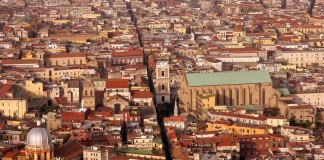
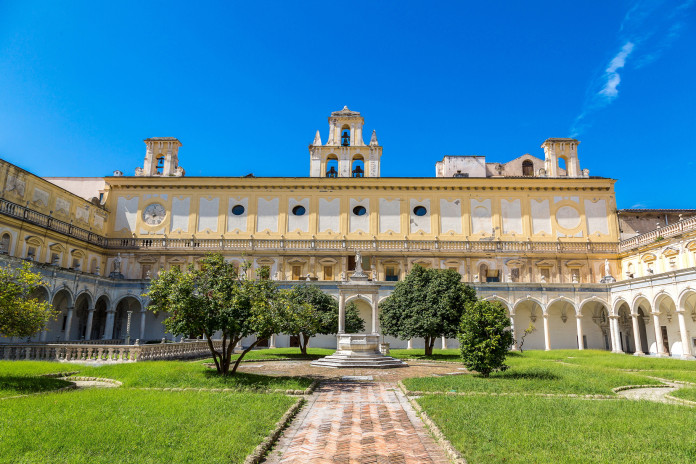
The Charterhouse of San Martino stands in the enchanting, almost dreamlike setting of the San Martino viewpoint.
It is one of the places most loved by Neapolitans, who climb up here to take in Naples and the entire gulf in a single sweeping glance. If you are looking for information about the museum inside the Charterhouse, visit the page dedicated to the Museum of San Martino.
This remarkable complex was built by Tino di Camaino and Attanasio Primario according to the architectural principles of the Carthusian Order.
Of the original structure, only the splendid and atmospheric Gothic underground spaces remain, as the Charterhouse underwent a profound transformation between the late 16th and early 18th centuries.
The present appearance of the Charterhouse is the result of work by three architects: Giovanni Antonio Dosio (1581), who softened its austere Gothic character by giving it an elegant Renaissance style; Cosimo Fanzago (1623), creator of its refined Baroque appearance; and Nicola Tagliacozzi (1723), who managed to combine architecture, painting and sculpture in a way that reflects the distinctive taste of the Rococo.
Over time, highly renowned artists worked for the Carthusian monks: among the painters were Ribera, Battistello Caracciolo, Lanfranco and Luca Giordano; among the sculptors, Giuseppe Sanmartino and Domenico Vaccaro.
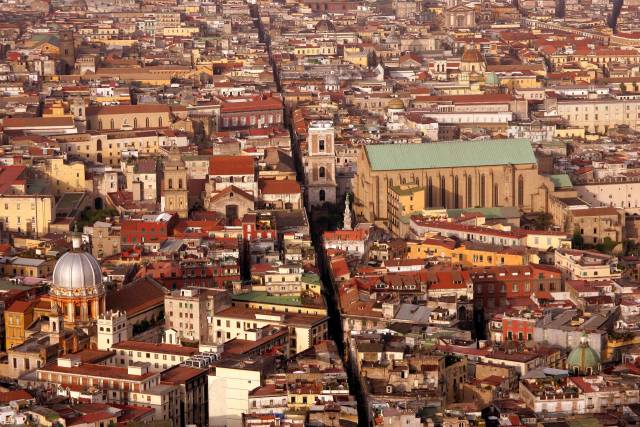
The Charterhouse of San Martino becomes a museum
Built in 1325 at the request of Charles of Anjou, Duke of Calabria, the complex underwent major changes from the very beginning, until, in the second half of the 19th century, the Charterhouse became an Italian National Museum.
An excellent restoration has given us the present layout of the Charterhouse, preserving the correct perception of the religious site and its ancient spaces within a museum itinerary that alternates between testimonies to the history of Naples and the Church, and breathtaking views from loggias, belvederes and gardens.
Through these changes, the Charterhouse of San Martino has fortunately enriched its prestigious and precious artistic, historical and architectural heritage, made up of marble, stucco work, sculptures, outstanding furnishings, frescoes and paintings.
The Church of the Charterhouse
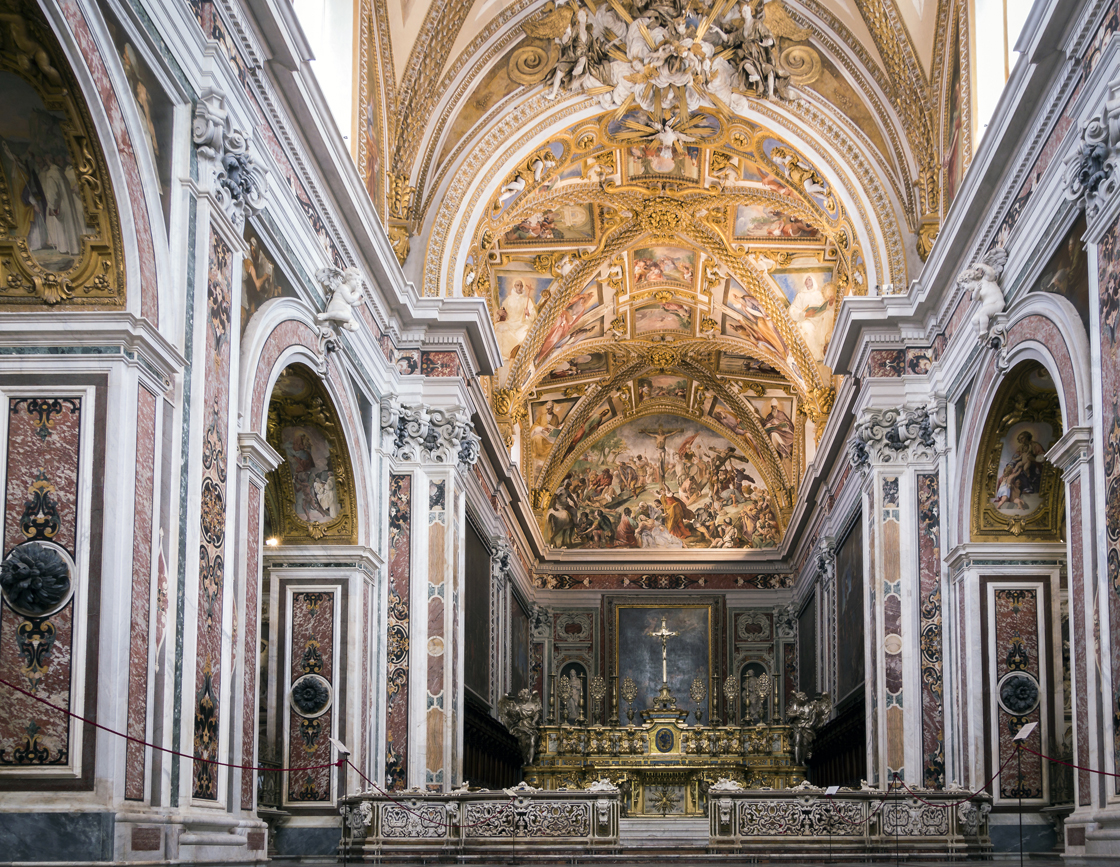
In the large courtyard, the exterior façade of the church immediately comes into view: a kind of treasure chest of Neapolitan painting and sculpture from the 17th and 18th centuries.
The chapels along the sides of the nave are covered with splendid marble inlays, particularly precious in the chapel by Cosimo Fanzago, dedicated to Saint Bruno, founder of the Carthusian Order.
The vault, which preserves its original 14th-century structure, was painted by Giovanni Lanfranco (1637–40), who magnificently rendered the Ascension of Christ in a blaze of golden light.
In 1754, in the Chapel of San Martino, Giuseppe Sanmartino created Fortitude, Charity and the four groups of cherubs, works that reveal, in all their splendour, the rare qualities of an exceptional master.
A lively balustrade of marble, precious stones and gilded bronze, dating from 1761, stands before the presbytery area.
The high altar of 1705, never definitively completed, is made of gilded and painted wood, worked to resemble marble. In the choir, the large canvases on the walls are by some of the most important artists of the 17th century: Guido Reni, Jusepe de Ribera, Battistello Caracciolo and Massimo Stanzione.
The walnut cabinets (1587–1600) in the monumental sacristy are decorated with wooden inlays by Flemish and Neapolitan artists.
The Chapel of the Treasury contains true masterpieces, such as Ribera’s Pietà (1637) on the altar, and Luca Giordano’s Triumph of Judith (1704) on the vault.
The cloisters of the Charterhouse
The Charterhouse of San Martino has two cloisters: the Great Cloister and the Procurators’ Cloister.
The Great Cloister was built on the same layout as the 14th-century cloister.
The cells of the Carthusian monks, arranged around the cloister, enjoyed a spectacular view over the Gulf of Naples.
The cemetery and the Carthusian cloister
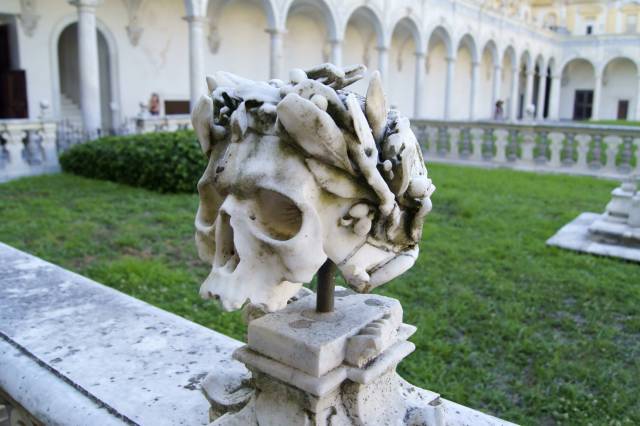
Integrated into the cloister is the Carthusian cemetery, with its Baroque balustrade decorated with skulls and bones.
The Procurators’ Cloister is surrounded by arches in piperno stone and white marble, with a decorated well at its centre.
Historical inscriptions, sculptures and coats of arms removed from palaces and streets of Naples during the period of the Risanamento urban renewal have been placed on the cloister walls.