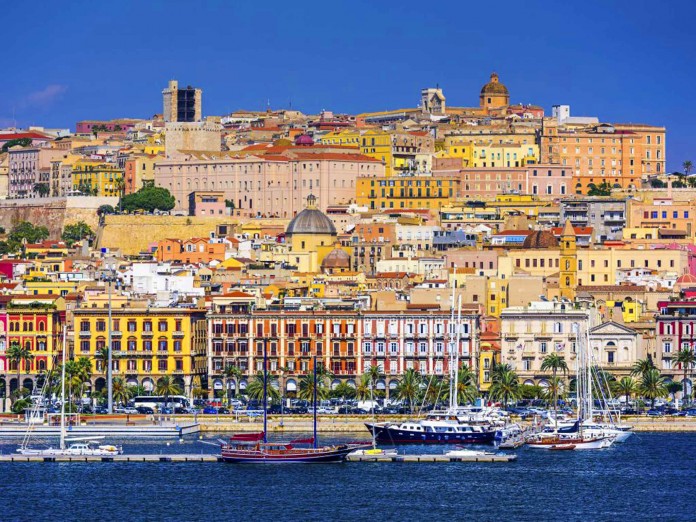
A city “of stone, bare and uphill, like a white Jerusalem”: this is how, in 1921, the British writer David Herbert Lawrence described Cagliari, an “almost fantastic” city enclosed between the blue of the sea and white limestone rocks.
Founded by the Phoenicians, colonised by the Carthaginians, occupied by the Romans, contested by the Pisans and the Spanish, and long governed by the Piedmontese, the Sardinian capital preserves in its palaces, churches, works of art and language the traces of its long and eventful history.
At the top of the Castello hill, the fortified citadel, with its white walls and tall medieval towers, dominates the city skyline. Among the paved lanes of the old Castello district, once the seat of civil, military and religious power, you can breathe in the oldest atmosphere of Cagliari, and it is here that the city’s most interesting attractions are concentrated.
Equally characteristic and rich in historical and artistic evidence are the other districts of the historic centre — Marina, Stampace and Villanova — where, among artisan workshops, trattorias, traditional markets and lively streets, you can discover small treasures — archaeological remains, museums and cloisters — and the spirit of the people of Cagliari.
In addition to history and culture, Cagliari also offers many natural wonders: lagoon areas populated by numerous bird species, green parks and beautiful beaches which, during the warmer season, come alive by day and night, offering relaxation and plenty of fun to tourists and locals alike.
On this page we point out the 10 things to see during a weekend or holiday in Cagliari.
If, instead, you are looking for a hotel, we recommend choosing from those offered by Booking.com. There are around 80 hotels with prices, photos and reviews from previous guests. Go to Booking.com.
The Bastion of Saint Remy in Cagliari
1
The Bastion of Saint Remy — named after the Baron of Saint Remy, the first Piedmontese viceroy who had it built — was constructed between 1896 and 1902 on the ancient Spanish bastions of the Zecca and the Sperone to connect the Castle district with the lower city.
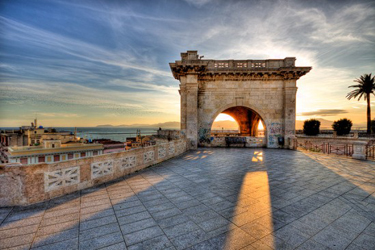
The scenic classical-style belvedere, built in granite and limestone, includes a hemicycle staircase formed by two flights that meet on a landing, from which you can access the Covered Walkway, a large painted space enclosed by grand arches.
Originally created as a banquet hall, the Walkway was used as an infirmary during the First World War and later as a shelter for displaced people during the Second World War. Today, after years of neglect and abandonment, it has returned to its former splendour as an exhibition space.
A second staircase with two circular flights, placed beneath a large arch, leads to the immense Umberto I Terrace, once the favourite promenade of the people of Cagliari and today home to a Sunday flea market, offering a splendid view over Cagliari and the Gulf of Angels.
From here, a short staircase leads to a second, smaller square dedicated to Saint Catherine. Partly destroyed by the bombings of 1943, the imposing complex was rebuilt after the war according to the original design.
Opening hours and ticket price for the Bastion of Saint Remy
Opening hours:
The Covered Walkway and the archaeological routes of the Galleria dello Sperone can be visited from Tuesday to Sunday, from 10 a.m. to 6 p.m.
Ticket price: €8.
How to get there: on foot in the Old City.
Sanctuary of Bonaria in Cagliari
2
The history of this religious complex on the Bonaria hill dates back to the 14th century, when Alfonso of Aragon, after his difficult victory over the Pisans, had a church built as a sign of gratitude, dedicated to the Holy Trinity and the Virgin, and donated it to the Mercedarian friars of the nearby convent.
Shortly afterwards, the small Gothic-Catalan-style church would become the most important centre of Marian devotion on the entire island.

On 25 March 1370, a mysterious crate thrown into the sea by a Spanish sailing ship during a storm washed ashore on the beach in front of Bonaria.
No one was able either to open it or lift it, except for the Mercedarian friars, who carried it to the church, where they discovered its contents. The crate contained a statue of the Madonna and Child, holding in her right hand a candle that was still lit.
With the arrival of the miraculous Madonna, venerated by the faithful and invoked by sailors as their protector, the little church became the Sanctuary of Our Lady of Bonaria.
The considerable influx of pilgrims led the friars to think about building a larger church.
The works, begun in 1704, continued for many long years. In 1926 the island’s largest Christian temple was consecrated and received the title of minor basilica. In 1908, Pope Saint Pius X proclaimed the Madonna of Bonaria the principal Patroness of Sardinia.
Opening hours and ticket price for the Sanctuary of Bonaria
Opening hours:
Weekdays: from 6:30 a.m. to 11:30 a.m. and from 4:30 p.m. to 6:45 p.m. Holidays and days before holidays: from 6:30 a.m. to 11:30 a.m. and from 4:30 p.m. to 8:30 p.m.
Ticket price: free.
How to get there: in the upper part of Cagliari, in Piazza Bonaria. Bus: lines 5, 6, 7, 30, 31, 5-11, 30-R
Cathedral of Santa Maria in Cagliari
3
Built during the 13th century in Pisan Gothic style, the church dedicated to the Assumption of the Virgin and to Saint Cecilia, martyr, became a cathedral in 1258.

Enlarged between the end of the 13th and the beginning of the 14th century, in 1669 the religious building was remodelled in the typical forms of Genoese Baroque by Domenico Spotorno.
In the first half of the 20th century, the marble Baroque façade was rebuilt in the Romanesque style of Lucca using limestone from the Bonaria hill, and the two medieval chapels hidden by previous renovations were recovered: the Pisan chapel and the Aragonese chapel of the Blessed Sacrament, dedicated to the Holy Thorn.
Of the original 13th-century church, the portal of the right transept, the rose windows, the architrave of the central doorway, the three-nave layout and the square-barrel bell tower remain.
Among the treasures of the Duomo, special attention should be paid to the pulpits dating back to the mid-12th century, the work of Guglielmo of Innsbruck; the beautiful 16th-century polyptych of the Annunciation; the wooden sculpture of the Madonna and Child from the Venetian school, dating from the second half of the 14th century; and the four column-bearing lions — 12th century — at the foot of the presbytery staircase.
Do not miss the crypt-sanctuary beneath the presbytery, built in 1618 by Archbishop Desquivel to honour the remains of the Sardinian martyrs.
The shrine, carved into the living rock, consists of three chapels with barrel vaults, covered in polychrome inlaid marble and embellished with Sicilian-style Baroque stucco decorations.
Opening hours and ticket price for the Cathedral of Santa Maria
Opening hours:
Weekdays: 7:30 a.m.–12 p.m. and 4 p.m.–8 p.m. Holidays: 8 a.m.–1 p.m. and 4:30 p.m.–8:30 p.m.
Ticket price: free.
How to get there: on foot in Piazza Palazzo.
Poetto Beach in Cagliari
4
Poetto is the beach of the people of Cagliari: an eight-kilometre stretch of sand extending from the promontory of the Sella del Diavolo to the coastline of Quartu Sant’Elena.
There are several theories about the origin of the name. It is likely that Poetto derives from the Catalan “poeht” — little well — referring to the cistern near the Tower of Sant’Elia, but it is also logical to think that the term may come from “Su Puertu” — The Port — the name used by the Spanish for the landing place of Marina Piccola, at the southern end of the beach, later Italianised as “Il Poetto”.

The construction of the tramline — the stops once served by the tram gave their names to the different areas into which the beach is still divided today: first stop, second stop, and so on up to the sixth — and the opening of the first bathing establishments in the early decades of the 20th century encouraged the local population to frequent the enchanting beach, with its emerald-green water and very fine white sand.
But things soon changed: due to wind erosion, the dunes disappeared, the buildings along the seafront narrowed the beach, not to mention the large quantities of sand removed for construction purposes.
The beach nourishment carried out in 2002 caused considerable dissatisfaction, as the new sand, mixed with fragments of shells and mineral substances, was far from white.
Although it is no longer what it once was, Poetto remains a beautiful beach, perfect for sunbathing and swimming, practising outdoor sports, and spending summer evenings among aperitifs, music and shows.
Civic Palace in Cagliari
5
It was 14 December 1896 when the city council, with the intention of giving Cagliari the appearance of a more dynamic and open city, decided to move the seat of the Civic Palace from the upper, fortified part of the city — Piazza Palazzo — to the area overlooking the port, symbol of the modern mercantile city.

The building, made of white limestone, is a blend of Gothic-Catalan elements and Art Nouveau motifs.
The majestic porticoed façade, decorated with bronze sculptures — two lions, an eagle with the city’s coat of arms and three statues symbolising Agriculture, Industry and Commerce — features two octagonal towers, 38 metres high, where the Moors of the Sardinian flag are carved on the four corners.
From the courtyard, a large staircase leads to the upper floors, where the Council Hall, reception rooms and offices are located.
Among the works displayed in the various rooms, special mention should be made of several paintings by Filippo Figari and Giovanni Marghinotti, a 16th-century retablo by Pietro Cavaro and a 17th-century Flemish tapestry.
The Elephant and San Pancrazio Towers in Cagliari
6
The characteristic Towers of San Pancrazio and the Elephant, which define the profile of the ancient Castello district, were part of the fortified system built by the Pisans in the 14th century against a potential attack by the Aragonese.

Erected respectively in 1305 and 1307 as lookout points, the two twin towers are made of white Bonaria limestone on three sides, where narrow loopholes open, while the fourth side, facing the Castle district, is open and shows the various floors built with wooden galleries.
The Tower of San Pancrazio, built on the highest point of the hill, consists of four floors and rises to over 36 metres; its three massive gates and two heavy portcullises protected the northern entrance to the Castle district.
Originally built for military purposes, over time the tower was used for other functions: lodging for officials and a warehouse during the Aragonese rule — 1328 — and then as a prison in the 17th century and until the end of the 19th century.
With its 30 metres in height and sturdy portcullis gate, the Elephant Tower, so called because of the small elephant carved in stone protruding from one side, protected the south-western side of the Castle district.
Originally a defensive stronghold, later used as a warehouse, powder magazine, armoury and prison, the tower, which has preserved its function as an entrance to the Castle district to this day, is one of the most important symbols of the neighbourhood. Thanks to 20th-century restoration work, the two constructions can now be admired in their original appearance.
Opening hours and ticket price for the towers
Opening hours:
Tuesday to Sunday, from 10 a.m. to 5 p.m. Closed: Monday.
Ticket price: €4.
How to get there:
San Pancrazio Tower: Piazza Indipendenza. Elephant Tower: Piazza San Giuseppe.
Molentargius Park in Cagliari
7
The Molentargius–Saline Regional Natural Park is a wetland of international importance, especially as a habitat for numerous species of water birds, within the metropolitan area of Cagliari. The history of the reserve is linked to the long history of the city’s salt pans, so much so that the site owes its name to the molenti — donkeys in Sardinian — the “means of transport” once used to carry the salt collected from the salt pans to the port.
The natural complex, which extends over about 1,600 hectares, includes freshwater basins — Bellarosa Minore and Perdalonga — waters with different degrees of salinity — the Molentargius and Quartu ponds, transformed in 1830 into a salt extraction plant that stopped operating in 1985 for hygiene and health reasons — and a sandy plain, Is Arenas.
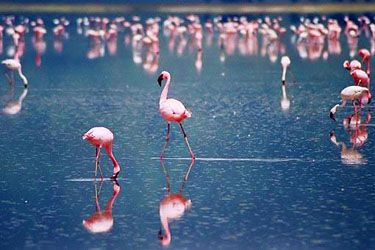
Thanks to the different ecosystems that compose it, the Park boasts a rich variety of plant and animal species, many of them protected. In particular, the site is famous for the presence of pink flamingos, “sa genti arrubia” — the red people — as they say around here, which nested here for the first time in 1993.
The Park headquarters are located in the Sali Scelti building, a former salt warehouse and an example of industrial architecture dating back to the 1930s.
Opening hours and ticket price for Molentargius Park
Opening hours:
From 1 March to 15 October: 6:30 a.m.–9 p.m. From 16 October to 28 February: 7 a.m.–6 p.m.
Sali Scelti Building Infopoint: every day, from 9 a.m. to 6 p.m.
Ticket price: free.
Boat tours of about one and a half to two hours depart every day at 10 a.m. The cost is €15 for adults, €10 for children aged 4 to 10, and free for children under four.
How to get there: Bus lines 3, PQ and PF.
Costa Rei near Cagliari
8
Turquoise waters, vast stretches of very fine white sand, lush Mediterranean scrub, wind-shaped dunes, dreamlike coves and imposing cliffs.

This is the splendid landscape that distinguishes Costa Rei, eight kilometres of spectacular beaches following one another in the south-eastern part of the island — Sarrabus — from Capo Ferrato to Cala Sinzias.
It is not hard to understand why the Caribbean-like beach of Costa Rei, the main beach of this beautiful coastline, was included by Lonely Planet in 2009 among the 10 most beautiful beaches in the world.
Equally evocative are Cala Sinzias, among the most unspoilt beaches, Cala Pira, one of the most beautiful stretches of coastline, and Piscina Rei with its natural pools. Discovered in the 1960s by Belgians, Costa Rei — Coast of the Guilty, due to the presence in the past of prisoners held in the nearby penal colony of Castiadas — quickly became one of the most popular tourist areas in Sardinia, a sort of holiday village made up of villas, hotels, shops, restaurants and discos.
What to Eat in Cagliari
9
The ingredients of Cagliari cuisine are: strong, sincere flavours, attachment to tradition, excellent-quality raw materials — typical of the area — and Catalan and Ligurian influences. This is what makes the cuisine of the Sardinian capital unique, rich in both variety and the quality of its dishes.

Where to start? With the appetisers, of course. Bread: the most famous is carasau, excellent with olive oil and salt — pane guttiau — and more elaborate in the frattau version, with tomato sauce, pecorino cheese and eggs. Cheeses: whether PDO — pecorino and fiore sardo — or not, fresh or aged, creamy or smoked, they are the Sardinian speciality par excellence.
Delicious seafood products are skilfully prepared: burrida — small dogfish cooked and marinated in a sauce made with walnuts, garlic and parsley — sliced bottarga, cocciula — clams — and cozzas — mussels — a schiscionera — cooked in a pan. Among the first courses, malloreddus, small semolina and saffron gnocchi served with tomato and cheese, and macaroni are of Genoese origin; fregula, similar to couscous and often served in fish broth, and culingionis — ravioli filled with pecorino, potatoes, garlic and mint, served with tomato sauce — are typical Sardinian dishes.
Of Iberian origin, on the other hand, are cassola, a tasty fish soup, and panadas, pastries filled with meat or vegetables. Wild boar and game roasts are excellent, as are kid goat, lamb and porceddu — suckling pig — roasted on the spit. In Cagliari it is also possible to taste various types of fish, especially sea bream, sea bass, small dogfish and eels.
And to finish, desserts. Among the best known are pardulas, small cheese-based sweets, candelaus, orange-flavoured almond paste balls, and seadas, delicious large ravioli filled with cheese, fried and covered with honey. Famous wines from Campidano include Nuragus — white — Monica — red — Moscato and Malvasia.
Where to Stay in Cagliari
10Cagliari has excellent accommodation capacity: there are around 80 hotels of all sizes and price ranges.

It is therefore not difficult to find a room with good value for money, especially outside the high season. Prices start from around €50 per night for a double room in a 3-star hotel. In summer, however, the situation changes: Cagliari and its coastline are flooded with tourists and holidaymakers travelling around Sardinia. So, if you intend to visit the Sardinian capital in July and August, it is best to book in advance. The cost of a room in a 3-star hotel rises to €70–80 per night.
The entire offer of hotels in Cagliari is available on Booking.com. Around 80 hotels with photos, services, prices and reviews from previous guests.
Go to Booking.com