
Wrocław, also known as Breslau — choose whichever is easier to pronounce — is a beautiful Polish city that, for many centuries, belonged to Germany.
From such a combination, something fascinating was bound to emerge, especially considering that the two peoples have not always been the closest of neighbours. A little-known tourist destination until just a few years ago, with the opening of a low-cost Ryanair route it has become a popular weekend escape.
And yet just a few steps into the Old Town are enough to realise that a few hours are not sufficient to enjoy Wrocław’s architectural harmony and relaxed atmosphere.
In the evening, that atmosphere becomes especially romantic and evocative, thanks to the work of a lamplighter who lights 103 gas lamps, one by one, before putting them out again at dawn.
Wrocław is small and easy to explore on foot, partly because its most important sights are concentrated within a short distance of one another: Market Square, the Town Hall and the Cathedral. Just a few bus stops away, meanwhile, are the Centennial Hall, the Racławice Panorama and a number of unusual attractions such as the Monument to the Anonymous Passers-by.
With Poland’s second-largest university after that of Kraków, Wrocław also has a lively social scene, thanks above all to a young population that fills its little streets at every hour of the day and night. On this page we show you the 10 things you absolutely must see during a visit to Wrocław.
If, on the other hand, you are looking for a hotel, we recommend choosing from those listed on Booking.com. There are around 170 hotels, with prices, photos and reviews from travellers who have stayed there before you.
Go to Booking.com
Wrocław’s Rynek
1
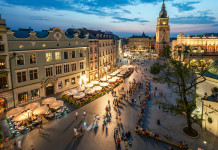
Wrocław’s great Market Square — the Rynek — has for centuries been the centre of the Polish city’s economic life, as well as one of the most beautiful and largest squares in Europe.

The Gothic outline of the Town Hall dominates the square (see point 3), while the Cloth Hall divides it at the centre.
The Rynek, which in Polish means Market Square, is surrounded by beautiful burgher houses, among which the “House of the Seven Electors” and the “House of the Golden Sun” stand out.
Particularly charming is the pair of small buildings in the north-west corner, known to the people of Wrocław as Jaś and Małgosia — Hansel and Gretel.
They are two old medieval buildings, joined by an archway that for many centuries served as the entrance to the cemetery. Note the inscription Mors est ianua vitae, “Death is the gateway to life”.
Next to the Rynek is the small plac Solny, the Salt Square, which for many centuries was the place where salt was sold and which today hosts a flower market, open every day of the year, without interruption.
Wrocław Old Town
2
An endless sequence of red roofs, brick houses and colourful façades makes Wrocław’s historic centre a small architectural jewel.

Looking at it closely, it is hard to believe that it was almost entirely destroyed by the bombings of the Second World War and then patiently reconstructed by its inhabitants with monastic dedication.
The heart of the Old Town is the Rynek, the Market Square (see point 1), a place of passage and encounter for locals and visitors alike.
The Gothic spires of the Town Hall (see point 3) are a reassuring point of reference for first-time visitors, as is the bell tower of the Cathedral of St John the Baptist (see point 6), the city’s most important religious monument.
The Old Town also has less touristy and more hidden corners, such as the romantic Tumski Bridge, also known as the Bridge of Love, both for its charming view over the River Oder and for the old-world atmosphere created by the still-functioning gas lamps.
Do not be surprised: the fashion for padlocks on bridges has reached Wrocław too. The best place from which to admire the Old Town is the bell tower of the Church of St Elizabeth, which stands on one corner of Market Square. Provided, of course, that you can face the 300 steps…
Wrocław Town Hall
3
Wrocław Town Hall — Wrocławski Ratusz — in the Rynek, is a masterpiece of Gothic art in Europe. Made up of three buildings, the complex construction of the Town Hall developed over a period of more than 300 years.

From 1242 onwards, the building served as a covered market, cellar and administrative centre, before becoming the seat of the Council that governed the city.
The turning point came between the 15th and 16th centuries, when Wrocław became a wealthy and powerful city. It was then that the façade and civic tower were built and the interior halls were arranged.
After various vicissitudes linked to wars and changes in the city’s “nationality”, today the Town Hall houses the Muzeum Miejskie Wrocławia, the “Museum of the City of Wrocław”, and is used mainly for cultural events.
Opening hours and ticket prices for the Town Hall
Opening hours: Wednesday to Sunday, 11 am–5 pm.
Ticket price: full price 15 PLN, students and pensioners 10 PLN. Family ticket — up to two adults and up to 5 children — 30 PLN. On Thursdays, admission to the permanent exhibitions is free.
How to get there: the Town Hall is in the historic centre and can be reached on foot.
The Racławice Panorama in Wrocław
4
The Racławice Panorama is one of Wrocław’s most fascinating attractions, even though not every visitor to the Polish city remembers to include it.

Inside an otherwise anonymous circular building is an extraordinary work of art with few equivalents in the world: a diorama, a scaled scenic installation that recreates the battle fought on 4 April 1794 between the Polish army and the Russian Empire near the village of Racławice.
The diorama is extraordinary in scale: 114 metres long and 15 metres high, created with painting, stones, carts, trees and light. It is a 3D setting that gives the viewer the impression of standing at the very centre of the battle.
Opening hours and ticket prices for the Racławice Panorama
Opening hours: Monday to Friday, 9 am–5.30 pm; Saturday and Sunday, 9 am–6.30 pm.
Ticket price: full price 15 PLN, students and pensioners 10 PLN. Free for ages 0–7. The ticket includes admission to the National Museum in Wrocław, the Ethnographic Museum and the Four Domes Pavilion.
How to get there: the Panorama is located at ul. JE Purkyniego 11. It can be reached by car, by tram — lines 2 and 10 — or by bus — lines A and N.
Centennial Hall in Wrocław
5
The building that houses the Centennial Hall is considered one of the finest examples of 20th-century architecture in Europe. It was built between 1911 and 1913 to commemorate the German victory over Napoleon Bonaparte in the Battle of Leipzig.

The hall is the most famous example of Modernism in Poland and has a reinforced-concrete dome, a common material today but extraordinary at the time of its construction, especially as it was then the largest of its kind in the world.
It is no coincidence that the architectural historian Peter Reyner Banham stated that “its reinforced-concrete structure must be considered one of the most perfect applications of this material for its time”.
In 2006 it was added to the UNESCO World Heritage List. Today the Centennial Hall mainly hosts exhibitions, conferences and events. From May to October, do not miss the multimedia fountain, open from 10 am to 10 pm, with shows created using lasers, scanners and fireworks.
Opening hours and ticket prices for Centennial Hall
Opening hours: April to October — Tuesday to Sunday, 10 am–6 pm. November to March — Tuesday to Sunday, 10 am–5 pm.
Ticket price: full price 25 PLN, children and students up to 26 years old and over-65s 20 PLN. Free for ages 0–3. Family ticket for 2 adults and up to 3 children up to 16 years old: 20 PLN per person.
How to get there: the centre is located at ul. Wystawowa 1. It can be reached by car, by buses 115, 145, 146 and 701, and by trams 1, 2, 4, 10 and 16 → Biskupin / Sępolno.
Wrocław Cathedral
6
Wrocław Cathedral is dedicated to St John the Baptist and is one of the finest examples of Gothic architecture in Poland. Built from around the year 1000 onwards, it has undergone additions and alterations over the centuries, but this does nothing to diminish the beauty of this red-brick church, powerful yet elegant.

The exterior features two tall bell towers and two lower towers on either side of the apse, the latter surrounded by three large chapels.
The interior is divided into three long naves with 20 chapels, among which the Gothic Chapel of St Mary and the two Baroque chapels of St Elizabeth and Corpus Christi — also known as the Electoral Chapel — stand out for their beauty.
Opening hours and ticket prices for the Cathedral
Opening hours: the Baroque chapels are currently closed. The terrace is open Monday to Saturday from 10 am to 5 pm and on Sunday from 2 pm to 4 pm. Closed in bad weather.
Ticket price: admission to the Cathedral is free. The ticket for the terrace costs 10 PLN full price, 8 PLN for visitors up to 25 and over 60.
How to get there: the Cathedral is in the centre, on the square of the same name, and can be reached on foot.
Wrocław’s Dwarfs and Passers-by
7
In the 1980s, when Poland was still under the influence of the Soviet Union, the sculptor Tomasz Moczek decided to support the Orange Alternative resistance movement with a very unusual artistic gesture.

He scattered hundreds of graffiti images of mocking gnomes across the walls of Wrocław’s historic centre.
The targets of the mockery were, of course, the powerful figures of the regime.
Communism has ended, but the city administration had the good sense to turn the dwarfs into a tourism marketing initiative: the little figures came down from the walls and became metal sculptures, scattered across the city in the most unexpected places and poses.
At the junction of Świdnicka and Piłsudskiego streets stands another extraordinary and much-photographed Wrocław monument: the bronze statues by the artist Jerzy Kalina, dedicated to the memory of those who disappeared during the period of martial law in force in Poland from 1981 to 1983.
The 14 statues, seven on each side of the street, seem to sink into the pavement, reminding citizens of all the ordinary people imprisoned by the Communist regime.
Cathedral Island in Wrocław
8
Ostrów Tumski, or Cathedral Island, an ancient island on the Oder now joined to the mainland, is the oldest, most picturesque and most peaceful part of Wrocław.

It was here, between the 9th and 10th centuries, that the first Slavic settlers built their stronghold, giving rise to the city’s earliest settlement. With the construction of the Cathedral around the year 1000, Ostrów Tumski became the centre of Wrocław’s religious life.
After the city’s core shifted to the other bank of the Oder, the island came under ecclesiastical jurisdiction, becoming a place of exclusively religious importance, as shown by the presence of beautiful sacred buildings such as the Cathedral of St John the Baptist and the Collegiate Church of the Holy Cross.
In addition to its churches, Ostrów Tumski preserves the look and charm of a medieval village, with its enchanted atmosphere and cobbled streets such as ulica Katedralna and ulica Idziego. If you want to enjoy the magic of this place to the full, we recommend an evening walk along ulica Idziego, lit by the glow of the gas lamps.
Unlike other cities where gas lighting is activated electrically, Wrocław still preserves the old craft of the lamplighter, who at dusk still lights each of the island’s lamps one by one, just as was done in the past.
What to Eat in Wrocław
9
Wrocław’s tables are rich in simple, hearty ingredients: meat, soups, dumplings and potatoes, the latter cooked in many different ways — boiled, fried, baked or mashed.

Typical dishes include żurek, a soup made with beef or chicken stock, onions, mushrooms, bacon, sour cream and rye flour, often served with sausage or hard-boiled eggs; and chłodnik, a cold beetroot soup with chives and sour cream, notable for its unusual pink colour.
Very common are pierogi, a kind of dumpling made from pasta dough, fried, boiled or baked, and filled with various ingredients such as mushrooms, meat, cheese, potatoes, ricotta or sauerkraut.
Other popular dishes include bigos, the famous stew of meat, cabbage, sauerkraut, prunes and spices, and kotlet schabowy, breaded pork cutlets.
Among desserts, pierniki deserve a mention: delicious biscuits made with honey and spices, glazed or covered in chocolate. The most widespread drink is beer, produced according to the old Silesian tradition and usually served at room temperature.
Where to Stay in Wrocław
10Wrocław has an excellent range of hotels, hostels and apartments at relatively accessible prices.

With the city’s growing success as a tourist destination, prices are rising somewhat, but they remain affordable. For a double room in the historic centre in a 3-star hotel, prices range from 40 to 80 euros per night.
The full range of Wrocław hotels is available on Booking.com. Around 170 hotels with photos, facilities, prices and reviews from guests who have already stayed there. Go to Booking.com