It is impossible to think of Verona without seeing it as the tragic setting for the love story of Romeo and Juliet. Shakespeare’s drama has certainly helped shape the fortunes of this city in Veneto: a significant part of Verona’s economy is built around this “romantic tourism”, which finds its natural conclusion beneath Juliet’s famous balcony.
And yet, identifying Verona solely as the city of Romeo and Juliet has overshadowed many of its other beauties. It is no coincidence that the city has been called the “Gateway to Italy”, because for those arriving from the north it offers an early glimpse of the face, beauty and essence of our country.
A concentration of artistic, historical and cultural treasures, immersed in the evocative atmosphere of narrow streets and squares, and completed by the flavours of traditional local cuisine.
If you enjoy looking beyond the famous little balcony, we suggest an itinerary through Verona’s best-known sights, typical flavours and enjoyable experiences, allowing yourself to be seduced by a city whose charm will make you want to return.
To visit Verona, we recommend buying the VeronaCard, available in two versions: €20, valid for 24 hours, and €25, valid for 48 hours.
With the VeronaCard, you get free entry to the following places: Castelvecchio Museum, the G. B. Cavalcaselle Fresco Museum at Juliet’s Tomb, the Achille Forti Gallery of Modern Art, Juliet’s House, the Natural History Museum, the Arena Amphitheatre and the Archaeological Museum at the Roman Theatre.
Here, then, is what to see in Verona during a weekend or a short break.
If you are looking for a hotel in Verona, we recommend choosing from those available on Booking.com. There are around 127 hotels with prices, photos and reviews from previous guests. Go to Booking.com.
**The Arena of Verona**
1
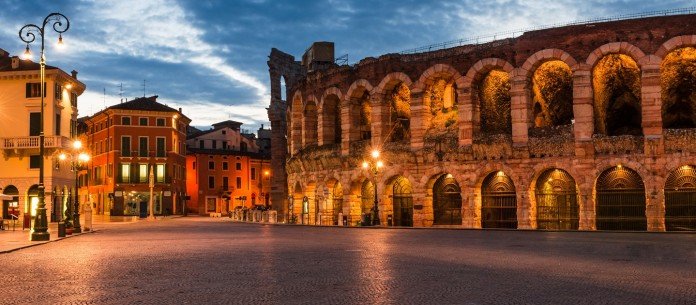
The Roman Amphitheatre, better known as the “Arena”, is, together with Romeo and Juliet, the symbol that has made Verona famous throughout the world and the first sight tourists choose to visit as soon as they arrive in the city.

Probably built around the 1st century AD, the Arena, like all amphitheatres, hosted gladiatorial games.
It was the fourth largest amphitheatre after the Colosseum in Rome, the one in Capua and the one in Milan. Its solid, imposing structure has an exterior faced with brick and Verona stone, creating a striking chromatic effect.
Inside the Arena of Verona
Inside, the concentric sweep of the tiers gives spectators a remarkable sense of grandeur.
Its name comes from the “rena”, the sand that covered the central area where the shows took place. It could hold up to 30,000 spectators, leaving ample space for those performing. A magnificent stage for major musical productions, the Arena continues to preserve its thousand-year-old function, although today with far less bloody performances!
Opening times and tickets for the Arena of Verona
Opening times: Tuesday to Sunday, from 9 am to 7 pm, last admission at 6.30 pm.
Closed on Mondays
Ticket price: €10. Free with the Verona Card.
How to get there: Piazza Bra, right in the historic centre.
Romeo and Juliet’s House in Verona
2
Verona is the stage on which the tragic love story of Romeo and Juliet unfolded, made immortal by the pen of William Shakespeare. In a 13th-century building in the historic centre,
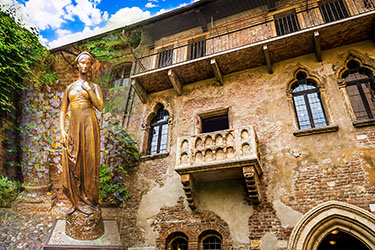
the people of Verona have recognised the house of the Capulets: here, legend and reality become intertwined, finding tangible points of reference.
A beautiful brick-clad façade with a Gothic-style portal leads visitors inside. In the courtyard stands a bronze statue of Juliet, together with the celebrated balcony where the love between the two young protagonists is said to have blossomed.
Juliet’s famous balcony
Visitors can see the courtyard, the ground floor, the first floor with Juliet’s balcony, and the second floor, where the bed created for Zeffirelli’s film Romeo and Juliet is on display.
Juliet’s House is an essential stop, albeit a very tourist-oriented one, for anyone wishing to discover the places that inspired the most famous love story of all. Whether or not you believe the legend, it remains one of the absolute must-see sights in Verona.
Romeo’s House
Romeo’s House has had less fortune. Today it is a private residence, a short distance from the Scaliger Tombs, point 8.
On the Gothic façade, an inscription reads: “Oh! Where is Romeo?… Hush, I have lost myself: I am not here, and I am not Romeo; Romeo is elsewhere” (Act 1, Scene 1).
Juliet’s Tomb
Juliet’s Tomb is located in an old 13th-century Capuchin convent in Via del Pontiere, 35. It can be visited from Tuesday to Sunday, 8.30 am-7.30 pm, and on Monday, 1.30 pm-7.30 pm. Full ticket: €4.50.
Opening times and ticket price for Romeo and Juliet’s House
Opening times: Tuesday to Sunday, from 9 am to 7 pm
(last admission at 6.30 pm)
Tuesday to Sunday, from 9 am to 7 pm
(last admission at 6.30 pm)
closed on Mondays
Ticket price: €6. Free with the Verona Card.
How to get there: Via Cappello 23, right in the historic centre.
The Basilica of San Zeno Maggiore in Verona
3
Legend has it that during the flooding of the Adige in 589, which submerged Verona, the water stopped at the threshold of this church, built on the burial place of Bishop Zeno. Saint Zeno, of African origin, was the eighth bishop of Verona, around 362-380, and converted the city to Christianity.
The Basilica of San Zeno Maggiore is one of the finest examples of Romanesque architecture in Italy, and its present appearance appears to date back to the 12th century.
The San Zeno Altarpiece
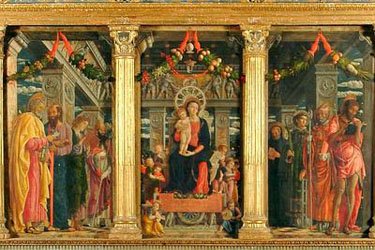
As well as preserving the body of the saint, the church is rich in sculptures and paintings dating from the 12th to the 16th century. Among these, particular attention should be given to the San Zeno Altarpiece by Andrea Mantegna, the first example of a “sacra conversazione”, with the Madonna and Child at its centre.
From the left, you can recognise Saint Peter with the keys, Saint Paul with the sword, Saint John the Evangelist in a pinkish robe, Saint Zeno in episcopal vestments, Saint Benedict in a monk’s habit, Saint Lawrence with the gridiron, Saint Gregory the Great dressed as pope and Saint John the Baptist in the typical clothing of a desert hermit.
You can tell it is a conversation because the direction and gestures of the figures give the impression that the saints are speaking to one another.
Opening times and tickets for the Basilica of San Zeno in Verona
Opening times
Monday to Friday from 10 am to 1 pm and from 2.30 pm to 6 pm.
Saturday from 10 am to 6 pm.
Sunday from 1 pm to 6 pm.
Ticket price: Free, but a voluntary contribution of €3 is requested.
How to get there: Piazza San Zeno, historic centre.
Piazza delle Erbe in Verona
4
A colourful fruit and vegetable market, with its rows of parasols and surrounded by historic buildings and monuments, is the defining feature of Piazza delle Erbe: Verona’s oldest square, where medieval buildings gradually took the place of Roman ones.
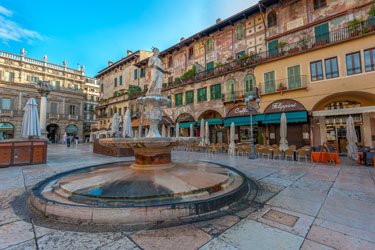
It is the place where you can best grasp the city’s most popular and lively side, without sacrificing the cultural dimension of your visit.
During the market, on Saturdays and Sundays, it becomes the city’s drawing room, where the people of Verona meet to do their shopping or to enjoy the evening aperitivo ritual.
The buildings of Piazza delle Erbe
Overlooking the square are the Palazzo del Comune, the Torre dei Lamberti, the Casa dei Giudici and the Mazzanti Houses. On the shorter side stands the Baroque Palazzo Maffei, embellished with several statues of Greek gods: Jupiter, Hercules, Minerva, Venus, Mercury and Apollo.
The Casa dei Mercanti
The Casa dei Mercanti, or Domus Mercatorum, is particularly beautiful and today houses the Banca Popolare di Verona. In the square stands the fountain known as “Madonna Verona”, which competes for attention with the Capitello, also known as the Tribuna and mistakenly called the Berlina.
It already existed in the 13th century, when the podestà would sit beneath it for the inauguration ceremony, as did the praetors before taking office.
Palazzo Maffei in Verona
5
Palazzo Maffei stands in Piazza Erbe, just two hundred metres from Juliet’s House. The building, restored to an exemplary standard, is worth a visit in its own right. Dating back to the 17th century, it is one of the most theatrical buildings in Verona. The collection is exceptional for both the variety and beauty of the works on display. It is absolutely not to be missed and should be included among the things to see when visiting Verona.
The Palazzo Maffei House Museum hosts more than 350 works, collected over more than 50 years by the collector and patron Luigi Carlon. The itinerary ranges from ancient to contemporary art, from paintings to sculptures and period furniture.
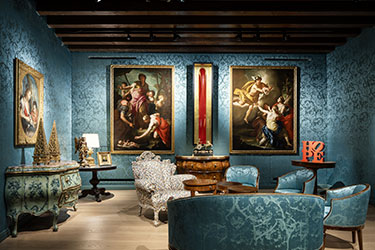
Particularly interesting is the section dedicated to masterpieces of 20th-century painting. Among the artists featured are Giacomo Balla, Lucio Fontana, De Chirico, Burri and Morandi. There are also works by Magritte, Duchamp and Picasso. One section is devoted to decorative arts: furniture, glass and ceramics, and oriental vases.
Guided tours are available by reservation, organised in groups of 15 people at a time. This is an option we recommend for those with limited time, as it allows visitors to explore the focus of the collection in greater depth without missing its highlights.
If, instead, you decide to visit the palace independently, we suggest allowing at least a couple of hours in order to gain a sufficiently broad overview of the museum itinerary. For a small supplement, it is worth going up to the panoramic terrace of Palazzo Maffei to admire Piazza Erbe and Verona from a truly remarkable viewpoint.
Opening days, opening times and ticket prices for Palazzo Maffei
Opening times: Monday, Thursday, Friday, Saturday and Sunday from 10 am to 6 pm.
Closed: Tuesday and Wednesday, 25 December and 15 August.
Ticket price: full ticket €14, or €15 with access to the terrace. Tickets can be purchased online or on site at the ticket office.
Reduced tickets: over 65s: €13; young people aged 11 to 26: €6; children aged 6 to 10: €3.50.
How to get there: on foot, in Piazza delle Erbe.
Bus: lines 11-12-13 or lines 21-22-23-24-41-42
The Bridges of Verona
6
The River Adige crosses Verona and divides it in two, so bridges have always played an essential role in the life of the city. Today there are seven of them, all sharing the same fate: they were destroyed by the retreating Nazis and then rebuilt in the years that followed.
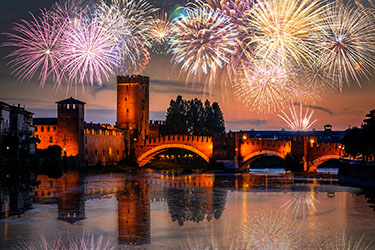
The oldest of all is the Ponte di Pietra, dating back to Roman times, which still connects the Roman Theatre with the city centre today.
Fortunately, the stone blocks and bricks hurled into the riverbed by the explosion were recovered and used to rebuild the bridge in a way that remained very faithful to the original.
The other symbolic bridge is the Scaliger Bridge, right opposite Castelvecchio. Built in the second half of the 14th century with three unequal arches, it suffered the same fate as the Ponte di Pietra and, like it, was rebuilt in 1951 using the original stones and bricks recovered from the bed of the Adige.
Piazza dei Signori and the Scaliger Tombs in Verona
7
Verona’s administrative power has always been centred on this beautiful square, surrounded by monumental buildings linked by porticoes and arches.
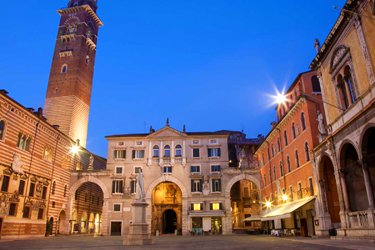
At the centre of the square, the eye is immediately drawn to the large statue of Dante, who found refuge in Verona shortly after his exile from Florence.
You enter the square through the Arco della Costa, and immediately to the left stands the façade of the Domus Nova. Continuing clockwise, you come to the Loggia del Consiglio and the Palazzo degli Scaligeri, the lords of Verona from 1260 to 1387.
Next comes the Palazzo del Capitanio, with its corner tower dominating the square, linked by an arch to the Palazzo della Ragione. Passing through the arch, you reach the courtyard of the Mercato Vecchio, with the splendid Scala della Ragione. From the Torre dei Lamberti, there are wonderful views over the square and the rooftops of Verona.
Almost set apart in a small square of its own is the Church of Santa Maria Antica, in whose courtyard stand the Scaliger Tombs. This evocative funerary complex is an extraordinary example of Gothic architecture in Italy.
The tombs were built to house the remains of several members of the della Scala family. Particularly striking for their monumentality and decoration are those of Cangrande I, Mastino II and Cansignorio.
Piazza Bra in Verona
8Piazza Bra is one of the largest squares in Europe, dominated by the outline of the Arena and enhanced by several historic buildings. The square takes its name from the German word breit, meaning broad.
The liston, where the people of Verona love to stroll

In Piazza Bra you will find the liston, the paving in pink Valpolicella marble, the same stone used to build the Roman Amphitheatre. Along the liston, the people of Verona love to meet, stroll and chat before taking a seat at the bar tables for a coffee or an aperitivo.
It is a long-standing tradition: even Goethe, in his Italian Journey, wrote that “..a multitude of people walked along the broad paving of the Bra’”. As well as the Arena, the square is overlooked by the Palazzo della Gran Guardia, a venue for exhibitions and events, and Palazzo Barbieri, home to the City Hall of Verona.
**Castelvecchio in Verona**
9
Cangrande II della Scala had Castelvecchio built to secure a stronghold against external threats that might come from across the bridge, but also against possible uprisings by the people of Verona following internal संघर्षs within the Scaliger family.
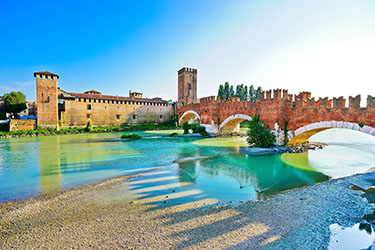
The Scaliger Bridge, to which it is connected, projected the castle beyond the river, providing an escape route into the countryside. Like the bridge, the castle too has had a chequered history.
After the fall of the Scaligeri, it was used by the Venetians as an armoury, before becoming a barracks under both French and Austrian rule. The restoration of 1926 removed the military additions and introduced Late Gothic and Renaissance features.
Castelvecchio has two sections: in the right-hand one are the main courtyard and the parade ground; in the left-hand one is the Scaliger residence, where the lords lived, with a narrower courtyard and a double curtain wall.
At the centre rises the tall Mastio Tower, from which you can access the Scaliger Bridge over the Adige. Today it houses a museum with works of medieval, Renaissance and modern art.
The museum is not especially large, but it contains at least 20 masterpieces, including Mantegna’s Holy Family, Caroto’s Boy with a Drawing, Rubens’ Portrait of a Lady, the Madonna of the Quails attributed to Pisanello, Bellini’s St Jerome in Penitence, and many others.
Opening times and tickets for Castelvecchio and its museum
Museum opening times: Tuesday to Sunday, from 10 am to 6 pm
(last admission at 5.30 pm)
Closed: Monday
Ticket price: €6
How to get there: On foot, in the historic centre.
Veronetta
10
In 1801, with the arrival of the French in the city, Verona was divided in two: on the left bank of the Adige were the Austrians, while Napoleon’s troops occupied the right bank. It seems that Bonaparte himself gave this part of Verona the rather disparaging name “Veronette”, meaning lower Verona. For centuries, this district of Verona lived from mills, tanneries, spinning mills and other water-related activities.

After more than a century of decline, Veronetta began to revive from the 1970s onwards, and today it is a characterful Veronese neighbourhood, a part of what might be called “old Verona”.
Craft workshops, artists and restaurants make it a lively district, offering an alternative to the more tourist-focused shopping streets on the right bank.
The Roman Theatre of Verona
There is no shortage of monuments and places to see as you make your way up San Pietro Hill and the views become increasingly beautiful. First of all, there are the remains of the splendid Roman Theatre, built in the 1st century BC, even before the better-known Arena. Every summer, the theatre hosts festivals and performances not to be missed.
The Roman Theatre is also home to the Archaeological Museum, which houses precious finds from ancient Roman times as well as interesting temporary themed exhibitions.
Castel San Pietro
Above the Roman Theatre stands Castel San Pietro, a fortress that can be reached either on foot by a pleasant walk or by funicular, after which you can enjoy a coffee on the terrace. The jewel of Veronetta is Giardino Giusti, with its noble palace: a wonderful Italian-style garden that has fascinated travellers from all over Europe for centuries.
**Around Verona**
11
The itinerary suggested on this page is enough to spend three days in Verona, visiting the city at a relaxed pace and truly appreciating it. But if you still have some time left, the area around Verona offers the chance to discover villages, history and nature.
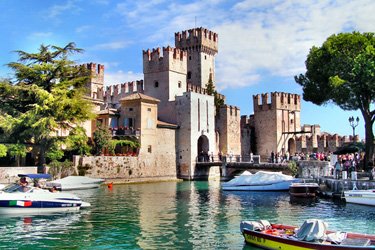
The first thought immediately goes to Lake Garda, not only on the Veronese shore but also on the Brescia and Trentino sides.
It is an itinerary that allows you, within just a few kilometres, to move from the thermal waters of Sirmione to surfing in Torbole, from the elegant atmosphere of Riva del Garda to mountain excursions.
Less than an hour by car from Verona is Mantua, with two villages not to be missed: Castellaro Lagusello and Borghetto sul Mincio. In the same area, a visit to Parco Sigurtà, one of the most beautiful gardens in the world, is also highly recommended.
Also about an hour away are two of Veneto’s finest cities of art: Vicenza and Padua, without forgetting that, with a little more travelling, you can reach Venice!
**What to eat in Verona**
12
Verona has a centuries-old culinary tradition, rooted in the kitchens of the local ruling families and continued today by its restaurants and trattorias. It is not only about rice and polenta, but also about specialities that are little known beyond the local area and absolutely worth trying:
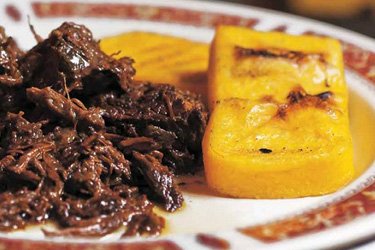
“pearà”, for example, is boiled beef served with a peppery bread and cheese sauce; “pastisada de caval” is a horse-meat stew traditionally served with local gnocchi; while “paparele” are tagliatelle with peas and beans.
Also worth trying is Renga de Parona di Verona, made with anchovies.
Verona’s desserts
Among the desserts are Pandoro, known all over the world, the nadalìn, shaped like an eight-pointed star, and the mandorlato from Cologna Veneta.
Veneto wines
It should not be forgotten that Verona is also Italy’s leading province for the production of D.O.C. wines, so make sure you enjoy a pleasant Bardolino or a full-bodied Valpolicella with your meal.
Hotel in Verona
H
Charming and romantic, Verona is the second most visited destination in Veneto for both Italian and international tourism.

The city, its province and Lake Garda welcome large numbers of tourists every year. Verona meets this demand with a wide range of hotels and bed & breakfasts, as well as comfortable, and certainly less expensive, youth hostels and agriturismi.
Prices are generally quite high, and it can be difficult to find a reasonably priced room in spring, especially during long weekends, the Christmas holidays and musical events at the Arena.
The advice is to book well in advance during these periods. Prices for a 3-star hotel in the centre start from €70, but can rise considerably for more luxurious properties or accommodation in the most monumental areas.
If you are looking for a hotel in Verona, we recommend choosing from those available on Booking.com. There are around 127 hotels with prices, photos and reviews from previous guests. Go to Booking.com