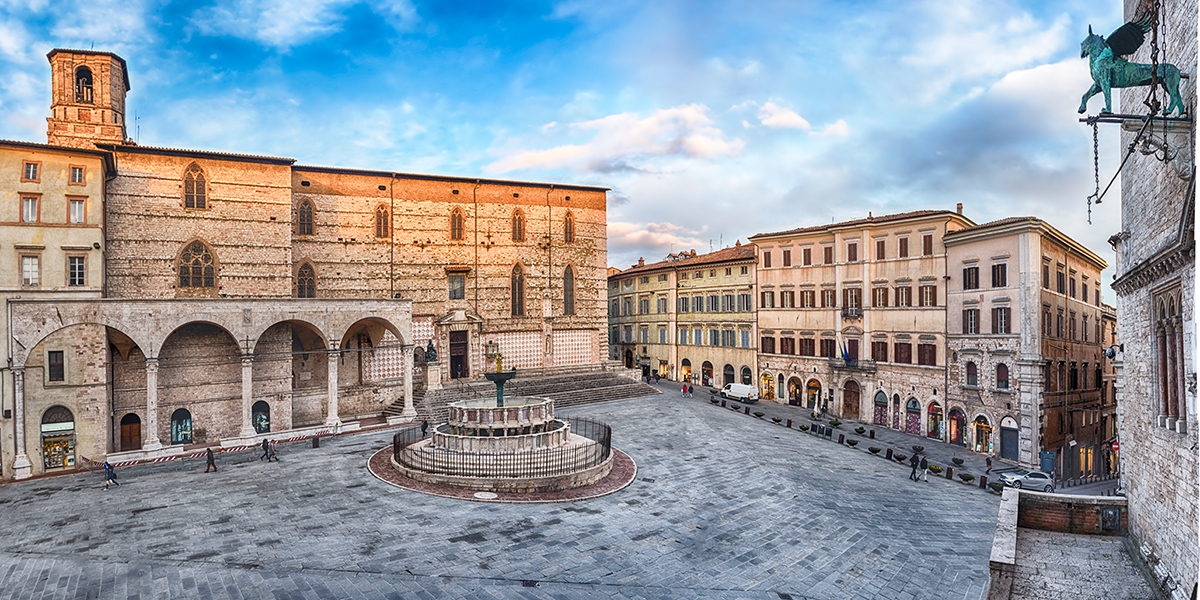
Perugia is a small jewel that slowly reveals itself before visitors’ eyes. This Umbrian town preserves artistic and monumental treasures that testify to its rich past and do justice to our country’s cultural excellence.
Although it retains the appearance and pace of life of a small fortified medieval town, Perugia has a very lively city life, linked above all to the presence of one of the oldest universities on the Italian Peninsula — founded in 1308 — as well as Italy’s most important University for Foreigners.
It is therefore not a museum city, full of tourists by day and empty by night, but a place that deserves more than a quick visit dedicated only to its most important monuments.
From the National Gallery to the Etruscan Well, from the Oratory of San Bernardino to Corso Vannucci, below we suggest the 10 things you absolutely must do and see during a visit to Perugia. The rest is a surprise you will discover for yourself.
If you are looking for a hotel, we recommend choosing from those offered by Booking.com. There are 130 hotels with prices, photos and reviews from previous guests. Go to Booking.com.
The Fontana Maggiore in Perugia
1
At the centre of Piazza IV Novembre stands this splendid fountain, one of the most famous in Italy and a symbol of medieval Perugia.
The Fontana Maggiore was built between 1275 and 1278, based on a design by Nicola and Giovanni Pisano, to receive the waters coming from the Monte Pacciano Aqueduct. The two artists designed the Fountain on a circular staircase, made up of two basins in pink and white stone, topped by a bronze bowl.
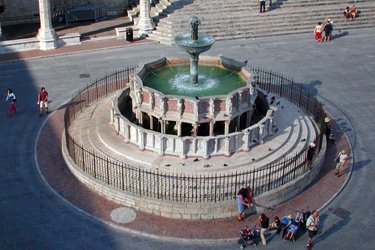
From here emerge three nymphs holding an amphora from which water flows.
The upper basin rests on small columns from which rise statues depicting figures connected to the mythical foundation of the city; the lower basin, on the other hand, is decorated with fifty panels depicting the calendar of agricultural work, several biblical, historical and mythological episodes, the two symbols of the city — the griffin — of the Guelph party — the lion — and of the empire — the eagle.
The series ends with the seven liberal arts and philosophy. Particularly unusual is the presence, among the panels, of two scenes taken from Aesop’s fables — the crane and the wolf, and the wolf and the lamb. After the most recent restoration, today it is possible to admire the work in all its original splendour.
The Aqueduct of Perugia
2
The Fontana Maggiore in Perugia was once fed by the aqueduct, which drew water from Monte Pacciano.
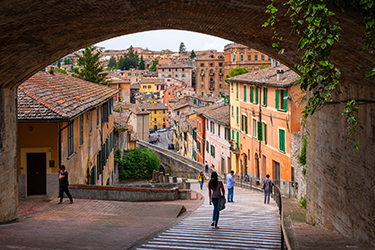
Built in 1245, it was an extraordinary work because, without using pumps, it managed to bring water to a steep city full of differences in level such as Perugia.
Decommissioned in the mid-1800s because it was too expensive to maintain, today the aqueduct offers one of the most beautiful walks in Italy. Its upper section is covered with steps and protected by parapets, making it a road in every sense.
The most characteristic section is the one that starts from Porta Sant’Angelo — near the Cathedral and the Fontana Maggiore — with a bridge supported by around ten bays with large arches and low, colourful houses. Truly unmissable.
If you have time, you could also visit what remains of the aqueduct in the Monte Pacciano area, with its characteristic “conservoni”, cisterns used to store water.
The Cathedral of San Lorenzo in Perugia
3
Work on the construction of the Cathedral dedicated to San Lorenzo, one of the city’s patron saints, began in 1345 and was completed in 1490. Both the side wall and the main façade, however, remained unfinished.
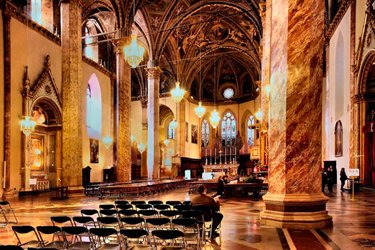
The side wall overlooks the Fontana Maggiore, and a geometric pattern of pink and white marble diamonds decorates only its lower section.
The façade and interior of the Duomo
The main façade, instead, faces Piazza Danti and features a Baroque portal from 1729. The interior, in a late Gothic style, has three naves of equal height, divided by imposing pillars.
The decorations were completed in the 18th century and, among them, the highlights include The Deposition by Federico Barocci, the 16th-century polychrome stained-glass window by Arrigo Fiammingo, and the Funeral Monument in honour of Bishop Andrea Baglioni, created by Urbano da Cortona.
The Chapel of the Holy Ring
For centuries, the Cathedral of Perugia has been a place of pilgrimage because the Chapel of the Holy Ring preserves the ring said to have belonged to the Virgin Mary.
It is a green stone made of chalcedony or onyx, stolen from the people of Chiusi by the German friar Winter of Mainz and donated to the bishop of Perugia in 1473. The ring is protected by the Reliquary of the Holy Ring, a masterpiece of Italian Renaissance goldsmithing.
Unfortunately, the reliquary is opened only twice a year — in July and September — when it is possible to admire the ring. Do not miss the cycle of paintings by Pandolfi — 1573–76 — in the Sacristy, an example of Baroque illusionistic painting.
The cloister of Perugia Cathedral
In the Cathedral cloister, the Capitular Museum is unmissable. In its 25 rooms, it houses works from the cathedral itself and from churches in the diocese. It is a rich collection of goldsmith works, liturgical vestments, illuminated manuscripts and, above all, paintings and sculptures from the 11th to the 19th century, including works by Arnolfo di Cambio, Meo da Siena, Agostino di Duccio and the Altarpiece of Sant’Onofrio, the only work by Luca Signorelli in Perugia.
From the Museum, visitors can also access the archaeological area of the Cathedral, where the different layers of the Etruscan, Roman, late antique and medieval city can be seen, including a richly decorated Roman house and an Etruscan-Roman road.
Opening hours and ticket price for Perugia Cathedral
Cathedral opening hours: weekdays 7:30 a.m.–12:30 p.m., 3:30 p.m.–6:45 p.m.; holidays: 8 a.m.–1 p.m., 4 p.m.–7:30 p.m.
Cathedral ticket price: free
Museum and Archaeological Area opening hours: from 1 November to 31 March: Tuesday to Friday 9:30 a.m.–1:30 p.m. | Saturday and Sunday 10 a.m.–5 p.m. From 1 April to 14 July and from 16 September to 31 October: Monday 10 a.m.–1:30 p.m. | Tuesday to Sunday 10 a.m.–1:30 p.m. / 2:30 p.m.–6 p.m. From 15 July to 15 September: Monday to Sunday 10 a.m.–1:30 p.m. / 2:30 p.m.–6 p.m. Closed: 25 December | the morning of 1 January.
Museum ticket price €6, Archaeological Area: €10 How to get there: right in the centre, on foot.
Underground Perugia
4
Below the cloister of the Cathedral of San Lorenzo, visitors can access Underground Perugia, namely the acropolis of Etruscan and Roman Perugia. For thousands of years, in fact, this place has always hosted the city space dedicated to the divinity.

Where the Duomo stands today, the Etruscans created a temple as early as around the 6th century BC. Directly beneath the altar, the walls of this temple are visible, as are those of another Etruscan temple from the 2nd century BC.
From the same period is the wall built by the Etruscans to support the acropolis and protect it from landslides.
Above these ancient layers, visitors can see the foundation wall of the medieval Cathedral, built around 1200.
The Roman road and the Domus
The Roman road is extraordinary, perfectly preserved, with the marks left by cart wheels still visible. Of a Roman-era domus, the internal courtyard — impluvium — and the floor of one of the rooms remain. The signs of the fire that destroyed Perugia in 40 BC are still visible: the first act of Roman Perugia and the last act of Etruscan Perugia.
Opening hours and ticket price for Underground Perugia
Cathedral opening hours:
From 1 April to 31 October and from 26 December to 6 January Weekdays: 10:30 a.m.–12:30 p.m. and 2:30 p.m.–5:30 p.m., with departures every 60 minutes — 10:30, 11:30, 12:30, 14:30, 15:30, 16:30, 17:30. Saturday, Sunday and holidays: 10:30 a.m.–12:30 p.m. and 2 p.m.–5:30 p.m., with departures every 30 minutes.
From 1 November to 31 March, excluding the period from 26 December to 6 January Weekdays: 10:30 a.m.–12:30 p.m., with departures every 60 minutes — 10:30, 11:30, 12:30. Saturday, Sunday and holidays: visit times are 10:30 a.m.–12:30 p.m. and 2:30 p.m.–5:30 p.m., with departures every 60 minutes.
The visit lasts about 50 minutes.
Booking is not compulsory but is recommended and can be made by email at [isolasanlorenzo@genesiagency.it](mailto:isolasanlorenzo@genesiagency.it), by phone at 0755724853, or by purchasing tickets directly online on the website [www.secretumbria.it](http://www.secretumbria.it).
Cathedral ticket price: full price €10; children aged 6 to 17 pay €5, and children aged 0 to 5 enter free. How to get there: right in the centre, on foot.
The National Gallery of Umbria in Perugia
5
Along Corso Vannucci, on the upper floors of Palazzo dei Priori, the National Gallery of Umbria has been located since 1878. The Gallery houses one of the most complete and richest artistic collections in the entire region.
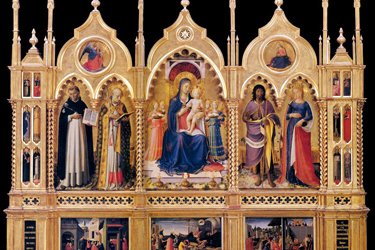
The works cover a period ranging from the 13th to the 19th century and are arranged according to a comprehensive chronological route: the third floor contains works from the 13th to the 15th century, while the second floor houses those from the 16th to the 19th century.
Unlike other major Italian and foreign museums, in the National Gallery of Umbria the masterpieces are gathered in a small space, so they follow one another continuously and can also be seen during a short visit.
In a single glance, visitors can admire the Madonnas and polyptychs of 15th-century Florentine and Sienese painting, alongside masterpieces of the Renaissance and unique pieces of Umbrian goldsmithing.
The masterpieces of Piero della Francesca, Pinturicchio and Perugino
Among them all, masterpieces by Duccio di Buoninsegna, Piero della Francesca, Fra Angelico, Pinturicchio and Perugino stand out. In addition, monographic collections dedicated to goldsmithing, ancient drawing, topography and Umbrian textiles enrich the collection.
Opening hours and ticket price for the National Gallery
Opening hours: 4 November – 17 March: Tue–Sun: 8:30 a.m.–7:30 p.m.
Closed: Monday, 25 December and 1 January
18 March – 3 November: Monday: 12 p.m.–7:30 p.m., Tue–Sun: 8:30 a.m.–7:30 p.m. Last admission: 6:30 p.m.
Free admission every first Sunday of the month, on 25 April and on 20 June
Ticket price: €8, reduced €2 How to get there: right in the centre, on foot.
Rocca Paolina in Perugia
6
Celebrated in a famous poem by Giosuè Carducci, Rocca Paolina is an ancient fortress commissioned by Pope Paul III and built by Antonio da Sangallo the Younger.
The Pope’s intention, still marked by the memory of the Sack of Rome, was to make the city safe and create an efficient refuge, just as Castel Sant’Angelo had been.
Its construction required the destruction of more than one hundred houses, as well as monasteries and churches, especially those belonging to the Baglioni family, deeply hated by the Pope.
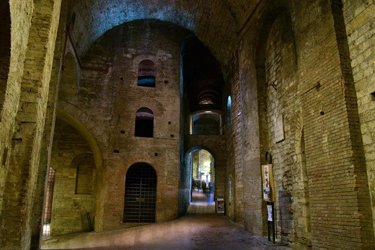
The Rocca was a symbol of papal authority until 1860, the year in which it was demolished after Perugia’s annexation to the Kingdom of Italy. Of that ancient construction, a section of the supporting walls and the bastion incorporating Porta Marzia are still visible.
The underground areas and escalators of Perugia
The most evocative part to visit of what remains of Rocca Paolina is its underground area, in particular the escalators that, from the Piazza Partigiani car park, cross the Rocca beneath the side portico of the Palazzo del Governo — 1870, seat of the Province — and arrive in Piazza Italia.
In this truly unique and atmospheric setting, a kind of city within the city, there are shops, boutiques and bookshops, and cultural events are often organised here. Along the route stands one of the most imposing works by Alberto Burri, “Il Grande Nero”, a kinetic sculptural machine donated by the artist and exhibited since 1984.
Opening hours and ticket price for Rocca Paolina
Opening hours: Porta Marzia, Via Bagliona, open from 7 a.m. to 8 p.m.
Escalators from 6:15 a.m. to 2 a.m.
Ticket price: free How to get there: at the end of Corso Vannucci, right in the centre.
The Oratory of San Bernardino in Perugia
7
The Oratory was commissioned by the Franciscan friars in honour of San Bernardino of Siena, whose preaching had stirred the people of Perugia on several occasions.
The splendid polychrome façade is the work of Agostino di Duccio, who, using different materials, managed to create a true symphony of colours that explodes in a fascinating play of reflections.
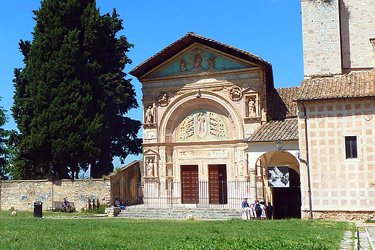
In a fine embroidery of stones and marbles, Agostino di Duccio succeeded in glorifying Bernardino and narrating his miracles. Agostino’s work is the most distinguished Renaissance monument in Perugia.
There is also the Oratory of Sant’Andrea
A double portal leads visitors into the Gothic-style interior, whose altar consists of a paleochristian sarcophagus from the 4th century containing the remains of Blessed Giles, companion of Saint Francis. Behind the altar, another portal leads into the Oratory of Sant’Andrea, with a coffered ceiling and paintings from the 18th and 19th centuries.
Opening hours and ticket price for the Oratory of San Bernardino
Opening hours: 8 a.m.–12:30 p.m., 3:30 p.m.–5:30 p.m. The Oratory of Sant’Andrea is open only from the Easter holidays to November.
Ticket price: free How to get there: Piazza San Francesco al Prato. On foot in the historic centre.
The Etruscan Well in Perugia
8
Once belonging to the Corbello family, the Etruscan Well is a great hydraulic work that testifies to the technical knowledge and level of civilisation reached by the people of Perugia as early as 300 years before Christ.
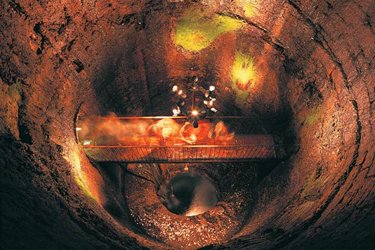
Its construction seems to date back to the 4th or 3rd century BC, but although the date is uncertain, there is no doubt about its dimensions: 37 metres deep and more than 5 metres in diameter.
An immense construction that once served as a water reservoir: the waters of three aquifers in Perugia flowed into it.
Visiting the well by descending into the depths of Perugia
Today the Well can be visited thanks to a system of stairs that allow visitors to descend to its deepest point. The bottom is partly covered with travertine blocks, which were also used for the covering. If you are in Piazza Danti, just a short walk from the Fontana Maggiore, do not miss the opportunity to admire this exceptional work of hydraulic engineering too.
The entrance to the Well is through the remains of a medieval tower. With the combined ticket, visitors can also visit Palazzo Sorbello, which belonged to various Perugian families and was acquired in 1780 by the Bourbon di Sorbello marquises. In the entrance hall there is an important example of wooden flooring, unique in Umbria and very rare in Italy.
The frescoed rooms of the palace preserve furnishings and Murano chandeliers, books, paintings, porcelain and textiles. On the ground floor there is a large hall with a frescoed vault and a panoramic terrace overlooking the city and the surrounding hills.
Opening hours and ticket price for the Etruscan Well
Opening hours: Monday to Sunday 10 a.m.–1:30 p.m.
Closed: 25 December and the morning of 1 January.
Ticket price: well only €3. Combined ticket for the Etruscan Well and the Palazzo Sorbello House Museum: €6 How to get there: right in the centre, on foot.
Perugina’s House of Chocolate
9
Not many people associate the famous Baci Perugina® with the Umbrian city from which they take their name. Originally known as “cazzotti”, they have become a world-famous icon.

The Perugina® factory is located just outside the historic centre and can be visited to discover the history of the company and, above all, to observe the production of Baci and other chocolate products.
The museum, the Buitoni archive and the record-breaking Bacio
The visit route is divided into three parts: it begins with the Perugina® Historical Museum and continues in the museum gallery, rich in materials from the Buitoni Perugina Historical Archive: images, wrappers, packaging and videos, including advertising Caroselli.
Of course, a special space is dedicated to the history of the legendary Perugina, including the record-breaking Bacio housed in the Museum.
A tasting of Perugina products, taken directly from the production line, is a must. Finally, visitors can watch production thanks to an elevated walkway. And at the end, they can take home a few delicious calories thanks to the Perugina shop!
At the end of the visit, visitors can access the Perugina Shop, with its wide range of products.
Opening hours and ticket price for the House of Chocolate
Opening hours: Monday to Friday: 9 a.m. / 1 p.m. – 2 p.m. / 5:30 p.m. Saturday 10 a.m.–4 p.m.
Ticket price: €10, reduced €8 How to get there: The House of Chocolate is located 5 km from Perugia railway station, in the San Sisto area. Bus: line A.
The Hypogeum of the Volumni in Perugia
10
Not everyone includes this place among the things to see in Perugia, but it is truly worth visiting.
Just outside the historic centre of Perugia, in the Ponte San Giovanni area, there is an extraordinary site from the Etruscan period: the Hypogeum of the Volumni, the oldest and best-preserved funerary monument from the Etruscan period.

The 3rd-century BC tomb, discovered in 1840, is part of the vast necropolis known as the “Palazzone”, a necropolis with more than 200 tombs, only some of which can be visited. The hypogeum takes its name from the Volumni, a wealthy and noble Etruscan family whose remains it contains.
The beauty of the construction lies in its characteristic shape, resembling an Etruscan-Roman house, and it consists of an atrium and seven rooms.
Opening hours and ticket price for the Hypogeum of the Volumni
Opening hours: Tuesday to Saturday 9 a.m.–5 p.m.; Sunday 9 a.m.–12 p.m.
Closed: Monday
Ticket price: €3, Sunday at the Museum: every first Sunday of the month, free admission. How to get there: The Hypogeum of the Volumni is located in Via Assisana, 53 – Ponte S. Giovanni – Tel. and fax: 075393329. Bus: 4, 92 and 93, then continue on foot or by taxi.
Città della Domenica
11
If you have small children and one extra day of holiday, Città della Domenica is the right destination. Just outside the centre, near the stadium, this nature park has housed Italy’s first amusement park since 1950.
It was conceived and created by Mario Spagnoli, son of Luisa Spagnoli, the woman who invented Baci Perugina and founded the fashion house of the same name.
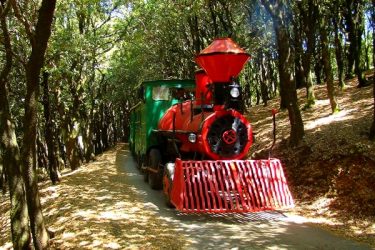
Wild animals and farm animals from the Italian tradition live freely across the 45 hectares of this hill. But there are also more exotic animals, such as snowy owls, kangaroos, reindeer, ostriches, yaks, llamas, dromedaries and buffalo. They can all be observed on foot or from the historic little train.
All the attractions of Città della Domenica
The park’s mascot is the Asinara donkey, a species that was saved from extinction precisely at Città della Domenica.
The park is also full of attractions, including Pinocchio’s Village, Little Red Riding Hood’s house, Sleeping Beauty’s Castle and Snow White’s Cottage. There are also more dynamic attractions, such as slides, mini-karts and mini-motorboats.
The park also includes the Perugia Reptile House, one of the most important in Europe, with alligators, caimans and many species of snakes, including some of the most venomous in the world.
Opening hours and ticket price for Città della Domenica
Opening hours: from June to November, 10 a.m.–7 p.m.
Ticket price: €17 adults. Reduced €13.50. Children from 70 cm to 1 m: €3.50. How to get there: 4 km from Perugia railway station, in the Ferro di Cavallo area. It can be reached by car or taxi.
The Surroundings of Perugia
12
Perugia lies at the centre of a magnificent area, so listing the things to see in the surroundings and across the whole province is truly difficult.
Let’s start with Assisi, with the places of Saint Francis, where Giotto and Simone Martini left their masterpieces, as well as a rich Civic Art Gallery, an extraordinary Temple of Minerva and a scenic Piazza del Comune.

We then move on to Gubbio, which over the centuries has jealously preserved its medieval appearance, reflected both in the character of its buildings and in the structure of its streets.
The town is made up of five parallel streets located on different levels and connected by flights of steps, alleys and stairways. If you love villages, Spello, Bevagna and Montefalco are unmissable.
Spello, with the best-preserved Roman fortified walls in Italy, three magnificent entrance gates to the village, a dense network of little streets that from May to July become a flower-filled stage, and works by Pinturicchio. Montefalco, homeland of Sagrantino and good food, and finally Bevagna, with its wonderful square and evocative medieval atmosphere, old-time palaces and artisan workshops.
Finally, a little gem: near Todi there is Monte Castello di Vibio, with the smallest theatre in Europe, a little-known jewel that deserves to be visited and supported.
What to Eat in Perugia
13
Perugian cuisine is linked to the gastronomic tradition of Umbria, which is why it is simple, genuine and of high quality. Prosciutto, cured meats, cheeses and meats are the true stars of the table.
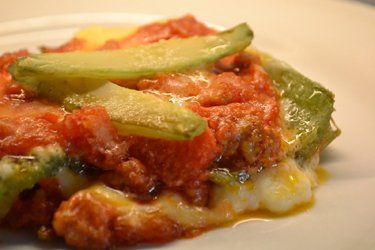
In restaurants, among the traditional dishes, you can taste “faraona alla leccarda” — guinea fowl seasoned with a sauce made from chicken livers, herbs and white wine — “torta al testo” — a flatbread made with flour, water and olive oil — and various recipes whose main seasoning is truffle.
Another Perugian speciality is parmigiana di gobbi: a dish made with cardoons, mozzarella, meat sauce and Parmesan. Flavours from the lake are also present: tegamaccio — an aromatic fish soup — is one of the best-known fish dishes, alongside crabs, trout, pike and carp cooked according to tasty and imaginative recipes.
To complete the meal, desserts: pinoccate, made with pine nuts, and torcolo, a ring-shaped cake with raisins and candied fruit, are the most famous.
Where to Stay in Perugia
Perugia is a tourist city that also attracts business travellers, many students and professors. Therefore, there is no shortage of hotels, apartments, hostels and Bed & Breakfasts, including farm stays in the surrounding areas. After all, we are in Umbria, and these accommodations are widespread throughout the region.
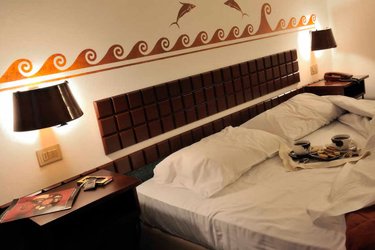
In some periods it may be difficult to find a reasonably priced place to stay, so it is preferable to move away from the historic centre towards the more peripheral districts, which are perfectly connected to the centre by buses and the city escalators.
During events such as Umbria Jazz or Eurochocolate, the number of tourists in the city is considerable; therefore, if your holiday coincides with these periods, book well in advance. Prices for a 3-star hotel in the centre start from €70 per night, for a couple, including breakfast.
At farm stays you can save money, with prices starting from €50 per night. For those looking for a different kind of hotel, there is also the Etruscan Chocohotel, the first hotel entirely dedicated to chocolate!
If you are looking for a hotel in Perugia, we recommend choosing from those offered by Booking.com. There are 130 hotels with prices, photos and reviews from previous guests. Go to Booking.com