Those who believe that Tropea is only a seaside destination to visit in summer, with little to see, are mistaken. Like many other places in Calabria, this town in the province of Vibo Valentia also hides gems that reveal themselves to those who know how to look for them.
The sea is wonderful, the nature luxuriant, and this is undeniable: even the most distracted traveller notices it immediately after leaving the Autostrada del Mare, when the road begins to follow the coastline. Here and there, wonderful glimpses of the blue sea open up, with the Aeolian Islands visible on the clearest days.
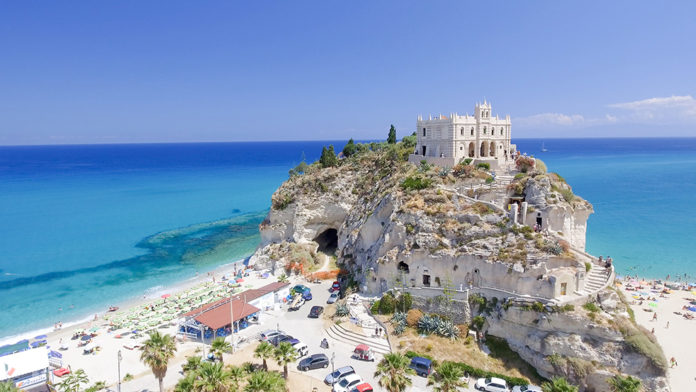
Tropea welcomes visitors with the outline of the Sanctuary of Madonna dell’Isola: if you have ever seen a photo of Tropea, it almost certainly showed this sacred place. In the historic centre, lively and colourful like all those in Southern Italy, magnificent views of the sea suddenly appear: here they are called “affacci”, because they are like opening a window onto infinity.
Right in the centre stands the Cathedral of Tropea, with a miraculous image of the Madonna of Romania. Not far away is the undeniable yet different charm of the deconsecrated Church of Madonna della Neve. There is little to say about the beaches: they are many, and all wonderful.
The surroundings deserve a few more words: not only Pizzo Calabro and Capo Vaticano, but above all Serra San Bruno and the Zungri Caves, two historical and architectural jewels that alone are worth spending a day away from the sea.
On this page we recommend the 10 things you absolutely must do and see in Tropea during a weekend or holiday.
If you are looking for a hotel in Tropea, we recommend choosing from those offered by Booking.com. There are around 500 hotels with prices, photos and reviews from previous guests. Go to Booking.com.
The Historic Centre of Tropea
1
The historic centre of Tropea lies high up, about 70 metres above the sea, in a maze of alleys, narrow streets, churches, noble palaces, panoramic terraces and incredible views over the blue sea that suddenly open up as you walk.
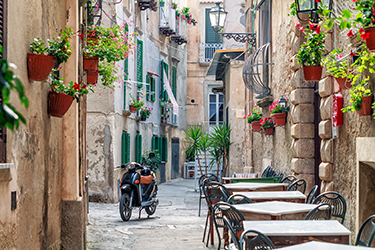
A walk through Tropea’s historic centre also allows you to discover artisan workshops, especially those working with textiles, iron and terracotta, and to buy local delicacies directly from farmers, such as fresh eggs, typical cured meats, dried fruit and olive oil.
Venturing through these streets, you can also admire the noble palaces built between the 18th and 19th centuries: many still display the family coat of arms on the outside and have charming balconies directly overlooking the sea.
The heart of the centre is Largo Ercole, with its beautiful square, from which you can reach Palazzo Toraldo, which also houses a collection of archaeological finds, and Villa Braghò.
Among the most beautiful viewpoints over the marina, the lower part of Tropea, are Largo Migliarese, Largo Galluppi and Largo Villetta.
Also worth discovering are the many churches enclosed here: the Cathedral, the Church of San Francesco d’Assisi and the deconsecrated Church of Santa Maria della Neve.
The Sanctuary of Santa Maria dell’Isola in Tropea
2
The Sanctuary of Santa Maria dell’Isola, also known as Isola Bella, is one of the jewels of Tropea and of the entire coast: both for its position, on a rock overlooking the sea in front of the Aeolian Islands, and because it is one of the most important places of worship in the area, rich in legends and the starting point, every 15 August, of the sea procession of the Assumption of the Virgin.
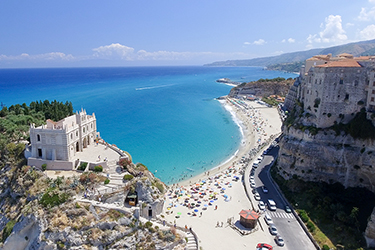
The sanctuary belongs to the Abbey of Montecassino and has dominated the sea and the marina, with the beach at its feet, for around 1,000 years.
In addition to spiritual and religious reasons, this sanctuary is worth visiting for the fantastic panorama offered by the outdoor square.
The atmosphere here is truly romantic: the eye embraces the entire horizon from Punta Riace to Punta Zambrone; below stretches the Tyrrhenian Sea, and the islands of Vulcano and Stromboli, and even Mount Etna, can be clearly seen.
This is why it is a very popular place with tourists and one of the most scenic locations for celebrating weddings.
Legends tell of miraculous places: among them, halfway up the steps leading to the sanctuary, there is a boulder where people suffering from gastric illnesses were brought, and many healings are said to have taken place.
Inside the church, on the high altar, is the Holy Family: made in the 18th century, these statues are carried down on people’s shoulders onto a fishing boat every year for the procession of the Assumption of the Virgin on 15 August.
The procession of boats starts from the Mare Picciulu, the “small sea”, in front of the sanctuary, and follows the entire stretch of water in front of the town of Tropea, ending at sunset, when the statues are raised again to return to the church and the procession concludes with Mass and fireworks.
Opening hours and ticket price for the Sanctuary of Santa Maria dell’Isola
Address: Via Lungomare, 89861 Tropea VV
Opening hours: every day from 9 a.m. to 8 p.m. from April to June and from September to October. July and August from 9 a.m. to 11 p.m. In November and December it is open depending on weather conditions, on Saturdays and Sundays from 9:30 a.m. to 4:30 p.m.
Ticket price: free admission to the church; €2 for visits to the garden, panoramic terrace and historical-liturgical route. Free for children up to 6 years old.
The Cathedral of Maria Santissima di Romania and the Diocesan Museum of Tropea
3
The Cathedral of Maria Santissima di Romania is Tropea’s cathedral and is also known as the Norman Cathedral, because it was built by the Normans at the end of the 13th century. It stands on the remains of a Byzantine cemetery and, together with the Sanctuary of Madonna dell’Isola, is the city’s most important place of worship.
Over the centuries this building has undergone many changes and has also been damaged by earthquakes: today it is a large, elongated building with three naves, notable for the yellow walls typical of the tuff stone with which it was built.

The protector of Tropea, the Madonna of Romania, already stands out on the exterior façade, but the original is inside, on the high altar: the Blessed Virgin Mary of Romania, painted by a pupil of Giotto around 1230.
According to popular tradition, this painting is considered miraculous because it protected the people from earthquakes, wars and disease.
The interior also houses an 18th-century pulpit and a majestic black wooden crucifix, dating back to the 17th century and located in the second chapel on the right.
The Chapel of the Blessed Sacrament and of Saint Dominic is enriched with polychrome marble decorations and altars, while the apse in the right nave contains the Madonna del Popolo, a sculpture made in 1555 by Fra Agnolo Montorsoli, a follower of Michelangelo Buonarroti.
The Civic Diocesan Museum of Tropea
Opened in 2004, this two-floor museum is located opposite the cathedral and preserves many precious works from the cathedral as well as from the many churches in Tropea that are now closed.
At the entrance, the portico houses a series of marble statues and a 17th-century triptych with the Madonna delle Grazie, Saint Francis of Assisi and Saint Clare. The collection on the first floor preserves a series of paintings from different periods, including two icons dating from the 13th and 15th centuries and three large canvases: a Madonna del Rosario, a Madonna del Carmine and an Incredulity of Saint Thomas by Nicola Menzele.
The second floor preserves medieval finds and houses a series of rooms dedicated to paintings of the Madonna. These include the Coronation of the Virgin, from the 17th-century Sicilian school, and works by Giuseppe Grimaldi, Tropea’s most important painter in the 18th century. Do not miss the Glory of the Immaculate Conception.
Opening hours and ticket price for the Cathedral and Museum
Cathedral address: Largo Duomo 12, 89861 Tropea (VV)
Museum: Via Roma, 1, 89861 Tropea (VV)
Cathedral opening hours and ticket: the cathedral is open every day from 9 a.m. to 12:30 p.m. and from 5 p.m. to 8 p.m. Admission is free.
Museum opening hours: the museum is open from April to June, 9 a.m.–1:30 p.m. and 3 p.m.–7:30 p.m.; July and August from 9 a.m. to midnight; September and October from 9 a.m. to 7 p.m.; November and December 9 a.m.–1:30 p.m. and 3 p.m.–5:30 p.m. From January to March it is closed. Ticket price: €2.00
The Church of Santa Maria della Neve in Tropea
4
Just outside the historic centre of Tropea — Via Carmine — in a silent citrus grove, stands a deconsecrated church that still preserves its artworks inside and is also open to the public for conferences and concerts. It is dedicated to Santa Maria della Neve, from which it takes its name, and is unmistakable thanks to its granite portals and the two statues on either side, Saint Joachim and Saint Anne.

The church dates back to the 16th century and its interior is dominated by an 18th-century wooden altar. Inside it hides many valuable works, including two paintings: Saint Anthony, from the 17th century, and the Crucifixion, from 1720. The church is also known locally as the Church of Michelizia.
This name comes from the contraction of Michaeli Militia, Church of the Angels, although legend attributes it to Michele Milizia, a merchant from Messina who, after a storm, found himself stranded with his sailing ship off this coast.
After praying, in the darkness he saw a light on the cliff, and right here, as a sign of thanks, he decided to dedicate a church to the Virgin Mary. In 2016, during restoration work, two burial chambers were discovered beneath the floor of the nave.
The Beaches of Tropea
5
Tropea is part of the Coast of the Gods, also known as the Costa Bella: 55 km of coves, beaches, rocks and caves, all overlooking waters ranging from deep green to turquoise.
The Coast of the Gods is truly one of Calabria’s most beautiful seaside areas, and in Tropea and its surroundings alone there are about ten beaches. Most of them can be reached on foot from the centre via stairways and small roads.

Starting from the centre, you find Rotonda Beach, protected by rocks on both sides, and a little further on Marina dell’Isola Beach, with white sand, overlooking the blue sea and with the striking view of the church above.
Near the beach there are bars and restaurants, and there are both free and equipped areas. From here you can reach the Grotta del Palombaro, which has at its feet a strip of sand washed by turquoise waters: the fittest can swim there, while others can reach it by pedal boat or by following the cliff.
Next to Isola Bella Beach is Rotonda Beach: a bay of fine white sand with transparent seabeds.
This beach is bordered by the San Leonardo rock, beyond which lies Cannone Beach, which is less crowded. It can be reached from the marina by stairs.
The largest beach in Tropea is ‘a Linguata, Linguata Beach: it can be reached from Marina dell’Isola Beach via a staircase, but the effort is rewarded by one of the most beautiful seabeds in the area, perfect for snorkelling.
On this beach there is a large free area, a beach club with entertainment and a beach volleyball court. Not far from the centre of Tropea, about 1 km away, is Passo Cavalieri Beach: it is wide, sandy and completely free.
Capo Vaticano near Tropea
6
Capo Vaticano is 9 km from Tropea: it can be reached by boat from Tropea or by car, so you can discover all its beauty more calmly. Its beaches, thanks to their seabeds, variety and vegetation, are considered among the 100 most beautiful beaches in the world.
It is a promontory more than 120 metres high, with 7 km of coastline overlooking a sea that offers every shade from light blue to deep blue.
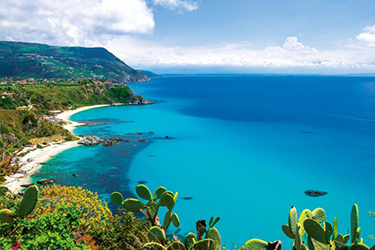
Nature here is truly spectacular, and the beaches are sandy coves alternating with rocks and rocky spurs that are a paradise for diving.
Among the most beautiful beaches to visit are Grotticelle Beach, with a shallow, crystal-clear seabed dotted with rocks, and Riace Bay, where you can also rent pedal boats and boats to discover the caves hidden beneath the coast.
In Capo Vaticano there are equipped beach clubs and free beaches, several campsites and, given the height, many viewpoints over the sea. Among these, along the provincial road, is the Belvedere viewpoint: from here, small steps cut into the rock lead down to little beaches, the most scenic of which is Praia du Focu.
Back on the Provincial Road, continuing onwards, you reach the square with the Navy lighthouse. From here, the view stretches across the entire horizon as far as the eye can see.
Pizzo Calabro
7
Pizzo Calabro, U Pizzu for Calabrians, is about 30 km from Tropea and, as its name suggests, is a town perched on a promontory overlooking the sea.
At its feet lie almost 10 km of small beaches, pebbly coves, bays, caves and sandy shores, washed by blue-reflecting waters that have earned the area from Capo Vaticano to Tropea the name “Coast of the Gods” or Costa Bella.

Among the most beautiful beaches are the small beach of Piedigrotta and Seggiola Beach. In addition to its beaches and the panorama, which also embraces the Aeolian Islands, Pizzo is famous for the little Church of Piedigrotta, Murat Castle and tartufo, the typical artisan ice cream: hazelnut ice cream covered with melted chocolate and then bitter cocoa.
The Church of Piedigrotta is located on the beach of the same name, in the town. It is one of the most visited places in Calabria, even more than the museum in Reggio Calabria with the Riace Bronzes: it is a large cave carved into volcanic stone, with various rooms created ad hoc, and it contains a varied series of statues sculpted directly into the rock: religious scenes, saints, angels, but also medallions of famous figures such as John F. Kennedy.
The cave takes its name from a painting of the Madonna of Piedigrotta and, as often happens in seaside villages, from a legend. It is said that a sailing ship with a Neapolitan crew was shipwrecked here in the 17th century: the sailors promised the Madonna of Piedigrotta, whose painting they carried with them, that they would build a chapel here if they survived.
And so it was, and the first votive chapel was created here in the rock. The statues were added later, made from 1880 onwards by local sculptor Angelo Barone and then by his son Alfonso.
In 1968, after acts of vandalism, the church and statues were restored thanks to Giorgio Barone, Angelo’s grandson, a Canadian sculptor who came here and decided to stay, restoring the statues to their original splendour.
Murat Castle is so called because Gioacchino Murat, King of Naples, was imprisoned and sentenced to death here in 1815. The structure dates back to the 14th century, with a watchtower against Saracen raids, later enlarged over the centuries. Today it is a castle with high walls overlooking the centre of Pizzo and is open to tourists. The visit includes the interiors, exteriors and cells, with an accurate historical reconstruction of the final period Murat spent here. According to accounts, the sovereign’s remains rest in the Cathedral of Pizzo Calabro, the Mother Church of San Giorgio, located in the historic centre.
The Zungri Caves near Tropea
8
The Zungri Caves, about 20 km from Tropea, are a rock settlement carved into the rock around the 8th century. In an area of over 3,000 square metres there is a real village, where houses, warehouses and animal stables were built over the centuries. Today the site includes at least 100 houses, some of them underground, among little streets, steps worn by time and a truly fascinating route.
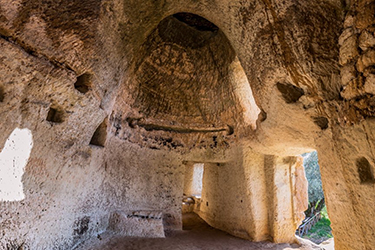
Part of the site is open to the public, and visitors can discover the rooms carved into the rock: descending, you first encounter the most recent constructions, then gradually move backwards in time, admiring cisterns for collecting rainwater and houses carved into stone, with niches for beds and central openings high above through which light entered. The guided tour also includes the Museum of Rock and Peasant Civilisation of Zungri, housed in a former olive press: a rich collection of objects, clothes, work tools and photographs from the peasant civilisation of these areas.
The Charterhouse of Serra San Bruno
9
The Charterhouse of Serra San Bruno is a Carthusian monastery located in the mountains, 815 metres above sea level, about 40 km from Tropea. The charterhouse was founded by Saint Bruno of Cologne in 1084 and was completely destroyed by an earthquake in 1793.
Rebuilt in 1894, today it is the only charterhouse in Italy where monks live, and therefore it can only be visited from the outside.

In their small cells, the monks devote themselves to prayer, meditation and manual work: the cheeses that can be bought in the museum are in fact produced right here.
The visit begins with a beautiful walk through greenery: the whole area is immersed in peace and silence, and from the charterhouse you reach the locality of Santa Maria, where there is a small lake with the statue of the saint, and above it the church of the same name, the Sanctuary of Santa Maria del Bosco.
From here, you can also continue through the woods along a path leading to a small mountain lake.
The Charterhouse Museum, opened in 1994, houses reconstructions of the monks’ cells, the church and panels illustrating the history of Saint Bruno.
A trip to the Charterhouse also allows you to admire the historic centre of Serra: here there are as many as nine churches to discover, the most beautiful of which is the Church of the Addolorata, as well as beautiful murals in the rughe, the pedestrian alleys of Serra’s historic centre.
What to Eat in Tropea
10
Tropea is best known for its red onion, a PGI product protected by a consortium.
This onion, very sweet and with a unique flavour, is grown throughout the area, but it is not the only speciality of this region. In Tropea you can enjoy fresh fish, especially grilled swordfish and tuna, as well as kid goat, wild boar and pork.

Dishes are flavoured with spices, chilli pepper, garlic and extra virgin olive oil.
Among the first courses to try are spaghetti with sardines, and fileja with pork sauce: handmade pasta served with a very rich sauce made from pork or wild boar.
Among the fish main courses, try fried surici: very small fish, breaded and fried. In addition to being used as a condiment, Tropea onion can also be tasted here in the onion tart, in which onions are flavoured with local pecorino, pepper and eggs and become the filling of a homemade shortcrust pastry. The mountains surrounding Tropea provide cured meats and cheeses.
Among these is Monte Poro pecorino, a Slow Food Presidium: rich, savoury and scented with mint. Among the liqueurs to finish the meal, bergamot liqueur is not to be missed, and among the desserts, of course, there is the tartufo of Pizzo Calabro. The wines that accompany Tropea’s dishes are Malvasia, Aglianico and Greco.
Hotels in Tropea
If you are looking for a hotel in Tropea, we recommend choosing from those offered by Booking.com. There are around 500 hotels with prices, photos and reviews from previous guests. Go to Booking.com.