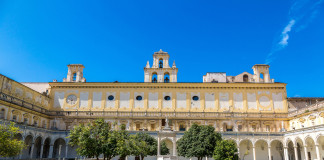

If there is one place in Naples that has always followed the city’s changing fortunes, it is certainly Piazza del Plebiscito. For many decades it was an irregular open space, almost a piece of countryside within the city, where Neapolitans gathered during the celebrations organized by the sovereigns to keep quiet a people who were always hungry and on the verge of revolt.
Piazza del Plebiscito was a true open-air theater: tournaments, weddings, carousels and contests between men-at-arms. But the square became even more famous for its “cuccagne” in the 17th and 18th centuries. The Spanish viceroys and the Bourbon rulers ordered enormous platforms to be set up in front of the Royal Palace, where, on certain occasions, every kind of food was made available to the people: chickens, cured meats, cheeses and cattle.
But as the beauty of the Royal Palace grew, the square could no longer stand comparison with the majesty of this royal residence, and so a series of works began that would eventually turn it into what it is today.
The ancient origins of Piazza del Plebiscito in Naples
It seems that the history of the square began together with that of the city itself: here stood the walls of the Greek Palepolis and those of the Roman Castrum Lucullanum, of which no fragment remains because they were demolished between the 13th and 14th centuries to make room for churches and monasteries.
Where Palazzo Salerno stands today, the Angevins built the monastery of Santa Croce; where the Palazzo della Prefettura now stands, the monastery of Santo Spirito was founded in 1326; and where the Church of San Francesco stands, the convent of San Giovanni ad Lampades was established in 1482.
An open-air theater
Between 1808 and 1815, to make this open-air stage even more impressive, King Joachim Murat abolished the various convents and instead ordered the construction of Palazzo Salerno and the Palazzo della Foresteria, today the prefecture building.
But Murat’s plans did not stop there: he planned to transform the square into a large amphitheater, whose steps were to be carved into the Pizzofalcone hill. His first move, therefore, was to have a semicircular colonnade built to enclose the amphitheater, which he had already named Foro Murat.
But when the French regime came to an end and Ferdinand of Bourbon returned to the throne, there was no more talk of Foro Murat.
The Gambrinus and the Turco, historic cafés of Piazza del Plebiscito in Naples
To hear Neapolitans tell it, the square experienced its greatest period of splendor between 1890 and the late 1930s, when all Naples poured into it to spend pleasant evenings accompanied by the music of the outdoor orchestras of two cafés facing each other: the Gambrinus and the Turco.

Sitting at the outdoor tables, chatting away, there was a real chance of meeting the most illustrious figures of culture and even some member of the House of Savoy.
The stories of these two famous cafés are typical of a Belle Époque that lasted longer in this city than elsewhere. Caffè Turco, which changed its name to Caffè Tripoli in 1911, enlivened the ground floor of Palazzo Salerno, while the Gambrinus had its shop windows on the ground floor of the Prefecture building.
The Gambrinus was built in 1890 and immediately took on the appearance of a “literary café”, but in 1938 its space was also greatly reduced by a prefect who could not tolerate the music of the small orchestra.
Only recently has it recovered part of its premises. Caffè Tripoli closed its doors in 1932 and was transformed into a club for Army officers. In practice, with the downsizing of the Gambrinus and the closure of the Tripoli, Piazza del Plebiscito seemed to be invaded by a strict and severe atmosphere that did not suit it at all.
This square, which until 1817 was called Largo di Palazzo and until 1860 Largo San Francesco di Paola, was made accessible only to pedestrians only recently, becoming in the 1990s the symbol of the New Neapolitan Renaissance.
Curiosities about Piazza del Plebiscito in Naples

The “game” that Neapolitans have tourists visiting the square play is quite well known.
The tourist has to be blindfolded and try to cross the square in a straight line, starting from the Royal Palace and reaching the space between the two large statues placed not far from the Palace.
The slight slope of the square’s surface makes the blindfolded person veer off course, preventing them from continuing straight and passing between the two statues. When the person opens their eyes, they will be very surprised to have changed their original trajectory so much. Try it yourselves!
How to get to Piazza del Plebiscito in Naples
Piazza del Plebiscito and the Royal Palace are located in the center of Naples, so they are an essential stop on any city sightseeing route. Those arriving from the Central Station must take Bus R2 (San Carlo stop). Those arriving from Capodichino must take the Alibus and get off at Piazza Municipio. The Royal Palace is only a few hundred meters away.
Where to sleep in Naples
If you are looking for a hotel, we recommend choosing from those offered by Booking.com. There are around 700 hotels with prices, photos and reviews from previous guests.
Go to Booking.com