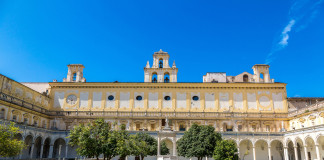
First a riding school and later home to the University, the MANN – National Archaeological Museum of Naples was inaugurated in 1816 and is today one of the most important museums in the world for the quality and quantity of the works it houses. King Ferdinand IV intended to create an impressive institute for the arts in Naples and, more than two centuries later, it can be said that his ambitions have been fulfilled.
The Archaeological Museum, one of the must-see attractions in Naples, not only contains finds from the excavations of Pompeii, but also houses artefacts from the Greco-Roman period, Egyptian and Etruscan antiquities from the Borgia collection, and ancient coins from the Santangelo collection. Not to be missed is the “Secret Cabinet”, which brings together ancient frescoes and sculptures devoted to the theme of eroticism. On this page, we recommend the 10 things you absolutely must see during a visit to the Archaeological Museum of Naples.
Farnese Collection in Naples
1
The creation of this collection is owed to Alessandro Farnese, who later became Pope Paul III, and to other members of his family. Bequests, confiscations, purchases and trade made it possible to gather an enormous quantity of ancient and modern objects, sculptures, paintings and gems to embellish Palazzo Farnese in Rome. After the death of all the male members of the family, this precious collection passed into the hands of Charles of Bourbon, thanks to the inheritance left by his mother, Elisabeth Farnese. Once he became King of Naples, and despite the opposition of the Papacy, Charles of Bourbon transferred the entire collection from the Roman palaces to the newly established Museum of Naples.

The Sculptures from the Baths of Caracalla in Naples
2
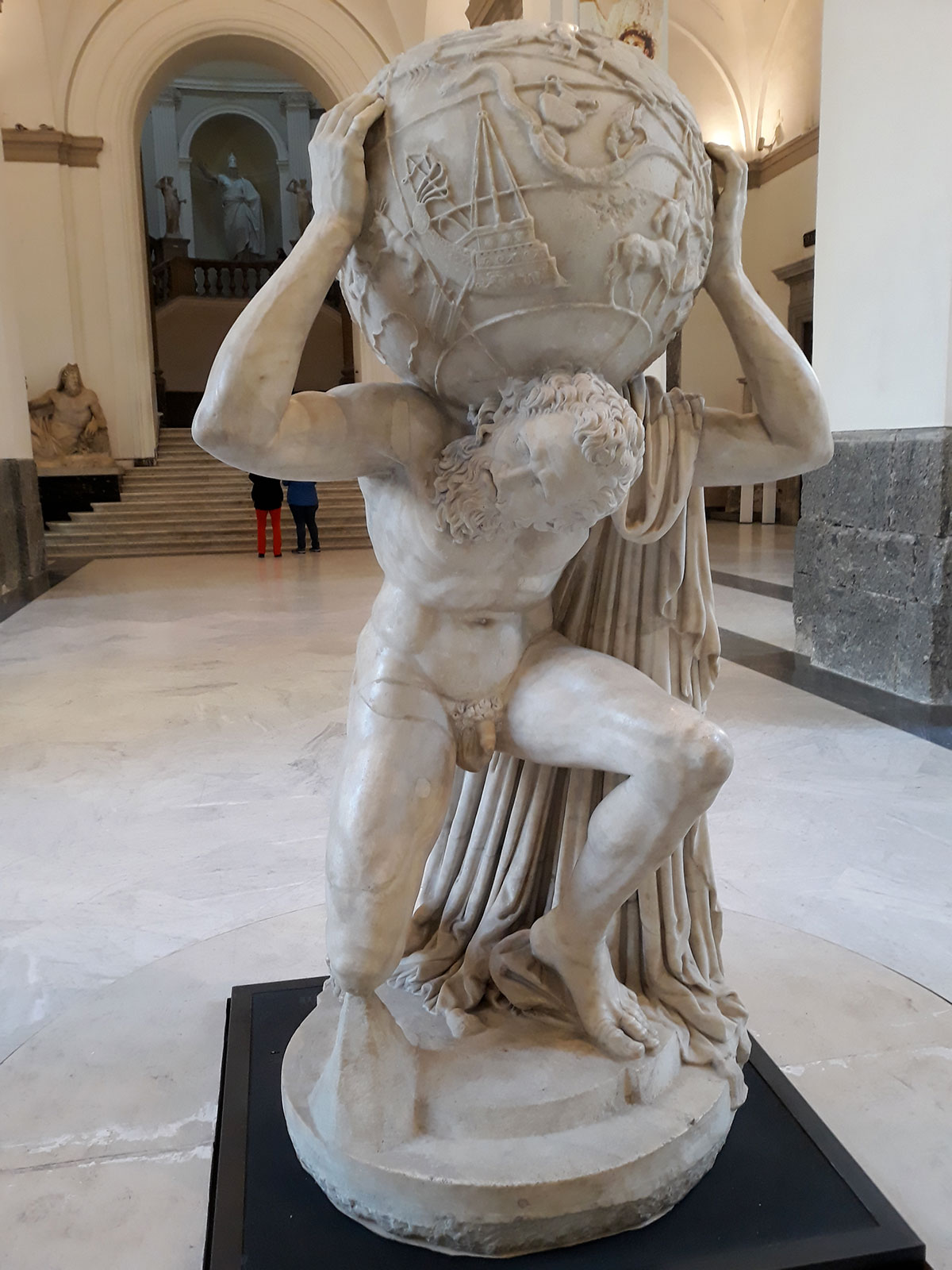
After the excavations begun under the pontificate of Sixtus IV, Paolo Farnese promoted new excavations at the Baths of Caracalla in order to bring to light materials that would embellish his palace in Campo de’ Fiori in Rome. With the transfer to Naples, many works were dispersed among various museums in Italy and around the world. Nevertheless, the Archaeological Museum of Naples still preserves numerous sculptural works from the Baths. The sculptural groups do not all belong to the same period: they form a heterogeneous ensemble, yet one harmoniously arranged according to size, composition and subject matter. Among the various works, the most famous are the Bull and Hercules.
Gallery of the Emperors in Naples
3
A key element of Renaissance collecting was the portraits of Roman emperors, which at the time represented absolute power. With the help of the librarian Orsini, the Farnese family managed to acquire several sculptural portraits of the most famous emperors. The works were displayed in the Great Hall and in the Hall of the Emperors of Palazzo Farnese, but with the transfer to Naples the collection underwent several restorations while nevertheless preserving its importance. Among the various sculptures, of particular interest are the colossal busts of Julius Caesar and Vespasian, and a statue of Alexander Severus in heroic nudity.
Gems of the Farnese Collection in Naples
4
The wonderful collection of ancient and modern gems also belongs to the Farnese Collection. More than two thousand pieces of exceptional artistic quality embellish two rooms on the ground floor of the Museum. The gems come from other private collections and from ancient centres in Campania. Among them, the oldest are those of the Venetian pontiff Paul II Barbo and Lorenzo the Magnificent, dating back to the 15th century and rich in unique specimens. The collection was inherited by Charles of Bourbon and, after being housed first in the Royal Palace of Naples and then in the Museum of Capodimonte, it arrived at the Archaeological Museum of Naples in 1817.
Pompeian Frescoes in Naples
5
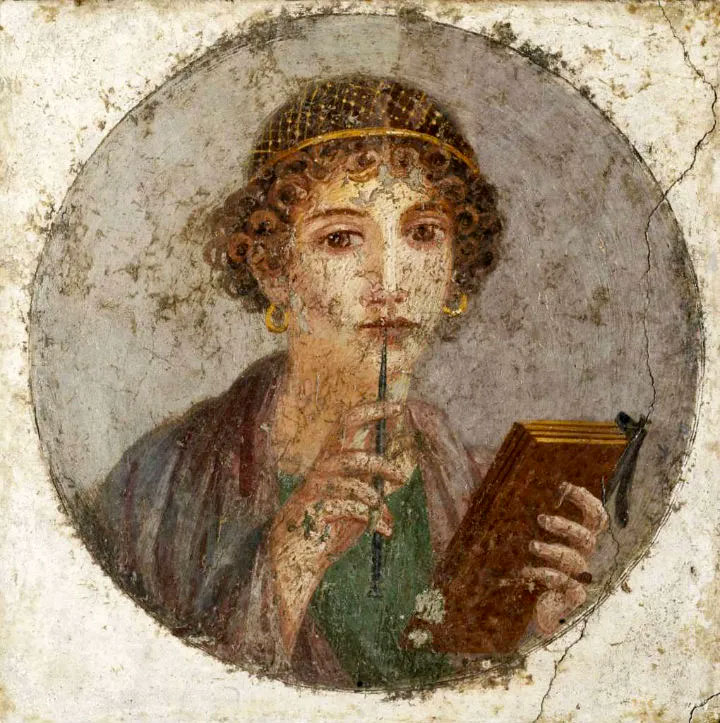
Some rooms on the first floor of the Museum house the frescoes of the Pompeian collection: these are paintings detached from the villas and houses of the cities buried by the eruption of Mount Vesuvius in 79 AD. The frescoes provide rich evidence of painting in the Roman period, and the exhibition is arranged according to both chronological and thematic criteria. The subjects depicted range from scenes of daily life to mythological and religious themes, still lifes and landscapes. This section also features a more “popular” but decidedly more practical type of painting, including shop signs and tavern decorations.
Pompeian Mosaics in Naples
6
While the first mosaics found among the ruins of Pompeii and Herculaneum were grouped together with the frescoes, as the discoveries became more substantial the two collections were separated and placed in their current locations. The mosaics are now housed in the western mezzanine of the Museum, divided by technique and material, and they bear witness to the art of mosaic-making between the 2nd century BC and the 1st century AD. Among the various mosaics that once covered the columns, fountains and floors of the most sumptuous Pompeian villas, the Battle of Issus mosaic is particularly noteworthy, depicting Alexander the Great’s victory over Darius.
Secret Cabinet in Naples
7
After a troubled history, marked by repeated bans and restrictions, the Secret Cabinet was permanently opened to the public in April 2000. It contains a collection of material — including sculptures, paintings and various objects — with a distinctly erotic theme. In Roman times, the phallic symbol, together with noise, was believed to be effective against the evil eye and illness, as well as a wish for prosperity. This explains the many amulets worn by men and women or displayed in shops, in which the male member predominates. Although there is now no form of censorship, children under the age of 14 should be accompanied by an adult.
Villa of the Papyri in Naples
8
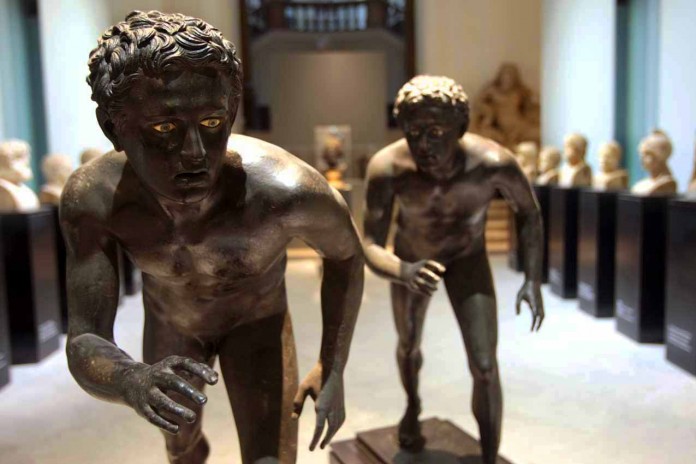
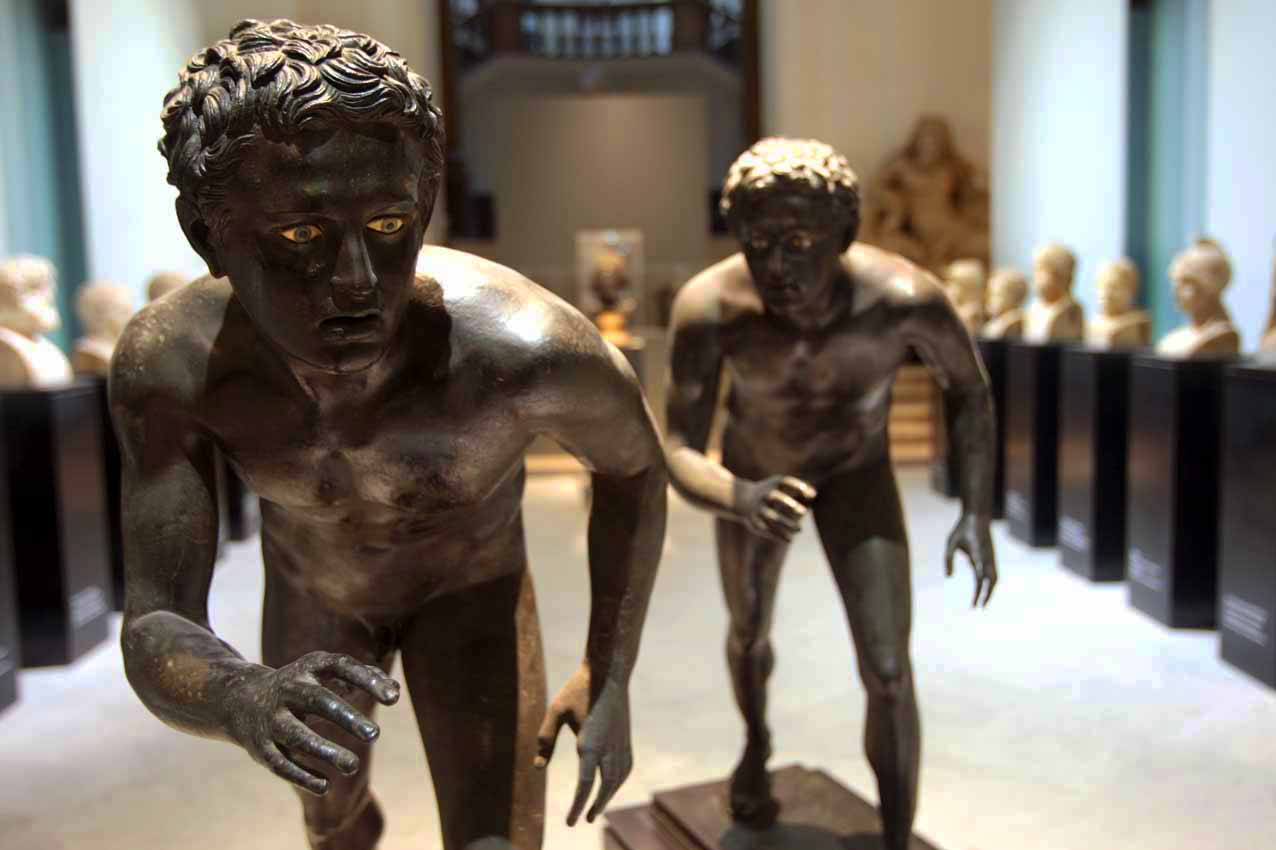
Between 1750 and 1764, thanks to a complex system of shafts and underground tunnels, the Villa of the Papyri was discovered, one of the richest and most sumptuous Roman villas. The Museum houses busts, statues and bronze heads from the Villa. Visitors can admire, for example, small busts of philosophers and men of letters, five statues depicting the “dancers” — women condemned for life to draw water after killing their husbands — two famous bronze statues of runners, as well as two carbonised and unrolled papyri and several reproductions of papyri kept in the National Library of Naples for study purposes.
Egyptian Collection in Naples
9
The Egyptian collection of the Archaeological Museum of Naples is the third most important in Italy, after those of the Vatican Museums and the Egyptian Museum of Turin. Formed between the second and third decades of the 19th century, the collection contains materials found during excavations in the Vesuvian and Phlegraean areas, as well as items from private collections. The core of the section is the Borgia collection, rich in objects and manuscripts from Egypt, followed by the Picchianti collection, which includes funerary objects and everyday accessories. In addition to preserving important archaeological finds, the collection has considerable historical value.
Hall of the Sundial in Naples

10
This enormous 17th-century hall is located on the first floor of the Museum. Because of its structural instability, during the 17th century it was almost never opened to the public, until King Charles of Bourbon entrusted the restoration work to the architect Giovanni Antonio Medrano. To reinforce the hall’s roof, Medrano used the device of a double roof: an inner structure of beams topped by a second order of trusses. On the vault, visitors can still admire the fresco by Pietro Bardellino celebrating King Ferdinand IV and his wife Maria Carolina as protectors of the arts.
Opening Hours and Ticket Prices for the MANN
Opening hours Monday to Sunday: 9:00 am – 7:30 pm
Closed on Tuesdays
Last admission 30 minutes before closing
Full ticket: Full price €13. Young people €2.
How to get there: on foot through the historic centre towards Piazza Dante. Metro Line 1 Museum stop, 100 m on foot. Metro Line 2 Piazza Cavour stop, 100 m on foot.