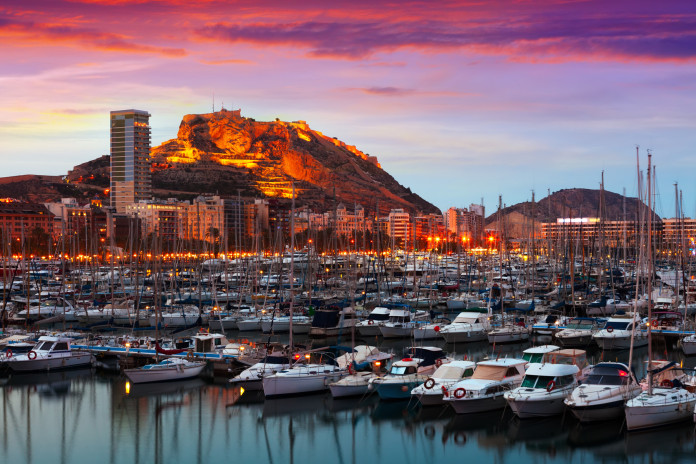
There is a short poem by Jacques Prévert entitled “Alicante” which reads as follows: “An orange on the table, Your dress on the rug, And in my bed, you, Sweet gift of the present, Coolness of the night, Warmth of my life“. When the French poet wrote these lines in the 1960s, Alicante was a little less crowded with people and concrete, and this stretch of Spain was a promised land for those in search of solitude and nature.
Fortunately, and unlike the nearby resorts of the Costa del Sol, Alicante stopped the environmental damage in time and today it is a beautiful seaside city, with a few too many neon signs and high-rise buildings, but still with the feel of a fishing village.
All you have to do is turn a corner and leave the most touristy streets behind to rediscover the atmosphere that inspired Prévert’s verses. On this page, we recommend the 10 things to do and see in Alicante.
If you are looking for a hotel in Alicante, we recommend choosing from those offered by Booking.com. There are around 70 hotels with prices, photos and reviews from guests who have stayed there before you.
Go to Booking.com
Santa Bárbara Castle in Alicante
1
An ever-present landmark for tourists and locals alike, Santa Bárbara Castle dominates Alicante and its gulf from a height of 166 metres. The castle is the largest medieval fortress in Spain and is the result of successive constructions carried out from the 14th century onwards.

The oldest part is the “Torreta” in the highest area, followed by the central section with the “Hall of Philip II“, the “Queen’s Bastion“, the “Arms Hall” and the “Guardhouse“. The last part to be built was the Revellín del Bon Repós in the lower section. The castle is the final destination of any walk in Alicante, especially in summer, when the cool air at that height helps you cope with the hot Spanish nights.
You can reach it on foot or by lift from Postiguet Beach, or by car or Turibus. From the same beach you can admire the “Cala del Moro“, the “Face of the Moor” carved by nature into the rock just below the castle walls. Impressive!
Opening hours and ticket price for Santa Bárbara Castle
Opening hours:
from 15 November to 27 February and from 5 September to 14 November: every day from 10 am to 6 pm.
from 28 February to 16 June: every day from 10 am to 8 pm.
from 17 June to 4 September: every day from 10 am to 11 pm.
Last admission 30 minutes before closing. Open 7 days a week.
Ticket price: free
How to get there: on foot in 30 minutes from the centre, by taxi, by lift on Avenida Juan Bautista Lafora, opposite Postiguet Beach, or by minibus from Plaza Gómez Ulla, in front of the MARQ, to the castle and back.
The Beaches of Alicante
2
Much of Alicante’s summer life takes place on its beaches. Clean, well organised, easily accessible and free, they are the main reason why people choose this Spanish town as a holiday destination. You do not need a car, and you do not need to take public transport.

Right in the historic centre, below Santa Bárbara Castle and at the end of the Explanada de España, is Playa del Postiguet, much loved by the people of Alicante. A little further from the centre is Playa de San Juan, the best-known and most appreciated beach in Alicante.
Three kilometres of very fine sand and crystal-clear water, where truly nothing is missing: football pitches, tennis courts, volleyball courts, water games, restaurants, beach bars, craft shops and entertainment for adults and children.
It is very popular in summer, but the large stretch of sand allows everyone to find their own little spot in the sun! You can get there by tram or bus, both of which stop just a few metres from the beach.
If you are looking for a less urban and crowded beach, just a short distance away there is Cabo de la Huertas, which is no coincidence a favourite playa among nudists. A special little beach is the one on Tabarca Island, box 5, but if you get in the car and head north or south, you will be spoilt for choice. You are in Spain!
Tabarca Island in Alicante
3
Few visitors to Alicante know about Tabarca Island and therefore decide to spend a few hours or a whole day there. A Mediterranean reserve, Tabarca Island is the only inhabited isla in the province of Valencia.

In reality, it is a small archipelago located about an hour by boat from the port of Alicante. The fishermen, who still live in the fortified village today, are descendants of their ancestors from Genoa, freed by Charles III from their captivity in Tabarka, near Tunis. The water is crystal clear, the beaches are peaceful, there is a good selection of fish restaurants, try the caldera, and also a small island museum.
How to reach Tabarca Island
when to go: in summer, connections are more frequent, with departures from 11 am onwards and returns from 4:30 pm to 7 pm.
Ticket price: around €20 per adult for a return ticket.
How to get there: the island is located 20 km off the coast of Alicante and can be reached by ferry from the marina on Paseo Tomás y Valient. The crossing takes about one hour.
Alicante Museum of Contemporary Art
4
Right next to the Basilica of Santa Maria, in the heart of the historic centre, stands this small but beautiful museum of contemporary art.

Housed in the Casa de La Asegurada, the oldest civil building in Alicante, which over the centuries has been used as a granary and a business school, the MOCA houses a collection donated to the city by the sculptor Eusebio Sempere, as well as works by Chillida, Picasso, Dalí, Miró, Braque, Gargallo, Cocteau, Chagall, Giacometti, Miró, Dalí, Max Ernst, Bacon, Rauschenberg and other 20th-century artists.
Opening hours and ticket price for the Museum of Contemporary Art
Opening hours:
from 22 June to 30 September: Tuesday to Saturday 10 am-8 pm. Sundays and public holidays 10 am-2 pm. The library is open Tuesday to Friday from 11 am to 2 pm.
From 1 October to 21 May: Tuesday to Saturday from 10 am to 8 pm. Sundays and public holidays from 10 am to 2 pm. The library is open Tuesday to Friday from 10 am to 3 pm.
Ticket price: free.
How to get there: the museum is located in Plaza Sta. María, in the historic centre, and can be reached on foot.
Church of Santa Maria in Alicante
5
As happened with many Spanish churches, the Church of Santa Maria in Alicante was built where an Arab Mezquita once stood. It has a beautiful façade with two asymmetrical towers and a very simple interior with a single nave.

The church, promoted to the rank of basilica a few years ago, is located in the heart of Alicante’s historic centre. It is not an unmissable monument, but outside there is a beautiful little tree-lined square with benches and café tables. If you are in Alicante on a Saturday or Sunday, you can sit and admire the spectacle of Spanish weddings, with a constant coming and going of brides, grooms, guests and, in many cases, accompanying musicians!
Opening hours and ticket price for the Church of Santa Maria
Opening hours:
Every day from 10 am to 1 pm and from 6 pm to 7:30 pm.
Ticket price: free.
How to get there: the church is located in Plaza Santa María, in the historic centre, and can be reached on foot.
Church of San Nicolás and Monastery of the Santa Faz
6
This beautiful Renaissance-Herrerian-style church, located near the marina, is worth a visit above all for three elements: the blue dome, the Chapel of Communion and the cloister. The 15th-century cloister, accessed through two Baroque portals, is a true oasis of peace, while the Chapel of Communion, located beneath the blue dome, is considered the most beautiful Baroque chapel in Spain.

Completed around 1738, it was worked on by Juan Bautista Borja, the same sculptor who created the portal of the Church of Santa María and the façade of the Monasterio de la Santa Faz. The monastery, located a few kilometres from the city in the direction of Valencia, preserves the “Veil of Veronica“, according to tradition the veil with which Veronica wiped the blood and sweat from Jesus’ face as he climbed Golgotha.
Opening hours and ticket price for the Church of San Nicolás and Monasterio de la Santa Faz
Opening hours: Monday to Friday from 8:30 am to 1 pm and from 5:30 pm to 8 pm. Saturdays and days before public holidays close at 8:30 pm. Sundays and public holidays from 8:30 am to 1:45 pm and from 5:30 pm to 8:45 pm.
Ticket price: free
How to get there: the cathedral is located in Plaza del Abad Penalva, 2, in the historic centre, and can be reached on foot.
Explanada de España
7
It took 6 million white, red and black marble tiles to create the characteristic waves of the Explanada de España’s paving.
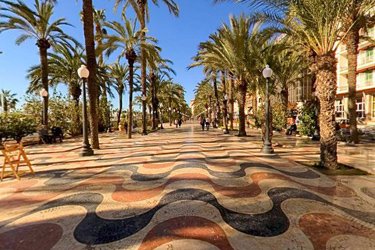
The reference to Alicante’s bond with the sea is clear in this beautiful paseo, 500 metres long, lined with palm trees, restaurants and bars with terraces overlooking the beach, benches where you can enjoy the cool air and beautiful sea views. A walk along the Explanada is almost a must for tourists and locals alike. People pass through it to go to the beach, to meet someone, to see and be seen. Especially in summer, it fills up with street artists, musicians, actors and craft stalls.
Alicante Central Market
8
Like every self-respecting Spanish city, Alicante also has its colourful and orderly Central Market. The monumental Art Deco façade leads into this paradise of fish, meat, fruit, vegetables and sweets, especially the typical Alicante nougat. It is located on Avenida Alfonso, in the city centre, and can easily be reached on foot. If you want to buy a typical gastronomic souvenir or have a quick, good and inexpensive lunch, this is the right place. Alicante Central Market is open every day until 2:30 pm and is closed on Sundays.
Provincial Archaeological Museum — MARQ
9
The Provincial Archaeological Museum, MARQ, of Alicante is a small but interesting museum, especially if you are passionate about Roman and Greek history. The museum is located in the building of the San Juan de Dios Hospital. Put like this, it might sound like the usual chronological, dusty and boring museum. Instead, the MARQ in Alicante is a modern, colourful and interactive museum that children and teenagers really enjoy.
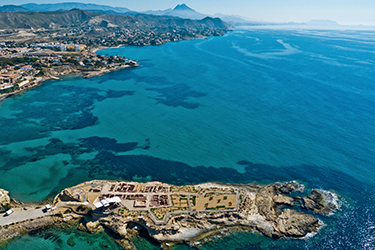
The rooms mainly contain finds from the area of Tossal de Manises, what remains of Lucentum, ancient Roman Alicante, which today is located 3.5 km from the centre. The ticket price also includes visits to Lucentum and the archaeological area of Illeta dels Banyets, 9 km from Alicante.
It is a peninsula stretching out into the sea, the result of a disastrous earthquake, from which an important archaeological area later emerged. Absolutely worth seeing for its position suspended over the sea.
Opening hours and ticket price for the MARQ in Alicante
Opening hours: Tuesday to Saturday 10 am-7 pm. Sundays and public holidays 10 am-2 pm.
Ticket price: €8 and includes visits to Lucentum and Illeta.
How to get there: on foot to Plaza Dr. Gómez Ulla.
Elche near Alicante
10
If there is a palm tree in your city, it is very likely that it was planted and grown in Elche, just a few kilometres from Alicante. Elx is the largest palm grove in Europe, and much of the city’s economic activity revolves around these plants. The Palmeral de Elche, declared a UNESCO World Heritage Site, contains more than 500,000 palm trees descended from those brought here by the Carthaginians.
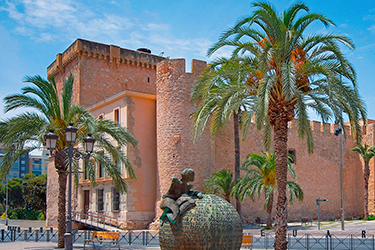
Even today, the care the city devotes to preserving this palm grove is extraordinary: a network of canals irrigates the palm trees and helps cope with the extremely hot local climate.
The “Huerto del Cura” is the most interesting part of the palm grove because it is home to a 200-year-old male palm tree called the Imperial Palm, which took this name in honour of Empress Sissi, who visited the garden in 1894.
If you are in the city on 14 and 15 August, do not miss the extraordinary “Misteri d’Elx” in the Basilica of Santa Maria, a 13th-century sacred drama performed only by men and children.
What to Eat in Alicante
M
Rice is the absolute star of Alicante cuisine: vegetables, meat and seafood, often combined, are the ideal companions for the local arroz. The ultimate synthesis of rice dishes is arroz a la alicantina, prepared with chicken, tuna, prawns, squid, garlic, tomato and peppers.
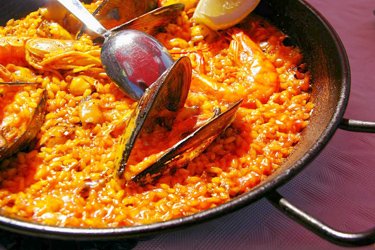
Also worth trying is the black version made with cuttlefish. All the ingredients in the sopa de pescado y marisco come from the sea. Among the meat ingredients, pork, cerdo, is the star in dishes such as cocido and olleta. Among the desserts, Alicante nougat stands out above all: the best in the world, made with whole, lightly toasted almonds. It can be enjoyed plain or in the many versions in which it is added to desserts or ice cream. Absolutely worth trying!
Where to Stay in Alicante
10
Overrun every year by thousands of tourists looking for sun and beaches, Alicante offers a good range of tourist accommodation, supplemented by that of the nearby Costa del Sol, especially Benidorm, which is just a few kilometres away. July and August are the busiest periods, when the city becomes a destination for British, German and Spanish holidaymakers.

If you do not like crowds, it may be better to choose June or September, when the weather is still pleasant and the mass of holidaymakers has already returned home. In high season, prices for a room in a 3-star hotel start from around €70 per night.
If you are looking for a hotel in Alicante, we recommend choosing from those offered by Booking.com. There are around 70 hotels in Alicante with prices, photos and reviews from guests who have stayed there before you. Go to Booking.com
Around Alicante
10If you have some time, you can explore the area around Alicante: there is the very lively Costa del Sol, with dozens of seaside and entertainment resorts, Malaga and also Valencia. Inland there is Murcia, and if you want to do something a little crazy, in two hours by high-speed train you can be in Madrid!