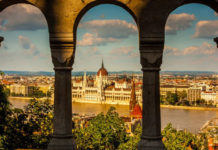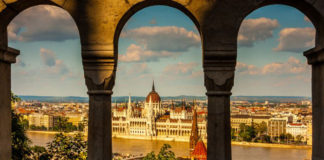

Two souls coexist in the city of Budapest: one ancient, Buda, and the other modern, Pest; one lives through its past, while the other keeps pace with the times. It is a symbiotic dualism that helps increase the charm of the “most beautiful city on the Danube”. Pest has the feel of a constantly moving metropolis, with its eclectic buildings, offices, expensive restaurants and fashionable boutiques. But it is also a popular district, with numerous open-air cafés, stalls and charming squares, always lively, where energy and tradition come together. There is no shortage of places of historical, cultural and artistic interest.
Around Pest
The old Jewish Quarter, with its narrow streets and the Great Synagogue, is certainly worth a visit, as is Belváros Church, one of the oldest churches in the city — 12th century — transformed by the Turks into a mosque, where you can find the mihrab, the prayer niche, one of the few remains of Ottoman rule in the capital. Pest also preserves wonderful Neo-Gothic, Baroque and Art Nouveau architectural treasures.
The Parliament Building
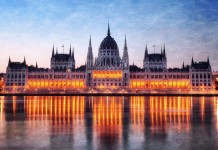
The Hungarian Parliament Building is one of the symbols of Budapest. It was built between 1885 and 1904 according to the grand design of Imre Steindl. For his work, the Hungarian architect drew inspiration from the Houses of Parliament in London and Cologne Cathedral, but he brought together elements from different styles in the building, creating one of the most beautiful and admired monuments in the country. For this reason, we have dedicated an entire page to the Parliament Building of Budapest.
Gresham Palace in Pest
Gresham Palace — 1906 — is one of the finest examples of Art Nouveau in the city. This splendid building overlooking the Danube was once the headquarters of the London-based Gresham Insurance Company; today it is a luxury hotel belonging to the Four Seasons chain.

With its façade of curved forms, decorated with crafted glass windows, mosaics, inlays, nature-inspired ceramic decorations and sculptures, it is one of Budapest’s architectural symbols. Among the most beautiful monuments, the Parliament Building stands out: an enormous Neo-Gothic palace with the appearance of a cathedral, dominating the panorama along the Danube on the Pest side.
Around Vörösmarty Square
The beating heart of Pest is Vörösmarty tér, an elegant square with luxury shops, traditional cafés, art galleries and the historic Gerbeaud pastry shop, famous for its sour cherries in cognac and, above all, for Dobos cake, exported all over the world. Around the square begins Budapest’s main shopping street:

Váci utca, the pedestrian artery lined with famous designer shops and prestigious jewellery stores, where it is very fashionable to stroll both during the day and in the evening. For less expensive and certainly more original shopping, the nearby Vásárcsarnok, the Central Market Hall, is truly worth a visit. It is the most beautiful market in the capital and the largest in Europe. It is an enormous red-brick building with a majolica-covered roof, topped by Neo-Gothic towers, and inside it alternates between colourful food stalls, small craft shops and unusual bistros. You can really find everything here at good prices, and leaving empty-handed is practically impossible!
Heroes’ Square in Buda
The solemn Heroes’ Square is striking for its scenic power: it is the largest square in Budapest, an imposing square with the Millennium Monument at its centre, built to celebrate the thousandth anniversary of the Magyar conquest.

A semicircular colonnade divided into two sections contains the statues of the most important figures in Hungarian history, topped by statues symbolising work, prosperity, wisdom, glory and peace. In the middle of the colonnade stands a 36-metre-high pillar, on top of which the Archangel Gabriel holds the Holy Crown and the apostolic cross.
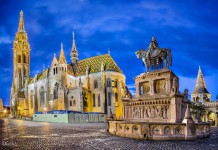
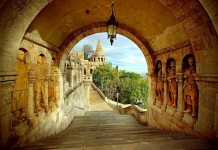
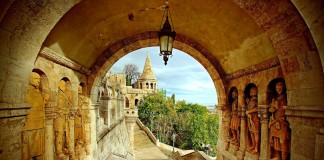
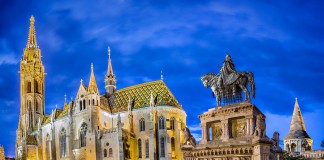
At its base stands a sculptural group dedicated to the legendary Árpád, who led the seven Magyar tribes to victory and to whom the conquest of the homeland in 1896 is attributed. It owes its name to the fish market that was held here in medieval times or to the guild of fishermen who, in the Middle Ages, were responsible for defending this stretch of wall. In front of the Bastion stands the equestrian statue of King Saint Stephen, founder of the Hungarian nation.
The monumental square is enriched by the Museum of Fine Arts, one of the richest museums in the world, and the Palace of Art, the largest exhibition space in Hungary, whose façades are inspired by Greek temples. The enormous square closes Andrássy Avenue, the UNESCO-listed avenue comparable in beauty and charm to a boulevard.
From Heroes’ Square to Városliget
Heroes’ Square is the gateway to Városliget, Budapest’s largest public park, covering an area of one square kilometre and a very popular place for leisure and entertainment in every season. Originally a marshy area, it was transformed into a splendid public park thanks to a major reforestation project begun in 1817. In 1896, for the Millennium celebrations, the first wooden and papier-mâché version of Vajdahunyad Castle — pictured — was built here to present the different architectural styles of Hungary: Romanesque, Gothic, transitional, Renaissance and Baroque. The different parts of the Castle are in fact copies of specific buildings found throughout the country. The architectural work was so successful that it was decided to rebuild it in stone between 1904 and 1908. Today it houses the Museum of Hungarian Agriculture. The Castle, which looks as if it has come out of a fairy-tale book, is reflected in the park lake, which invites visitors to go boating in summer and ice skating on an artificial rink in winter. The Castle, however, is not the park’s only attraction. Inside the park there are also the Municipal Circus, the Zoo, the Botanical Garden, the Amusement Park, the Garden of the Blind and the famous Széchenyi Baths. A curiosity for anyone who dreams of becoming a writer: in the park there is the Statue of the Anonymous — so called because a veil covers his face — representing King Béla’s scribe holding a pen. It is said that whoever touches that pen will become a great writer. Try it and let us know if it works!
Where to stay in Budapest
To book a hotel in Budapest, we recommend Booking.com. You can choose from around 200 hotels, with photos and reviews from previous guests.
Go to Booking.com