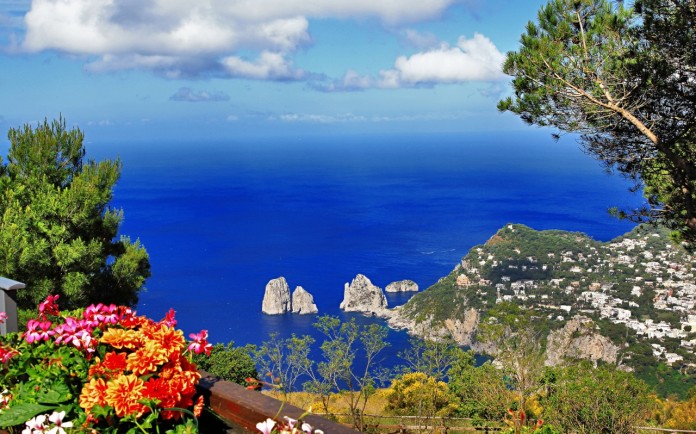
Capri, the Blue Island, lying like a siren in the Gulf of Naples, has always been synonymous with a chic and expensive holiday. But it doesn’t have to be that way: on these pages you’ll find the most beautiful things to see and do on Capri without spending a fortune. Its proximity to Naples and Sorrento makes Capri an ideal destination for a quick escape, even just for a day. From the legendary Faraglioni to the Blue Grotto, from the famous Piazzetta to Emperor Tiberius’s villa, you’ll discover how to savour the beauty of Capri at its very best.
If you’re looking for a hotel, we recommend choosing from those available on Booking.com. Around 120 hotels on Capri, with prices, photos and reviews from guests who have stayed there before you. Go to Booking.com
The Faraglioni of Capri
1
The Faraglioni are one of Capri’s great symbols. These three imposing rock stacks rise just off the island’s coast, surrounded by deep blue water, and can be reached by boat.
But where can you admire them without hiring a dinghy or booking a tour? The closest viewpoint is the small terrace of Punta Tragara, reached from Via Camerelle. From here, they seem almost close enough to touch. The most panoramic postcard view, however, is from the Gardens of Augustus, before taking Via Krupp.
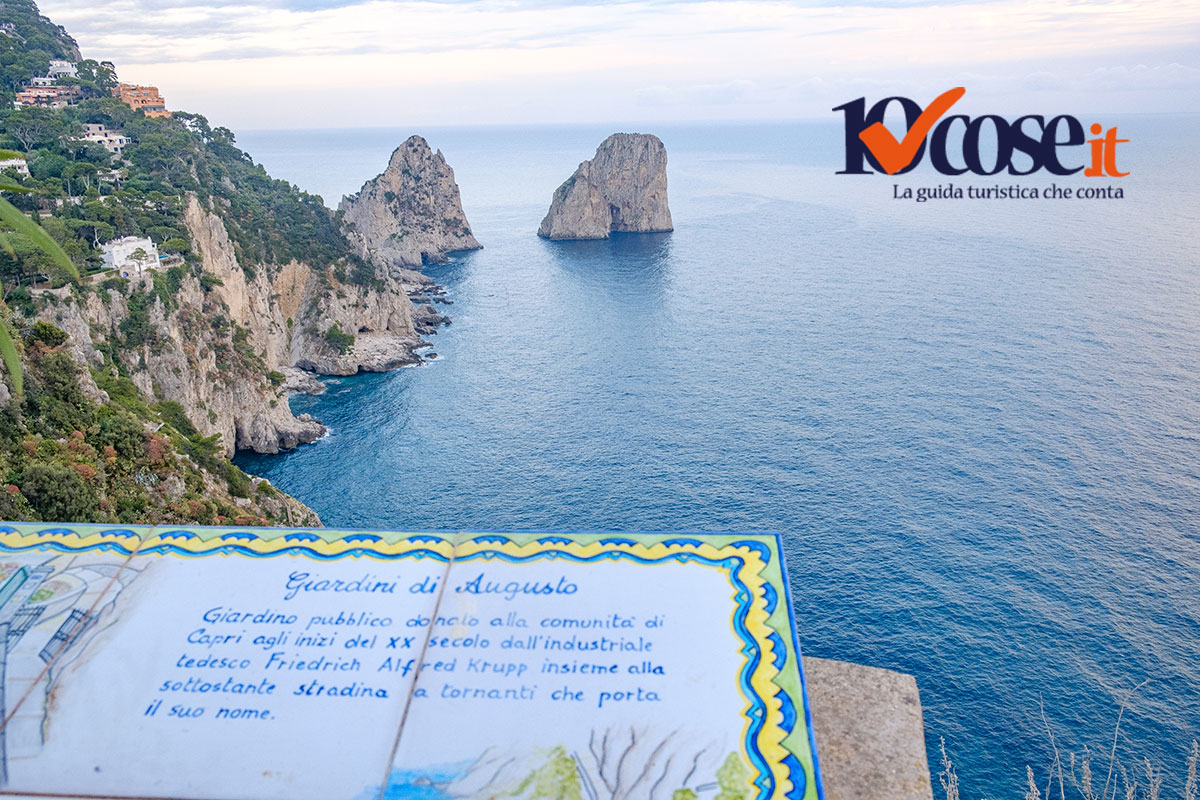
The tallest stack reaches an impressive 109 metres, while the one in the middle is pierced by a natural arch that can be sailed through by boat. The name “Faraglioni” comes from the Greek Pharos, referring to the great fires once lit here to guide sailors along their route.
Did you know that each Faraglione has its own name? The one closest to the mainland is called Saetta, the one in the middle is Stella, and the outermost one is Scopolo.
Together with the summit of Monte Solaro, Scopolo is home to the only specimens in the world of the Blue Lizard. It belongs to the same family as the common lizard, but thanks to isolation and mimicry it has taken on the colours of Capri’s sea and sky.
Boat trips to the Faraglioni depart mainly from Marina Grande — the harbour where hydrofoils and ferries arrive — and prices start from around 10 euros. Check whether swimming stops, aperitifs on board and other services, such as a visit to the Blue Grotto, are included.
The Blue Grotto of Capri
2
The famous Blue Grotto of Capri has been known since the time of Emperor Tiberius, who had a passage built from his villa to the grotto so he could bathe there.
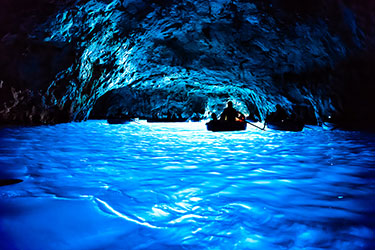
Its fame and its name come from the extraordinary blue of the water inside: in fine weather, the sea seems to be lit from beneath, and you can see countless tiny silver fish swimming just below the surface.
Entrance to the Blue Grotto is by small rowing boats, each carrying no more than four people.
The entrance is only one metre high, so visitors must lie down at the bottom of the boat while the boatman grips the chain fixed to the rock wall and lets the boat glide into the cave. The wait to enter the grotto, especially in high season, can be as long as an hour: a hat, sunscreen and water are recommended.
The visit lasts about 5 minutes, and swimming into the grotto or diving is not allowed.
Opening hours and ticket price for the Blue Grotto of Capri
Opening hours: every day, from 9 am to 5 pm. The grotto cannot be visited in rough seas or strong winds. This cannot be predicted in advance, as the boatmen decide each morning whether visits can go ahead. It is very difficult to find it open in winter.
Closed: 25 December and 1 January.
Ticket price: full ticket 14 euros.
How to get there: from the port of Marina Grande with the boatmen, or from Anacapri by following the signs.
Monte Solaro on Capri
3
At 589 metres, Monte Solaro is Capri’s “mountain” and the perfect place to let your gaze wander from the island lying at your feet to the mainland, with Naples and Salerno, set against the endless blue of the sea.

Many species of birds nest here, including the Peregrine Falcon, and visitors can admire the typical flora and fauna of the Mediterranean.
The best time for an excursion to Monte Solaro is spring, when the heady scents of freesias and wisteria guide you along the paths.
On Monte Solaro, two places are well worth a visit: the Hermitage of Santa Maria a Cetrella, once a spiritual retreat for monks, and the remains of the Barbarossa Castle, built around the 11th century and stormed in 1535 by the Turkish admiral Khair-ad-din, the feared Barbarossa himself.
Opening hours and ticket price for Monte Solaro
Opening hours: open every day of the year, although the best period for walks is from April to September.
Ticket price: free on foot. €9 or €12 by chairlift.
How to get there: Monte Solaro can be reached by chairlift from Piazza Vittoria in Anacapri — €12 return ticket or €9 one way — or on foot, via a hike lasting about one hour and thirty minutes from the centre of Anacapri.
Villa Jovis on Capri
4
Villa Jovis, the villa dedicated to Jupiter by the Roman emperor Tiberius, is one of the best-preserved examples of Roman architecture in the Mediterranean. It was not the only residence the emperor had built on Capri, but it is certainly one of the most imposing: the complex extends over some 7,000 square metres on the far eastern promontory of Capri.

From here, the view takes in Ischia and Procida, the Gulf of Salerno and the Cilento coast, in a truly dreamlike setting. The villa was built in the 1st century BC, and the emperor spent 12 years here, governing the fate of the Roman Empire from the island.
Today, its remains can be visited: at the centre are large cisterns used to collect rainwater, while all around are a series of rooms once divided between those reserved for the emperor and those used by his aides, slaves and the throne room.
The remains of the villa were plundered during the Bourbon period, but the site was restored in 1932 thanks to the work of Amedeo Maiuri, then director of the National Archaeological Museum of Naples.
Opening hours and ticket price for Villa Jovis
Opening hours: Thursday to Sunday.
January – February: closed
March: 10 am-4 pm
April – May: 10 am-6 pm
June – September: 10 am-7 pm
October: 10 am-6 pm
November – December: 10 am-4 pm
Ticket price: €6
How to get there: route 1: from the Piazzetta — Piazza Umberto I — along Via Le Botteghe, Via Fuorlovado, Via Croce and Via Tiberio.
Route 2: also from Piazza Umberto I, along Via Longano, Via Sopramonte and Via Tiberio. The route is entirely uphill and takes about 45 minutes.
The Piazzetta of Capri
5
Piazza Umberto I, the social heart of Capri, is known throughout the world as the “Piazzetta”.
This is where people meet for a coffee, exchange a few words, enjoy the view from the terrace and perhaps indulge in a little VIP watching.
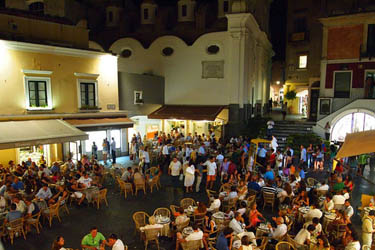
Until the last century, Capri’s small square hosted market stalls; today, it is the symbol of Capri’s dolce vita, where locals, international jet-set figures and ordinary visitors mingle at the café tables overlooking the stone-paved square.
The main streets for exploring Capri start from the Piazzetta, leading into the famous Via Camerelle, Capri’s shopping street, lined with the finest boutiques of international fashion houses.
Make the most of a stop in the Piazzetta for an aperitif, and perhaps visit the nearby Centro Caprense Ignazio Cerio, a small museum preserving 20,000 archaeological and natural-history finds from the island, bearing witness to its history.
Anacapri
6
At the foot of Monte Solaro, just 15 minutes by bus from the lively scene around the “Piazzetta”, lies Anacapri, the largest municipality on the island. A maze of colourful lanes and narrow alleyways shaded by bougainvillea reveals little squares, beaches and historic places all waiting to be discovered.

Indeed, this is where the chairlift to the summit of Monte Solaro departs. Alternatively, by following Via Pagliaro, you can reach the famous Blue Grotto by land; or, if you love wild nature and want to enjoy the spectacle of the sun setting over the sea, you can head to Punta Carena and its imposing lighthouse, the largest in Italy after the one in Genoa.
Anacapri also preserves one of the most beautiful and representative churches of Neapolitan Baroque: the Church of San Michele Arcangelo, with its magnificent majolica floor depicting the expulsion of Adam and Eve from Paradise.
Another unmissable attraction is the Casa Rossa, whose façades are marked by a vivid Pompeian red. Once the residence of the American colonel John Clay Mackowen, it now houses a permanent exhibition of paintings portraying Capri and Anacapri between the 19th and 20th centuries, as well as an extensive collection of archaeological finds discovered in the Blue Grotto.
Axel Munthe’s Villa
7
In Anacapri, Villa San Michele, also known as Axel Munthe’s villa, is well worth a visit. Munthe was the personal physician of Queen Victoria of Sweden and first came to Capri in 1876, at the age of 19. He was immediately struck by the beauty of the island and, in particular, by the Chapel of San Michele, then in ruins.
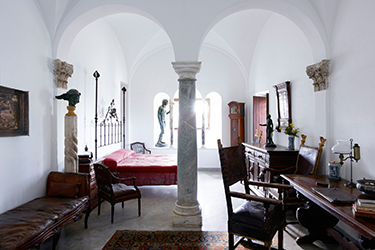
So began his lifelong love affair with Capri and the construction of this jewel, now a museum. The villa owes its fame not only to its beauty, but also to the book “The Story of San Michele”, which Munthe himself published in 1929 and which remains one of the most translated Swedish books in the world.
In the book, he tells of the discovery of a 3,200-year-old sphinx, whose origin and finding are still shrouded in mystery, and of a Medusa head uncovered during the construction of the villa.
An ancient Roman villa once stood on this site and yielded other treasures that are now part of the museum. The collection also includes objects that Munthe bought, found on the seabed or received as gifts: a head of Ulysses, statues of Apollo and Hypnos, god of sleep, a head of Bacchus and a statue of Dionysus.
Munthe’s idea was to create a Greek temple filled with space and light, because, as he wrote, “the soul needs more space and light than the body”. What makes the villa so striking is the furnishing of its rooms, the perfect integration of the building with the garden, and the view over the sea and Naples.
Opening hours and ticket price for Axel Munthe’s villa
Opening hours:
January and February 9 am-3.30 pm
March 9 am-4.30 pm
April 9 am-5 pm
May to September 9 am-6 pm
October 9 am-5 pm
November and December 9 am-3.30 pm
Ticket price: €10
Belvedere Tragara on Capri
8
If you’re in Capri, you really shouldn’t miss the view from the Belvedere Tragara, one of the most spectacular on the whole island. The walk to get there from the Piazzetta is an experience in itself, as it lets you soak up Capri’s unmistakable colours and scents.
The walk takes around 15–20 minutes and is well signposted: from Piazza Umberto I you pass the famous Hotel Quisisana, continue along Via Camerelle, Capri’s street of shopping and strolling, and then carry on along Via Tragara, the road lined with historic villas.
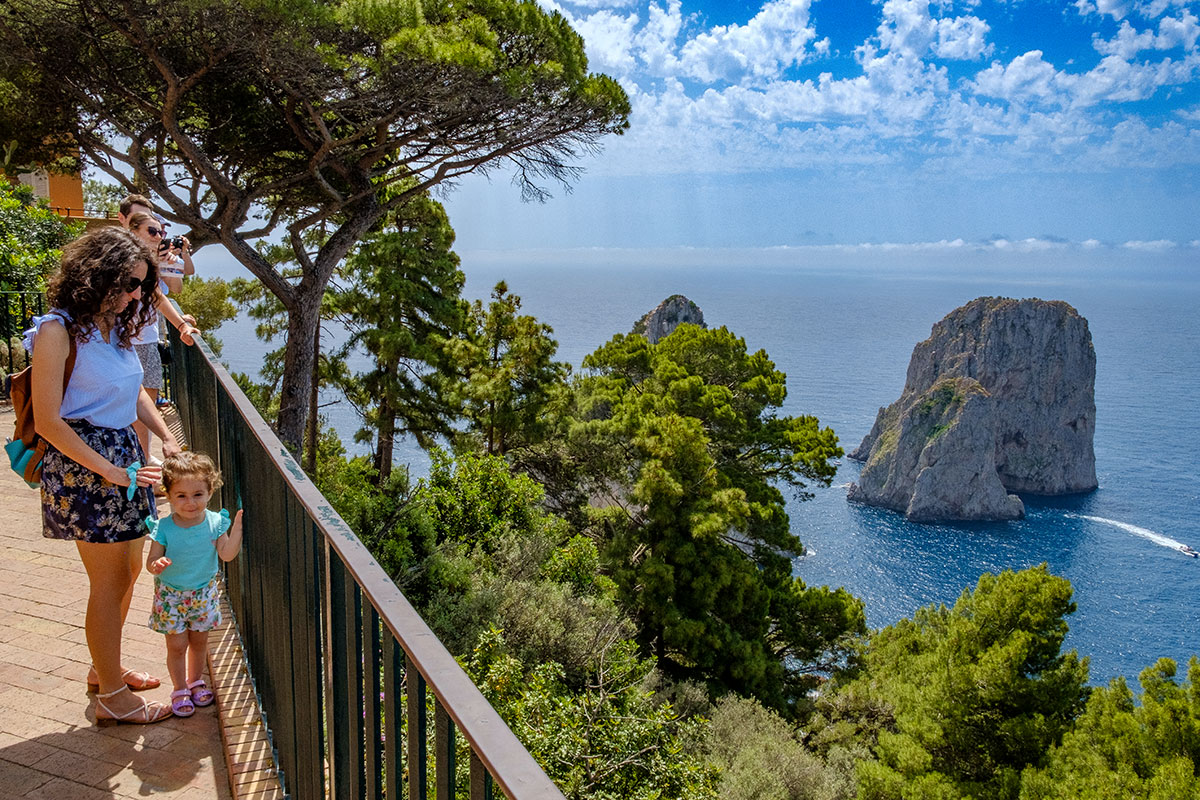
Once you reach the Belvedere, all that’s left to do is enjoy the view — and of course take the obligatory photos and selfies. Admire the Faraglioni from a unique and close-up perspective, the bay of Marina Piccola, the harbour and the boats moored offshore. In the background, Monte Solaro and the houses set into the hillside complete the scene.
If you’re staying in Capri for a few days, it’s worth coming to the belvedere at different times of day to appreciate the panorama in all its moods: in daylight, in the evening, and above all at sunset, which is by far the most magical moment. From here you can continue down towards the Faraglioni and follow Via del Pizzolungo all the way to the Natural Arch, taking in the Monacone rock and Villa Malaparte along the way.
The path leading to the belvedere is paved and has no particularly demanding climbs or descents, though it’s still best to avoid the hottest hours of the day. In high season it is often crowded, so it’s a good idea to come early in the morning, which is also the most pleasant time temperature-wise.
It’s advisable to bring some water with you, as prices at the kiosk are quite steep — very much in keeping with Capri’s average.
Behind Belvedere Tragara stands the five-star luxury Hotel Punta Tragara, designed by Le Corbusier. It is one of the island’s most iconic and prestigious hotels, and from its panoramic terrace it feels as though you could almost touch the Faraglioni with your fingertip.
The Beaches of Capri
9
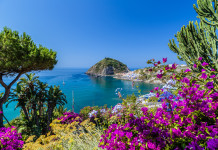
Capri is a rocky island: you won’t find long sandy beaches here, but rather pebbly coves and platforms from which to dive into the sea. The reward, however, is magnificent water: the seabed is transparent, with shimmering shades of green and blue. On Capri there are both free beaches and beach clubs equipped with umbrellas, sunbeds, showers, bars and restaurants.

In the harbour area, at Marina Grande, you’ll find the island’s largest beach: a pebbly bay overlooking the blue sea.
It can be reached in just a few minutes from the hydrofoil terminal and has both a free section and an equipped area with sunbeds, umbrellas, a bar and a restaurant. On the opposite side of the island are the beach clubs of Marina Piccola, which can be reached on foot through the centre or by bus.
Here too, there are two free beaches and several equipped beach clubs: these are small pebble coves, among the most popular with both locals and visitors. If you love breathtaking sunsets, don’t miss a swim in the area around the lighthouse: here the sun sinks into the sea in a setting of rare beauty. There are free areas and private beach clubs, and the beach can be reached by bus or with a walk of about an hour from the centre of Anacapri.
Boat Tour Around the Island of Capri
10
The best way to experience Capri from the sea is with a boat tour around the island. At the port of Marina Grande, several companies offer shared boat tours around Capri.

Departures are very frequent, and you can choose between one-hour and two-hour excursions. Most island tours also include a stop at the Blue Grotto for those wishing to visit it — the entrance ticket to the grotto is paid separately.
The boat tour around Capri starts from Marina Grande and follows the island’s coastline clockwise, passing some of the most beautiful points along its rugged shores, such as Villa Jovis and the Faraglioni. Continuing south, the boat skirts Marina Piccola: here the coast is full of inlets, hidden bays and sea caves, including the Green Grotto, named after its emerald reflections.
The tour continues past the imposing silhouette of the lighthouse and along Capri’s hidden side, between Mediterranean vegetation and sunlit rocks. The Blue Grotto is located in this area.
How to take a boat tour around the island of Capri
From the port, every day from 9 am to 5 pm, weather permitting.
Ticket price: from €17.
What to Eat on Capri
M
You cannot talk about Capri without mentioning the Caprese salad: tomato and mozzarella, olive oil, salt, oregano and basil.
A simple, unmistakable dish, famous all over the world. Its secret lies in its simplicity, but above all in the ingredients, as fragrant and full of flavour as the rest of Capri’s cuisine. 
Caprese salad is perfect both as a starter and as a dish in its own right. Among Capri’s first courses, you’ll find ravioli capresi, homemade with Capri caciotta cheese and marjoram, as well as fish-based dishes such as linguine with scorpionfish sauce.
Fish, crustaceans and seafood reign supreme among the main courses: don’t miss the squid with potatoes and the mussel soup.
The meal ends with torta Caprese, a delicious cake made with almonds and cocoa, and Limoncello prepared with Capri lemons, served in chilled glasses.
Where to Stay on Capri
HOf course, Capri is not known as a budget island, but finding a place to stay is less expensive and less difficult than you might think.

Especially out of season, the island offers accommodation in small hotels, bed & breakfasts and apartments at prices accessible to a wide range of travellers. Naturally, in high season or in the major luxury hotels, prices can be frighteningly high. The price is influenced by the location — panoramic or otherwise — and by proximity to the island’s chicest spots, such as the Piazzetta and the shopping streets. The range is therefore very varied, with prices starting from around 90 euros per night for a double room, breakfast included.
If you’re looking for a hotel on Capri, we recommend choosing from the hotels available on Booking.com. Around 120 hotels with prices, photos and reviews from guests who have stayed there before you. Go to Booking.com