At the National Gallery of the Marche, inside the Ducal Palace of Urbino, there is a painting that is a symbol of Italian art: the “Ideal City“, attributed, depending on the critic, to Piero della Francesca, Leon Battista Alberti, Luciano Laurana, Francesco di Giorgio Martini and other artists.
Admiring this painting, which, like the Mona Lisa, is part of everyone’s collective imagination, is the best way to understand what Urbino represented for Italian and world art.
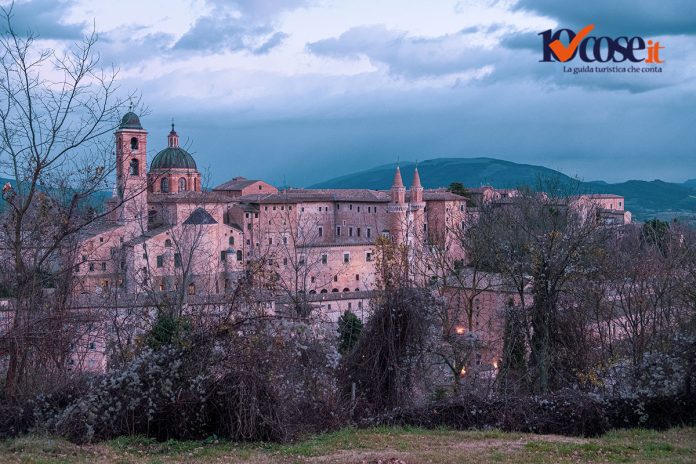
With its rigorous perspective, it embodies the dream of Federico da Montefeltro, shared by the artists around him, of building the ideal city of the Renaissance. Wandering through its alleys, palaces and squares, you realize that the Duke did not fall far short of his goal.
The historic center of Urbino is, in fact, protected as a UNESCO World Heritage Site. In just a few hundred square meters, there is a concentration of heritage that shaped European art and architecture for many decades, and which you can enjoy just a few kilometers from home.
On this page, we recommend the 10 things you absolutely must see in Urbino.
If you are looking for a hotel in Urbino, we recommend choosing from those offered by Booking.com. There are around 20 hotels with prices, photos and reviews from previous guests. Go to Booking.com.
The Ducal Palace of Urbino
1
Calling the Ducal Palace simply a “palace” is definitely an understatement: it is a small fortified city commissioned by Federico da Montefeltro and built starting in 1444.
Cultured and refined, Federico wanted the Ducal Palace of Urbino to surpass all the other princely residences in Italy in beauty.
It was not just a way to celebrate his own power: he wanted to transform Urbino into the “Ideal City“, of which the Palace was to be the highest expression.
He also loved artists and wanted a place where he could host them and let them work. The construction involved several architects over more than 30 years.
The works were carried out successively by Maso di Bartolomeo (the Palazzetto della Jole, the Melaranci apartment and part of the courtyard), Luciano Laurana (the porticoed courtyard, the grand staircase, the Library, the Hall of Angels, the Audience Hall, the upper loggias, the sacred area with the studiolo) and Francesco di Giorgio Martini, who completed the unfinished works.
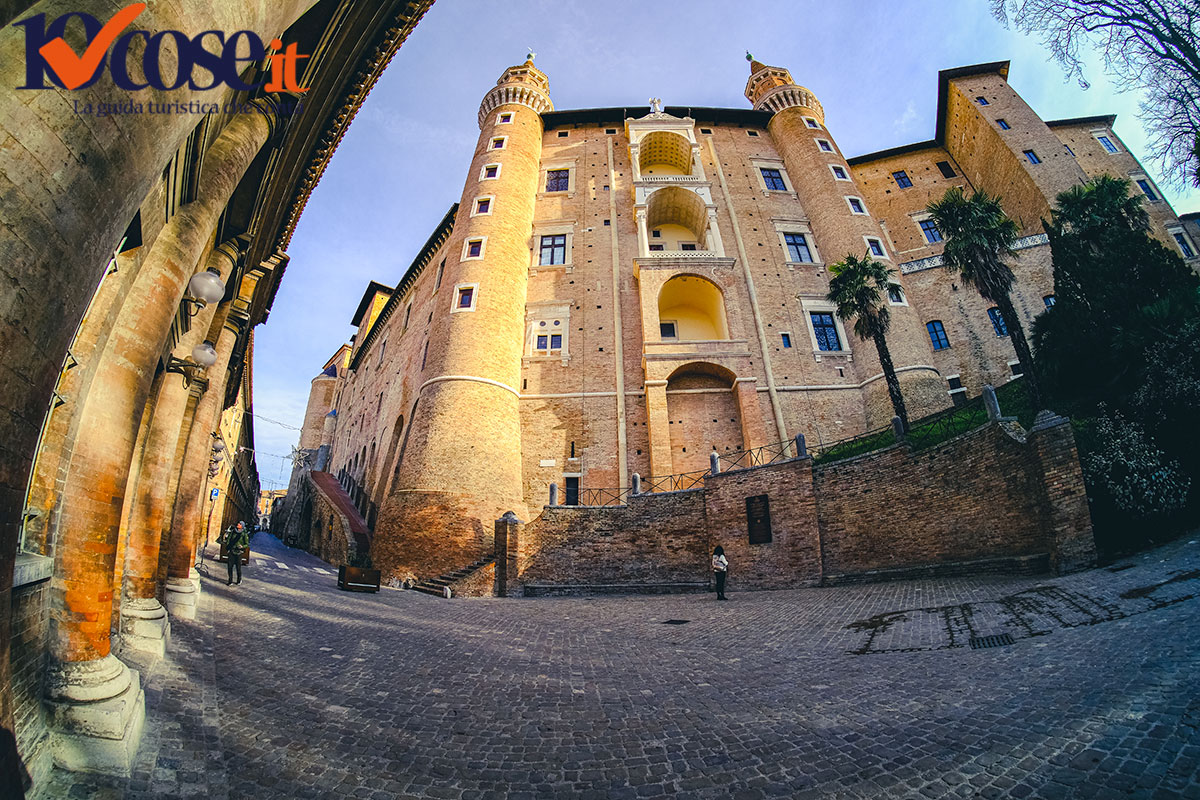
The two most beautiful examples of this thirty-year project are the “Façade of the Torricini”, perhaps the most photographed spot in Urbino, and the “Studiolo“, rightly described as a “treasure chest of beauty, refinement, perspective…“.
Today the Ducal Palace houses the National Gallery of the Marche, with works by Raphael, Titian and Piero della Francesca (point 2).
Opening hours and ticket price for the National Gallery of the Marche / Ducal Palace
Opening hours: Tuesday to Sunday: from 8:30 am to 7:15 pm, with the ticket office closing at 6:15 pm. Closed: Monday, December 25, January 1
Ticket price:
€8.00 Full price
€2.00 Reduced
€1.00 Booking fee
€12 ticket also including the Fortress of Gradara.
How to get there: in the center of Urbino, you cannot miss it.
National Gallery of the Marche in Urbino
2
Around 80 rooms of the Ducal Palace have been converted into a museum and house the works of the National Gallery of the Marche. The collection includes works from the 14th to the 17th century, mainly paintings, but also furniture, sculptures, tapestries and drawings. The main works are on the first floor, divided among the apartments where the Duke and his family lived. In the Duke’s Apartment there are two masterpieces by Piero della Francesca: The Flagellation of Christ and the Madonna of Senigallia.

Then come the Duke’s Studiolo and several state rooms, where the “Ideal City”, the Communion of the Apostles by Justus of Ghent and the Profanation of the Host by Paolo Uccello are displayed.
At least one work by Raphael could not be missing: Portrait of a Gentlewoman, alongside Titian’s Resurrection and Last Supper. On the second floor, works from the 16th and 17th centuries by Barocci, Gentileschi and Guerrieri are displayed.
Opening hours and ticket price for the National Gallery of the Marche / Ducal Palace
Opening hours: Tuesday to Sunday: from 8:30 am to 7:15 pm, with the ticket office closing at 6:15 pm. Closed: Monday, December 25, January 1
Ticket price:
€8.00 Full price
€2.00 Reduced
€1.00 Booking fee
€12 ticket also including the Fortress of Gradara.
How to get there: in the center of Urbino, you cannot miss it.
Raphael’s House in Urbino
3
Raphael’s birthplace houses only a few original works by the great painter from Urbino, almost all from his youth, but it is worth a visit because art history passed through here.
Located in the artisans’ district, in this house Raphael Sanzio was born on March 28, 1483 and spent his childhood training in his father’s workshop, an artist at the court of Federico da Montefeltro.

After various events, in 1873 the house was acquired by the Accademia Raffaello and since then has housed works connected to Raphael’s life and his time.
On the ground floor is the workshop of his father Giovanni Santi, now used for temporary exhibitions. On the first floor there are copies of Raphael’s paintings and tributes by other artists to the great painter from Urbino.
In the “Bedroom of Raphael” there is a fresco depicting the “Madonna and Child“, considered an early work created together with his father. On the first floor there is also a small courtyard with a well and a washbasin where the colors used for the works were ground.
Opening hours and ticket price for Raphael’s House
Opening hours: Monday to Saturday: 10:00 am – 1:00 pm / 3:00 pm – 6:00 pm. Sundays and holidays: 10:00 am – 1:00 pm / 3:00 pm – 6:00 pm.
Closed: December 25 and January 1.
Ticket price: €4.00 for visitors over 16; free up to 15 years old
How to get there: in the center of Urbino, at Via Raffaello 57
The Oratories of San Giovanni and San Giuseppe in Urbino
4
Do not be fooled by the plain Gothic façade from the early 1900s.
The masterpiece of the Oratory of San Giovanni is well hidden beyond the entrance door and is painted on the walls: it is the cycle of frescoes by the brothers Lorenzo and Jacopo Salimbeni from San Severino (around 1400), the most important interpreters of the late Gothic style in the Marche.
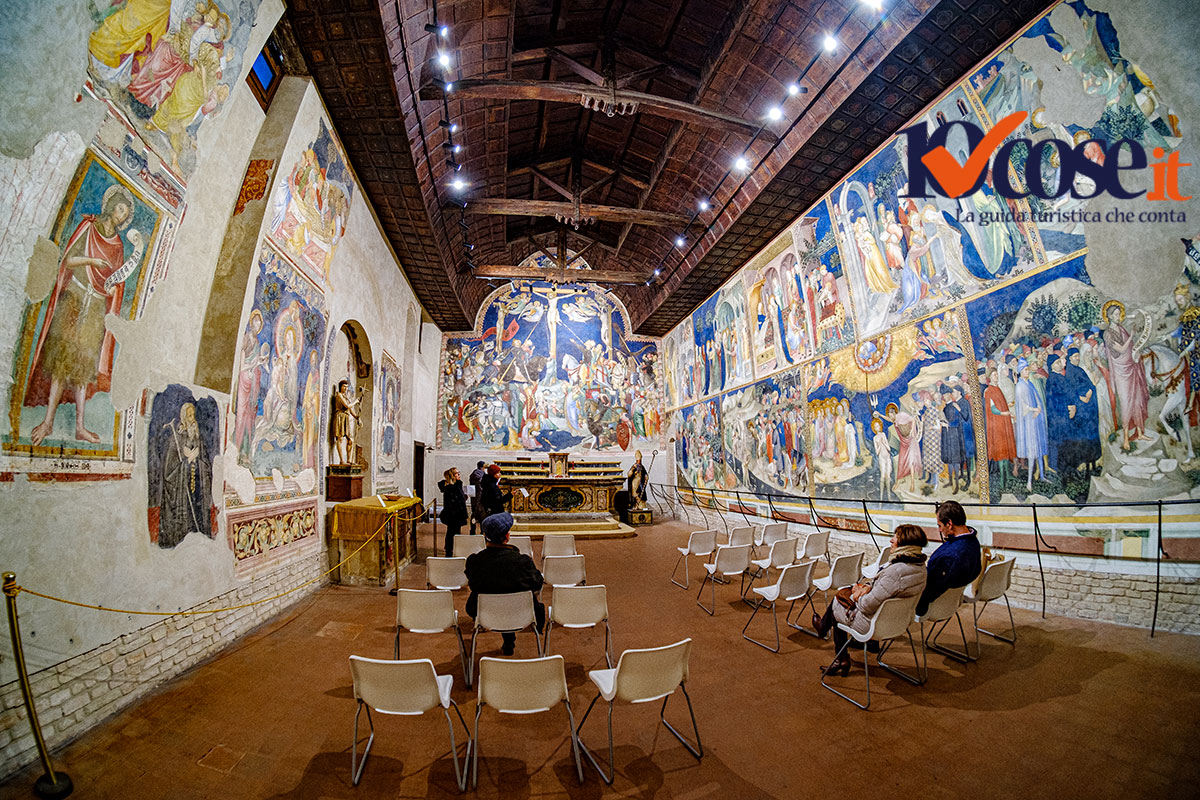
You are immediately struck by the “Crucifixion“, which covers the entire wall of the apse: your eyes go to the three crosses, as classical iconography dictates.
Jesus is in the center and the two thieves are on either side: but little by little, as you move closer and look at the details, you realize how much humanity revolves around the Passion of Christ.
Despair and indifference animate the scene, moving it from religious reality to earthly reality. The oratory takes its name from the frescoes on the right wall, which, in two levels, lower and upper, illustrate the life of Saint John the Baptist. On the left wall there is a Madonna of Humility. In the same little street where the Oratory of San Giovanni is located, there is also the Oratory of San Giuseppe.
It is especially worth a visit for the stucco nativity scene from 1560, made with life-size sculptures and considered the oldest nativity scene in the world.
The church of the Oratory has a single nave and a rectangular layout. The walls, apse and vault are frescoed with paintings by Carlo Roncelli.
Opening hours and ticket price for the Oratory of San Giovanni and San Giuseppe
Opening hours: every day from 10:00 am to 1:00 pm and from 3:00 pm to 6:00 pm
Closed: December 25 and January 1.
Ticket price: combined ticket Oratory of San Giovanni + Oratory of San Giuseppe: full price €5.00. San Giovanni only €3
How to get there: in the center of Urbino, at Via Raffaello 57
The Cathedral of Urbino
5
The Cathedral of Urbino is the most important church in the city, but certainly not the most beautiful. Unfortunately, at the moment it is closed for restoration work that was supposed to end in 2018 but seems endless.
History has not been kind to the churches that have stood on this site: the first building dates back to 1021, replaced by a new church built by Francesco di Giorgio Martini, Federico da Montefeltro’s trusted architect, who also worked for many years on the nearby Ducal Palace.
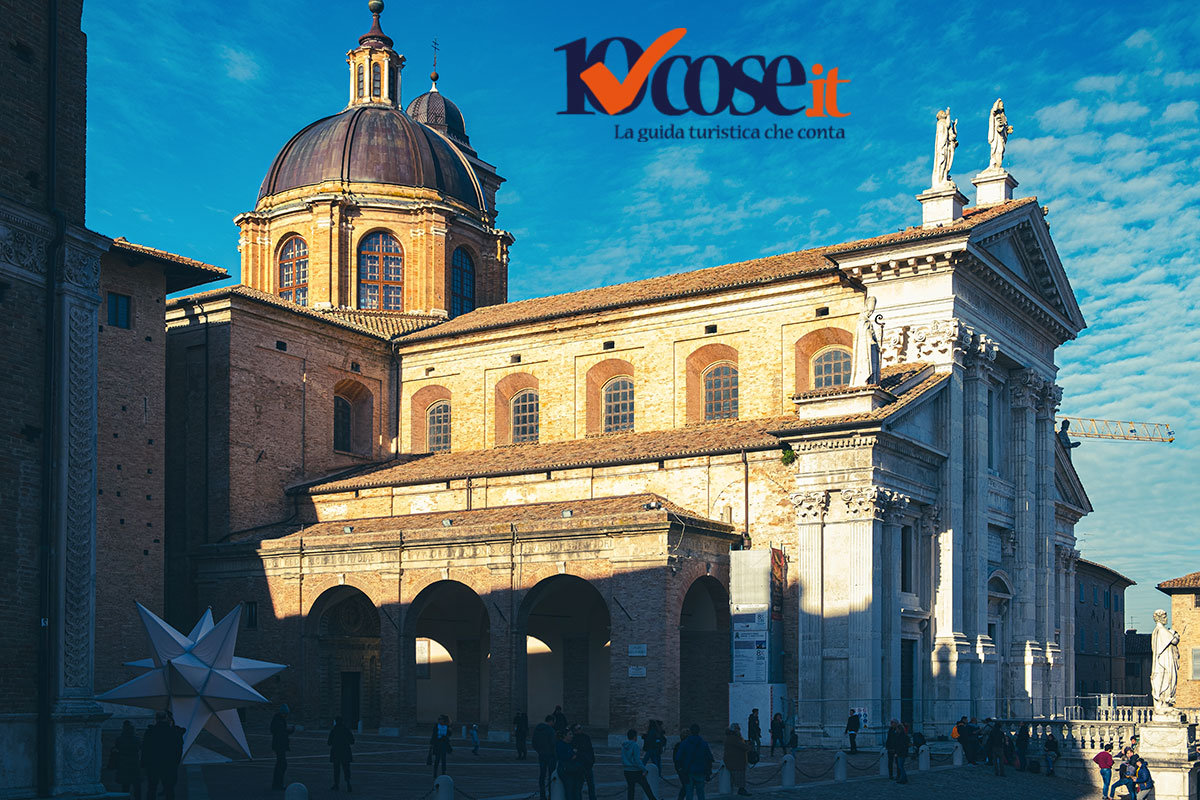
After the earthquake of January 12, 1789, the Roman architect Giuseppe Valadier was commissioned to build the current Cathedral in neoclassical style.
Inside there are two beautiful canvases by Federico Barocci: the Martyrdom of Saint Sebastian and the Last Supper. The most interesting part of the Cathedral is the Crypts, which over the centuries housed a Confraternity.
During the Second World War, to protect them from bombs and the Germans, the crypts housed the treasures of St. Mark’s Basilica in Venice.
In the crypts there are several chapels and the Corridor of Forgiveness: according to an ancient tradition of Urbino, people secured forgiveness for their sins by walking through this corridor several times on Easter Monday.
Opening hours and ticket price for the Cathedral of Urbino
Opening hours: every day from 7:30 am to 1:00 pm and from 2:00 pm to 8:00 pm;
Ticket price: free. Museum + Cathedral Crypts entrance €3.50
How to get there: next to the Ducal Palace
Church of San Bernardino in Urbino
6
Two kilometers from the historic center, in the middle of the countryside, the austere brick silhouette of the Church of San Bernardino appears.
The church, also known as the Mausoleum of the Dukes, was commissioned by Federico da Montefeltro to house his remains after his death.
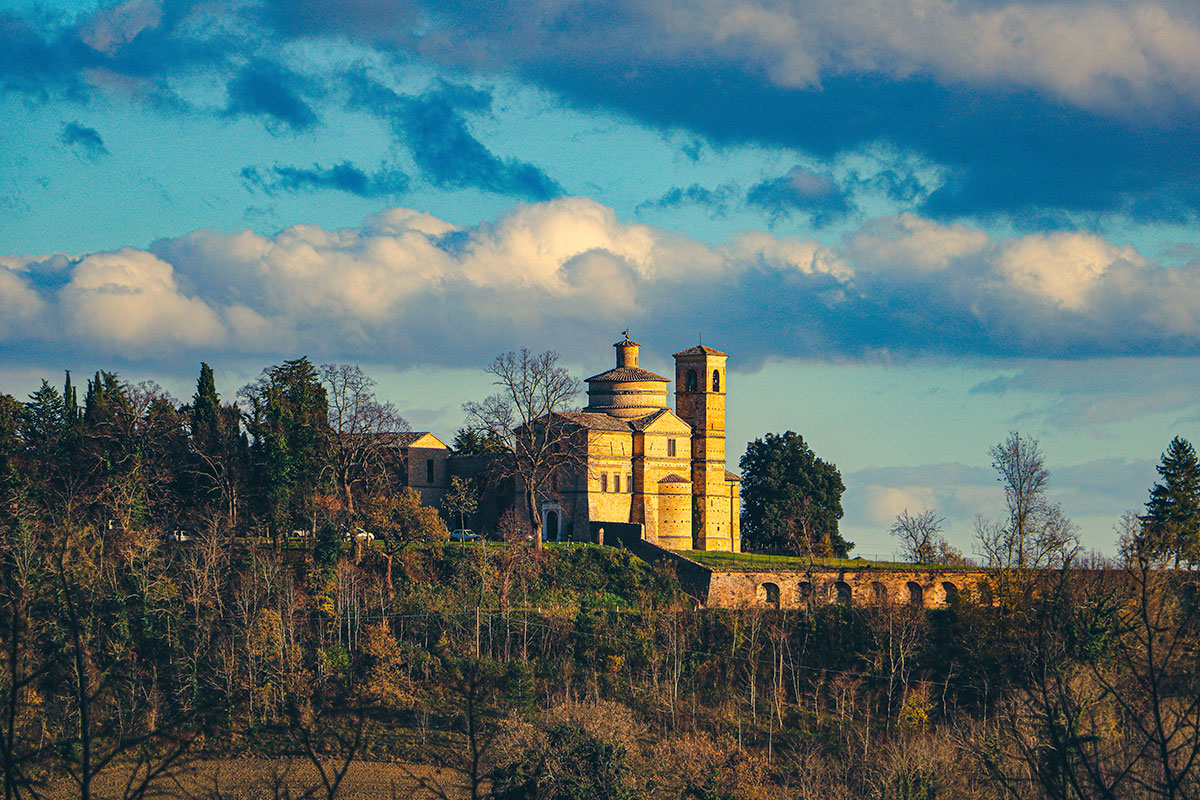
Historians believe that the building was the result of a collaboration between Francesco di Giorgio Martini, Federico da Montefeltro’s trusted architect, and Bramante, whose style can be sensed above all in the simplicity of the interior.
Today the church does not house any major works, but for many centuries the altar was embellished with the extraordinary “Montefeltro Altarpiece“, painted by Piero della Francesca between 1472 and 1474.
The altarpiece is now known as the “Brera Altarpiece” because it has been kept since 1811 in the Milanese Pinacoteca, where it was taken following the Napoleonic looting.
Opening hours and ticket price for the Church of San Bernardino
Opening hours: every day from 10:00 am to 6:00 pm
Ticket price: free
How to get there: 2 km from the center, by car towards “Cesane sul colle” of San Donato.
Helical Ramps and Raphael Theater in Urbino
7
Urbino is a vertical, steep city, with narrow little streets. In the 15th century, it was therefore the ideal place for anyone who wanted to organize an ambush against the powerful figure of the day.
The danger was very clear to Federico da Montefeltro, who had a bastion built right at the foot of the Torricini of the Ducal Palace, and inside it the helical ramps.
Thanks to this magnificent work of engineering, the Duke could reach the ducal stables directly from the Palace. To make it even more complete, gun ports were also added to the bastion, allowing control over the Mercatale area below.
Raphael’s theater
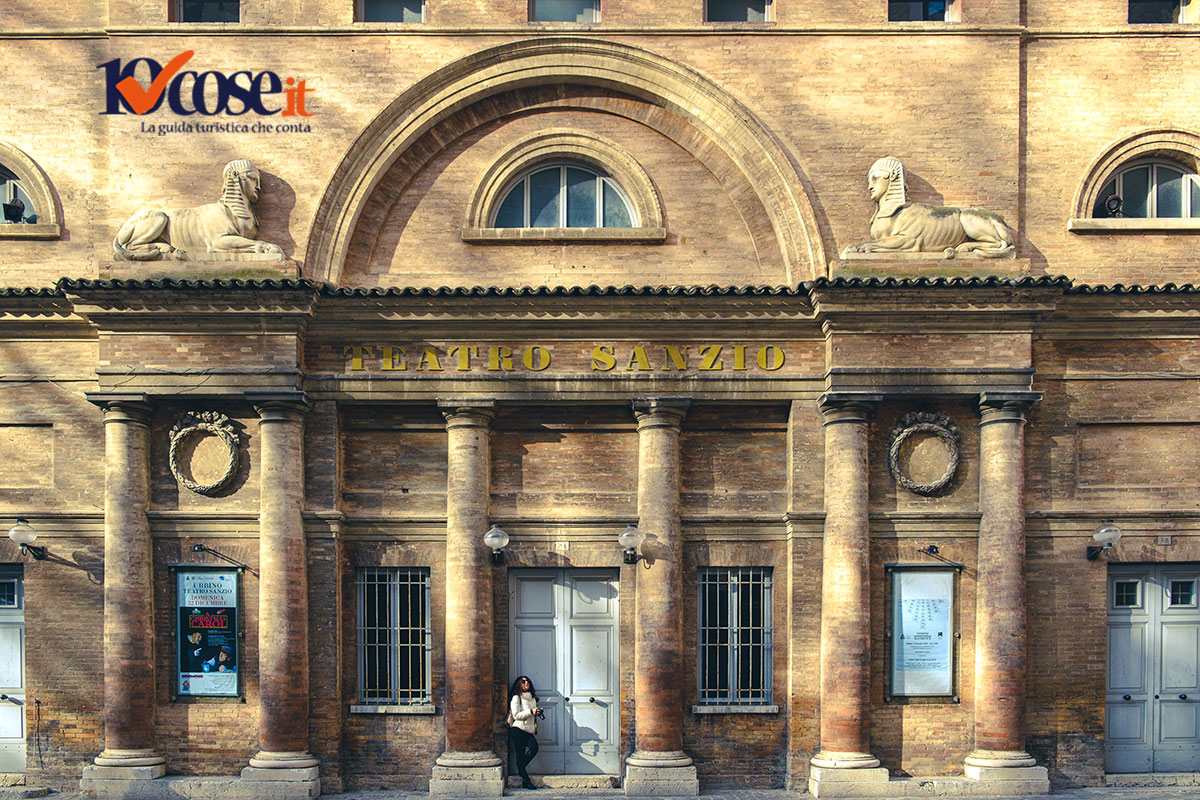
In the 19th century, the Raffaello Sanzio Theater was built over the bastion, a choice that caused controversy because it was considered an element foreign to the city’s architecture. Restored in the 1970s, today the Ramps are a slow and panoramic, but very tiring, way to reach the historic center.
Unfortunately, the theater cannot be visited because it is almost always closed. A curiosity: right in front of the theater entrance there is a curved wall. If you stand at the two ends of the wall and try to speak very softly, the person on the other side will hear you.
It was not done on purpose, but it is an acoustic effect discovered by chance by some women from Urbino who were gossiping about one another!
Parco della Resistenza and Albornoz Fortress
8
If you have ever seen a panoramic photo of Urbino, it was most likely taken from Parco della Resistenza.
Going up towards Raphael’s House along the steep street named after the artist, you reach a magnificent park dominated by the Albornoz Fortress.

Parco della Resistenza is a panoramic green space where students from the nearby Academy of Fine Arts spend their time outdoors, when Urbino’s weather allows it!
Not many tourists venture up here, so it is a place of absolute peace where you can spend a few hours in the greenery and admire all the beauty of Urbino from above.
The fortress, which today houses a museum dedicated to medieval weapons, was built to defend the city from Cardinal Albornoz and has been altered several times over the centuries.
Opening hours and ticket price for the park and fortress
Opening hours: park open every day from 9:00 am to 9:00 pm.
Fortress: 9:00 am-1:00 pm and 3:00 pm-6:00 pm.
Ticket price: park free. Fortress €1.50.
Around Urbino: Gradara
9
For many people who did not appreciate the Divine Comedy at school, the name Gradara may not mean much. The story of Paolo and Francesca, told by Dante, takes place in the castle of this medieval village.
“Love, that absolves no beloved one from loving, seized me so strongly with delight in him, that, as you see, it does not leave me yet“. He was Paolo Malatesta, and she was Francesca da Polenta.

Having become lovers, they met their death at the hands of Gianciotto Malatesta, his brother. Dante necessarily places them in the circle of the lustful, but pity and understanding shine through for her as she tells the unfortunate story.
Beyond the legend of the two lovers, whether true or not, Gradara is worth a visit because it is a perfectly preserved village, almost unreal in its perfection and tranquility, although today it is a little too crowded with tourists, especially in spring and summer.
Read the guide to Gradara.What to eat in Urbino
10
Products of the land are the undisputed stars of Urbino’s cuisine. Halfway between the sea and the Apennines, with Tuscany and Emilia just a short distance away, it is no surprise that mushrooms and truffles often appear on the plate, including the highly prized truffle from nearby Acqualagna, available all year round.

They are ideal condiments for local fresh pasta such as passatelli, and the perfect accompaniment to game dishes.
A typical product from Urbino is Crescia, a kind of flatbread similar to piadina, served with Salame di Montefeltro, Prosciutto di Carpegna, pecorino di fossa and, above all, with Casciotta, an ancient D.O.P. pecorino cheese much appreciated even by Michelangelo.
Among the main courses, beef triumphs, especially Marchigiana, a local breed that produces extraordinary steaks.
There are several restaurants and many informal places where you can eat a quick crescia in the company of university students.
Among the restaurants, the most sought-after is l’Angolo Divino, located opposite the Cathedral. It has very few seats, so you need to book at least one day in advance, otherwise it is impossible.
A good alternative is Trattoria del Leone in Via Cesare Battisti, opposite the town hall. Outside the historic center, in Via Urbinate, Ristorante Pizzeria Amici Miei is worth a dinner.
Where to sleep in Urbino
HTogether with Ascoli, Urbino is the most important tourist destination in the Marche and one of the most visited art cities in Italy.
Unfortunately, it does not have a very large accommodation capacity, especially in the historic center: there are fewer than 20 hotels, while a few more options can be found a few kilometers from the center.
During the high season, spring and autumn, it can become difficult to find a room at a good price. It is therefore best to book a little in advance.
As for prices, a room in a 3-star hotel in the historic center starts from 50 euros per night.
If you are looking for a hotel in Urbino, we recommend choosing from those offered by Booking.com. There are around 20 hotels with prices, photos and reviews from previous guests. Go to Booking.com