
Known for a long time only as the gateway to the Amalfi Coast, Salerno has experienced impressive tourist growth in recent years. The Luci D’Artista event, which decorates the city at Christmas, attracts around 1 million tourists every year, while the new tourist port with cruise ships has made Salerno known beyond the borders of Campania.
But it would be a mistake to think of Salerno as the “city of Christmas lights” with nothing else to see. It was the capital of the minor Lombard kingdom, of which the Arechi Castle and the San Pietro a Corte Complex remain. It has a magnificent Cathedral and an almost intact medieval historic centre. A panoramic seafront and extraordinary cuisine. In short, there are many reasons to visit Salerno, and you can discover them starting from the 10 things you absolutely must do and see in Salerno.
If you are looking for a hotel in Salerno, we recommend choosing from those offered by Booking.com. There are around 600 hotels with prices, photos and reviews from previous guests. Go to Booking.com.
Salerno Cathedral
1Do not be fooled by the almost ordinary Baroque façade, because the beauty of Salerno Cathedral reveals itself only once you enter. You are immediately welcomed by a four-sided portico, the only example in Italy together with that of Sant’Ambrogio in Milan.
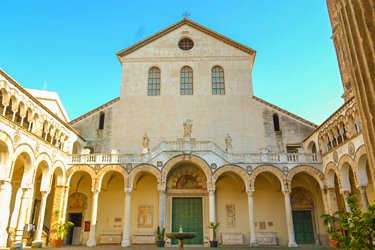
The feeling is that of having been transported to an Arab country or to Andalusia: the colonnade, with columns from the ancient Roman Forum; the arches decorated with inlays of volcanic stone; and the loggia with mullioned windows.
The feeling is that you are in a very rare place, especially in Southern Italy. Not surprisingly, this portico is considered the first example of Mediterranean Architecture.
The interior reflects the many changes made over the centuries, and of particular interest is the Crypt, which houses the remains of Saint Matthew, one of the four Evangelists and the patron saint of Salerno.
Remodelled in Baroque style at the beginning of the 17th century, the crypt is frescoed with scenes from the Gospel of Matthew and episodes from Salerno’s history. The Arab-Norman bell tower is almost 52 metres high, with a base measuring about ten metres on each side.
Opening hours and ticket price
Basilica – weekdays: from 8:30 a.m. to 8 p.m.
holidays: from 8:30 a.m. to 1 p.m. and from 4 p.m. to 8 p.m.
Crypt – weekdays: from 9 a.m. to 7:45 p.m.
holidays: from 8:30 a.m. to 1 p.m.
from 4 p.m. to 6 p.m.
Ticket price: free
Historic Centre and Via Mercanti
2
Salerno has a mainly pedestrian historic centre, dotted with shops, cafés, restaurants and artisan workshops, making it an ideal place for those who love strolling and window-shopping. Start from the station and walk along Corso Vittorio Emanuele, which runs parallel to the seafront.

Before reaching the oldest part, a small turn onto Via Velia leads to Piazza Flavio Gioia, a small round gem with a fountain at its centre. Returning to the main street, when the road narrows into an alley, you enter the oldest part of Salerno: Via dei Mercanti.
No more than five metres wide, Via dei Mercanti has been Salerno’s main commercial street since the Lombard period. It was called Drapparia because it was home to shops selling drappi, or fabrics.
Along Via dei Mercanti are Palazzo Pinto, with the Municipal Art Gallery, and, about halfway along, the Cathedral, just a short distance away — see point 1.
During the Christmas period, like all of Salerno, Via dei Mercanti is also decorated with Luci d’Artista — see point 7. Several streets are particularly characteristic: Via Botteghelle, Via dei Barbuti and Vicolo della Neve. One of the most famous monuments in the centre is the Fountain of the Fish in Sedile del Campo, attributed to Luigi Vanvitelli.
The Garden of Minerva and the Salerno Medical School
3
Wool, milk, bed: warmth, light food and rest. If you have ever heard this saying as a method for recovering from a fever, you should know that it originated at the Salerno Medical School, the first university of medicine in Europe. 
By the year 1000, Salerno’s doctors had already found remedies for common illnesses, to the point that they were considered the first professors of medicine in the modern world.
These were practical remedies, born from experience, in which women — Mulieres Salernitanae — played a fundamental role. According to legend, the School was born on a stormy night beneath the arches of Salerno’s aqueduct, where its four founders are said to have met by chance: the Arab Adela, the Greek Ponto, the Jew Elino and the Latin Salerno.
In the centre of Salerno, the Garden of Minerva, which the Salerno Medical School used to teach students the use of medicinal herbs, is perfectly preserved and open to visitors.
For this reason, it is considered the first of all the botanical gardens later created in Europe. In the garden there is a herbal tea room with panoramic tables overlooking the Gulf of Salerno!
Opening hours and ticket price
Ticket price: €3.00.
Opening hours: Tuesday to Sunday: from 9:30 a.m. to 4:30 p.m.
Monday: weekly closing for works.
How to get there: Vicolo Ferrante Sanseverino no. 1, on foot from the historic centre.
Lungomare Trieste
4
Salerno has a beautiful seafront, which in the 1950s was considered the most beautiful in Italy. This nearly 2-km-long promenade has not lost its beauty: it runs alongside the sea and offers a view stretching from Cilento to the Amalfi Coast.

The seafront consists of three parallel avenues running alongside the historic centre, lined with palms, pines and tamarisks. At the end of the avenue is Santa Teresa Beach, recently redeveloped, and the Villa Comunale, which at Christmas, during Luci d’Artista, turns into an enchanted garden. A little further on stands the new maritime station designed by Anglo-Iraqi architect Zaha Hadid, which has received several awards and has been celebrated worldwide as an architectural work.
Arechi Castle
5Salerno was a Lombard capital for three centuries: it was Arechi II, the Lombard prince, who moved the capital of the duchy from Benevento to Salerno.

To live in Salerno, he chose a fortress 300 metres above sea level that had stood there since Roman times. Arechi had it reinforced, creating a virtually impregnable castle, unique in Southern Italy.
For Arechi II, therefore, it was only necessary to strengthen the manor and incorporate it into a more complex urban defensive system.
After being a Norman and then Aragonese fortress, it was completely abandoned during the 19th century. Today it houses a medieval museum with weapons, coins and ceramics that tell the story of Salerno and its ancient trades.
Arechi Castle is worth a visit even just for the panorama, which stretches from the Amalfi Coast all the way to Calabria.
Opening hours and ticket price for Arechi Castle
Where: in the upper part of Salerno. Località Croce.
Opening hours: Tuesday to Saturday from 9 a.m. to 5 p.m. Sunday from 9 a.m. to 3:30 p.m. Closed on Monday.
Ticket price: Adults: €4
The San Pietro a Corte Complex
6
Crossing Via dei Mercanti, you reach Larghetto San Pietro a Corte, one of the most important places in Salerno’s history: this space is occupied by the San Pietro in Corte complex, which has performed different functions over the centuries.

Born as a thermal complex for the Romans, it became a small church and cemetery during the early centuries of the Christian era, and later a Private Chapel dedicated to Saints Peter and Paul and reserved exclusively for Prince Arechi II. In the Middle Ages it became a Parliament and a place where degrees were awarded to students of the Salerno Medical School. Almost all the historical periods are visible in the complex: there is the ancient Roman frigidarium, where Christians later created a church and also used it as a private funerary chapel for an important figure from Byzantine Salerno. At the end of the 10th century, an external bell tower was added, followed in 1775 by a small external chapel.
Opening hours and ticket price
Where: Larghetto San Pietro
Opening hours:
Tuesday to Saturday 9:30 a.m.–6:30 p.m. — last admission 6 p.m.
Sunday 10 a.m.–7 p.m. — last admission 6:30 p.m.
Monday closed
Opening of the Palatine Chapel — Confraternity of Santo Stefano — by the Gruppo Archeologico Salernitano Association
Winter period from 25 September to 30 June:
Saturday 10 a.m.–1 p.m. / 6 p.m.–9 p.m.
Sunday 10 a.m.–1 p.m.
Summer period from Saturday 1 July to Sunday 24 September
Saturday 6 p.m.–9 p.m.
Sunday 10 a.m.–1 p.m.
Ticket price: free
Luci D'Artista in Salerno
7
The discovery — or rediscovery — of Salerno as a tourist destination is due to the Luci D’Artista event, which every year lights up Christmas in Salerno with spectacular illuminations.

From early November to late January, Salerno’s main squares, large and small streets, parks and the municipal villa are decorated with themed Christmas lights. Almost one million people travel every year from Italy and abroad to admire a show unique of its kind. The event also includes several Christmas markets located in different parts of the city, offering typical products from Southern Italy. Since Christmas 2016, Europe’s largest Ferris wheel with a sea view has also been installed on Lungomare Trieste!
The Amalfi Coast
8
Salerno is the gateway to the Amalfi Coast: Vietri, Ravello, Amalfi and Positano are just some of the seaside villages found along this scenic stretch of coast, protected by UNESCO as a World Heritage Site.

It starts with Vietri, the town of ceramics, then passes through Ravello, a place loved by artists from all over the world, before reaching Amalfi, with its Cathedral, lemons and centuries-old history. But there are also night-loving Positano, Cetara, homeland of tuna and anchovies, Furore with its fjord, and many other enchanting places. In short, this is a wonder that deserves more than just a few days’ visit and that you will not easily forget.
Cilento
9
The province of Salerno includes Cilento, a welcoming land of undeniable beauty, rich in exceptional historical and archaeological evidence, green areas and coasts overlooking one of the cleanest seas in Italy. The Cilento Coast is the most beautiful area of the Campania region, beginning in Agropoli and ending in Sapri, on the border with Basilicata.

A partly still wild coastline marked by golden beaches, coves and cliffs; characteristic towns nestled among hills and mountains; fascinating villages scented with the sea; and a lush National Park, a true “sanctuary of nature” and “living landscape” protected by UNESCO.
In these places, Magna Graecia meets the Mediterranean diet, ancient myths intertwine with modern ones, and the blue of the sky blends with that of the sea in a succession of splendid scenic views.
From the temples of Paestum to coastal fortresses, from the ruins of Velia to the Monastery of San Lorenzo, from the myth of Palinuro to Hemingway, from Punta Licosa to the Dolomites of the South, Cilento holds astonishing surprises. It is easy to be charmed by this magical territory, so varied and yet equally authentic, an extraordinary place for holidays and relaxation that enchants visitors just as the siren Leucosia enchanted Ulysses.
Here, then, are the things you absolutely must see during a holiday or weekend in Cilento!
What to Eat in Salerno
10
Salerno and the sea are one and the same, so it is only natural that the local cuisine is mainly based on fresh Mediterranean fish. Local restaurants almost always include fish on the menu, even in the form of the simplest and cheapest “street food”.
 Restaurants are mainly located close to the seafront or on the parallel Via Roma. In the historic centre it is easier to find small fry shops, pizzerias or cafés for a quick lunch. Among the dishes to try are the classics of Campanian tradition — spaghetti with clams, scialatielli with seafood — without forgetting that anchovies and tuna, in all their varieties — colatura, preserved in oil — come from nearby Cetara. Try tuna genovese. But it is not only about the sea: just outside Salerno lies the Piana del Sele, with its PDO buffalo mozzarella. Among the desserts to taste is the “Scazzetta” from Pantaleone in Via dei Mercanti — ask the owner to tell you its story!
Where to Stay in Salerno
10For much of the year, Salerno has a wide range of affordable places to stay: from early November to mid-January, however, finding a hotel room or B&B becomes impossible or very expensive. Luci d’Artista attracts almost one million people, with a corresponding demand for rooms. Thanks to this event, accommodation facilities in the city have grown exponentially, alongside the historic offer of the nearby Amalfi Coast. Usually, the cost of a room or B&B is around €50 per night, even in good accommodation in the historic centre. The minimum cost on the Coast is at least double, especially in July and August. Booking in advance is essential at Christmas, during spring holiday weekends and in summer.
If you are looking for a hotel in Salerno, we recommend choosing from those offered by Booking.com. There are around 600 hotels with prices, photos and reviews from previous guests. Go to Booking.com.
OTHER DESTINATIONS IN CAMPANIA
10 Things to Do and See in Ischia
10 Unmissable Things to Do and See on Capri