
The Veiled Christ
The Veiled Christ in the Sansevero Chapel is one of the most captivating and mysterious works of art to be seen in Naples — and indeed in Italy. Even if you are in Naples for just a few hours, the Chapel belongs among the absolute must-see sights.
Legend has it that the marble veil covering Christ’s body is, in fact, a real fabric veil turned to stone by a special liquid invented by the shadowy Prince of Sansevero, a celebrated alchemist. Others, however, maintain that this astonishing effect is entirely the result of the genius of Giuseppe Sanmartino, the sculptor who created the Veiled Christ.
The discovery of a secret chamber and of certain macabre works, visible inside the Sansevero Chapel, has helped surround both the Prince and the Veiled Christ with an aura of mystery. The Chapel is worth visiting not only for the Christ, but also for the other works housed in this small jewel hidden among the lanes of Naples: a place rich in esoteric and religious symbols, which we help you discover through the 10 things to know and see during a visit to the Sansevero Chapel in Naples.
The Veiled Christ
1
Placed at the centre of the Sansevero Chapel, Giuseppe Sanmartino’s Veiled Christ immediately captures the visitor’s gaze, inviting endless questions about the mystery of this extraordinary work.
Its most remarkable feature is the veil covering the body of the dead Christ, laid out on cushions.  What is extraordinary is how this marble veil seems, in reality, to be made of fabric, with its soft, delicate folds.
On Jesus’s face and body, you can make out the marks of the torture inflicted upon him: the wound in his side, the feet and hands pierced by nails, and the features drawn by suffering.
It is a work of such beauty and fascination that Antonio Canova declared he would have given up ten years of his life to possess it.
The legends surrounding the veil of the Veiled Christ
2
The veil that rests so delicately over Christ’s body has been the subject of much debate and is the source of a curious legend: the “marbling” of the veil by the Prince of Sansevero.
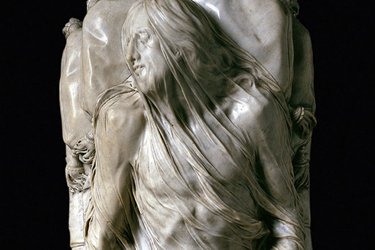
Although made of marble, the veil appears almost too soft and delicate, producing an effect that is uncannily close to reality. According to legend, this softness is not due to Giuseppe Sanmartino’s sculptural skill, but to the esoteric powers of Prince Raimondo di Sangro, who was said to be able to solidify fabrics, and even bodily organs, using a liquid of his own invention. What, then, is the truth?
The petrified skeletons
3
The two “petrified” skeletons were long believed to have been the Prince’s servants, though every self-respecting legend also has a more plausible version of events.

Notarial deeds discovered later document the existence of a contract between the Prince and Dr Salerno, under which the physician was commissioned to create two skeletons on which he would install the cardiovascular system prepared by the accomplished alchemist.
The document clearly specifies that the system of arteries and veins was made of wire and coloured wax, treated with secret substances, and that the models were intended solely for educational purposes.
The curious legend took hold partly because the institution that owns the works long opposed scientific analysis of the “anatomical machines”, thereby fuelling every rumour about the Prince’s somewhat sinister personality.
Statues and frescoes in the Chapel
4
The Sansevero Chapel is not only home to the Veiled Christ, but also to many other works created by some of the finest artists of the period. The statues and frescoes that adorn the Chapel are strikingly beautiful and are arranged according to the symbolic structure of a Masonic temple.

All the works either commemorate or resemble various members of the di Sangro family. The Prince conceived some of them together with the expert sculptor Corradini, himself a Freemason. Corradini is credited with the beautiful Veiled Modesty, a statue Raimondo di Sangro wished to dedicate to his mother, Cecilia Gaetani d’Aragona, who died at just 23, when the Prince was not yet one year old.
Veiled Modesty and Disillusion
5
Among the many statues, we recommend pausing in particular before Veiled Modesty and Disillusion. As their names suggest, these two works stand in contrast to one another and symbolise the Prince’s mother and father.
As noted above, Veiled Modesty is dedicated to the Prince’s mother and depicts a woman entirely enveloped in a veil that clings to her body, tracing its forms. She leans against a broken tombstone, symbolising the young age at which his mother died.
The Prince dedicated the virtue of modesty to the mother he never knew, in deliberate contrast to the reckless lifestyle of his father.
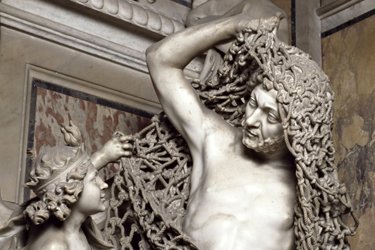
Antonio di Sangro was an unabashed libertine, and the Prince dedicated to him the statue of Disillusion, sculpted by Francesco Queirolo, in which a man is shown attempting to free himself from a net and move towards faith, symbolised by a winged angel who helps him.
After a dissolute and depraved life, Antonio di Sangro eventually chose to retire to a monastery.
The tomb of Raimondo di Sangro
6
How could one fail to pause at the tomb of Prince Raimondo di Sangro, an expression of both his magnificence and his lack of modesty? At first glance the tomb appears sober and austere, but do not be deceived:

the mausoleum is rich in clearly visible symbols celebrating his scientific, literary and military achievements.
The most fascinating part of the tomb is the inscription on the large marble slab: the funerary eulogy is not carved into the stone but raised in relief, thanks to a technique developed by the Prince himself using various chemical solvents.
The subject of the dedication, almost certainly determined by the Prince before his death, is even more intriguing: “an extraordinary man, endowed for all things he dared to undertake […] a renowned investigator of the most hidden mysteries of Nature” — a solemn, highly celebratory act of self-praise.
The tomb of Cecco di Sangro
7
One of the most unusual works in the Sansevero Chapel is the monument to Cecco di Sangro. The statue stands above the entrance and depicts a real episode involving one of the Prince of Sansevero’s ancestors.

Cecco di Sangro was a commander in the service of Philip II and became famous during a military campaign in Flanders. He remained hidden inside a crate for two days and, thanks to this stratagem, managed to enter the fortress of Amiens and take his enemies by surprise.
According to legend, this monument also recalls the death of the Prince: as his end approached, Raimondo di Sangro had himself cut into pieces and shut inside a coffin, from which he was meant to emerge alive after a predetermined time. But his family opened the coffin too soon, preventing his resurrection.
The labyrinth floor of the Chapel
8
Faithful to his role as an alchemist, the Prince of Sansevero could hardly have chosen anything other than a labyrinthine floor to complete the Chapel’s allegorical journey.

To attain wisdom, the initiate must follow a difficult, intricate path, at the end of which lies “knowledge”.
To reach this goal, one had to follow the continuous line of white marble which the Prince wanted to be uninterrupted and free of joints.
It was an extremely difficult work to execute, and in fact the Prince died without seeing it completed. Unfortunately, the labyrinth was almost entirely destroyed during the collapse of 1889, although a section can still be seen in the small passage in front of Raimondo di Sangro’s tomb.
The Chapel vault and its Masonic symbols
8
Masonic and esoteric references could hardly be absent from the vault of the Sansevero Chapel. Painted by a little-known artist, a certain Francesco Maria Russo, the fresco represents the Glory of Paradise, also known as the Paradise of the di Sangro.

The work is unusual for two reasons. The first is the triangle which, together with the dove, dominates the centre of the scene. For Christians, the triangle represents the Trinity; for followers of Pythagoras, cosmic birth; and for Freemasons, the sign of the Worshipful Master.
The second curiosity lies in the colours: to mix the tempera paints, Russo used a formula invented by Raimondo di Sangro himself.
Two hundred and fifty years have passed, the colours have never been retouched, and yet they remain as vivid and radiant as on the first day. How did he do it?
The legend of the origins of the Sansevero Chapel
8
From the time of its construction, legend has accompanied the Sansevero Chapel and the di Sangro family. In 1590, an innocent man who was about to be dragged to prison passed near the di Sangro palace in nearby Piazza San Domenico Maggiore. There, he saw part of a wall collapse, revealing an image of the Virgin Mary.

The man then prayed to the Virgin for grace and, in exchange for his release, promised to offer her a silver lamp and an inscription.
He was found innocent, and from that moment the image of the Virgin became a pilgrimage destination.
Shortly afterwards, Giovan Francesco di Sangro, who was gravely ill, was also healed after thanking the Virgin with a small votive chapel.
It was, however, Giovan Francesco’s son, Alessandro di Sangro, Patriarch of Alexandria, who created a true temple that would also serve as a funerary chapel for the family’s ancestors and future descendants.
Of that chapel, only the original layout remains, because in the 18th century, the alchemist Prince Raimondo reorganised it into the form we see today.
Opening hours and ticket prices for the Sansevero Chapel and the Veiled Christ
Opening hours:
Thursday to Monday: 9:00 am–7:00 pm
Closed on Tuesdays and Wednesdays
Last admission 30 minutes before closing
Full-price ticket: €8. Young people aged 10 to 25 inclusive: €5.00.
How to get there: in the historic centre, on foot via Spaccanapoli or Via dei Tribunali
From Capodichino Airport: Alibus to Piazza Municipio, then continue on foot.
From the Central Station: Metro Line 1, Dante stop.