

It is difficult to talk about what to see in Rome in just a few words, just as it is difficult to believe that this wonderful city was born from a small settlement of shepherds on the Palatine Hill and from a she-wolf that nursed two children as if they were her own cubs.
Perhaps it is this mystery that millions of tourists are searching for every day of the year, tirelessly, during their trips to Rome.
This makes modern Rome less romantic than one might expect, with a constant coming and going of cars, people and things.
Despite this, the Capital of Italy remains a destination as beautiful as few cities in the world. It is not easy to sum up the things to visit in Rome in just 10 points.
So here we list the 20 things you absolutely must see in Rome, but if you have a little time, Rome has many other places of interest and things not to be missed!
If you are looking for a hotel in Rome, we recommend choosing from those offered by Booking.com. There are around 2,000 hotels with prices, photos and reviews from guests who stayed there before you. Go to Booking.com
The Colosseum in Rome
1
If it is true that when the Colosseum falls, Rome will fall and with it the whole world, we sincerely hope that the structure will stand for a very long time yet.
Inaugurated as the Flavian Amphitheatre, it was called the Colosseum only later.
This was probably because of the enormous statue known as the “Colossus of the Sun God“, located nearby, which had the features of Nero.
It is undoubtedly one of the first, if not the very first, among the things to see in Rome.
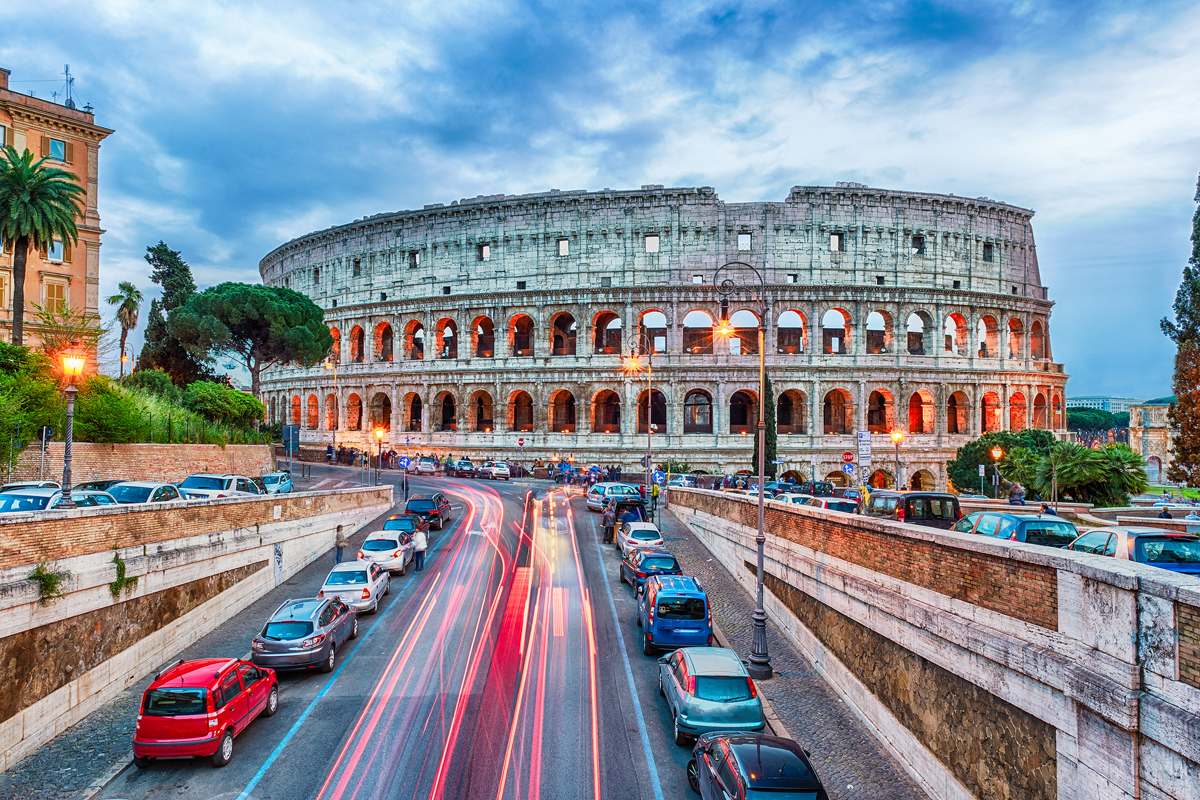
Here, the Romans enjoyed watching fights between gladiators and wild animals, or simulations of naval battles.
The construction of the Colosseum was ordered and begun by Emperor Vespasian, founder of the Flavian dynasty, and continued in the years that followed.
Titus, Vespasian’s son and successor, added two tiers of seats to the structure commissioned by his father and, to celebrate the work (80 AD), proclaimed one hundred days of games.
Today the Colosseum is still one of Rome’s most important and representative monuments, imposing its majestic presence in the heart of the city.
Around the Amphitheatre it is easy to find the “Centurions”, friendly characters dressed in the typical clothing of Roman fighters.
Between a joke in Roman dialect and a photograph, they too have become part of the tradition.
Even without knowing its history and architecture, everyone is fascinated by the monument for which Rome is known throughout the world.
Seeing it in the evening with all the lights on is truly indescribable!
Opening hours and ticket cost for the Colosseum
Opening hours:
from March 27 to August 31: 9:00 am – 7:15 pm
from September 1 to September 30: 9:00 am – 7:00 pm
from October 1 to October 30: 9:00 am – 6:30 pm
from October 31 to December 31: 9:00 am – 4:30 pm
Closed: January 1 and December 25
Ticket cost:
the most convenient option is the 24H ticket from €16. It includes the Colosseum, Imperial Forums and Palatine Hill.
Tickets can be purchased exclusively online on the CoopCulture website, the official concessionaire.
How to get there: on foot from Piazza Venezia
Metro: Line B, Colosseo stop
Bus: 60 – 75 – 85 – 87 – 117 – 271 – 571 – 175 – 186 – 810 – 850 – C3
Tram: 3
The Imperial Forums
2
Between the Colosseum and Piazza Venezia stretches one of the most fascinating archaeological areas to visit during a holiday in Rome:
the valley of the Forum, the area where Roman civilization was born and developed over the centuries.

The construction, on former marshland, of buildings used for political, religious, judicial and commercial activities marked the birth of the Roman Forum (7th century BC), the centre of public life in ancient Rome for more than a millennium.
There are many valuable remains from the Roman era, such as: the Curia, the Basilica Aemilia, the Rostra, the Arch of Septimius Severus, the Temple of Vespasian and Titus, the Temple of Antoninus and Faustina, the Basilica of Maxentius and the Column of Phocas.
When the population grew and the Forum became too small, an urban redevelopment became necessary, resulting in the construction of the Imperial Forums.
Caesar was the first emperor to want to build a forum bearing his name and, following his example, all the greatest Roman emperors built one.
The five Forums of Rome
There are five monumental complexes that make up the Imperial Forums, namely:
the Forum of Caesar, with the Temple of Venus Genetrix (of which the podium and three Corinthian columns remain);
the Forum of Augustus, with the Temple of Mars Ultor, erected in honour of Caesar;
the Forum of Peace (also known as the Forum of Vespasian), built to celebrate the conquest of Jerusalem;
the Forum of Nerva, also known as the Forum Transitorium because it connected the Forum of Vespasian and the Forum of Augustus.
The last imperial square is the Forum of Trajan, the largest of the Forums, with the Basilica Ulpia, Trajan’s Column and Trajan’s “Markets”, a large multi-level structure used for administrative and commercial activities.
Opening hours and ticket cost for the Imperial Forums
Opening hours:
from March 27 to August 31: 9:00 am – 7:15 pm
from September 1 to September 30: 9:00 am – 7:00 pm
from October 1 to October 30: 9:00 am – 6:30 pm
from October 31 to December 31: 9:00 am – 4:30 pm
Closed: January 1 and December 25
Ticket cost:
the most convenient option is the 24H ticket from €16. It includes the Colosseum, Imperial Forums and Palatine Hill.
Tickets can be purchased exclusively online on the CoopCulture website, the official concessionaire.
How to get there: on foot from Piazza Venezia
Metro: Line B, Colosseo stop
Bus: 60 – 75 – 85 – 87 – 117 – 271 – 571 – 175 – 186 – 810 – 850 – C3
Tram: 3
Campidoglio, Capitoline Museums and Aracoeli
3
Next to the Altar of the Fatherland is the Campidoglio, but to enjoy all the beauty of Piazza del Campidoglio you must climb a long, steep and tiring staircase — the Cordonata — designed by Michelangelo.
Once in the square, you will be welcomed by the statues of the two Dioscuri, the Palazzo dei Conservatori on the right and Palazzo Nuovo on the left.
In front stands the Palazzo Senatorio, which houses the Mayor’s offices.

In the centre, a copy of the equestrian statue of Marcus Aurelius sternly watches over the square.
The original of this work is housed in the Capitoline Museums, located in the two twin palaces, Palazzo Nuovo and Palazzo dei Conservatori, which offer an extraordinary journey through the history of Rome.
From the Capitoline Wolf to the statues of the Popes, from the frescoed rooms to Saint John the Baptist, it is worth dedicating a few hours to visiting these museums.
On this, one of the seven hills of Rome, the history of the Eternal City has unfolded.
The Campidoglio hill is also known as the Capitoline Hill, and the word capital derives from here.
The staircase next to the one leading to the Campidoglio leads to the church of Santa Maria in Aracoeli, a church much loved by the Roman people.
Until 1994 it housed the statue of the Bambinello, considered miraculous, which was later stolen and is now replaced by a copy.
Opening hours and ticket cost for the Capitoline Museums
Opening hours:
Every day, from 9:30 am to 7:30 pm.
Ticket cost: €14
How to get there:
Metro: Line B, Colosseo stop, or on foot from the historic centre.
The Altar of the Fatherland
4
Just a few metres away on foot — in fact, right next to the Imperial Forums — stands
the Altar of the Fatherland, a symbolic place not only for Rome but for all of Italy.
The monument, also known as the Vittoriano, was erected in honour of King Victor Emmanuel II, the promoter of Italian unification.
The Altar of the Fatherland is actually only one part of the monumental complex that symbolizes a state, as well as an identity that is not only political but also artistic and cultural.
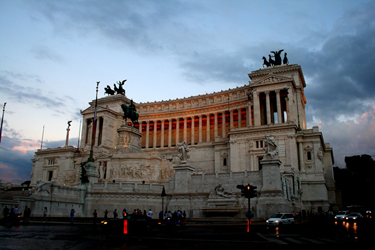
Its construction in the Campidoglio area required the demolition of entire medieval districts, and the project was entrusted to the architect Giuseppe Sacconi.
After the end of Fascism, during which the Vittoriano became merely a stage for regime demonstrations, the monument returned to shine as a symbol of national unity.
Opinions on the aesthetics of the Altar of the Fatherland have never been unanimous: some consider it “a symbolic object of nothingness”, while others, though not criticizing it so harshly, still consider it completely out of context with Rome’s forms, colours and architecture.
Opening hours and ticket cost for the Altar of the Fatherland
Opening hours:
Every day, from 9:30 am to 7:30 pm (last admission at 6:45 pm).
The changing of the guard at the Tomb of the Unknown Soldier takes place every hour.
Ticket cost: free.
Lift to the terrace: €7
How to get there:
Metro: Line B, Colosseo stop, or on foot from the historic centre.
The Pantheon in Rome
5
With its dome and columned pronaos, the Pantheon is one of Rome’s most famous monuments.
According to legend, it stands on the spot where Romulus, at his death, was seized and carried up to heaven by an eagle.
A temple dedicated to all the gods (Pan – all, Theon – divinity), it was built by Emperor Hadrian between 118 and 125 AD to replace an earlier temple by Marcus Agrippa dedicated to Mars and Venus.
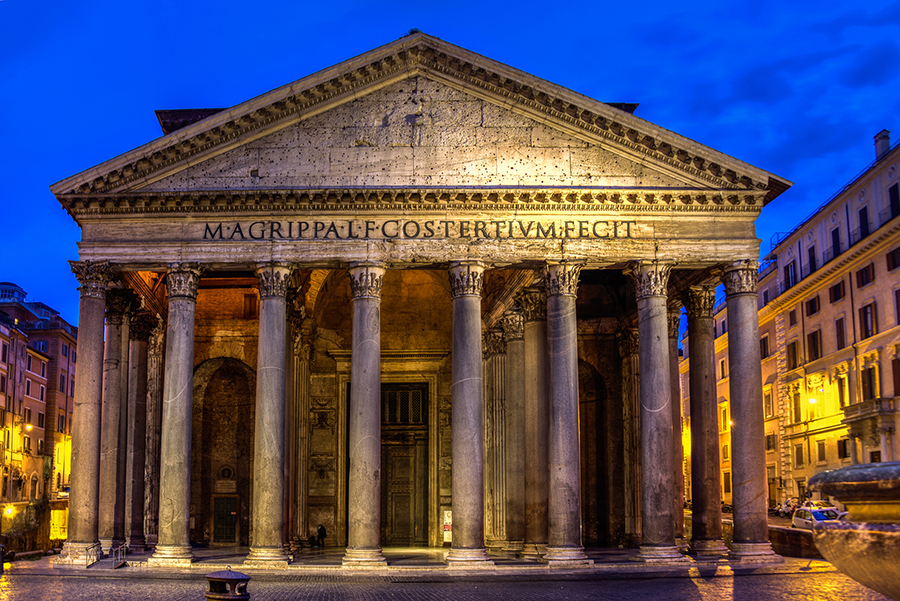
In 609, the Roman temple was converted into a Christian basilica under the name Santa Maria ad Martyres.
In 1870 it became the shrine of the kings of Italy. Inside are the tombs of Victor Emmanuel II, Umberto I and Margherita of Savoy, as well as that of the great Raphael.
What characterizes the building more than anything else is the large hemispherical dome with a diameter of 43.3 m, equal to the height from the floor, at the top of which is the large — and only — opening, the 9-metre oculus.
Light enters through this hole, but when it rains, water also falls in. However, it drains quickly thanks to both central and side holes in the floor, which prevent puddles from forming.
So, it is not true that rain does not enter the Pantheon.
It is true, however, that when it rains, the opening creates a “chimney effect”, meaning an upward air current that breaks up the raindrops.
So even when the rain outside is heavy, the feeling is that it rains less inside.
Opening hours and ticket cost for the Pantheon in Rome
Opening hours:
The Basilica is open every day from 9:00 am to 7:00 pm (last admission at 6:30 pm).
Closed: January 1, August 15 and December 25.
Ticket cost: free.
How to get there: Piazza della Rotonda, in the heart of the historic centre.
Metro: Barberini stop (Line A).
Bus: 30, 40, 62, 64, 81, 87 and 492 (Largo di Torre Argentina stop).
Trevi Fountain in Rome
6
If you are in Rome and intend to return, then do not hesitate to toss a coin into the famous Trevi Fountain to make your wish come true.
Designed by the architect Nicolò Salvi, the fountain has received the waters of the Aqua Virgo aqueduct since the time of Augustus.
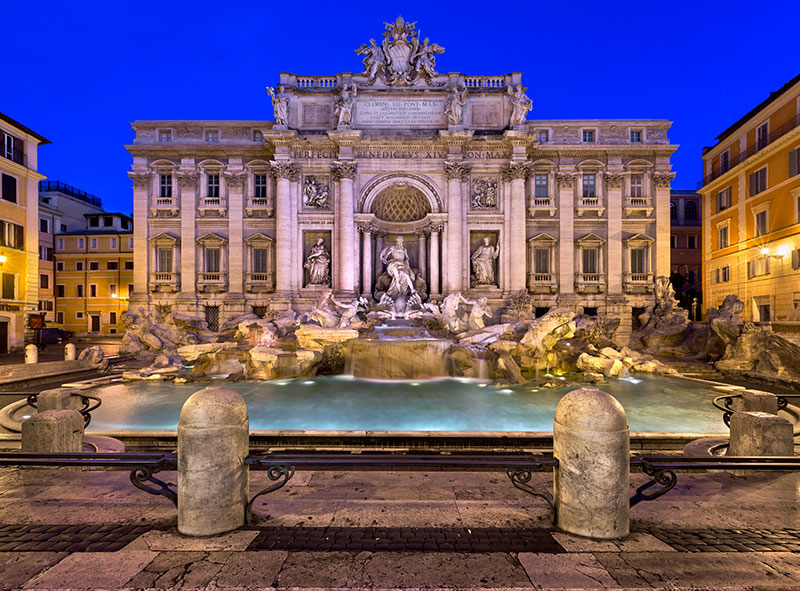
The central theme of the work is the sea, and Baroque meets Classicism in perfect harmony.
The Trevi Fountain has been a film set, a stage for events and a backdrop for great celebrations.
Let one thing be clear: only Anita Ekberg in “La Dolce Vita” is allowed to bathe in the fountain.
If you try it, you will have to deal with the police who, we assure you, will not take it very well.
The beauty of the construction is truly breathtaking because of its grandeur, and few people notice a detail which, according to popular legend, was created simply out of spite.
On the right of the Trevi Fountain is a travertine vase called the “Ace of Cups“, which legend says Salvi placed there to block the view from the shop of a barber who constantly criticized the architect’s work.
How to get to the Trevi Fountain
Take Metro Line A to Spagna or Barberini and walk a short distance.
Piazza Navona in Rome
7
It is one of the squares most loved by Romans and tourists, the ideal place to spend time comfortably seated at a café table among Baroque sculptures and architecture.
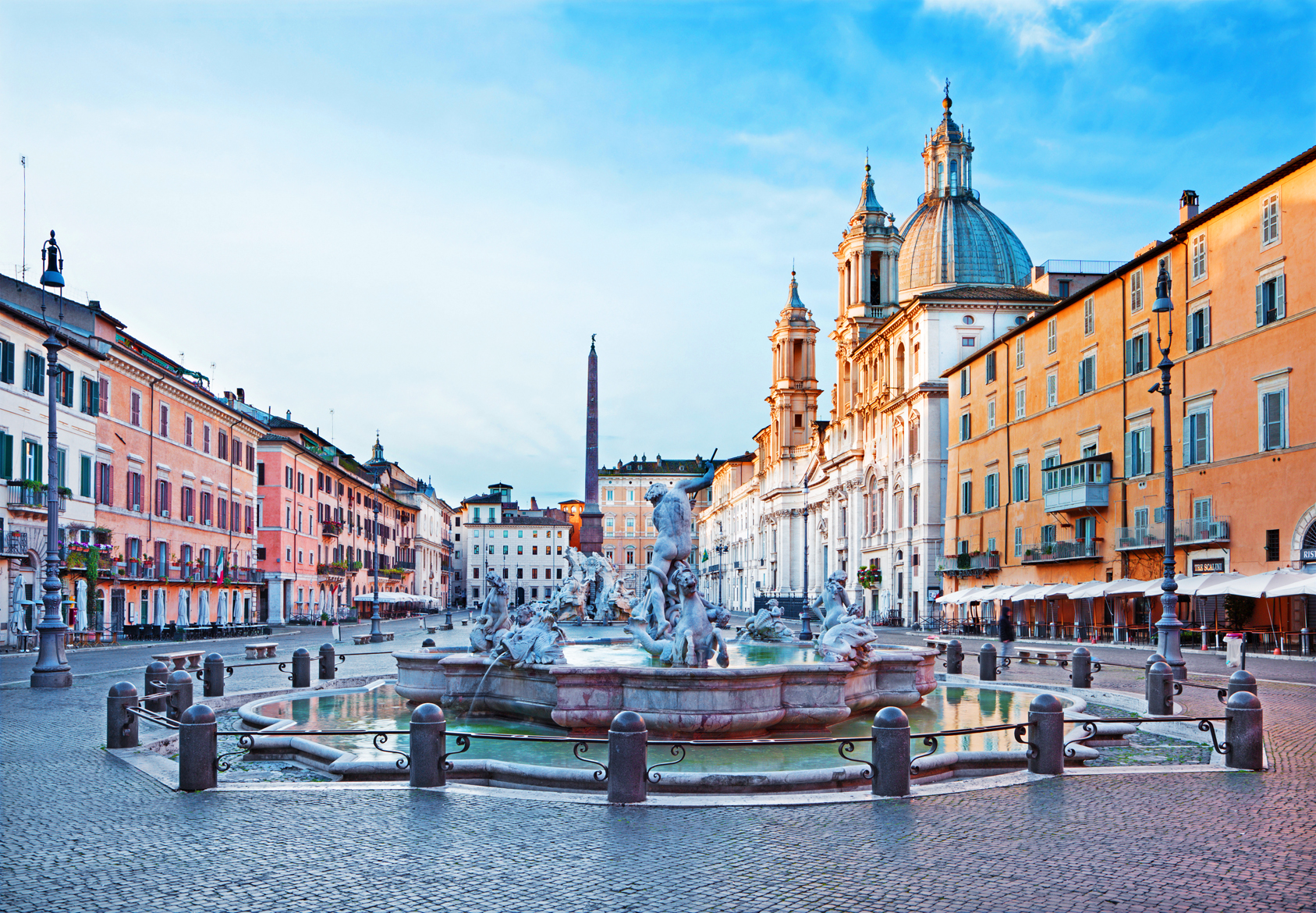
Piazza Navona stands on the site of the ancient Stadium of Domitian — hence its oval shape — which the emperor commissioned to host athletic competitions, or agones.
Until the 19th century, games and sporting events were organized in the square.
In August, the square was flooded by closing the drains of the fountains, to offer Romans some relief from the heat.
The main attraction of Piazza Navona is the Fountain of the Four Rivers, a work by Gian Lorenzo Bernini (1651).
The rivers are the Ganges, the Danube, the Río de la Plata and the Nile, represented by four giants arranged on a pyramidal rock from which a Roman obelisk rises.
Opposite the magnificent fountain stands the Church of Sant’Agnese in Agone, with its concave façade, designed by Borromini to enhance the dome.
Two other fountains embellish the square: the Fountain of Neptune, or Fountain of the Calderari, at the northern end, and the Fountain of the Moor, facing Palazzo Pamphilj at the southern end of the square, both designed by Giacomo della Porta.
Filled with tourists during the day and young people at night who come here to spend their evenings, it is a spectacle not to be missed.
Especially during the Christmas period, when it fills with characteristic stalls, and on the night between January 5 and 6 for the feast of the Befana.
How to get to Piazza Navona
On foot in the centre of Rome.
Bus: 64, 46, 70, 81, 116, 186 and 492.
The Vatican Museums and the Sistine Chapel
8
Born from the patronage of the popes, who for centuries collected and commissioned extraordinary works, the Vatican Museums are considered among the most beautiful museum complexes in the world.
They include 13 museums, each different from the others, and one of the finest art collections on the planet.

The greatest museum treasures consist of highly prized works from Greek and Roman antiquity — the Laocoön, the Apoxyomenos, the Apollo Belvedere — as well as the rich collections of Egyptian art, including mummies, and Etruscan art, including the Mars of Todi.
The Pinacoteca houses a small but valuable collection of paintings ranging from the 12th to the 19th century, with works by Raphael, Caravaggio and Leonardo da Vinci.
The Museums also include some magnificently frescoed rooms, such as:
the Borgia Apartment, frescoed by Pinturicchio around 1490;
the Raphael Rooms, the four rooms used by Pope Julius II as his residence and decorated by Raphael;
the famous Sistine Chapel — named after its founder, Pope Sixtus IV — which, thanks to the extraordinary genius of Michelangelo, has become one of the most celebrated artistic treasures in the world, visited every day by 20,000 people.
The frescoes of the Creation on the vault and the Last Judgment on the altar wall are considered among the greatest and most intense pictorial masterpieces in the history of art.
Faced with so much beauty, how could one disagree?!
Opening hours and ticket cost for the Vatican Museums
Opening hours:
Monday to Saturday: from 9:00 am to 6:00 pm.
Closed: every Sunday, except the last Sunday of the month.
January 1 and 6
February 11
March 19
April 18
June 29
August 15
November 1
December 8 and 26
Ticket cost:
€17.00 without online booking
€17.00 + €4 with booking on the official Vatican Museums website , including the “skip-the-line” option
How to get there: Vatican City
Metro: Line A stops: Ottaviano – San Pietro; Cipro (both 10 minutes on foot)
Bus: 49, 32, 81, 982, 492, 990; Tram 19.
St Peter’s Basilica in Rome
9
With its Michelangelo-designed dome and monumental façade, St Peter’s Basilica dominates the spectacular colonnaded portico of St Peter’s Square, an architectural masterpiece by Bernini.

The heart of the Catholic Church, the Basilica stands where in 324 Constantine had a shrine built in honour of the First Apostle, who was crucified and buried in that very place.
In 1506, Pope Julius II commissioned Donato Bramante to design what was to become the largest church in the world, with a surface area of 22,000 square metres.
Bramante, Michelangelo and Giacomo della Porta were only some of the architects who worked on the “construction of St Peter’s” over the more than one hundred years required to complete the grandiose work.
The greatest artists of the Roman Renaissance and Baroque periods left masterpieces of extraordinary beauty here.
Just think of the wonderful Pietà by Michelangelo, the Chair of St Peter, the monument to Urban VIII and Bernini’s sumptuous Baldachin.
An unmissable place, therefore, for pilgrims and visitors from all over the world.
Opening hours and ticket cost for St Peter’s
Opening hours:
Basilica: every day, from October 1 to March 31: from 7:00 am to 6:30 pm; from April 1 to September 30: from 7:00 am to 7:00 pm.
Tombs of the Popes: Booking is made by written request, sending a message to scavi@fsp.va, by fax to +39 06 69873017, or directly at the Excavations Office (entrance to the left of Bernini’s colonnade).
Dome: 7:30 am – 5:00 pm.
Ticket cost:
Dome:
Lift to terrace level, then continue on foot (320 steps): ticket €10.00
Climb on foot, 551 steps: ticket €8.00
How to get there: Vatican City
Metro: Line A stops: Ottaviano – San Pietro.
Bus: 49, 32, 81, 982, 492, 990; Tram 19.
Villa Borghese and Borghese Gallery in Rome
10
The park of Villa Borghese is the green “heart” of Rome.
Designed in 1605 for the hedonistic Cardinal Scipione Borghese, Pope Paul V’s favourite nephew, remodelled over the centuries by his successors and purchased by the State in the early 20th century, this large public park is still today a true garden of delights.
Within its 6 km circumference, the park contains neoclassical statues, exotic buildings, an artificial lake, an aviary, numerous fountains, gardens and groves, a riding track, a zoo — the Bioparco — an amphitheatre — Piazza di Siena — and several museums.
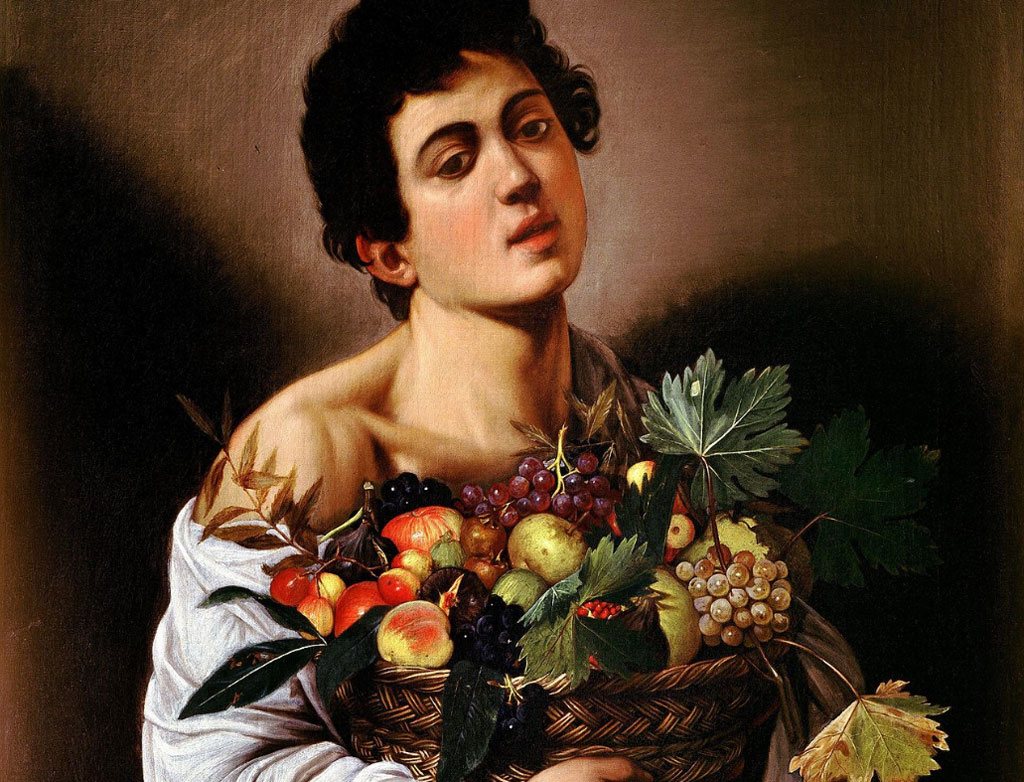
The most famous is the Borghese Museum and Gallery, one of the city’s most important art museums, housed in the 17th-century villa of the same name, known as Casino Borghese.
Designed to house the magnificent private Borghese collection, it was initially assembled by Scipione, to whom the most important core of the collection is due.
The villa is divided into two sections:
the sculpture collection, the Museum, on the ground floor, where you can admire masterpieces by Bernini — “The Rape of Proserpina”, “Apollo and Daphne” — and the famous Pauline Bonaparte portrayed by Canova;
and the picture gallery on the first floor, which includes works by great masters of painting such as Titian, Raphael, Caravaggio and Rubens.
Opening hours and ticket cost for the Borghese Gallery
Opening hours:
Villa Borghese Park
The park is open every day from dawn to dusk.
Gallery
Tuesday to Sunday. From 9:00 am to 7:00 pm
Last admission at 5:45 pm.
Ticket cost: €13
Admission is free on the first Sunday of the month.
How to get there:
The park has as many as 9 entrances, including Porta Pinciana, Trinità dei Monti, Piazza del Popolo and Piazzale Flaminio.
Metro: Line A, Spagna stop (follow signs for Villa Borghese – Via Veneto)
Bus: 5, 19, 52, 53, 63, 86, 88, 92, 95, 116, 204, 217, 231, 360,490, 491, 495, 630, 910, 926.
Piazza di Spagna in Rome
11
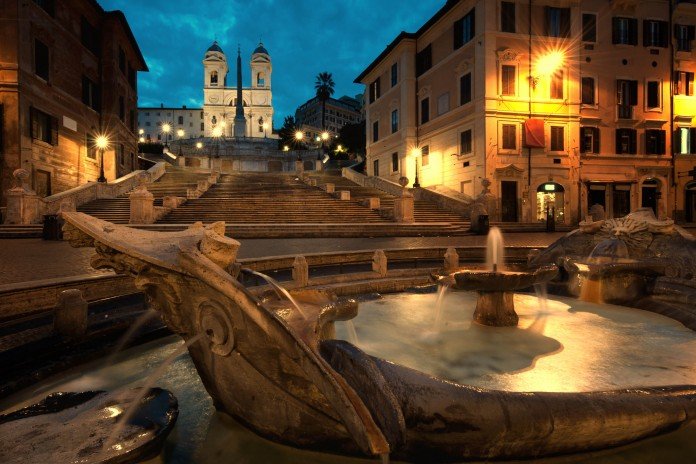
You cannot go to Rome and not see Piazza di Spagna with its Trinità dei Monti staircase, which with its 135 steps seems to climb toward the sky.
A wonderful setting for haute couture fashion shows and a famous protagonist of numerous films, Piazza di Spagna is known and loved all over the world.
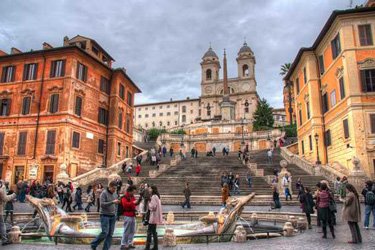
Many historical figures have passed through here, such as Giuseppe Balsamo, known as Cagliostro, the famous alchemist and esotericist, who stayed in one of the inns adjoining the square.
It is said that his arrest took place right in the square and that the ghost of his wife still wanders around this area, because it was she who denounced her husband to the Holy Office, the congregation of the sacred Roman and universal Inquisition.
Today the atmosphere is more reassuring, with thousands of tourists sitting on the steps — although they are not supposed to — or around the “Barcaccia“, the not particularly beautiful fountain located in the centre of the square, ideal for cooling off in summer.
How to get to Piazza di Spagna:
Metro: Line A, Spagna stop
Mouth of Truth and Santa Maria in Cosmedin
12
It is remarkable how what was once a sewer manhole has become one of the monuments of Rome where tourists most love to have their photos taken, even paying €2 to do so since September 2016.
The Mouth of Truth is, in fact, nothing more than this: a large marble mask, depicting the head of a faun, known to everyone as the “Mouth of Truth”, set into the wall of the church of Santa Maria in Cosmedin since 1632.
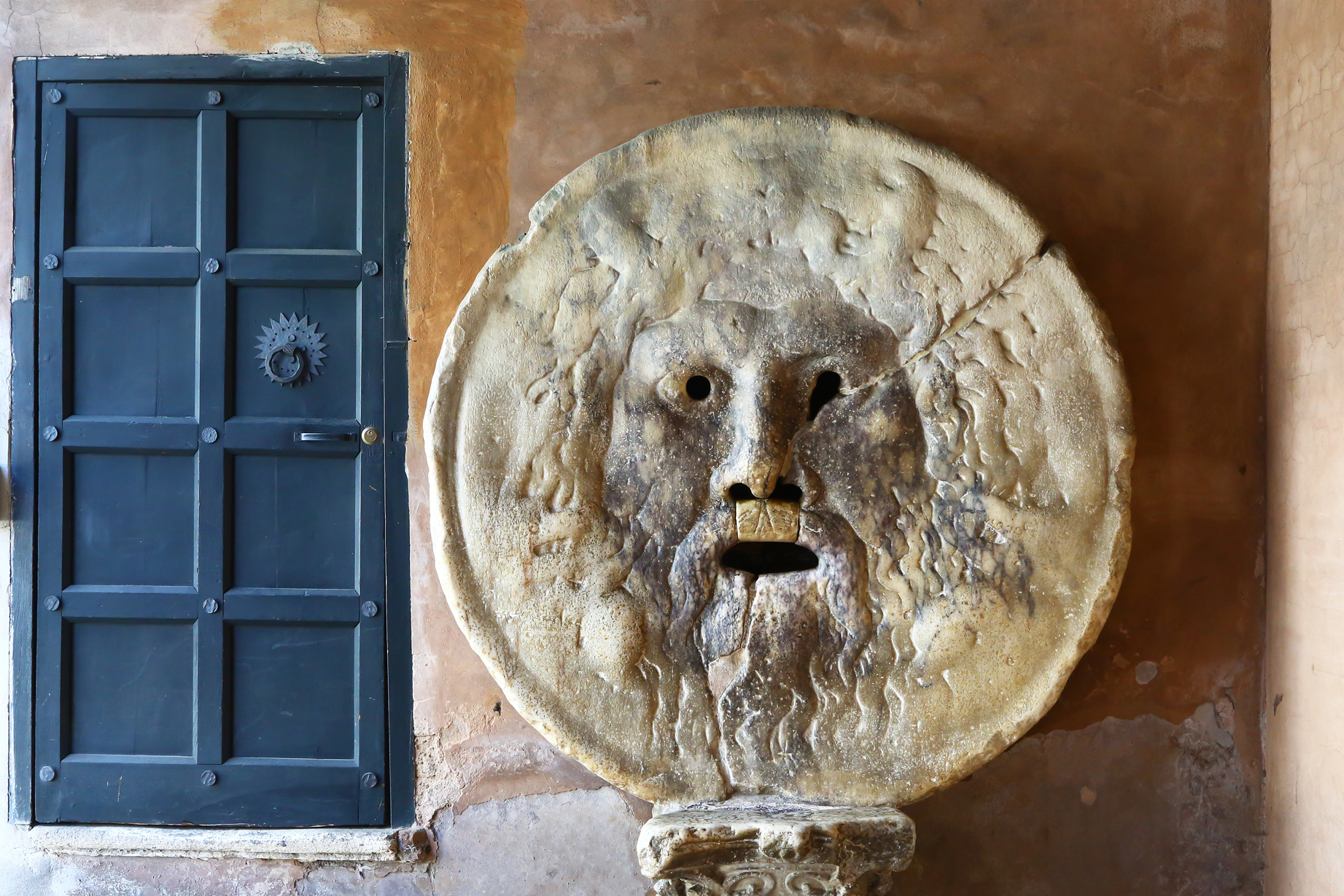
This large bearded male face, with holes for eyes, nose and mouth, was probably a manhole cover of the Cloaca Maxima, one of the largest sewers in all of Rome.
The sculpture dates back to the 1st century, has a diameter of 1.75 m and weighs around 1,300 kg. The mask is very well known, and it is thought to be the object mentioned in the early Mirabilia Urbis Romae, a medieval guide for pilgrims, where the mouth is attributed the power to deliver oracles.
Opening hours and ticket prices for the Mouth of Truth
Winter opening hours: 9:30 am-5:00 pm (gate closes at 4:50 pm)
Summer opening hours: 9:30 am-6:00 pm (gate closes at 5:50 pm)
Ticket prices: €2
Address: Piazza Bocca della Verità
How to get there: Metro Line B, Circo Massimo stop
Bus 60 – 75 – 85 – 87 – 117 – 271 – 571 – 175 – 186 – 810 – 850 – C3
Tram 3
Piazza del Popolo
13
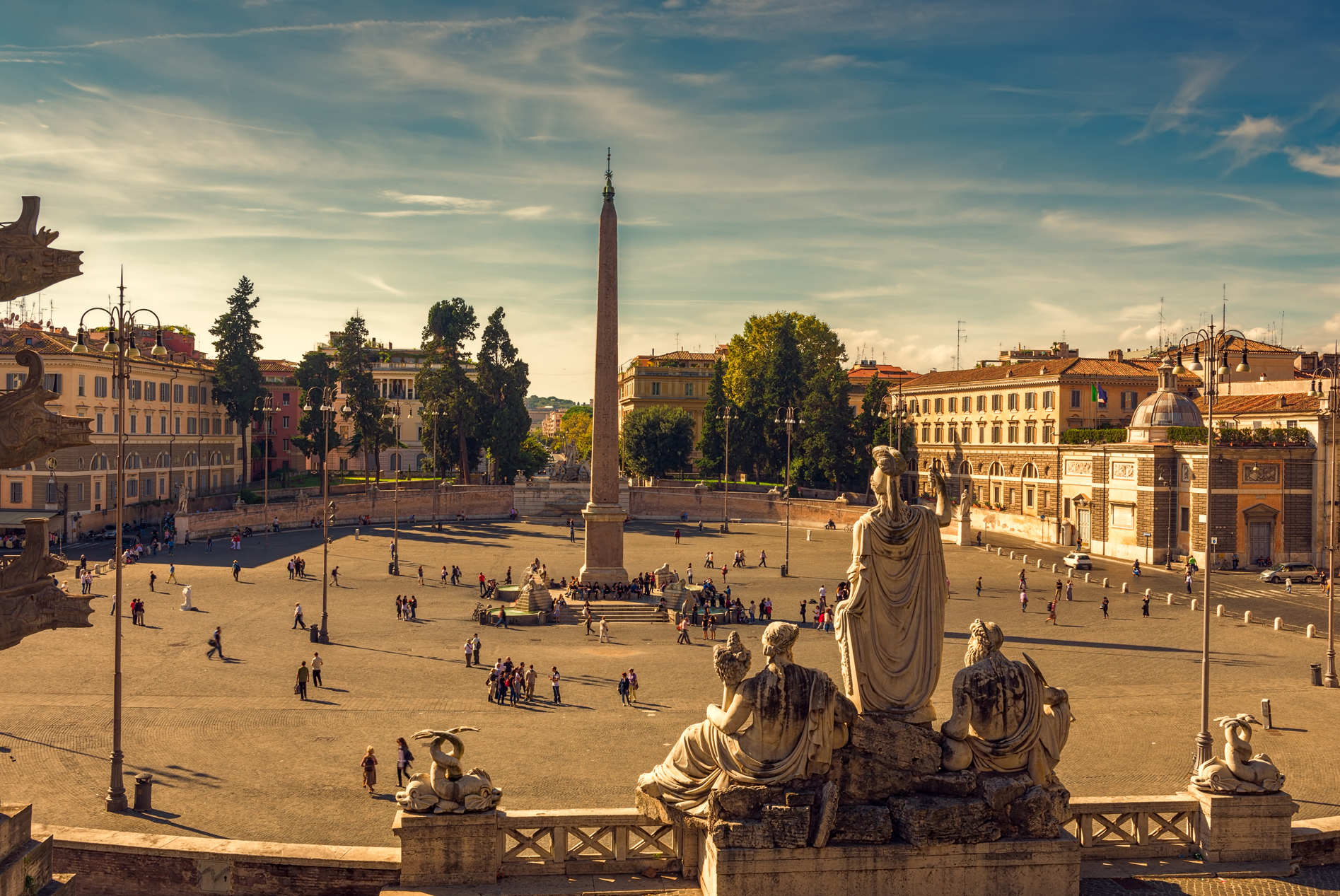
Famous for being the starting point of three important shopping streets — Via del Corso, Via del Babuino and Via di Ripetta, the so-called Tridente —
Piazza del Popolo is a magnificent gateway to the heart of Rome.
According to some, the name of the square derives from “populus”, the Latin word for poplar, referring to a grove of poplars that seems to have been near Nero’s tomb.
For others, however, it was the church of Santa Maria del Popolo — beside Porta del Popolo — an evolution of the small chapel erected in 1099 and paid for by the Roman people, that gave the square its name.
Not to be missed in the church are the Chigi Chapel designed by Raphael and Caravaggio’s “Conversion of Saint Paul” and “Crucifixion of Saint Peter” in the Cerasi Chapel.
The square’s current appearance is due to the work of architect Giuseppe Valadier, who in the 19th century added two exedras, giving it its characteristic oval shape.
At the centre of each of the two hemicycles is a fountain topped by a marble group — Rome between the Tiber and the Aniene, and Neptune among the Tritons.
Valadier also designed the basins and the four Egyptian-style lions around the ancient central obelisk, moved here from the Circus Maximus in 1589 by order of Sixtus V.
At the southern end of the square are the two “twin” churches, Santa Maria dei Miracoli and Santa Maria in Montesanto, apparently identical.
They were designed in 1658 by Carlo Rainaldi, who used the two domes and two elegant porticoes to give architectural harmony to the square.
How to get to Piazza del Popolo
Metro: Line A, Flaminio stop
Trastevere
14
It seems that the district’s coat of arms, the head of a lion on a red background, is no coincidence.
It is said, in fact, that a lion once lived in a cage on the Campidoglio, a symbol of majesty and power, and that it was put down after tearing apart a boy who had come too close to the cage.
When a symbol had to be chosen to identify the district “beyond the Tiber” in the new division of the city, the head of the historic lion was chosen.
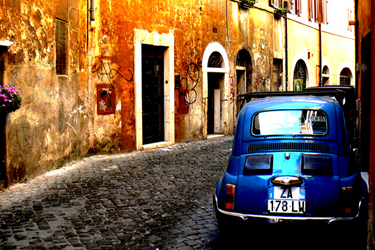
It is one of the city’s most characteristic districts, the one that best preserves the Roman spirit of the capital, with its narrow streets paved with sampietrini and lined with medieval houses with small balconies from which climbing plants hang.
During the Imperial period, the district was populated by the wealthy patrician aristocracy, who built villas here for very important figures such as Gaius Julius Caesar.
During the Middle Ages, however, Trastevere appeared as a maze of dirty, abandoned alleyways.
Today it is one of the favourite places of Roman nightlife: at night it fills with young people who meet in Piazza Trilussa or Piazza Santa Maria to drink a beer bought in the pubs that populate Trastevere’s narrow lanes.
Do not miss the beautiful Basilica of Santa Maria in Trastevere, in the square of the same name, a lively meeting place for Romans and non-Romans alike, with its wooden ceiling by Domenichino and splendid choir mosaics from the 13th century.
Campo de’ Fiori in Rome
15
Tourists arriving in Rome are always enchanted by the spectacle of Campo de’ Fiori: it is not only one of the most famous squares in Rome, perhaps it is also the most authentic.
The daily assault of thousands of tourists has not managed to erode its deeply popular soul: the fruit stalls, the voices of the vendors and the flower market preserve their centuries-old charm.
Just as in the 1400s, when fruit and vegetables from the Roman countryside arrived here.
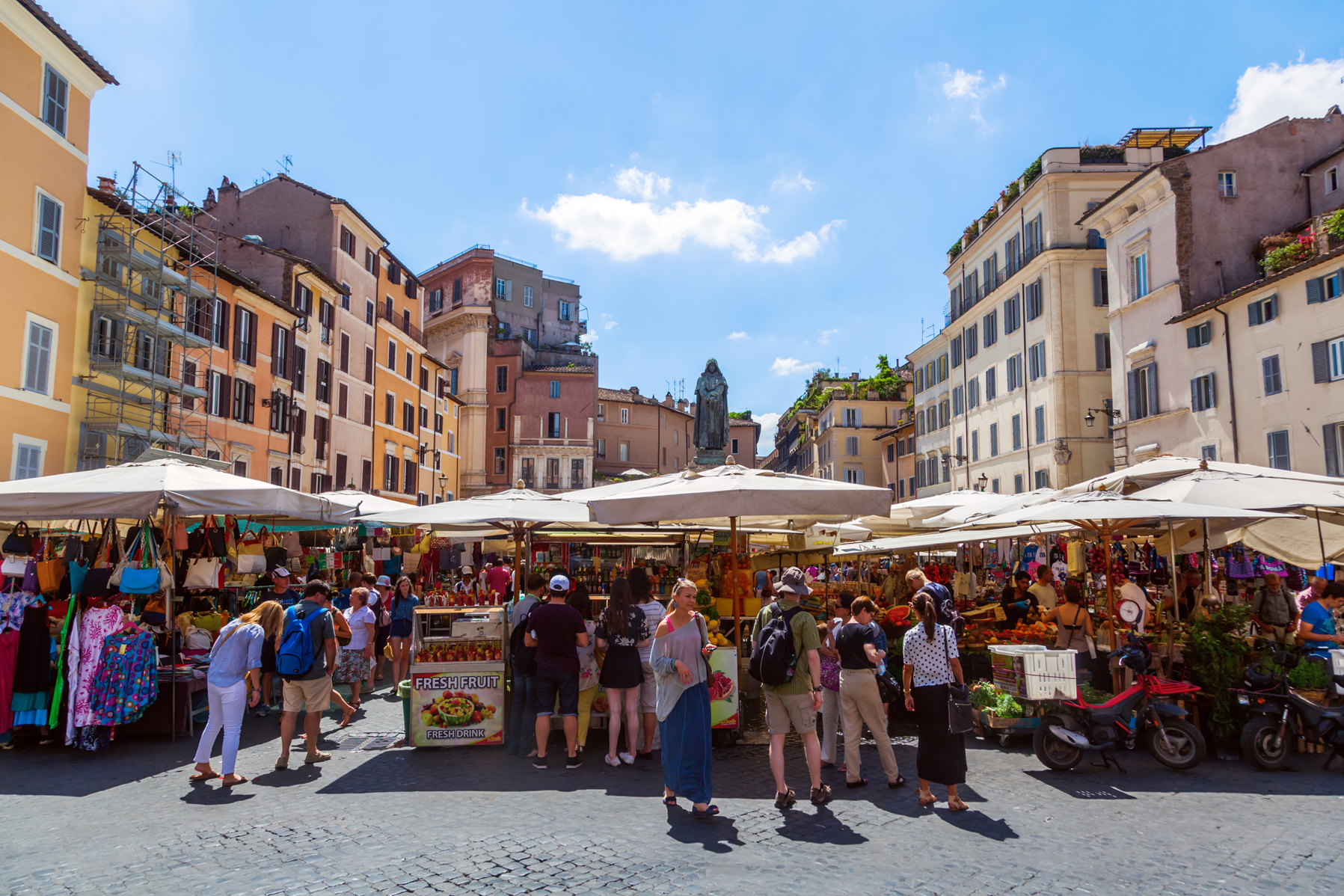
Back then, Campo de’ Fiori was also home to inns for pilgrims and merchants, which fuelled a thriving market of courtesans.
It was a square full of freedom, so we can imagine that Giordano Bruno would have been pleased to be burned right here.
He was the philosopher from Nola who, in the name of his freedom of thought, refused to obey the Church and was therefore burned alive where today his statue sternly watches over the square.
The square has not lost this vocation for freedom even today, because once the vendors’ stalls have been dismantled and the streets cleaned, Campo de’ Fiori turns into one of the places of Roman nightlife.
Dozens of bars, clubs, pubs and beer houses attract thousands of people every evening.
Piazza and Palazzo Farnese
16
Palazzo Farnese dominates the famous Piazza Farnese, embellished by two twin fountains by Girolamo Rainaldi and distinguished by the Swedish national church of Saint Bridget.
Piazza Farnese is a small oasis in the tourist chaos of Rome, a corner where you can stop for a few minutes to rest and enjoy the calm and harmony of the square. Although it is usually not included in

the list of what to see in Rome, Palazzo Farnese and the square are truly worth a visit.
Especially since the French Embassy, which is housed in the palace, has once again allowed visits.
Opening hours and ticket prices for Palazzo Farnese
Opening hours:
Guided tour required, approximately every hour.
You can visit the Atrium of Sangallo, the courtyard, the garden, the Hall of Hercules and the Carracci Gallery.
Ticket prices: €12. Tickets can be purchased exclusively through the official portal.
Address: Piazza Farnese, in the centre of Rome
How to get there: on foot
Palazzo Colonna
17
Palazzo Colonna is one of the most beautiful, largest and oldest private palaces in Rome.
Here too, as with Palazzo Farnese, hurried tourists avoid including this wonderful residence among the main things to see in Rome.
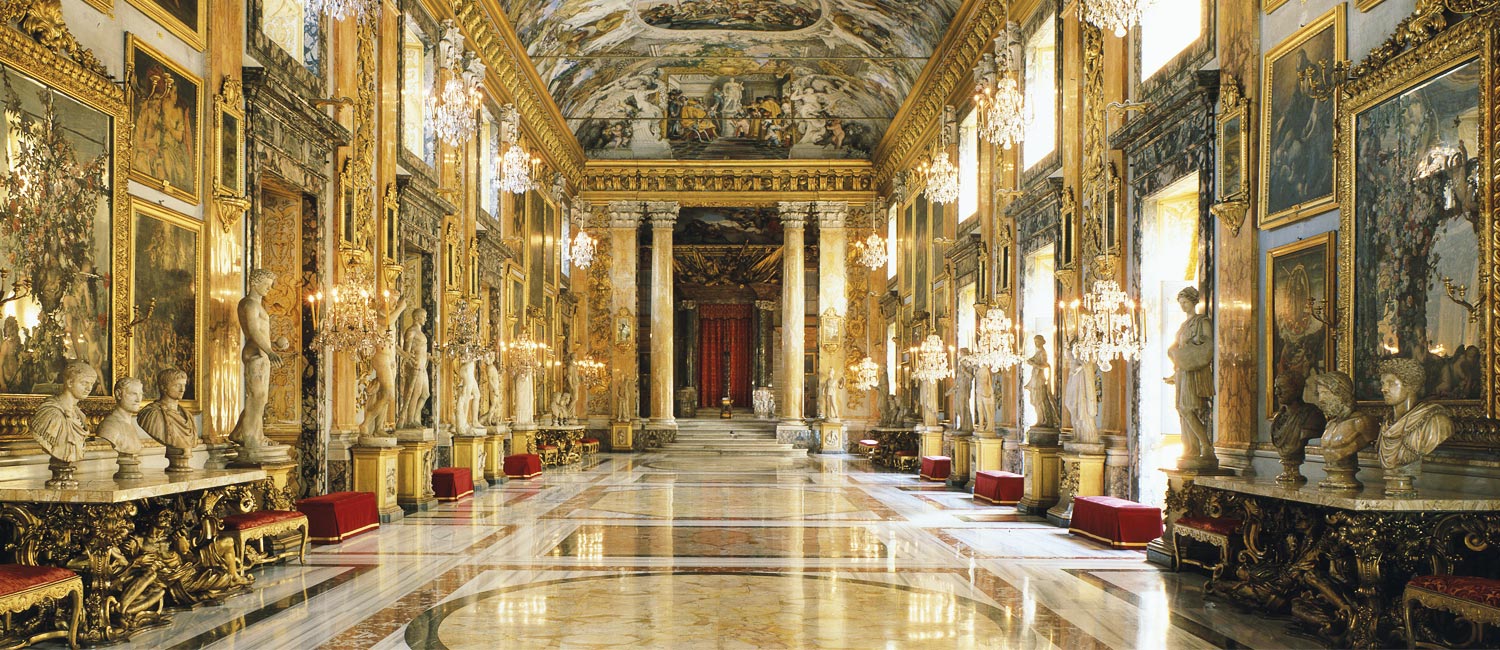
Perhaps because they do not know that for 23 generations, from the 1500s to today, members of the Colonna family have lived in these rooms.
At the same time, the construction of the various wings of the palace evolved, and for this reason it bears the signs of a mixture of architectural styles that reflect the different periods to which they belong.
The most beautiful apartments of the residence can be visited, and with the extended tour also the wonderful gardens.
Opening hours and ticket prices for Palazzo Colonna
Opening hours:
every Saturday from 9:15 am to 1:15 pm
Ticket prices:
Short tour: Gallery Apartments, Pio Apartments and gardens: €15
Complete tour: Gallery Apartments, Pio Apartments, Princess Isabelle Apartments and gardens: €25
Address: Via della Pilotta, not far from Via del Corso.
How to get there: on foot from Via del Corso.
Metro: Line A, Spagna stop, then on foot.
Castel Sant’Angelo
18
What a marvel, the bridge surrounded by statues that leads into Castel Sant’Angelo; and what a marvel, the interior of the castle that has accompanied the history of Rome for centuries.

It was meant to be the Mausoleum of the great Emperor Hadrian, who wanted it in what was then a quiet and uninhabited area of Rome.
Then the city became large, enormous, and the mausoleum found itself in a strategic point for the defence of the city.
So, in 403 AD, Emperor Honorius had it incorporated into the most important part of the city, the Aurelian Walls, causing it to lose its original function.
From that moment on, in fact, Castel Sant’Angelo became a fortress beyond the Tiber for the defence of the city.
Opening hours and ticket prices for Castel Sant’Angelo
Opening hours:
Monday to Sunday from 9:00 am to 7:30 pm
Closed: January 1, May 1 and December 25.
Ticket prices: €15.
How to get there: on foot along the Lungotevere.
Metro: Line A, Lepanto stop.
The Baths of Caracalla
19
The Thermae Antoninianae, or Baths of Caracalla, were the most important thermal complex of antiquity.
Built in the southern part of Rome by order of Caracalla, their construction began in 212 and ended in 217 thanks to the support of Severus Alexander.
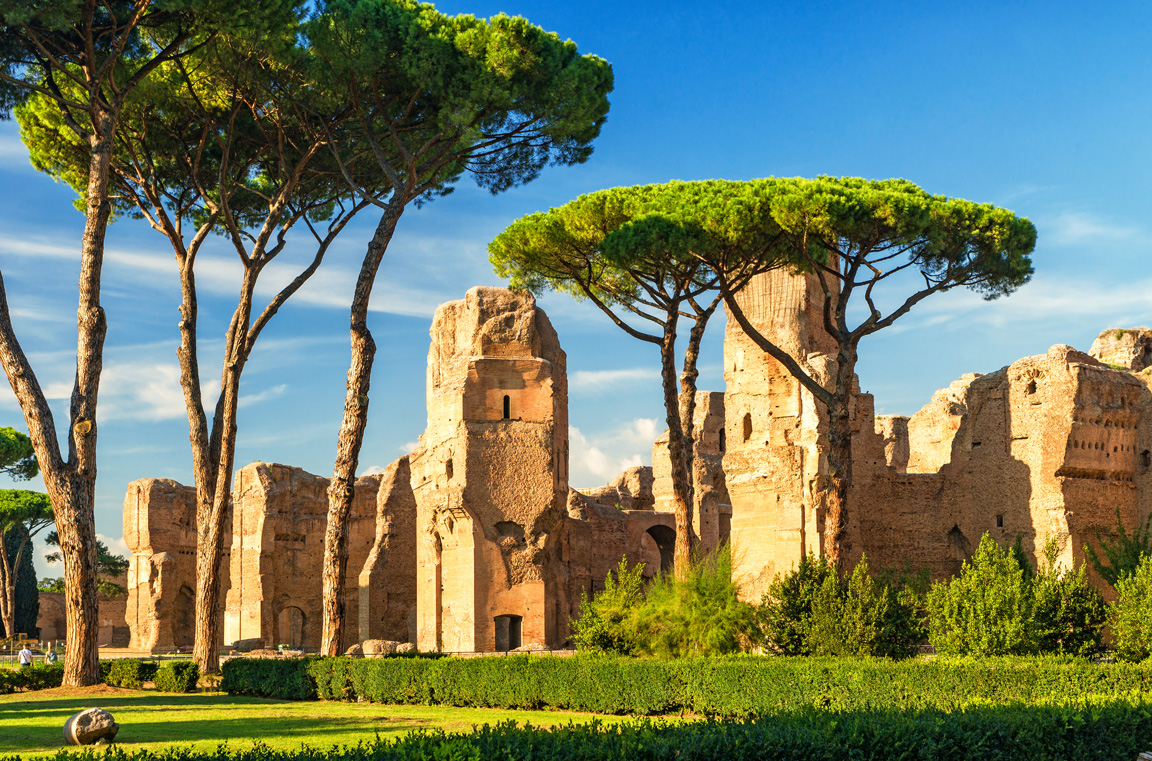
Restored by Aurelian between 270 and 275, the baths remained usable until the time of the Gothic Wars, when the army of Vitiges, which was besieging the city, destroyed part of the Antonine Aqueduct that supplied the complex.
Thus, in 537, the baths ceased to function.
Until the inauguration of the Baths of Diocletian, the complex remained the largest centre of entertainment in Roman life.
The baths, whose ruins stand at the foot of the Aventine Hill, opened onto the Via Nova, parallel to the Appian Way, which served as the main entrance to the establishment, laid out according to the planning principles of the 2nd century.
Opening hours and ticket prices for the Baths of Caracalla
Opening hours:
Open every day.
Opening time: 9:00 am
- from the last Sunday in October to February 15: last admission 3:30 pm, exit 4:30 pm;
- from February 16 to March 15: last admission 4:00 pm, exit 5:00 pm;
- from March 16 to the last Saturday in March: last admission 4:30 pm, exit 5:30 pm;
- from the last Sunday in March to August 31: last admission 6:30 pm, exit 7:15 pm;
- from September 1 to September 30: last admission 6:00 pm, exit 7:00 pm;
- from October 1 to the last Saturday in October: last admission 5:30 pm, exit 6:30 pm.
On Mondays, last admission is at 1:00 pm, with exit at 2:00 pm.
Closed: January 1, May 1 and December 25.
Ticket prices: €10.
Address: In the Circus Maximus / Colosseum area.
How to get there:
Metro: Line B, Circo Massimo stop.
Bus: 118 – 160 – 628.
What to eat in Rome
20
Roman cuisine is genuine, popular, simple yet hearty, and has remained unchanged over the centuries.
Traditional dishes include rigatoni with pajata — beef or veal intestines cooked in a very tasty sauté — and bucatini all’amatriciana with tomato, guanciale and pecorino, as well as cacio e pepe: all high-calorie dishes par excellence, but they are worth making an exception to your diet for.

The original recipe comes from Amatrice, a town in Lazio where thick spaghetti with guanciale and pecorino was the typical dish of shepherds and mountain dwellers of the central Apennines.
It then spread throughout Italy. Do not miss the other great dishes of Roman tradition, such as spaghetti alla carbonara, which is said to have been created using the food rations of the Allies during the Second World War, or cacio e pepe.
The cuisine of the capital is not based only on first courses: in one of the city’s excellent trattorias you can taste typical dishes such as abbacchio alla romana, coda alla vaccinara, mixed fried meat and porchetta from nearby Ariccia,
accompanied by the famous artichokes alla giudia, chicory or puntarelle. If you are still standing, end your meal with a nice maritozzo with whipped cream!
Where to sleep in Rome
HPapal audiences, international events, concerts, demonstrations, school groups and millions of tourists make finding a low-cost place to sleep an exciting challenge, but Rome has exceptional tourist accommodation capacity.

Of course, by booking in advance, you can save a lot and/or find better accommodation, but there is always a place available, even during very high season.
Naturally, staying in the historic centre requires a high budget or, if you spend little, a willingness to adapt to small hotels without breakfast or many services.
Many more options are available in hotels just outside the centre, in more peripheral neighbourhoods. The average price of a 3-star hotel for one night starts from €80.
If you are looking for a hotel in Rome, we recommend choosing from those offered by Booking.com. There are around 2,000 hotels with prices, photos and reviews from guests who stayed there before you. Go to Booking.com


