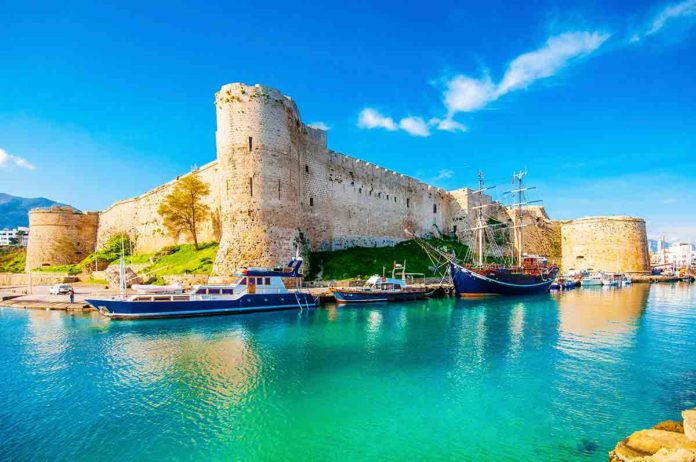
Cyprus is the island of Aphrodite, the goddess of love and beauty, born from the waters off the coast of Paphos. Legend, history and culture make a visit to the third largest island in the Mediterranean truly unique.
Its capital is Nicosia, the only European city crossed by a Green Line that separates the Republic of Cyprus from the Turkish Republic of Northern Cyprus. Peaceful coexistence between the Greek and Turkish sides is guaranteed, along the Green Line, by UN supervision.
Historically, the island has been an important crossroads between East and West, and many peoples have tried to dominate it precisely because of its strategic importance. You will find traces of Roman and Byzantine rule, as well as military bases in the areas of Akrotìrion and Dekèleia, under British sovereignty.
The signs of the recent Turkish invasion of 1974 are still visible, following the military coup, supported by Greece, against the then president Makarios. What makes Cyprus special is precisely its blend of cultures, which you will also find in everyday habits, such as driving on the left in the British style, or in its cuisine with Turkish and Greek influences.
The climate, with hot, dry summers and mild winters, makes it an ideal destination at any time of year. Some of the 10 things to see and do in Cyprus concern the capital Nicosia, fortified by Venetian walls, precisely because of the beauties it preserves and the importance it holds on the international stage.
If you are looking for a hotel in Cyprus, we recommend choosing from those offered by Booking.com. There are around 4,000 hotels with prices, photos and comments from people who stayed there before you. Go to Booking.com.
The Buyuk Han in Nicosia
1
In the northern area of Nicosia, the Turkish part of the city, there is the Buyuk Han, the largest caravanserai on the island. Built by the Ottomans in 1572, besides being an excellent architectural work of the period, it served as a resting place for merchants.

When travellers arrived, they found everything they needed to recover: an inn where they could eat; a fountain for ablutions; a mosque where they could pray; and rooms for the night, heated by fireplaces.
The ancient inn still occupies the ground floor of the building today and houses the Sedirhan Restaurant & Cafe, where you can taste typical local dishes with excellent value for money.
During the days of British colonisation, the Buyuk Han was also used as a prison. In fact, from the outside it almost looks like a fortress, and the small windows, built to protect merchants from thieves, later proved perfect for preventing escapes as well.
Access to the caravanserai is possible from two entrances: the main gate to the east, on Asmaalti Square, or the second entrance to the west.
In the centre of the square there is the unusual fountain, on which a mosque stands. On the ground floor of the Buyuk Han there are shops, bars and restaurants.
Climbing one of the two symmetrical stone staircases, you reach what were once the 68 dormitory rooms, now occupied by artisan galleries and shops producing handmade works, paintings and ceramics. The Buyuk Han is also very atmospheric at night, with the right lighting and live music: you may even happen to watch a folk dance performance.
Opening hours and ticket price:
Address: Asmaalti Sk, Lefkosa;
Opening hours: always open;
Ticket price: free.
Ledra Street in the historic centre of Nicosia
2
Walking along Ledra Street, the pedestrian street in the historic centre, is a pleasant way to buy souvenirs while also exploring the characteristic alleys and side streets of Nicosia.

This street is not only an open-air shopping centre, but also tells part of the history of Cyprus.
At the end of the street you will find an opening along the Green Line that allows passage from the Greek-Cypriot side to the Turkish-Cypriot side. While waiting for passport control, you may find yourself reflecting on how this clear dividing line was established.
It was General Peter Young, commander of the British forces, who drew a green line on the island’s map separating the Turkish side from the Greek side, in the hope that it would bring about a ceasefire.
Passing through this division creates mixed feelings: on one hand, you are left incredulous by the strong architectural and cultural difference; on the other, you feel anger at the thought that there are still places where UN peacekeepers must guard the territory to prevent clashes.
In addition to visiting boutiques, cafés, restaurants and international chains, while walking along Ledra Street it is worth going up to the eleventh floor of the Shacolas Tower Museum & Observatory, a skyscraper offering a breathtaking view over the city.
Opening hours and ticket price for the Shacolas Tower Museum & Observatory:
Address: Ledra Street, Nicosia;
Opening hours: every day from 10:00 to 17:00 from December to April; from 10:00 to 18:00 in May; from 10:00 to 19:00 from June to October; from 10:00 to 18:00 in November;
Ticket price: 2.50 euros.
Selimiye Mosque or Cathedral of Saint Sophia
3
The minarets of the Selimiye Mosque, formerly the Cathedral of Saint Sophia, are visible in the distance shortly after the Green Line in Ledra Street, in the Turkish-Cypriot part of Nicosia.
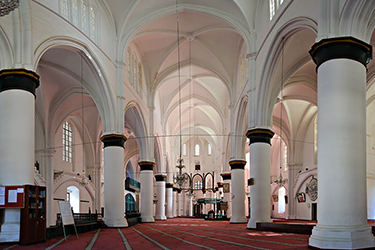
To enter the imposing Gothic structure, you must be barefoot, and women must cover their heads as a sign of respect for Muslim worship.
It has not always been this way: what today welcomes Muslim prayers was originally a Catholic cathedral.
Built during the rule of the Latin Archbishop Eustorge de Montaigu in 1208 AD, it has suffered earthquakes and various reconstructions over the years.
It was the church where the kings of the Lusignan dynasty were crowned. In 1570, when the Turks invaded Cyprus, the cathedral was converted into a mosque. It was given the name “Selimiye Mosque”, in honour of the Ottoman sultan Selim II, who led the empire during the conquest of Cyprus.
The great transformation is especially noticeable inside the mosque, where the paintings and stained-glass windows have disappeared; the white of the walls dominates, creating a strong contrast with the red carpet. During the first weeks of August, at the Selimiye Mosque, you may happen to witness Kurban Bayram — the Feast of Sacrifice — one of the main Muslim religious holidays, similar to Catholic Christmas.
Opening hours and ticket price:
Address: Selimiye Sk, Lefkosa;
Opening hours: during prayer times;
Ticket price: free.
The Cyprus Archaeological Museum in Nicosia
4
The Cyprus Archaeological Museum in Nicosia shows how this island was an important cultural crossroads in the ancient world. Towards the end of the 19th century, under British rule, the first archaeological finds began to emerge. At first they were kept by a private institution, and only in 1935 did the British administration found the Department of Antiquities.

The Museum consists of 14 rooms arranged in chronological order: from the Neolithic period to the Byzantine period. Cyprus has an ancient tradition of pottery, visible in the first rooms, whose collection dates back to the Bronze Age.
In Room IV you will be welcomed by many terracotta votive statues, dating from 600-500 BC, from the sanctuary of the village of Ayìa Irìni in Turkey.
They depict horsemen, farmers, soldiers and priests with unusual headdresses: their sizes range from just a few centimetres to life-size.
The semi-basement floor is evocative, housing carved tombs and sarcophagi, both in stone and clay, while the royal tombs of Salamis are in Room XII. Before leaving, admire the marble statues, especially that of Zeus Keraunios (500 BC) and the small statue of Aphrodite of Soloi.
Opening hours and ticket price for the Museum:
Address: Mouseiou Street 1, Lefkosia;
Opening hours: Tuesday, Thursday and Friday from 8:00 to 16:00, Wednesday from 8:00 to 17:00, Saturday from 9:00 to 16:00 and Sunday from 10:00 to 13:00. Closed on Monday;
Ticket price: Admission €4.50.
The Byzantine Museum of Cyprus in Nicosia
5
The extreme attempt to save Byzantine icons from decay and illegal trafficking was the reason why the Byzantine Museum of Cyprus was created.

In the heart of Nicosia you will find the richest and most representative collection of Byzantine art in Cyprus. Before entering, the building you see beside it is the Church of Saint John, whose interior frescoes are well worth a visit.
From the earliest discoveries in the northern part of the island, it became clear how important it was to preserve the works of Cypriot sacred painting. The museum was built only in 1982 and was dedicated to Makarios III, Archbishop and President of the Republic of Cyprus in 1960, who during his mandate repeatedly tried to promote its creation.
The Byzantine Museum displays around 230 works and 48 icons, from the 9th to the 19th century, although many are still in the hands of art traffickers in Germany. In the three large rooms, the chronological itinerary shows the evolution of icons and the influence they received from the Italian Renaissance and especially the Venetian one.
You will also find frescoes, ecclesiastical utensils, manuscripts, parts of carved wooden iconostases and fragments of seven 6th-century mosaics taken from the apse of the church of Panagia Kanakarias in Lytrangomi.
Opening hours and ticket price for the Byzantine Museum:
Address: Plateia Archiepiskopou Kyprianou, Nicosia;
Opening hours: Monday to Friday: from 09:00 to 16:30; Saturday: from 09:00 to 13:00;
Ticket price: 4 euros.
The Troodos Mountains and Kykkos Monastery
6
The Troodos Mountains are the best destination for finding relief from the summer heat and admiring the island of Cyprus from another point of view.

Amid the silence of the forests, the mountains preserve a UNESCO World Heritage Site: 10 Byzantine churches, built between the 11th and 16th centuries and beautifully frescoed. Seeing them all is a little complicated, especially if you have little time available, but it is worth visiting at least a couple.
Each one has its own special feature: for example, the sloping roof of Agios Ioannis Lampadistis covers no fewer than three churches, and in Agios Herakleidios there is the oldest templon in Cyprus: a wooden screen depicting animals and the weapons of Latin knights.
Also enchanting are the wall paintings that completely cover the church of Agios Nikolaos tis Stegis, “Saint Nicholas of the Roof”, rich in artistic treasures and especially Byzantine paintings. In the Troodos Mountains there is also the fascinating Kykkos Monastery.
The monastery preserves a legend explaining the presence of the icon of the Virgin Mary painted by the Apostle Luke. It is said that the Byzantine governor of the island, Manuel Voutomitis, got lost in the woods during a hunting trip.
Near the monastery he met a hermit, Isaiah, who apparently lived there and, having no contact with people, did not answer Voutomitis’ request for directions. The governor treated the hermit badly and, when he was struck by a serious illness, asked God what he could do to be healed. The answer was to apologise to Isaiah by giving him the icon of the Madonna kept in the imperial palace of Constantinople.
Opening hours and ticket price:
Address: Marathasa Valley, 13km from Pedoulas village;
Opening hours: June-October from 10:00 to 18:00; November-May from 10:00 to 16:00;
Ticket price: 5 euros.
The ghost town of Famagusta
7
In every district of Cyprus, as in that of Famagusta, there are wonders to discover and stories to tell. Its Citadel is known as the Othello Tower because everything suggests that, when Shakespeare wrote in the tragedy of the same name, “…a seaport in Cyprus[…]”, he was referring precisely to the port of the medieval city of Famagusta.
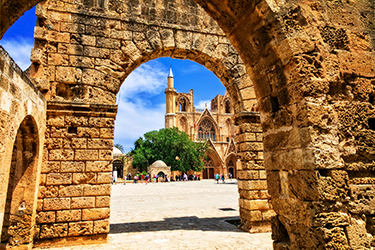
The bastions surrounding the historic centre offer a beautiful view from above of what remains of the Byzantine churches. In 1492, the Venetians decided to transform the citadel into a true stronghold equipped with artillery.
In fact, already during the Lusignan rule in the 12th century, the importance of protecting the port was understood, given its central role in trade between East and West.
Arriving in the pedestrian square, you are fascinated by another church converted into a mosque: the Cathedral of St. Nicholas, with its Gothic-style façade, which, with the addition of the minaret, became the Lala Mustafa Pasha Mosque.
Do not miss the ruins of the Byzantine Church of Saint George of the Greeks, where you can admire the large apse, the side wall and part of its entrance.
The Famagusta riviera, Varosha, was supposed to be the ideal holiday destination, with luxury hotels, beaches and crystal-clear sea, but since the Turkish invasion of 1974 its transformation has been radical.
The inhabitants fled, leaving everything behind in the hope of returning, but the Turkish army prevented them from coming back. So, more than forty years later, what you will see from the outside, properly fenced off, is a ghost town: dust and debris have covered the furniture and furnishings of the apartments that the inhabitants had to abandon suddenly.
Paphos and the Kato Paphos Archaeological Park
8
One of the most visited destinations in Cyprus is Paphos, located at the southwestern tip of the island. Walking among its archaeological sites, you will discover stories and legends of the peoples who passed through Cyprus: Greeks, Romans, Byzantines, Franks, Venetians and Ottomans.

Its cultural richness and the mosaics of Paphos led to its designation as a UNESCO World Heritage Site in 1980. Legend has it that the Greek goddess of love and beauty, Aphrodite, was born from the sea at Petra tou Romiou, a few kilometres from Paphos.
Among the places dear to the goddess is the natural pool where she used to bathe, known as the Baths of Aphrodite, and it is said that its waters are still a powerful beauty elixir today.
Walking along the city’s seafront and passing the picturesque harbour, you reach the necropolis known as the “Tombs of the Kings”, where high-ranking officials were buried. It was believed that, thanks to their proximity to the sea, they would be the first to be ferried by Charon.
The monumental harbour complex also includes the unmissable Kato Paphos Archaeological Park. Among the remains of four luxurious Roman villas — the House of Dionysus, the House of Orpheus, the House of Aion and the House of Theseus — dating from the 2nd to the 4th century AD, you can admire mosaic floors depicting mythological figures, hunting scenes or floral motifs.
There are few shaded areas, and in summer it is advisable to avoid the hottest hours and perhaps bring a hat, as well as comfortable shoes. If you have time left, the church of Panagia Chrysopolitissa and the column of Saint Peter, where it is said that the Saint was tied and whipped, are also worth a visit.
Opening hours and ticket price:
Address: Leoforos Griva Digeni, 43, Paphos;
Opening hours: Monday to Friday, in the winter period (September – April) from 8.30 – 17.00 and in the summer period (April – September) from 8.30 – 19.30;
Ticket price: 4.50 euros.
Limassol and the archaeological park of Kourion
9
The coast of Limassol satisfies everyone, with archaeological sites, beaches, wonderful sea, restaurants and venues for having fun. A place crossed during the Crusades, the city overlooks Akrotiri Bay, which was one of the seats of the Templars.

Second in population in Cyprus, the historic centre of Limassol is a gem.
The medieval castle, built at the end of the 12th century under the reign of King Guy of Lusignan, houses, in its wonderful rooms, a museum of medieval artefacts belonging to the period from the 5th to the 19th century.
History also tells that in its chapel, in 1191, Richard the Lionheart married Berengaria of Navarre. Step out onto the terrace to admire a splendid panorama over the port and the city of Limassol.
The historic centre also houses the Archaeological Museum, with ceramics, terracotta statues and other artefacts from the Neolithic period to the Roman period. Dedicate some time to the archaeological site of Kourion, whose Roman and Byzantine ruins stand on a panoramic hill.
Mosaics are also the main attraction among these remains, dating from between the 2nd and 5th centuries AD. In the House of Achilles there is a mosaic depicting the moment when Odysseus reveals Achilles’ true identity at the court of King Lycomedes on Skyros. Also worth seeing are the mosaics depicting battle scenes in the House of the Gladiators and those covering the floors of the complex of Eustolios, the residence of a wealthy Christian.
The summer period is full of events and theatrical performances staged against the spectacular and evocative backdrop of the amphitheatre, with its 3,500 seats, built in the 2nd century BC and restored by the Romans.
In addition to the Agora, the early Christian basilica and the Roman fountain of the Nymphaeum, you cannot leave without seeing the Sanctuary and Temple of Apollo, just 3 kilometres away. Without a doubt, it was one of the main religious centres of ancient Cyprus, where Apollo was worshipped as the god of the woods.
Opening hours and ticket price for Kourion:
Address: Limassol;
Opening hours: Winter period (16/9 – 15/4) every day from 08.15 – 17.15; Summer period (16/4 – 15/9) every day from 8.15 – 19.45;
Ticket price: 4.50 euros.
What to eat in Cyprus
10
The cultural melting pot of Cyprus, which draws especially from Greek and Turkish cuisine, can be tasted through meze, short for “small delicacies”: a selection of appetisers based on vegetables, meat and fish, as well as creams and sauces such as chickpea hummus and tzatziki.
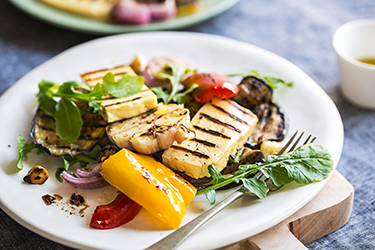
Around ten courses, hot and cold, to share with your companions while chatting.
With the freshness of its sea and land products, Cypriot cuisine is an excellent example of Mediterranean cuisine. Also try halloumi, the goat’s and sheep’s cheese recognised by the European Union as a traditional Cypriot PGI product, excellent eaten grilled and sometimes containing mint leaves.
Cypriots also pair it with watermelon in summer, and when travelling it is always worth trying unusual combinations. Among meats, lamb is part of various typical dishes: cooked on the grill or slowly in a clay oven and seasoned with bay leaves — a dish known as ofto leftiko — or cooked with onions, tomatoes, potatoes and cumin in tava.
As street food you will find kebab, to be enriched with sauces according to your taste. Desserts, on the other hand, have been more strongly influenced by Turkish tradition: try the dried fruit and fruit in syrup, Daktyla, namely ladyfingers with almonds, hazelnuts and cinnamon, or their typical Christmas dessert made with semolina, known as Shiamali.
Nearby
Just as Zrce is for Croatia and Rimini for Emilia-Romagna, Ayia Napa is the hub of entertainment and nightlife for Cyprus, but also of beautiful beaches. Along Ippocratous Street, you will be spoilt for choice among discos and clubs with non-stop music.
Ayia Napa is on the Greek side of the island, on the south-east coast, with an entire coastline that, in addition to crystal-clear sea, offers many activities in contact with nature.
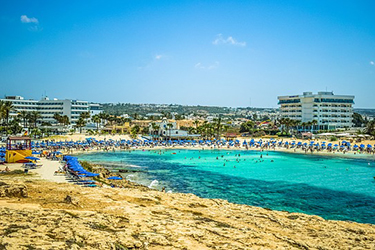
Do not miss the beautiful and evocative Sea Caves, the caves between Ayia Napa and Cape Greko Natural Park, which can also be visited with organised boat tours. Snorkelling in the Blue Lagoon, with its crystal-clear waters and variety of fish, will give you an unforgettable experience.
The sea is clear along the entire coast: in some stretches it is rocky, while in others it is sandy, as at the famous Nissi Beach, where DJs take turns to guarantee music and fun day and night.
If you prefer calm or beaches suitable for children too, opt for Konnos Beach, sheltered from the winds, with shallow, clear waters. Do not miss a walk in the Cape Greko nature reserve, with breathtaking views, trekking trails and plenty of nature.
Hotels in Cyprus
If you are looking for a hotel in Cyprus, we recommend choosing from those offered by Booking.com. There are around 4,000 hotels with prices, photos and comments from people who stayed there before you. Go to Booking.com.